
What AI Can (and Can’t) Do for Your MVP — A Reality Check for 2025

The first quarter of 2025 wasn’t just a funding cycle; it was a statement. A staggering $115 billion in global venture funding was deployed, with an incredible $59.6 billion—over 53% of the total—poured directly into AI startups. This isn’t just a trend; it’s a full-blown gold rush, and for founders, the message is clear: the pressure to build with AI has never been higher. With AI coding assistants boosting developer productivity by up to 55% and text-to-UI tools turning ideas into mockups in minutes, the barrier to launching a Minimum Viable Product (MVP) has effectively crumbled.This accelerated pace makes thoughtful MVP Development even more crucial. 

But here’s the brutal reality check nobody puts in their pitch deck: this gold rush is creating a graveyard. The failure rate for AI startups is projected to be a terrifying 90%, significantly higher than for traditional tech companies. Why? Because while it’s easier than ever to build something, it’s also easier than ever to build a business on rented land. Too many founders are falling into the “thin wrapper” trap: slapping a pretty user interface on top of a third-party API from OpenAI, Google, or Anthropic. They’re building products with no defensible moat, where the entire business can be rendered obsolete by a single platform update from the tech giants they rely on. They are using AI’s power to efficiently build solutions for problems that don’t exist, becoming another casualty of the #1 startup killer:no market need.  

So, how do you leverage AI’s incredible power to build faster and smarter without creating a business that’s doomed from the start? This is your 2025 reality check. We’ll cut through the hype to give you a clear-eyed playbook, distinguishing the game-changing applications of AI for your MVP from the fatal traps that are consuming capital and killing companies.

What AI CAN Do: Your Unfair Advantage in Speed and Efficiency

For a founder in 2025, the most significant impact of AI isn’t some far-off promise of sentient machines; it’s the immediate, tactical advantage it provides in speed and capital efficiency. AI has fundamentally changed the economics of starting a company, allowing you to build more, faster, and with less money than ever before. Here’s where AI is a true force multiplier for your MVP.

Radically Reduce Development Costs & Timelines

The traditional costs associated with getting a software product off the ground have been decimated by AI. What once required a significant seed round can now be achieved by a lean, bootstrapped team.

  • Slash Development Costs: AI-powered tools are dramatically lowering the financial barrier to entry. By leveraging AI coding assistants, low-code platforms, and automated testing, startups can slash development costs by as much as 70-75%. For example, a travel management company was able to reduce its development costs by a staggering  
  • $400,000 by using Replit’s AI-powered suite.  
  • Accelerate Coding with AI Co-Pilots: AI coding assistants are now standard issue for high-performing development teams. GitHub Copilot, used by nearly 42% of engineers, leads the market, but a suite of powerful tools like Gemini Code Assist, Cursor, and Tabnine are transforming how code is written. These tools don’t just complete lines; they suggest entire functions, help debug complex problems, and can boost developer productivity by 15-55%. This means a smaller team can build your MVP in a fraction of the time.
  • Go from Idea to Interactive Mockup in Minutes: The design phase has been supercharged. AI-powered UI/UX tools like Uizard and Visily can now transform simple text prompts or hand-drawn sketches into polished, interactive prototypes in minutes. This allows non-technical founders to create high-fidelity mockups for user testing and investor pitches without writing a single line of code, dramatically shortening the path from concept to feedback.
  • Offload Backend Complexity with BaaS: Building and maintaining a secure, scalable backend is a major cost center. Backend-as-a-Service (BaaS) platforms like Firebase and AWS Amplify handle the heavy lifting of database management, user authentication, and server infrastructure, allowing you to focus on the front-end user experience. This BaaS model significantly reduces upfront costs and accelerates your time-to-market. All these factors streamline the MVP Development process.  

Achieve Hyper-Fast Ideation and Validation

Before you build, you must validate. AI provides an unprecedented ability to understand your market and test your assumptions at a speed that was previously impossible.

  • Conduct Market Research in Days, Not Months: Forget expensive consulting firms. AI tools can now perform deep market intelligence by analyzing industry reports, social media trends, and competitor activities in real-time. Startups like  
  • Cashew Research are using AI to take a simple prompt and generate a full research plan, a customized survey, and a synthesized report, making deep customer insights accessible to any founder.  
  • Instantly Gauge Customer Sentiment: Want to know what your potential customers really think? AI-powered sentiment analysis tools like Brand24 and SurveySensum can scan thousands of online reviews, social media comments, and forum discussions to identify nuanced emotions like frustration, excitement, or confusion about existing products in your space. This gives you a raw, unfiltered look at market pain points before you even start designing.  
  • Generate and Test Your Go-to-Market Strategy: AI can help you kickstart your validation cycle faster. Use generative AI to create initial user personas, draft landing page copy, and even outline your first marketing campaigns. This allows you to start testing your messaging and value proposition with real audiences immediately, gathering crucial data while your MVP is still in development.

What AI CAN’T Do: The Founder’s Reality Check for 2025

While AI offers a powerful toolkit for accelerating your MVP, it’s crucial to understand that it is a co-pilot, not the founder. Relying on it for core strategic functions is a direct path to failure. The speed and efficiency AI provides can easily mask fatal flaws in your business model and product strategy. Here are the critical areas where AI falls short and where your human insight is irreplaceable.

The “Thin Wrapper” Trap: Building a Business on Rented Land

The most seductive and dangerous pitfall for founders in 2025 is the “thin wrapper” startup. These are businesses that don’t build proprietary AI but simply create an attractive user interface (UI) that makes API calls to a powerful third-party model from providers like OpenAI, Google, or Anthropic. While easy to build, this model is fundamentally broken and is why a staggering 90% of AI startups are projected to fail.  

  • You Have No Defensible Moat: Your core technology is rented, not owned. Any competitor can subscribe to the same API, build a similar UI, and replicate your entire product in weeks. The half-life of your competitive advantage is brutally short. Consider TextGen Pro, a startup that spent $3 million on proprietary marketing copy technology, only to have its entire value proposition commoditized overnight when Meta released its powerful Llama 2 model for free.  
  • The Economics Are Brutal: Thin wrappers operate on razor-thin margins, paying a recurring cost for every API call their users make. You are essentially an unpaid distribution channel for the large AI labs, subsidizing the growth of the very platforms that will eventually make you obsolete.  
  • The Platform is Your Biggest Competitor: The API providers see exactly which use cases are gaining traction. Nothing stops them from incorporating the most popular features directly into their own platforms, effectively killing your business with a single product update.  

AI Cannot Validate Your Core Problem

AI is brilliant at analyzing existing data, but it cannot replace the essential, human-to-human work of discovering a true customer pain point. It can tell you what people are talking about online, but it can’t tell you why they feel that way or the deep, unmet needs behind their words. This is why  

42% of startups still fail due to “no market need”—a problem that AI, for all its power, cannot solve on its own. An AI can generate a list of business ideas, but it has never felt the frustration of a broken workflow or wished for a product that doesn’t exist. That insight—the spark for every great company—must come from you.  

The Technical Traps: Hallucinations, Bias, and the Black Box

Even when used as a tool, AI has inherent technical limitations that can fatally misdirect your MVP Development strategy if you’re not vigilant.

  • AI Hallucinations: Generative AI models are designed to be plausible, not truthful. They frequently “hallucinate”—inventing facts, statistics, or sources with complete confidence. This has led to real-world consequences, from  
  • Air Canada’s chatbot inventing a refund policy the company was legally forced to honor, to a New York lawyer being sanctioned for citing non-existent legal cases generated by ChatGPT in a court filing. Building your MVP Development strategy on AI-generated market research without rigorous human fact-checking is like building a house on a foundation of sand.  
  • Algorithmic Bias: AI models learn from vast datasets scraped from the internet, which are filled with historical and societal biases. The AI inevitably learns and amplifies these biases, which can lead to discriminatory outcomes in your product. An AI-powered hiring tool might unfairly penalize certain candidates, or a marketing tool might exclude specific demographics. Launching an MVP that scales discrimination, even unintentionally, can destroy your brand before you even find product-market fit.  
  • The “Black Box” Problem: Many complex AI models are “black boxes,” meaning it’s impossible to fully understand or explain how they arrive at a specific decision. This lack of transparency is a major obstacle in regulated industries like finance and healthcare, where auditability is essential. For users, it erodes trust; for founders, it makes debugging errors and biases nearly impossible.  

Relying on AI for core strategic insights creates a dangerous feedback loop. If you use AI to define your user personas, design your UI, and write your marketing copy, you risk building and validating your MVP against an AI’s flawed, artificial understanding of the market—not the real one.

Of course. Now that we’ve established what AI can and can’t do, let’s move to the most critical part: the strategic framework. This section provides an actionable playbook for founders on how to leverage AI smartly in 2025.

The 2025 Strategic Framework: How to Use AI the Smart Way

Understanding AI’s power and its pitfalls is only half the battle. For founders in 2025, the key to survival and success lies in a disciplined, strategic framework. It’s not about having an “AI strategy” but about building a sound business strategy in an AI-saturated world. This means moving beyond the hype and making deliberate choices about how and where to deploy AI to create real, defensible value.

AI-Enabled vs. AI-Native: Choose Your Path Wisely

The first strategic decision is to clarify the role AI plays in your venture. In 2025, startups fall into two distinct categories :  

  • AI-Native: In these companies, the AI is the product. The core innovation is a new algorithm, a foundational model, or a proprietary AI system that creates a fundamentally new capability (e.g., autonomous robotics, AI-powered drug discovery). This is a high-risk, capital-intensive path reserved for teams with deep, specialized research expertise.
  • AI-Enabled: These companies use existing AI tools and platforms to make their product or service faster, smarter, or more efficient. The core value proposition is solving a specific business problem, and AI is the engine that enhances that solution.

For the vast majority of founders, the strategic choice is clear: focus on being AI-Enabled. The data shows this is where the smart money is flowing. In the first half of 2025, 9 out of 11 mega-deals ($100M+) in digital health went to AI-enabled startups, not those building foundational models from scratch. Investors are backing companies that use AI to solve real-world problems in specific industries, not just those engaged in pure research.  

Build a Data Moat, Not an Algorithm Moat

In previous tech cycles, a proprietary algorithm could be a defensible competitive advantage. In 2025, that moat has evaporated. With powerful open-source models being released constantly, any algorithmic edge is fleeting. As investor Janet Bannister notes, software is now easier to replicate, but  

“Data… is much more durable”.  

Your most defensible asset is a unique, proprietary dataset that competitors cannot easily access or replicate. Your MVP Development strategy must be built around this principle from day one. Design your product not just to solve a user’s problem, but to generate valuable data in the process. This could be:

  • Unique User Interaction Data: Capturing how users in a specific niche interact with your workflow.
  • Proprietary Industry Data: Aggregating data from a fragmented industry that isn’t well-represented in public datasets, like what BidBlocks is doing for construction pricing.  
  • Human-Generated Data: Creating a feedback loop where human experts refine or label data, creating a unique, high-quality dataset that improves your AI over time.

An algorithm can be copied. A unique, compounding data asset cannot. That is your long-term competitive advantage.

Implement a “Human-in-the-Loop” Imperative

The biggest mistake a founder can make in 2025 is to blindly trust AI-generated outputs. The risks of hallucinations, bias, and a lack of real-world context are too high. The most successful founders are implementing a formal “human-in-the-loop” process to ensure quality and strategic alignment.  

This means recognizing the fundamental difference between an AI summary and a human insight. An AI can analyze thousands of customer support tickets and report, “Patients are forgetting to take their afternoon medication.” A human researcher, however, can add the critical context that leads to a breakthrough: “Patients who are parents are forgetting their medication because they are busy picking their children up from school”. That single piece of human-derived insight is infinitely more valuable for product development.  

Apply this principle across your MVP development:

  • Code: Use AI to generate code, but have a human developer review it for security, efficiency, and logic.
  • Design: Use AI to generate mockups, but have a human designer validate them for brand consistency and user experience nuance.
  • Content: Use AI to draft copy, but have a human writer refine it for tone, accuracy, and emotional connection.

AI is your co-pilot—an incredibly powerful tool for execution. But you, the founder, must remain the pilot, providing the vision, judgment, and strategic direction that AI fundamentally lacks.

Your AI Co-Pilot, Not Your AI Founder

In the high-velocity startup landscape of 2025, one thing is certain: AI is no longer optional. With 83% of companies declaring AI a top priority, the ability to leverage these tools is now table stakes for any founder with serious ambitions. As we’ve seen, AI offers a powerful arsenal to build your MVP faster, leaner, and with more data-driven insight than ever before, dramatically lowering the barriers to entry.  

But this accessibility is precisely what makes the current environment so treacherous. The greatest danger in 2025 is not falling behind on AI adoption, but adopting it for the wrong reasons. Relying on AI to be your strategist—to find your market, define your value, and be your defensible moat—is a fatal error. The startup graveyard is filled with “thin wrapper” companies that were quick to build but had no real business, and ventures that used AI to efficiently solve problems nobody actually had.  

The most successful founders of this era will be those who master the art of leading their AI co-pilot, not being led by it. They will use AI as an incredibly powerful tool for execution—to write code, analyze data, and accelerate workflows—while reserving the most critical tasks for themselves in their MVP development efforts. Your unique, human-driven vision, your deep empathy for a customer’s pain point, and your strategic judgment are the things AI cannot replicate. That is your ultimate competitive advantage.  

Use AI to build your MVP, but let your human insight build your business.

Navigating this landscape requires a partner who understands both the technology and the strategy. If you’re ready to build an MVP that leverages AI smartly without falling into the common traps, let’s discuss how to build it right.

From Vendors to Venture Allies: Offshore Teams That Think With You, Not Just for You

The ambition across the Gulf Cooperation Council (GCC) in Q3 2025 is palpable. Grand national strategies like Saudi Vision 2030, the UAE Centennial 2071, and the Qatar National Vision 2030 are not just policy documents; they are blueprints for a future powered by technology, innovation, and a diversified, knowledge-based economy. Giga-projects are reshaping skylines, and sovereign wealth funds are fueling a surge in venture capital, positioning the region as a global hub for the future.

But beneath the gleaming headlines of multi-million dollar funding rounds and state-led initiatives lies a different reality for the bootstrapped founder. For you, the 2025 landscape presents a stark paradox. The opportunities are immense, but the ground-level challenges are more acute than ever. Consider the whiplash of the MENA funding market: after a 105% surge in April 2025, investment plummeted by a staggering 82% in June, highlighting extreme volatility. A fierce regional “talent war” for specialized skills in AI and data science has sent salaries soaring, with 41% of the UAE workforce needing to transform their core skills by 2030. Furthermore, navigating the fragmented regulatory landscape—where a license in the UAE doesn’t grant automatic access to Saudi Arabia’s vast market—adds layers of cost and complexity. All of this unfolds against the backdrop of the universal startup killer: 42% of ventures still fail because they build a product with no market need.

In this high-stakes environment, the traditional view of an offshore development team as a simple, cost-saving “vendor” is not just outdated—it’s a liability. A team that merely takes orders and executes tasks cannot help you navigate the complexities of the 2025 GCC market. To succeed, bootstrapped founders need more. You need a “Venture Ally”—a true strategic partnership with an offshore team that thinks with you, not just for you. This ally challenges your assumptions, contributes to business strategy, and helps you build a product that is not only technically sound but also culturally relevant and commercially viable across the region. This post will explore why this shift from vendor to Venture Ally is critical for survival and provides a founder’s guide to identifying and cultivating a true offshore development team that acts as a strategic partner.

The 2025 GCC Gauntlet: Why Your Old Offshoring Playbook Is Broken

For a bootstrapped founder in the GCC, the ambition of the region’s grand visions is met with a sobering set of on-the-ground challenges. In this high-stakes environment, relying on a traditional offshoring playbook—where an offshore development team is treated as a low-cost, task-based vendor—is not just inefficient; it’s a direct path to failure. Here’s why that model is fundamentally broken for the 2025 GCC reality.

The Capital Efficiency Crisis in a Volatile Market

While MENA’s venture capital scene shows incredible resilience, it is also defined by extreme volatility. In 2025 alone, the market saw a 105% month-on-month funding surge in April followed by a staggering 82% drop in June. For a bootstrapped founder, this isn’t just a headline; it’s a stark warning that access to capital is unpredictable. Compounding this, investors have shifted their focus dramatically. The old “hypergrowth” model is out; a clear path to profitability is in. Top investors now recommend that early-stage ventures secure a 24-36 month cash runway as a safety net, a significant increase from the previous 18-24 month standard.

  • Where a Vendor Fails: A traditional vendor operates on a task-based model. They build what you ask and bill for the hours, burning through your precious runway without contributing to strategic capital efficiency. They are an expense, not an investment in optimization.
  • The Venture Ally Imperative: In a market demanding extreme capital efficiency, you need a partner obsessed with maximizing the value of every dollar spent. A venture ally helps you prioritize features that will achieve critical validation milestones faster, making your limited capital work harder to attract the region’s increasingly cautious investors.

The Regional “Talent War” vs. Global Skill Pools

The economic diversification push across the GCC has ignited a fierce “talent war.” With Saudi Arabia’s Public Investment Fund creating companies at a remarkable pace and the UAE’s focus on becoming a global AI hub, the demand for specialized tech talent has soared. A 2018 study projected a skilled worker shortage of 663,000 in Saudi Arabia by 2030, and more recently, it was reported that 41% of the UAE workforce will need to transform their core skills by 2030. As a bootstrapped startup, you are in direct competition for talent with government-backed giga-projects and established corporations offering salary packages that are often 60% higher than market rates.

  • Where a Vendor Fails: A simple vendor provides bodies to fill seats. They offer manpower but lack the integrated, high-level expertise needed to compete technically. They are a temporary fix for a deep strategic problem.
  • The Venture Ally Imperative: A true offshore development center acting as a venture ally gives you immediate access to a cohesive, world-class team of specialists in AI, cloud architecture, and data science without the crippling cost and time sink of local recruitment. This isn’t just about finding a developer; it’s about embedding a high-performing tech unit into your startup from day one.

The “No Market Need” Epidemic Meets Regulatory Fragmentation

Globally, the number one startup killer is building a product nobody wants (42% of failures). In the GCC, this risk is amplified by market and regulatory fragmentation. A product that finds traction with 9.5 million people in the UAE doesn’t automatically have access to the nearly 37 million in Saudi Arabia. Each country has a distinct regulatory framework, and navigating cross-border approvals can take over a year, creating a significant drain on a bootstrapped startup’s limited resources.

  • Where a Vendor Fails: A vendor will build precisely what you specify, even if the architecture isn’t optimized for cross-border adaptation. They are not incentivized to question whether your product can be efficiently scaled from Dubai to Riyadh to Doha.
  • The Venture Ally Imperative: A strategic partnership with a venture ally involves proactive planning. This offshore development team helps you architect a modular MVP that can be efficiently adapted and validated for different regulatory environments and cultural nuances, turning a major regional obstacle into a potential competitive advantage.

The Litmus Test: Differentiating a Vendor from a Venture Ally in the GCC Context

In the high-pressure environment of the 2025 GCC startup scene, choosing the right offshore development partner is one of the most critical decisions a bootstrapped founder will make. The distinction between a transactional vendor and a true Venture Ally can mean the difference between burning through your runway and building a resilient, scalable business.

A vendor simply executes tasks. A Venture Ally, however, becomes an extension of your core team, contributing to strategy and sharing accountability for your success. They understand that for a bootstrapped startup in the Middle East, success isn’t just about clean code; it’s about navigating a complex ecosystem to achieve tangible business outcomes. Here is a practical litmus test to help you differentiate between the two.

Litmus Test AreaThe Traditional Vendor (Task-Taker)The Venture Ally (Strategic Partner)
Core FocusOutputs: Delivers lines of code, completes tickets, and bills for hours spent. Their job is to build what is specified.Outcomes: Focuses on achieving your business goals, such as validating product-market fit in the Saudi market, reducing churn in your UAE user base, or building features that attract regional VCs.
Communication StyleReactive: Waits for your instructions and detailed specifications. Questions are typically limited to clarifying technical tasks.Proactive: Asks “why” behind the features. Suggests leveraging technology that aligns with the UAE’s AI Strategy 2031 or warns about potential data sovereignty issues when planning for KSA expansion.
Success MetricsOn-Time, On-Budget Delivery: Success is measured by their ability to complete the assigned work within the agreed-upon timeframe and budget.Your Business Success: Considers their success tied to yours. They aim to help you achieve the traction needed to secure a seed round from a regional investor or prove the positive unit economics that VCs now demand.
Technical ApproachBuilds to Spec: Follows your technical roadmap precisely, even if it’s not optimized for the region’s unique challenges.Architects for Regional Scale: Understands the GCC’s regulatory fragmentation. They will architect your MVP in a modular way, making it easier and more cost-effective to adapt for different compliance and cultural needs in the UAE, Saudi Arabia, and Qatar.
Talent ContributionProvides Developers: Offers access to developers to fill seats and augment your capacity. They are a human resource solution.Solves the Talent Gap: Acts as your strategic answer to the fierce regional “talent war”. This offshore development center provides a cohesive, high-performing team with specialized skills in AI, cloud, and data science that are scarce and expensive to hire locally.
Problem SolvingIdentifies Technical Blockers: Will inform you when they hit a technical wall or cannot proceed with a task as assigned.Anticipates Business Risks: Will flag potential business risks, such as a feature that might not resonate with cultural nuances in the Saudi market or a technology choice that could hinder future scalability.

Choosing your offshore development services is no longer a simple procurement decision; it’s a core part of your venture-building strategy. A vendor will help you build a product. A Venture Ally will help you build a business. For a bootstrapped founder in the 2025 GCC market, making the right choice is everything.

The Strategic Advantages of a Venture Ally Partnership in 2025

For a bootstrapped founder in the GCC, every decision must be a force multiplier. Choosing your offshore development partner is no exception. Moving beyond the outdated vendor model to embrace a strategic partnership with a Venture Ally unlocks critical advantages that directly address the region’s most pressing challenges. This isn’t just about building a product; it’s about building resilience and a competitive edge.

Accelerated Time-to-Validation Across a Fragmented Market

The GCC is not a single market. A significant barrier to growth is the fragmented regulatory environment, where a license in one country doesn’t grant access to another, often requiring a costly and time-consuming approval process that can take over a year. For a bootstrapped startup, this can be fatal. A Venture Ally tackles this head-on by architecting your product for regional scale from day one. Instead of a monolithic build, they help create a modular MVP. This approach allows you to efficiently adapt and deploy features that comply with the specific data sovereignty laws, consumer protection regulations, and business requirements of the UAE, Saudi Arabia, and Qatar. This dramatically shortens your validation cycle across borders, allowing you to gather crucial market data faster and more cost-effectively, directly combating the #1 startup killer: building a product with no market need.

Winning the Regional Talent War

The economic ambitions of the GCC have ignited a hyper-competitive “talent war.” With Saudi Arabia facing a projected skilled worker shortage of over 663,000 by 2030 and 41% of the UAE workforce needing to transform their core skills, the demand for expertise in AI, data science, and cybersecurity has sent salaries soaring. As a bootstrapped founder, you are competing for talent against government-backed giga-projects and established corporations offering salary premiums of up to 60%.

A Venture Ally is your strategic solution to this talent gap. It provides immediate access to a cohesive, pre-vetted offshore development center of world-class specialists. This isn’t about hiring a freelancer; it’s about embedding a high-performing technology unit that brings deep expertise in the very technologies—like AI, which can boost productivity by up to 40%—that are essential for competing in 2025. This allows you to punch above your weight, matching the technical capabilities of much larger, better-funded competitors without the crippling costs and delays of local recruitment.

Navigating Cultural and Business Nuances

Success in the Middle East requires a deep understanding that the region is not a monolith. Consumer behaviors, business etiquette, and cultural expectations can vary significantly between Riyadh, Dubai, and Doha. A simple vendor, focused only on technical tasks, will miss these critical nuances, leading to products that feel foreign and fail to gain traction.

A Venture Ally invests the time to understand this complex context. They work with you to ensure your product’s user experience, features, and messaging are not just translated, but culturally adapted. This proactive approach helps you avoid costly missteps, such as a user interface that doesn’t feel intuitive to a local user or a marketing message that doesn’t resonate. For a bootstrapped founder with limited capital for mistakes, this cultural attunement is invaluable. It leads to better product-market fit, higher user adoption, and a stronger foundation for sustainable growth across the diverse markets of the GCC.

Finding and Cultivating Your Venture Ally: A Founder’s Guide to Offshore Team Management

Identifying and integrating a true Venture Ally is one of the most strategic moves a bootstrapped founder in the GCC can make in 2025. This process goes far beyond reviewing a portfolio or comparing hourly rates. It requires a shift in mindset from delegation to deep integration. Here is a founder’s guide to effective Offshore team management—from vetting to cultivating a partnership that drives real business results.

The Vetting Process: Asking the Questions That Matter

When evaluating potential offshore development services, look past the polished sales pitches and dig into their strategic capabilities. A true Venture Ally will welcome these questions because it shows you understand the value they aim to provide.

  • Probe for Regional and Cultural Acumen:
    • Instead of asking: “Have you worked with clients in the Middle East?”
    • Ask: “Can you provide a case study where you helped a client navigate the regulatory differences between the UAE and Saudi Arabia? How did you architect the product to account for this?”
    • Ask: “How do you approach UX/UI design for a primarily Arabic-speaking audience? Can you show us examples of your Right-to-Left (RTL) design implementation and how you’ve adapted for local cultural nuances?”
  • Test Their Strategic Mindset:
    • Instead of asking: “What is your development process?”
    • Ask: “Our goal is to align with the UAE’s AI Strategy 2031. If we came to you with a feature request that didn’t align with this, how would your team handle it? Describe your process for challenging a client’s assumptions.”
    • Ask: “Given the ‘talent war’ in the GCC, how does your offshore development center provide a competitive advantage beyond just cost savings?”
  • Verify Their Focus on Business Outcomes:
    • Instead of asking: “How do you ensure projects are on time and on budget?”
    • Ask: “How do you measure success for a client’s MVP? Can you share an example where your team’s contribution directly helped a client achieve a specific business metric, like improving their LTV:CAC ratio or securing a seed round?”

Integration, Not Delegation: The Core of Offshore Team Management

Once you’ve chosen your partner, the real work begins. The most common mistake founders make is treating their offshore development team like a separate, siloed unit. To unlock their full potential as a Venture Ally, you must integrate them into the very fabric of your startup.

  • Share the “Why,” Not Just the “What”: Don’t just send a list of features from your product roadmap. Share your overarching business goals. Explain why a feature is important. If your target is the Saudi market, explain how your startup fits into the broader goals of Vision 2030. If you’re in Qatar, connect your mission to the Qatar National Vision 2030‘s focus on building a knowledge-based economy. This context transforms them from coders into strategic contributors.
  • Establish Unified Communication Channels: Treat your offshore team as you would your in-house team. Include their lead developers in your core strategy meetings. Give them access to the same communication tools (like Slack or Teams) and project management platforms. This fosters a sense of shared ownership and eliminates the “us vs. them” mentality.
  • Empower Proactive Contribution: Explicitly create a culture where your Venture Ally is encouraged to be proactive. Ask for their input on your technology roadmap, feature prioritization, and even your go-to-market strategy. A true partner will have valuable insights from their experience with other ventures, and empowering them to share those insights is a critical aspect of effective Offshore team management.

Aligning on Goals: Measuring What Truly Matters

For a bootstrapped founder in the 2025 GCC market, success is not just a functioning app; it’s achieving the metrics that prove viability to increasingly cautious investors. Your success metrics with your Venture Ally must reflect this reality.

  • Move Beyond Technical KPIs: While metrics like “sprint velocity” and “bug count” are important for project management, they don’t measure business success.
  • Establish Shared Business-Centric KPIs: Work with your Venture Ally to define and track metrics that matter to your bottom line. Examples include:
    • Time to First 1,000 Users: A clear measure of market validation.
    • LTV:CAC Ratio: Aim for a ratio of 3:1 or higher to demonstrate a profitable and scalable business model.
    • User Engagement & Retention Rates: Proving that your product solves a real problem and keeps users coming back.
    • Cost Per Validated Learning: A metric that frames development spend as an investment in de-risking your business model.

By aligning on these outcomes, you transform the relationship. Your Venture Ally is no longer just building software; they are a strategic partner committed to helping you win in the competitive and complex 2025 GCC startup gauntlet.

Your Offshore Team is Your Strategic Co-Pilot, Not Just a Passenger

The path for a bootstrapped founder in the GCC in Q3/Q4 2025 is one of immense promise, set against a backdrop of unprecedented national ambition. The goals of Saudi Vision 2030, the UAE Centennial 2071, and the Qatar National Vision 2030 are actively reshaping the region into a global hub for innovation and investment. However, this opportunity is intertwined with the stark realities of a volatile funding climate, a fierce regional talent war, and the complexities of a fragmented market.

In this high-stakes environment, the old offshoring playbook is no longer sufficient. Treating your offshore development partner as a simple, task-based vendor is a critical misstep—one that burns through precious capital and fails to address the strategic challenges of building a resilient venture. The evidence is clear: to succeed, you need more than a service provider; you need a Venture Ally.

This is a strategic partnership with an offshore team that thinks with you, not just for you. A Venture Ally helps you navigate the demand for capital efficiency that now dominates investor conversations. They provide the specialized technical expertise needed to compete in the regional talent war. And they architect your product with the foresight required to scale across the diverse markets of the Middle East.

Ultimately, in the dynamic 2025 GCC ecosystem, your offshore development team is one of your most critical strategic assets. They are not just passengers on your journey; they are your co-pilots, helping you navigate turbulence, identify opportunities, and accelerate toward your destination. The smartest founders in the region will be those who recognize this shift and choose their partners not based on cost alone, but on their ability to contribute to the venture’s long-term success.

Your vision is ambitious. The region’s vision is transformative. Ensure you have a partner who can help you realize both.

Is your offshore partner a true Venture Ally? If you’re ready to build a strategic partnership designed for the unique challenges and opportunities of the 2025 GCC market, let’s talk.

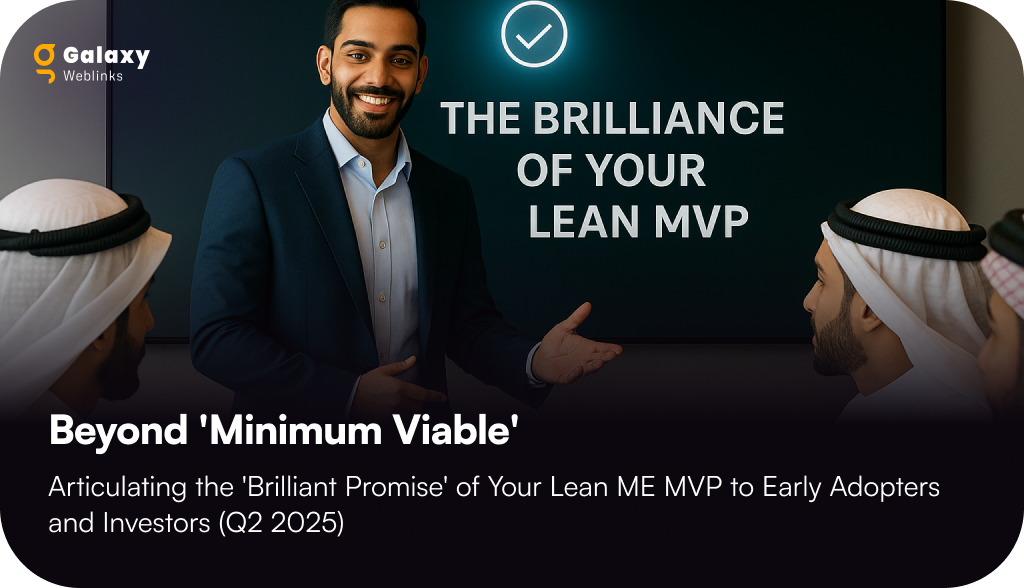
Beyond ‘Minimum Viable’: Articulating the ‘Brilliant Promise’ of Your Lean ME MVP to Early Adopters and Investors (Q2 2025)

A recent Q1 2025 report from ‘Gulf Digital Insights’ revealed a brutal truth for new apps in the region: for every $1,000 spent acquiring new users in major hubs like Dubai and Riyadh, an estimated $650 is incinerated within the first minute of use. Users are not just abandoning apps; they are rejecting them with ruthless efficiency. This isn’t a marketing problem; it’s a product philosophy problem.

The cause is a plague infecting the startup world: the “Minimum Disappointing Product” (MDP). An MDP is an MVP that technically works but feels cheap, uninspired, and disrespectful of the user’s time. It’s the tragic result of founders misinterpreting the lean startup MVP philosophy as a license to deliver a frustrating first experience. In a market where users are accustomed to the world-class polish of super-apps, this is a fatal error.

The only rational response is to stop building MDPs and instead deliver a “Brilliant Promise.”

A “Brilliant Promise” is not about adding more features. It is the disciplined art of using strategic UI/UX design for startups to make your lean product feel like a small, focused piece of a much bigger, high-quality vision. It is the tangible difference between a product that feels “unfinished” and one that feels “purposefully minimalist,” communicating deep respect for the user and unshakeable confidence in your future.

To survive now, your MVP development process must be redefined. You must learn to articulate a “Brilliant Promise” that wins the immediate trust of a skeptical audience and proves to investors you understand what quality truly means in 2025.

Why a ‘Viable’ MVP is No Longer Enough in the 2025 Gulf Market

In other markets, a clunky-but-functional MVP might get a pass. In the Middle East, it is a critical strategic failure. Three regional realities have created an environment where a superior user experience is no longer a “nice-to-have,” but a fundamental requirement for survival.

1. The World-Class User Expectation The average digital user in Dubai, Riyadh, or Doha has been trained by the best. They manage their lives through the seamless super-app experience of Careem, they shop with the sophisticated e-commerce power of Noon, and they handle their finances with the polished, secure banking apps from Al Rajhi Bank or FAB. This is their baseline. When they encounter your MVP, they are not comparing it to other startups; they are subconsciously comparing it to these world-class products. A clunky, confusing interface doesn’t just look bad—it positions your product as amateurish and unworthy of their time.

2. The Trust-Deficit Multiplier As we’ve discussed previously, every new startup in the region begins with a “Trust-Deficit.” A poor user experience acts as a powerful multiplier for this deficit. It provides tangible evidence that confirms a user’s worst fears. A slow-loading screen, a confusing layout, or a buggy button are not just technical flaws; they are red flags that signal a lack of professionalism and stability. This amplifies the “Insha’Allah Risk”—the user’s rational fear that your company is not a serious, long-term venture. A polished UI/UX is one of the fastest ways to start paying down that trust deficit.

3. The Investor Signal Discerning investors in 2025 look beyond the pitch deck; they look for proxies of founder quality. The importance of UI/UX for startups has grown because it is now seen as a direct signal of the founding team’s standards and capabilities. A thoughtfully designed MVP, even with just one feature, proves you are obsessed with the customer, detail-oriented, and capable of executing at a high level. Conversely, an MVP with a poor user experience signals to an investor that you are willing to cut the wrong corners, which is a major red flag for any business hoping to scale.

The ‘Brilliant Promise’ Playbook: Three Plays for a High-Impact MVP

Knowing you need a premium feel is not enough. The challenge is achieving it within the tight constraints of a lean startup MVP. This requires a ruthless focus on what truly matters. Instead of spreading your limited resources thin, you will execute three specific, high-impact plays designed to engineer a “Brilliant Promise” into your product from day one.

Play #1: The “First-Touch” Polish (Mastering the First 30 Seconds) The highest ROI in early user experience design for startups is found on the very first screen a user sees. This is where their trust is either won or lost.

  • The Play: You will invest a disproportionate amount of design effort into the login/signup screen and the initial loading animation. This is not about adding features; it’s about signaling quality. Use a clean layout, a high-quality font, and a single, smooth micro-interaction—like a button that animates satisfyingly when tapped.
  • The Use Case: Imagine a user downloads your health-tech MVP. Instead of a generic, default-font login form, they are greeted by a beautifully designed screen with a calming color palette, a clear and confident headline, and an elegant loading animation. This small, focused effort does not change the product’s function, but it instantly communicates professionalism, builds trust, and lowers their skepticism before they even use the core feature.

Play #2: The “Magic Moment” Engineering (Delivering One ‘Wow’ Interaction) A prototype demonstrates a function, but a “Brilliant Promise” MVP delivers an emotional payoff. This play involves identifying the single most valuable moment for your user and making it feel exceptional.

  • The Play: Map out your user’s journey and pinpoint the one moment they feel the most relief, accomplishment, or value. This is your “magic moment.” You will invest your design and development resources in making this specific interaction feel seamless and delightful.
  • The Use Case: Consider a fintech app for international remittances. The user’s moment of highest anxiety is right after they hit “send.” Your “magic moment” is the confirmation screen. Instead of a bland “Transaction Complete” message, the screen comes alive with a reassuring animation—perhaps a paper plane flying across the screen—and clear, comforting text: “Success! Your 5,000 AED has been securely sent to Priya.” This transforms an anxious moment into a delightful and memorable one.

Play #3: The “Vision-Casting” Copy (Articulating the Future, In-App) Your lean MVP will, by definition, be incomplete. The key is to frame this as a deliberate choice, not a lack of resources. This play uses the UI itself to tell the story of your future vision.

  • The Play: Instead of simply disabling or hiding unbuilt features, you will use confident “vision-casting” copy. A greyed-out button in the dashboard becomes a signpost for your roadmap.
  • The Use Case: Your MVP for a social media management tool might only allow posting to one platform. In the menu, other platform icons are disabled. Next to them, the copy doesn’t say “Coming Soon.” It says, “Next Up: LinkedIn Integration (Est. August 2025)” and “Phase 3: Analytics Suite.” This small detail transforms early adopters from users of an incomplete product into insiders on an exciting and credible journey. It shows them you have a plan, building their confidence in your long-term vision.

Articulating the Promise: Tailoring the Message for Two Audiences

A well-designed MVP that delivers a “Brilliant Promise” is a powerful asset. But its value is only fully realized when you articulate it correctly. The story you tell your first users is different from the one you tell potential investors. Both are true, but they emphasize different outcomes.

For Your Early Adopters: Sell the Experience and the Exclusive Journey

Your first users are not buying a finished product; they are buying into your vision and the feeling of being an insider. Your messaging to them should be passionate, inclusive, and focused on the premium quality of their immediate experience.

  • What You Say: “We are obsessed with getting the details right. We believe the future of [your industry] should be effortless and delightful. Experience the first step of this journey with a product that focuses on doing one thing perfectly. Join our small circle of founding users and help us shape what comes next.”
  • Why It Works: This language reframes the MVP’s limited feature set as a deliberate focus on quality, not a lack of resources. It positions them as pioneers, not beta testers, and makes them feel valued and integral to the product’s evolution.

For Your Investors: Sell the Founder Quality and the Strategic Insight

Investors are betting on your ability to execute and scale. They see your MVP as a direct reflection of your standards, strategy, and understanding of the market. Your messaging to them must connect the “Brilliant Promise” to business acumen and de-risk their investment.

  • What You Say: “We intentionally built this lean MVP with the same design discipline and user-centric obsession that we will apply to the full, scaled-out platform. The quality of this product is the first piece of hard evidence that demonstrates our ability to execute at a high level. It proves we understand the importance of UI/UX for startups in the competitive Gulf market and that we know how to build a product that can win the trust of discerning users.”
  • Why It Works: This articulation frames your excellent user experience design for startups as a strategic decision, not just a cosmetic choice. It tells investors that you are a founder with high standards who knows how to mitigate risk (the “Trust-Deficit”) and build a product that can create a sustainable competitive advantage. It positions your approach to MVP development as a sign of maturity and a predictor of future success.

Viability is the Floor, Brilliance is the Goal

The old philosophy of “move fast and break things” has given way to a new reality in the Middle East. In the selective 2025 market, where users are discerning and trust is paramount, the era of the “good enough” MVP is definitively over. Your product’s viability is now merely the starting point, not the destination.

The “Brilliant Promise” is not about adding more features, more code, or more complexity. It is about a ruthless obsession with quality, a deep respect for the user’s time and intelligence, and a clear, confident vision for the future. It is the understanding that your MVP is not just a tool to test a hypothesis; it is your single most important piece of marketing and your first, best chance to prove you are a founder capable of building a world-class company.

Your MVP is not a test of your idea; it is a demonstration of your standards.

Is your MVP just viable, or does it articulate a brilliant promise?

Contact Galaxy Weblinks to discuss how strategic UI/UX design can transform your minimum viable product from a simple test into your most powerful asset.