EHR Software Development Guide (2026): Cost, Features, Tech Stack & Compliance 

There was a time when patient records lived on paper files. Lost folders. Duplicate entries. Manual errors. Care teams worked in silos. Managing patient data was messy, risky, and inefficient. EHR software development changed that narrative.  

Modern EHR systems centralize data, streamline workflows, and improve care delivery across departments. Doctors get real-time access. Administrators gain visibility. Patients experience continuity of care. No delays. Fewer mistakes.  

But benefits alone are not enough. Building a reliable EHR system requires the right strategy, architecture, compliance planning, and execution.  

The global EHR market is projected to cross $40 billion by 2030, driven by digital health mandates and operational efficiency goals as per GrandViewResearch.  

However, building systems like this isn’t theoretical work. It comes from hands-on experience with regulated healthcare platforms.  

For example, while developing a HIPAA-compliant wellness and health tracking platform for a leading U.S. university, our teams worked closely with researchers to securely capture, store, and analyze sensitive health data across mobile apps, wearables, and cloud dashboards.  

That experience shaped how we approach EHR software development today—compliance-first, data-secure, and built for real clinical and research workflows. 

This guide goes beyond advantages. It breaks down how to design, develop, and scale a robust EHR software system—step by step. 

From technology choices to development process, everything that matters is covered. 

What is Electronic Health Record System or EHR in Healthcare? 

So, what exactly is an EHR system? In simple language, it is a digital version of a patient’s paper chart. But it’s way better than a dusty folder. It’s a smart platform used to manage all patient data in one spot.  

We’re talking about lab reports, prescriptions, medical history, and even those allergy warnings. Such medical records software makes sure doctors don’t have to guess what happened during a patient’s last visit.   

When a healthcare institution or hospital invests in EHR software development, they are building a bridge between different departments. Everything is instant. No more waiting for faxes!  

The core of EHR development is about making data move fast and staying secure. It helps providers see the full picture of a person’s health.  

Using EHR software means less mistakes and much faster treatments. It’s basically the “brain” of a modern hospital. If you want better care, you need a solid system.  

EHR is often taken synonymous to EMR because they share similar functions and goals, though there are a few differences. Hence, EHR and EMR are used interchangeably.  

Considerably, EMR hospital software programs are used for a single unit, while EHR is used by multiple providers and health systems.  

How to Develop EHR Software: Complete Process to Build Custom EHR Systems 

Building EHR software is complex. No shortcuts here. It touches clinical workflows, patient data, compliance, and long-term scalability. That’s why EHR software development requires more than coding skills. You need domain knowledge.  

Regulatory awareness. And real healthcare experience. A competent EHR software development company like ours brings all of that together. They understand how hospitals work, how clinicians think, and how systems must scale securely.  

Without the right expertise, even well-funded EHR system development efforts fail fast. Below is a practical, end-to-end process for custom EHR software development, broken down clearly. 
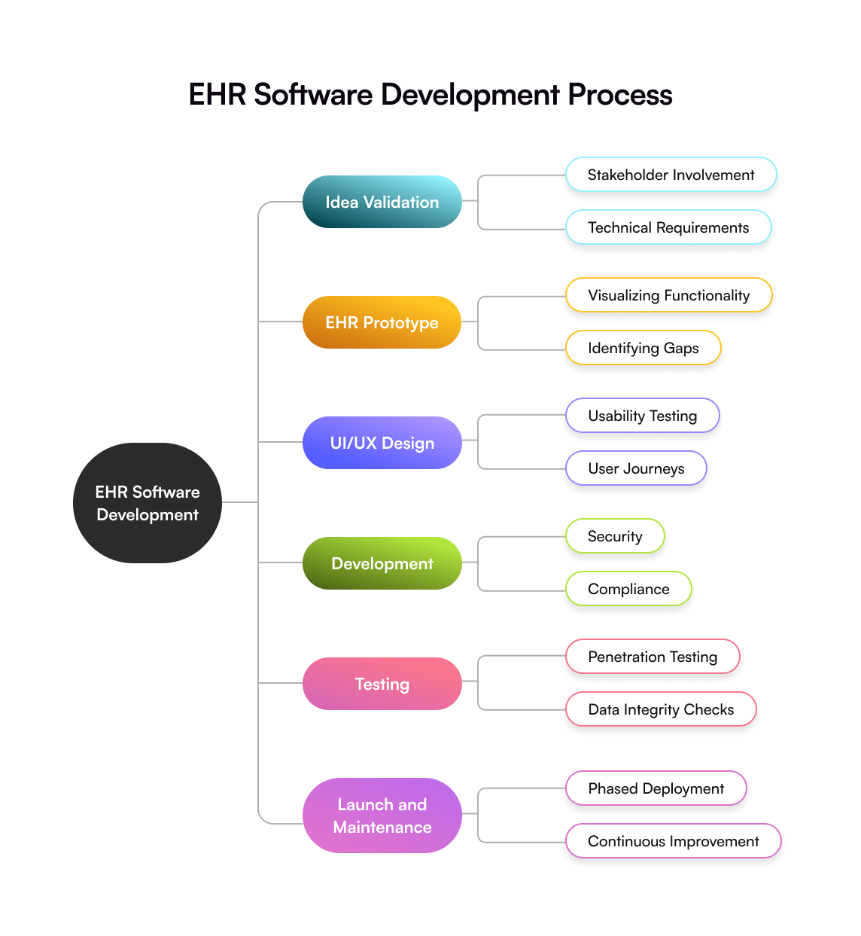
Idea Validation 

Every EHR starts with a problem. Usually many problems. 

Inefficient workflows. Poor data access. Legacy systems that don’t integrate. Before writing code, these issues must be validated. Properly. 

This stage involves stakeholders. Clinicians. Admin teams. IT leaders. Everyone who will use the system. An experienced EHR developer helps translate real-world pain points into technical requirements. 

The goal is clarity. What to build. What not to build. And why. Skipping this step leads to bloated EHR software. And wasted budgets. 

EHR Prototype 

Once the idea is validated, teams move fast to prototyping. 

An EHR prototype shows how the system might work. Not perfect. Not final. But tangible. Screens. Flows. Core interactions. 

This helps decision-makers visualize the product early. It also exposes gaps. Workflow breaks. Missing features. Confusing navigation. 

For enterprise buyers, this stage reduces risk. You see the product before committing fully. Adjustments here are cheap. Later, they are not. 

UI/UX Design  

EHR UI/UX design is not about beauty. It’s about speed.  

Doctors don’t want ten clicks. Nurses don’t want clutter. Admin teams need clarity. Design must support real clinical workflows.  

Good EHR software development focuses on usability, accessibility, and consistency. Every screen should feel familiar. Predictable. Fast.  

This stage includes wireframes, user journeys, and usability testing. Often with real users. Feedback matters here. A lot. 

Development 

Now the real build begins. 

During EHR system development, teams focus on architecture, security, integrations, and scalability. Backend. Frontend. APIs. Everything comes together. 

Developers implement features like patient portals, interoperability, role-based access, audit logs, and billing workflows. Compliance is baked in. Not added later. 

An experienced EHS software development company ensures the system aligns with HIPAA, supports standards like FHIR and HL7, and integrates with existing healthcare systems. 

Testing 

Testing is not optional. Ever. 

EHR software must be tested for functionality, performance, security, and compliance. Across devices. Across user roles. Under load. 

This includes penetration testing, usability testing, and data integrity checks. Errors here can impact patient safety. Or trigger compliance violations. 

Good testing prevents expensive fixes post-launch. 

Launch and Maintenance 

Launching EHR software is just the beginning. 

Deployment is usually phased. One department first. Then others. Training is critical. Support matters. Adoption decides success. 

Post-launch, the system needs updates. Security patches. Feature improvements. Regulatory updates. Ongoing maintenance keeps the EHR relevant and reliable. 

Long-term success depends on continuous improvement. Not just a successful launch. 

CTA

Budgeting for EHR Software: How Much It Costs to Build EHR Systems 

Budgeting for EHR software development is rarely straightforward. There’s no flat price tag. Too many variables. Too many stakeholders.  

The cost of EHR software depends on scope, compliance depth, integrations, and how customized the system really is.  

A small clinic and a multi-location hospital will never pay the same. And they shouldn’t.  

At a high level, the cost of implementing EHR in hospital environments usually ranges from mid five figures to several hundred thousand dollars.  

Sometimes more. Especially when legacy systems are involved.  

Let’s break it down. 

EHR Implementation Cost Breakdown  

Typical cost components include:  

  • Discovery, planning, and compliance mapping  
  • UI/UX design for clinicians, admins, and patients  
  • Core development and integrations (labs, billing, devices)  
  • Security, audits, and regulatory compliance  
  • Testing, training, rollout, and ongoing support  

Each phase adds up. Skipping one only increases risk later. 

Estimated Cost Based on Different Development Rates   

Where your development team is located makes a big difference. Let’s see how. 

Region Average Hourly Rate Estimated Project Cost 
North America $120–$180/hr $150,000 – $500,000+ 
Western Europe $80–$130/hr $120,000 – $400,000 
Eastern Europe $50–$80/hr $70,000 – $250,000 
South Asia $25–$50/hr $40,000 – $180,000 
Australia $100–$160/hr $130,000 – $450,000 

Lower rates don’t always mean lower quality. But healthcare experience matters. A lot. 

Key Factors That Influence the Cost to Build Custom EHR Software  

Some things drive costs up fast. Others keep it sane.  

  • Customization level: Off-the-shelf logic is cheaper. Custom workflows cost more. Worth it, usually.  
  • Compliance requirements: HIPAA, GDPR, regional health laws. Security isn’t optional. It adds effort.  
  • Integrations: Labs, pharmacies, billing systems, devices. Each integration has a price.  
  • Scalability needs: Single facility vs hospital network. Architecture changes everything. 
  • Post-launch support: Updates, audits, user feedback, new features. EHRs are never “done”.  

In short, EHR software development is an investment. Not an expense. The right budget avoids rework, downtime, and compliance risk later. Cheap systems fail quietly. Good ones scale with care delivery. 

Must-Have Features in Custom EHR Software (2026 Checklist) 

Building a custom EHR system isn’t just a tech decision. It’s a long-term investment. It affects clinical work, operations, compliance—everything.  

EHR software has to support real workflows. Not ideal ones. It needs to be compliant, must integrate with existing systems, and scale when the organization grows. Because one department today could expand to many locations tomorrow.  

In large hospital environments, EHR platforms rarely operate in isolation. They form part of a wider-ranging hospital management ecosystem responsible for processing admissions, billing, staffing, and operations on a large scale. They work coherently with a hospital management system.  

The success of custom EHR software development depends heavily on its features. Not how modern it looks. Not buzzwords. Features that actually work in daily healthcare operations.  

So, you must build an EHR software solution that can efficiently handle real world operations, scale with your growth, and align with what industry regulators want. Not shiny software.  

Besides, building software with cutting-edge functionality like cloud, IoT, blockchain, and AI in healthcare is also crucial to craft modern-day solutions.  

Listed below are the key features of custom EHR software that a healthcare organization should focus on to achieve efficiency, security, interoperability, and scalability. 

Patient Portal with Secure Access 

A patient management portal is an essential component of an EHR system that lets them view records, lab results, prescriptions, visit history, and other data easily and securely. Also, they can book appointments. Fill out admission forms. Message providers and pay bills.  

A special ID is generated for every patient in the system that electronic medical software uses to track all interactions with them.  

For healthcare organizations, this reduces admin workload. Improves engagement. Supports value-based care. HIPAA compliance here is non-negotiable. 

Data Security, Privacy, and Compliance Controls 

Security is not a feature. It’s the foundation. It must be built with strong security features. Custom EHR systems must control who sees what.  

Doctors, nurses, admins—each role needs limited access. Nothing extra. Implement encryption for data at rest and in transit, MFA, and secure authentication. Besides, use automated backups and disaster recovery to easily restore data in case of an incident.  

HIPAA and regional data protection compliance must be built into the architecture. Not added later. 

E-Prescribing  

E-prescription is also one of the major features that an electronic health record system should support. It digitizes prescriptions written by practitioners for their patients to make them more accessible, secure, and shareable. 

It removes manual errors. No illegible handwriting. No guesswork. It makes sharing information about a patient’s conditions, treatments, and diagnosis convenient.  

This improves safety. And keeps systems aligned with healthcare regulations. 

Clinical Dashboard  

Clinicians need clarity. Dashboards show key data at a glance. They can see, for example, whether the patient is having normal or abnormal vitals, lab trends, treatment history, etc. All these are put up on a single screen in just a click. 

This component of EHR software enables clinicians to access and record patient information. It centralizes data for patients that improves workflow efficiency, patient care, and reduces administrative burden.    

Secure Messaging and Care Team Collaboration 

Secure communication is not optional in healthcare systems. We’ve seen this firsthand while building enterprise-grade virtual care platforms where providers exchanged medical files, consultation notes, and patient messages in real time.  

In HIPAA-compliant telehealth systems we developed, secure messaging, role-based access, and audit logs were foundational—not add-ons.  

These same principles apply directly to custom EHR software features, where data leaks are simply unacceptable. 

Billing and Financial Dashboard  

A financial and billing dashboard provides healthcare teams with visibility into claims, payments, denials, and outstanding balances. All in one place. No jumping between systems.  

It supports automated billing workflows, insurance claims tracking, and reconciliation. Fewer errors. Faster reimbursements.  

For leadership, it offers clear financial insights. For operations teams, it reduces delays and manual follow-ups. 

Laboratory, Imaging, and Third-Party Integrations 

Manual data entry slows everything down. And causes errors. 

Custom EHR systems should integrate directly with labs and imaging platforms. Results flow in automatically. 

API-driven integrations allow expansion without rebuilding core systems. Important at enterprise scale. 

Scalability, Performance, and Multi-Facility Support 

Healthcare organizations grow. Data grows faster. 

Custom EHR software must support multiple facilities, high concurrent users, and consistent performance. Even under load. 

Cloud-ready architecture coupled with a modular design enables systems to evolve without breaking the reliability. 

Interoperability and Standards Compliance (FHIR & HL7) 

Interoperability isn’t optional. 

Custom EHR software must exchange data with labs, pharmacies, imaging systems, insurers, and third-party platforms seamlessly. 

Support for HL7, FHIR, and CDA ensures structured data exchange. Less vendor lock-in. More flexibility long-term. It directly affects care coordination, reporting accuracy, and compliance. 

The multi-tenant telehealth platform we developed and integrated with EMR system  

Reporting, Analytics, and Population Health Management 

Data alone isn’t useful. Insights are. 

Advanced reporting enables compliance tracking, operational analysis, and performance monitoring. Population health analytics help improve outcomes and resource utilization. 

Technology Stack for EHR Software Development 

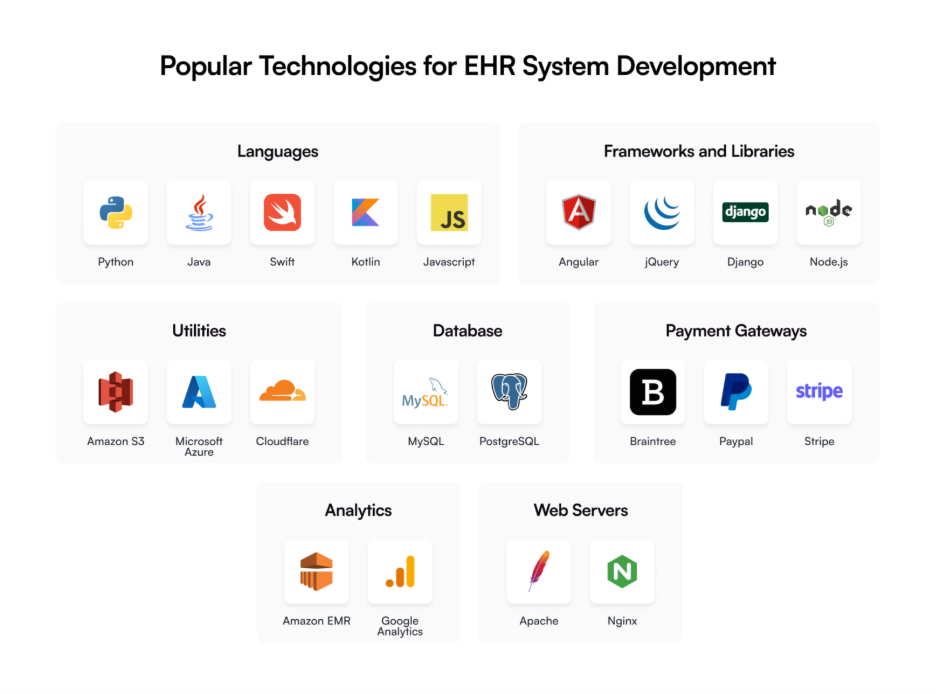
Building reliable EHR software is not about picking trendy tools. It’s about choosing tech that survives audits, scales across hospitals, and doesn’t break workflows.  

That’s why custom EHR software development usually needs a seasoned EHR software development company.  

Healthcare systems are complex. Regulations are strict. Data is sensitive. The wrong stack costs years, not weeks.  

A capable partner helps you avoid that pain by selecting proven, compliant, future-ready technologies.  
Backend & Core Logic 

Most enterprise EHR systems rely on Node.js, Java, or .NET. Stable. Secure. Built for long-running healthcare workloads. Microservices help when systems grow messy. And they always do. 

Frontend (Web & Mobile) 

React, Angular, or Vue power clinician dashboards. Clean. Fast. No clutter. Mobile access often uses Flutter or React Native for shared codebases.  

Database & Data Storage 

Structured data lives in PostgreSQL or MySQL. Clinical documents? MongoDB or cloud object storage. Performance matters here. A lot.  

Interoperability & Standards 

FHIR and HL7 aren’t optional. They’re mandatory. APIs must speak healthcare fluently or nothing integrates properly.  

Security & Compliance 

Encryption everywhere. OAuth 2.0. MFA. Role-based access. HIPAA isn’t a feature. It’s the baseline.  

Cloud & Infrastructure 

AWS, Azure, or GCP. High availability. Auto-scaling. Disaster recovery baked in.  

The right stack doesn’t just run EHR software. It protects it. And that’s what healthcare teams really need. 

Buy vs Build Custom EHR Software: Which Is More Economical? 

This decision shows up early. And it matters a lot. Buying off-the-shelf EHR software looks cheaper at first. Faster setup. Fixed pricing.  

But you inherit limits. Rigid workflows. License fees that grow every year. Customization costs add up quietly.  

Custom EHR software development takes more effort upfront. No denying that. But it aligns with how your hospital or healthcare startup actually works.  

You build only what you need. Integrations fit. Scaling feels natural, not forced. Over time, many organizations realize the total cost is lower.  

The advantage? Fewer workarounds. Less vendor lock-in. More control. 

Factor Buy EHR Software Build Custom EHR 
Upfront Cost Lower Higher 
Customization Limited Full control 
Long-term Cost High (licenses + add-ons) More predictable 
Scalability Vendor-dependent Built for growth 
Ownership Vendor-owned You own the system 

There’s no universal answer. Smaller organizations may buy. Large organizations often prefer to build custom solutions. The most economical option depends on scale, compliance needs, and how long you plan to run the system. 

Types of EHR Software Solutions You Can Develop 

Not every healthcare organization needs the same system. EHR system development looks different for a hospital chain than for a digital health startup.  

That’s why EHR and EMR software development usually branches into a few core solution types. Each solves a different problem. Each fits a different scale.  

On-Premise EHR Systems 

Built for hospitals that want full control. Data stays inside the facility. Higher upfront cost, more IT responsibility. Still preferred by large institutions with strict governance.  

Cloud-Based EHR Software 

Hosted on secure cloud infrastructure. Easier to scale. Faster updates. Lower infrastructure burden. Ideal for growing healthcare networks and multi-location practices.  

Web-Based EHR Platforms 

Accessed through a browser. No heavy installs. Works across devices. Often used by clinics, labs, and outpatient centers that value speed and flexibility.  

Mobile EHR Applications 

Designed for care on the move. Clinicians access patient data, notes, and alerts from phones or tablets. Big boost for field care, home health, and emergency teams. 

Hybrid EHR Systems 

A mix of on-premise and cloud. Sensitive data stays local. Everything else runs in the cloud. Common in enterprise EHR system development projects.  

Specialty-Specific EHR Solutions 

Built for cardiology, oncology, mental health, or pediatrics. Workflows match real clinical practice. Less clutter. More efficiency.  

The right choice depends on scale, compliance needs, and long-term growth plans. One size never fits all. That’s the reality of EHR and EMR software development. 

Key Considerations for EHR Software Development to Overcome Challenges 

Building EHR platforms is rarely smooth. Electronic Health Record System development comes with real-world constraints—clinical pressure, regulations, legacy systems.  

Planning for these early saves time, money, and frustration. A capable EHR software development company knows where things usually break and how to prevent it. 

Key considerations that matter:  

  • Don’t miss regulatory compliance as it matters more than you think.  
  • Software must adapt to clinicians, not the other way around. Poor UX kills adoption fast. 
  • Security must be integral to software right from the design stage.  
  • The system should handle both increase in data volume and user flow without rework.  
  • Training and rollout matter as much as code.  
  • Choose partners who’ve done Electronic Health Record System development before.  

These considerations reduce risk. They keep timelines realistic. And they make the difference between software that works—and software that survives. 

Regulatory & Compliance Checklist for EHR Systems 

Compliance isn’t just a boring task; it is essential to avoid penalties and adhere to regulations. These compliances often define how you should approach your EHR system development project. From coding to deployment, there are several compliances you need to align with to avoid risks and penalties.  

HIPAA Privacy & Security Rules 

This is the big one. Protect PHI (Protected Health Information) with everything you got. Use encryption, access controls, and audit trails. No shortcuts here. Honestly, HIPAA compliance is the baseline, not some fancy extra feature. If you don’t have it, you don’t have an EHR system.  

For example, as we built a HIPAA-compliant wellness platform for the University of Vermont, we implemented controlled SSO access and secure cloud data handling. It ensured that only approved study participants could access sensitive health data. 

CMS & ONC Readiness 

Follow the CMS requirements for billing and reporting accuracy. Also, stay ready for ONC certification. This ensures your EHR software plays nice with others and follows the 21st Century Cures Act. It’s about being “interoperable.”  

FHIR & HL7 Standards Support 

Data needs to move cleanly between systems. Support for FHIR (Fast Healthcare Interoperability Resources) and HL7 is basically mandatory now. It’s what allows a lab result from a different clinic to show up in your app without a glitch.  

Disaster Recovery & Backup 

Systems fail. It happens. But your plan shouldn’t. Set up automated backups and a real recovery strategy. In a crisis, you need to be back online in minutes, not days. EHR software development that ignores this is just waiting for a crash. 

Why Software Fails: Common EHR Software Development Mistakes to Avoid 

EHR software development fails more often than teams admit. Not because of bad intent. Because of missed details. Small decisions. Big impact later. Below are the mistakes that quietly derail EHR projects—and how to avoid them.  

  • Designing for “ideal” processes instead of real-world usage kills adoption fast. Clinicians won’t adjust. The software must.  
  • HIPAA and regional regulations can’t be patched in later. Miss this early, and you’re rebuilding core architecture. Expensive mistake.  
  • More features don’t mean better software. Bloated EHRs slow teams down and frustrate users. Build what’s needed. Nothing extra.  
  • Skipping HL7 or FHIR support blocks integrations with labs, billing, and devices. Data silos form quickly. Care quality suffers.  
  • No MFA. Poor access controls. Incomplete audit logs. One breach can shut everything down. Trust is hard to regain.  
  • Systems built for one clinic break when expansion begins. EHR software development must plan for growth from day one.  
  • EHRs aren’t “launch and forget.” No update strategy leads to performance issues and compliance risks over time. 

How Galaxy Weblinks Can Help in Your EHR Software Project  

EHR systems sit at the center of modern healthcare. They manage patient data, support clinical decisions, and keep operations compliant. When they fail, workflows break. Care slows down. That’s why EHR software development needs more than just technical skill. It needs healthcare understanding.  

Galaxy Weblinks as a trusted software development company helps organizations build EHR platforms that actually work in real environments. We have proven experience in healthcare development and delivered HIPAA-compliant healthcare platforms for universities and health programs, including a wearable-enabled wellness tracking system developed for the University of Vermont. 
We start with workflows. Then architecture. Security and compliance are baked in, not added later. Interoperability is planned from day one.  

Our teams design, build, and scale custom EHR solutions for hospitals, clinics, and healthtech companies. The focus stays clear. Stable systems. Clean data. Software that supports care delivery and grows with your organization. 

Frequently Asked Questions (FAQs) 

1. How long does EHR software development usually take?  

Depends on the scope. A basic MVP takes 3–6 months. Big enterprise systems? You’re looking at 9–18 months or more. Don’t rush it; quality code takes time. 

2. What is the biggest challenge in EHR software development?  

Interoperability, for sure. Making different systems talk—like labs and billing—is a headache. Legacy software is also a pain to integrate.  

3. Is custom EHR software better than off-the-shelf?  

For big hospitals, definitely. It fits your actual workflow. You don’t get stuck with “vendor lock-in” or useless features you don’t need.  

4. What is the cost of implementing EHR in a hospital?  

It’s a wide range. Small clinics might spend $40K–$90K per provider. Large networks? Easily $1M to $10M+ depending on how much you customize.  

5. How do you ensure HIPAA compliance in EHR software?  

Encryption is a must. You need MFA, audit logs, and secure hosting. In 2026, things like “zero-trust” access are becoming the new standard.  

6. Can EHR software integrate with existing systems?  

Yes, if you use the right standards like HL7 and FHIR. Good EHR software development builds these bridges from day one.  

7. What’s the difference between EHR and EMR systems?  

EMRs are mostly for one office. EHRs are built to travel. They share data across different providers and hospitals seamlessly. 

8. Do EHR systems support telehealth?  

Modern ones do. Video calls and remote monitoring are often built-in now. It’s not just a “bonus” feature anymore; it’s expected.  

9. Should startups build from scratch?  

Start with an MVP first. Validate the idea. Then sink the big money into full EHR development. Scaling too fast is a trap.  

10. How secure is cloud-based EHR software?  

Very. Usually safer than a server in a closet. Cloud providers have massive security teams, but you still gotta configure it right.  

11. Can EHR software scale across facilities?  

Yes. That’s the whole point of enterprise EHR software development. It handles multiple locations and thousands of users easily.  
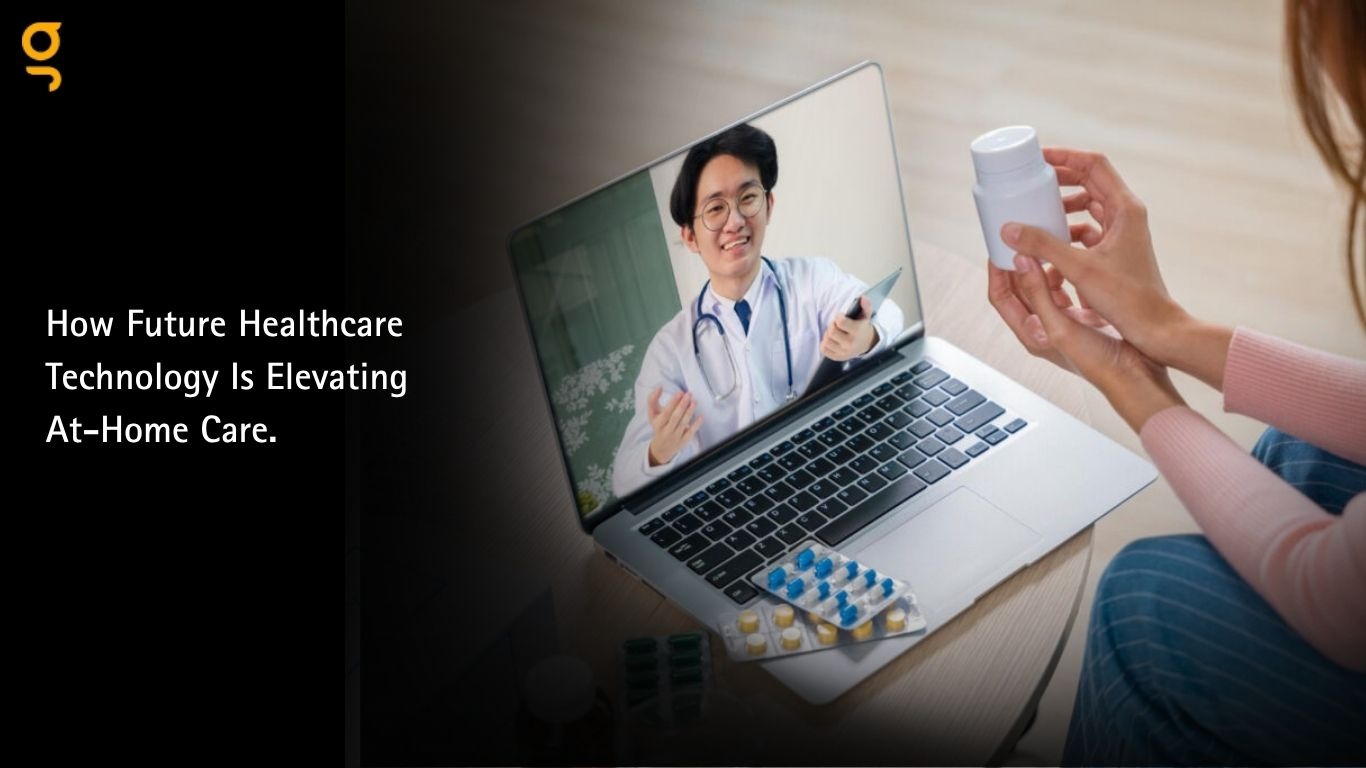
How Future Healthcare Technology Is Elevating At-Home Care

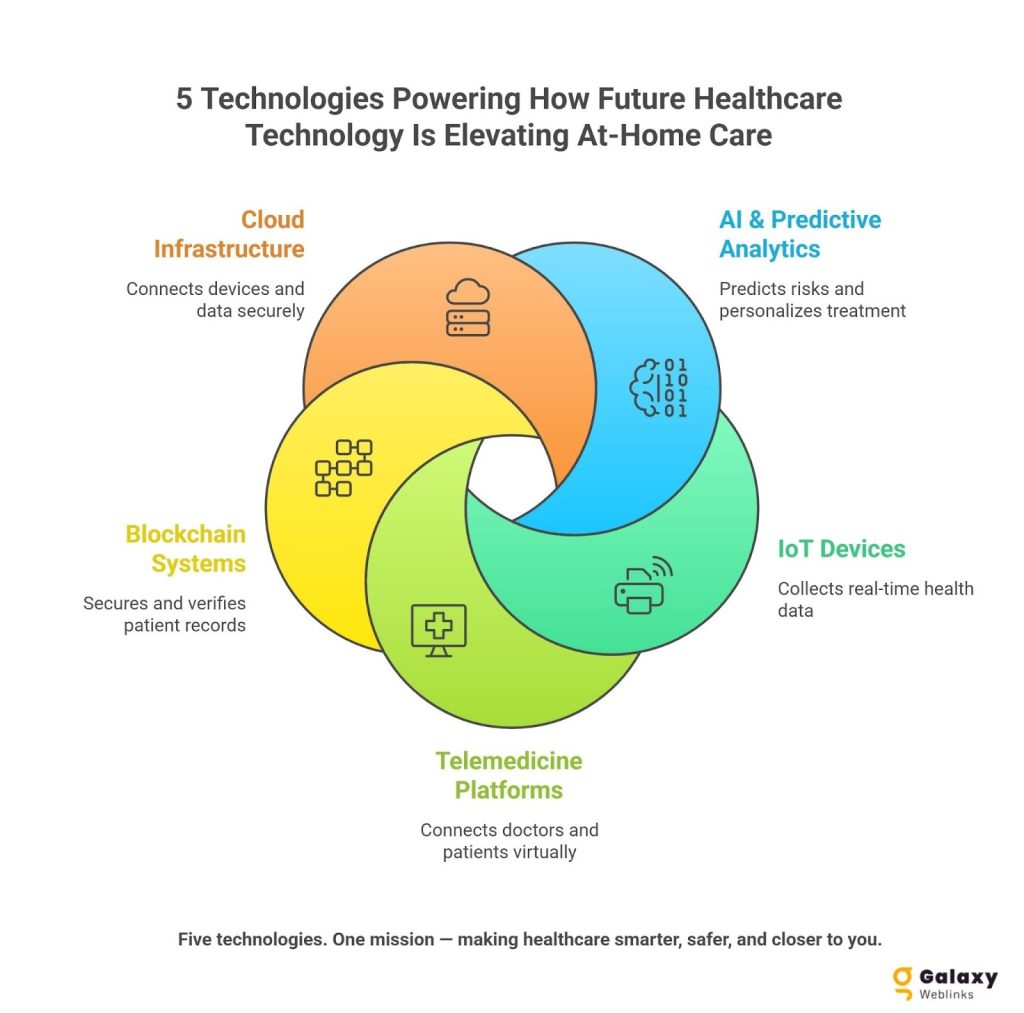
Healthcare is no longer limited by hospital walls. The rise of AI-powered monitoring, IoT-based medical devices, and virtual consultations has brought treatment, diagnosis, and prevention right into our homes.

Simply put, how future healthcare technology is elevating at-home care is about turning traditional, reactive care into a proactive, data-driven experience. Patients can now track their vitals in real time, doctors can make informed decisions instantly, and families gain peace of mind through smarter, safer digital systems.

From wearable sensors that predict health issues to AI chatbots that provide instant guidance, these innovations are closing the gap between patients and providers — creating healthcare that’s not only advanced but also deeply human.

Understanding How Future Healthcare Technology Is Elevating At-Home Care

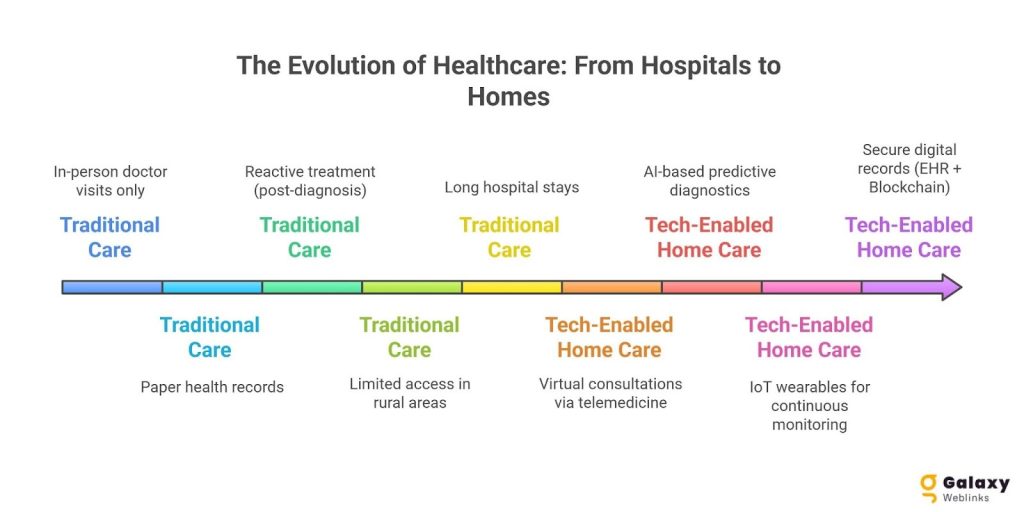
Healthcare has quietly shifted from a place you go to — into something that now comes to you. Over the past few years, this change has accelerated, thanks to breakthroughs in digital connectivity, data analytics, and intelligent health devices.

At-home care used to mean visiting nurses or family support. Today, it’s powered by AI-driven diagnostics, IoT-connected medical devices, and cloud-based health platforms that bring continuous, personalized care to patients — without stepping into a hospital.

The Rise of Home-Based Healthcare

  • The global home healthcare market is projected to surpass $500 billion by 2028, growing rapidly as healthcare systems face cost pressures and aging populations.
  • More than 60% of patients with chronic conditions say they prefer home monitoring over hospital visits.
  • Providers are adopting “hospital-at-home” programs that combine technology and clinical care for faster recovery and better patient satisfaction.

What’s Driving This Transformation

FactorImpact
Aging populationIncreased demand for chronic disease management and non-hospital care
Healthcare cost controlRemote monitoring reduces hospital stays and readmissions
Digital adoptionSmartphones and broadband make remote care accessible
Pandemic influenceAccelerated acceptance of telehealth and at-home treatment
Data intelligenceAI enables real-time decision-making and prevention

The Human Side of Tech-Enabled Home Care

Beyond convenience, this shift is deeply personal.

A patient recovering from surgery can now be monitored remotely by doctors who receive real-time alerts if their vitals change. A senior living alone can get a gentle reminder from an AI assistant to take their medication. And families can rest easy knowing technology is watching over their loved ones, even when they can’t.

That’s the essence of how future healthcare technology is elevating at-home care — bringing together compassion, connectivity, and intelligence to create care that feels both advanced and accessible.

Why the Future of Healthcare Relies on Technology-Driven Home Care

The healthcare industry is facing a pivotal moment. Rising costs, an aging global population, and the demand for continuous, personalized care are forcing providers to rethink the traditional hospital model. This is why the world is seeing a rapid shift toward technology-driven home healthcare — a model that is smarter, more sustainable, and more human.


A Changing Landscape Backed by Data

  • According to McKinsey & Company, up to $265 billion worth of healthcare services could shift from traditional facilities to home-based care by 2025.
  • The World Health Organization (WHO) projects that by 2030, 1 in 6 people globally will be aged 60 or above, significantly increasing the need for long-term home support.
  • Deloitte’s 2024 Global Healthcare Outlook found that digital health adoption among healthcare providers rose by over 60% post-pandemic — with remote patient monitoring (RPM) cited as a top investment area.

These numbers show a clear direction: healthcare is decentralizing. The hospital of the future isn’t a building — it’s a network of connected homes supported by intelligent technologies.

The Core Drivers Behind This Shift

Core DriverWhat’s ChangingReal-World Impact
Cost EfficiencyHospitals spend less on bed occupancy and staffingReduced operational burden and readmissions
Chronic Disease Management70% of healthcare spend goes to chronic illnesses (CDC)Continuous remote monitoring improves outcomes
Patient ExpectationsDigital-native generations expect healthcare on-demandRise in telehealth and virtual consultations
Workforce ShortageGlobal shortage of 10M healthcare workers by 2030 (WHO)Technology bridges the staffing gap
AI and Data IntegrationPredictive analytics enable preventive careShift from reactive to proactive care models

How Technology Makes the Home a New Point of Care

Imagine this:

  • A patient with heart disease wears a connected ECG patch that streams live data to their cardiologist.
  • An AI algorithm analyses trends and sends a preventive alert if irregularities are detected.
  • A secure cloud platform shares updates with caregivers, ensuring transparency and quick response.

This is how future healthcare technology is elevating at-home care — by transforming homes into safe, intelligent health environments.

A Sustainable Future Model

Technology-driven home healthcare isn’t just efficient — it’s sustainable.
By minimizing unnecessary hospitalizations and leveraging data-driven decisions, the system reduces carbon emissions, saves time, and builds resilience.

In short, it’s not just the future of healthcare — it’s the evolution of how we care for one another.

How Future Healthcare Technology Is Elevating At-Home Care Through AI and Predictive Analytics

Artificial Intelligence (AI) has become the beating heart of modern healthcare innovation — and its most meaningful impact is now happening inside our homes. From early disease prediction to medication management and intelligent monitoring, AI is redefining what “care” looks like.

This is how future healthcare technology is elevating at-home care: by turning passive data into proactive action.

Real-Time Intelligence that Saves Lives

AI enables real-time analysis of patient data coming from wearables, home diagnostic devices, and mobile health apps.

  • Predictive analytics help clinicians forecast potential health deterioration before symptoms even appear.
  • AI-driven dashboards track vitals like oxygen levels, blood pressure, and glucose trends — alerting caregivers instantly when values move outside safe limits.
  • Natural language AI tools (like conversational assistants) guide patients with medication reminders or daily wellness check-ins.

According to a PwC Global AI Report, AI applications in healthcare could contribute up to $150 billion annually in savings for the U.S. healthcare economy by 2026, mainly through automation and predictive interventions.


AI in Action — Common Use Cases

Use CaseTechnology InvolvedBenefit
Early Disease DetectionMachine learning algorithmsDetect cardiac, diabetic, or respiratory anomalies early
Personalized TreatmentPredictive analyticsTailors medication and lifestyle advice
Smart DiagnosticsAI image recognitionRemote review of X-rays, ECGs, or scans
Behavioral Health InsightsNLP and sentiment analysisMonitors mood changes and mental health remotely
Virtual Health AssistantsConversational AI & voice botsImproves patient engagement and compliance

Real-World Example

A hospital in the U.S. partnered with an AI analytics provider to track patients with heart failure remotely.

The AI model analyzed vitals and lifestyle inputs, identifying risk factors 10 days before symptoms appeared. The result? A 40% reduction in hospital readmissions, according to Harvard Business Review.

That’s not just smarter care — it’s life-saving foresight.


Galaxy Weblinks Insight

At Galaxy Weblinks, we’ve seen how integrating predictive algorithms with patient-facing apps empowers healthcare organizations to reduce response times and optimize treatment accuracy.
Through AI-powered dashboards and predictive modeling, we help providers see what’s coming — not just what’s already happened.

👉 Explore our AI Development Services

How Future Healthcare Technology Is Elevating At-Home Care with IoT and Remote Patient Monitoring

If AI gives healthcare its “intelligence,” the Internet of Things (IoT) gives it “awareness.”
Through a network of smart medical devices and sensors, doctors can monitor patients continuously — even when they’re miles away.

This seamless exchange of data is transforming the home into an extended care environment, where every heartbeat, breath, and step can tell a story about a patient’s health.

The Scale of IoT in Healthcare

  • The global IoT healthcare market is projected to reach $446 billion by 2028, growing at a CAGR of 16.8% (Statista).
  • A Deloitte study (2024) found that over 60% of U.S. hospitals have implemented at least one form of remote patient monitoring solution.
  • Patients using connected devices reported a 25% improvement in treatment adherence and reduced readmission rates, according to Frost & Sullivan.

These numbers reveal how IoT is not just improving care — it’s redefining how healthcare systems operate.

Common IoT Devices Powering Home Healthcare

Device TypeFunctionBenefit
Smartwatches / Fitness TrackersMonitor heart rate, activity, sleepPreventive care insights
Connected Glucose MonitorsTrack blood sugar in real timeContinuous diabetic management
Digital Stethoscopes & ECG PatchesRecord and transmit heart dataInstant doctor feedback
Wearable OximetersMonitor oxygen levelsVital during respiratory illnesses
Smart Pill DispensersAutomate dosage remindersBoosts medication adherence

A Day in the Life of IoT-Enabled Care

Imagine a patient recovering from heart surgery.
Their wearable ECG patch transmits data every few seconds to a secure cloud platform. An AI model analyzes the data, and when it spots an irregularity, it notifies the cardiologist immediately.
Within minutes, the doctor calls the patient, preventing a potential emergency.

This is how future healthcare technology is elevating at-home care — through real-time visibility, faster intervention, and smarter recovery.

The Integration Challenge

However, IoT isn’t just about collecting data — it’s about making that data usable.
Healthcare organizations face the challenge of integrating IoT device data with Electronic Health Records (EHRs) while maintaining HIPAA compliance and data interoperability.

At Galaxy Weblinks, we design connected health platforms that solve this problem by building secure, interoperable data pipelines — ensuring every data point flows smoothly between patient, device, and provider.

Discover our IoT App Development Services

How Future Healthcare Technology Is Elevating At-Home Care with Telemedicine and Virtual Consultations

In just a few years, telemedicine has gone from a niche service to a mainstream healthcare channel.
It’s one of the clearest examples of how future healthcare technology is elevating at-home care — by connecting patients and doctors instantly, no matter the distance.

With telemedicine, healthcare has finally become location-agnostic — accessible, flexible, and immediate.

The Telehealth Boom — By the Numbers

  • The global telemedicine market is expected to reach $286 billion by 2030, expanding at a CAGR of 12.5% (Grand View Research).
  • During the COVID-19 pandemic, telehealth utilization increased by 38x, according to McKinsey & Company.
  • A Cleveland Clinic study (2023) found that 82% of patients who used telemedicine reported equal or better satisfaction compared to in-person visits.

How Telemedicine Is Transforming At-Home Care

Transformation AreaDescriptionValue to Patients
Virtual ConsultationsLive doctor-patient video calls for diagnosis and treatmentReduced travel & faster care
Hybrid Care ModelsCombination of AI triage + live doctor consultationsShorter wait times
Remote Specialist AccessConnects rural or remote patients to top specialistsImproved healthcare equity
E-Prescriptions & Digital RecordsEnables seamless medication managementSimplifies patient compliance
Post-Discharge Virtual Follow-upsContinuous recovery monitoringLower readmission rates

Real-Life Impact: The Human Connection

For elderly patients or those with mobility challenges, telemedicine offers more than convenience — it restores independence.
A patient in a small town can now consult a city-based cardiologist or therapist through their smartphone.
Families no longer need to take days off or travel long distances for checkups.

And with features like secure video conferencing, digital health records, and AI-powered symptom checkers, the quality of remote care has improved dramatically.

The Next Evolution: Virtual Health Ecosystems

The future of telemedicine isn’t just a one-on-one video call — it’s a connected ecosystem where:

  • Doctors collaborate digitally with labs, pharmacies, and insurers.
  • AI assistants schedule appointments and summarize consultations.
  • Patients access 360° health dashboards to track their journey in real-time.

That’s how technology is reshaping the continuum of care — making it seamless, data-rich, and human-first.

Galaxy Weblinks Perspective

At Galaxy Weblinks, we build custom telehealth platforms that prioritize patient experience, HIPAA compliance, and scalability.
From real-time video infrastructure to AI-powered triage tools, our solutions ensure healthcare organizations deliver care that’s accessible to everyone, everywhere.

How Future Healthcare Technology Is Elevating At-Home Care Using Blockchain and Data Security

In a world where healthcare data moves faster than ever — across apps, devices, and cloud platforms — trust has become just as important as treatment.
That’s why how future healthcare technology is elevating at-home care isn’t only about innovation; it’s also about protection.

With billions of health records being digitized, technologies like Blockchain and Zero Trust Architecture are transforming how sensitive information is stored, shared, and secured.

Why Data Security Matters in At-Home Healthcare

  • According to IBM’s 2024 Cost of a Data Breach Report, healthcare has the highest average data breach cost across all industries — $10.93 million per incident.
  • The U.S. Department of Health and Human Services (HHS) recorded over 500 healthcare data breaches in 2023 alone.
  • Patients are increasingly aware of privacy issues — 84% say they want control over who accesses their health data (Deloitte Insights).

These stats underline a painful truth: without trust, technology adoption stalls.

How Blockchain Reinforces Trust

Blockchain FeatureRole in At-Home HealthcareBenefit
DecentralizationData stored across secure nodesEliminates single point of failure
ImmutabilityEvery transaction is time-stampedPrevents data tampering or fraud
Smart ContractsAutomates patient consent and data sharingBoosts transparency
Audit TrailsTracks who accessed what dataEnhances compliance with HIPAA/GDPR

When integrated into home healthcare platforms, blockchain creates a tamper-proof medical record where every action — from a doctor’s note to a device update — is recorded transparently and securely.

Real-World Example

Estonia, one of the pioneers in digital health, has already deployed blockchain to secure patient health records nationwide.
This ensures complete traceability and zero unauthorized access, setting a global benchmark for digital trust in healthcare (Source: Estonian eHealth Foundation).

The “Zero Trust” Future

Beyond blockchain, the Zero Trust Security Model — which assumes no device or user is automatically trusted — is becoming the new healthcare standard.
It enforces continuous authentication, encryption, and least-privilege access, reducing risks in home-based digital systems.

At Galaxy Weblinks, we implement Zero Trust frameworks and blockchain integrations to help healthcare providers:

  • Secure multi-device data flows
  • Ensure compliance with HIPAA and GDPR
  • Build patient confidence through transparency

In Short

As healthcare becomes more decentralized, data becomes the new heartbeat.
And just like a healthy heart, it must be protected, traceable, and trusted.

That’s how future healthcare technology is elevating at-home care — by ensuring innovation never compromises privacy.

Multi-Stakeholder Impact — Patients, Providers, and Payors

The impact of how future healthcare technology is elevating at-home care goes far beyond patients.
It’s transforming the entire healthcare ecosystem — from how clinicians deliver care to how insurers measure outcomes and technology partners enable innovation.

This shift isn’t just medical; it’s operational, financial, and cultural.

Patients — Personalized, Empowered, and Connected

Technology is giving patients a voice in their own health journeys.

  • 24/7 visibility: Through wearables and health apps, patients can track vitals anytime.
  • Predictive insights: AI algorithms help identify early warning signs of chronic issues.
  • Empowerment: Remote consultations and virtual care remove barriers of geography and mobility.
  • Emotional support: Digital assistants and AI chatbots provide daily motivation and reminders, enhancing mental wellness.

“Patients are no longer passive recipients — they’re active participants in their healthcare.”

Providers — Data-Driven Efficiency and Improved Care Coordination

For healthcare providers, technology reduces workload while improving precision.

  • Remote Monitoring: Doctors can track hundreds of patients simultaneously using IoT dashboards.
  • Predictive Analytics: AI suggests interventions before complications escalate.
  • Workflow Automation: Administrative tasks (like documentation or follow-up scheduling) are automated, freeing up clinician time.
  • Enhanced Communication: Unified platforms connect physicians, nurses, labs, and caregivers seamlessly.

According to a Journal of Medical Internet Research, 72% of clinicians report improved patient outcomes after implementing telemonitoring and AI tools.

Payors — Smarter Reimbursement and Risk Reduction

Insurance providers are increasingly adopting value-based models, where payouts depend on outcomes, not volume.
Technology makes this possible by providing real-time data on patient health progress.

Benefit AreaTechnology InvolvedImpact
Claims AutomationAI + BlockchainFaster, fraud-free claims processing
Outcome MeasurementRPM + Predictive AnalyticsVerifiable patient data supports reimbursements
Risk PredictionMachine Learning ModelsHelps insurers anticipate chronic cases early
Cost OptimizationDigital Health PlatformsReduces hospital stays and repeat procedures

A report by Accenture HealthTech 2024 notes that 63% of payors are investing in AI and analytics to improve claims efficiency and member experience.

Galaxy Weblinks’ Role in the Ecosystem

At Galaxy Weblinks, we collaborate across the healthcare chain —

  • Empowering patients with user-friendly apps,
  • Supporting providers with interoperable AI tools, and
  • Helping payors integrate analytics into decision-making.

Our goal is to create an interconnected digital ecosystem where everyone — from the patient to the payer — benefits from transparency, trust, and technology.

👉 Explore Our Healthcare Case Studies

Key Takeaway

How future healthcare technology is elevating at-home care is not a one-sided innovation — it’s a shared evolution.
Each stakeholder gains a new level of control, visibility, and efficiency that ultimately leads to one universal outcome: better, more equitable healthcare for all.

How Future Healthcare Technology Is Elevating At-Home Care Across Regions

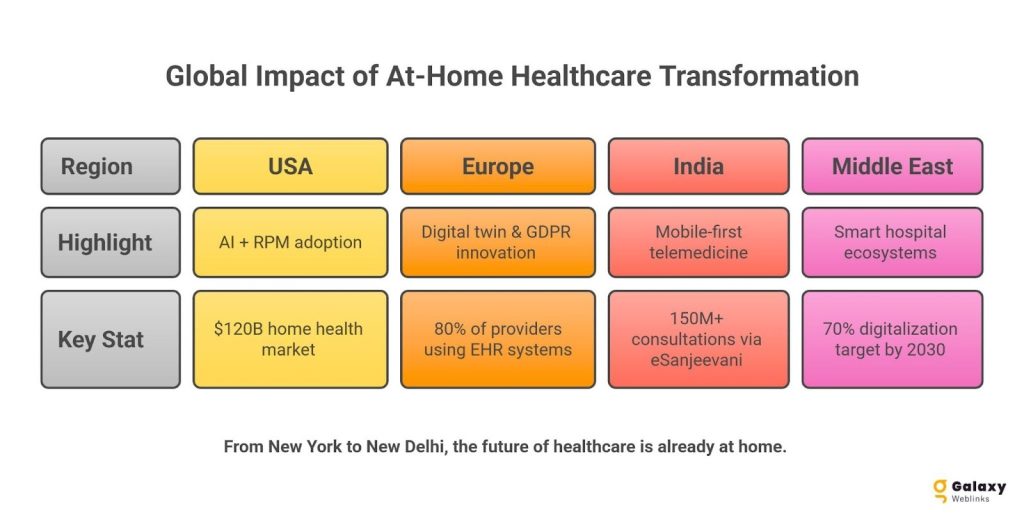
The move toward at-home healthcare isn’t limited to one geography — it’s a global transformation.
While advanced markets like the U.S. and Europe are refining digital healthcare systems for efficiency and scalability, regions like India and the Middle East are rapidly leapfrogging traditional healthcare barriers through mobile innovation and government-backed health digitization.

Together, these diverse regions show one clear pattern — technology is making healthcare borderless, continuous, and personal.


The Global At-Home Healthcare Landscape

RegionFocus AreaMarket InsightSource
United StatesAI & remote patient monitoringThe U.S. home healthcare market surpassed $120 billion in 2023, driven by telehealth and chronic disease management.Grand View Research
EuropeData privacy & digital integrationThe EU Digital Health Strategy promotes interoperable EHR systems and AI-driven home care under GDPR.European Commission eHealth Strategy
IndiaAccessibility & affordabilityThe Ayushman Bharat Digital Mission (ABDM) is building a unified digital health ecosystem; India’s telemedicine market to hit $5.5B by 2025.IAMAI–PwC Report
Middle East (KSA, UAE)Smart hospitals & health digitizationSaudi Vision 2030 and UAE’s Smart Health initiatives aim to digitize 70% of patient interactions by 2030.Saudi Vision 2030 Health Sector Transformation

How These Markets Differ — Yet Converge

  • United States focuses on AI-driven home monitoring, reducing costs and hospital congestion.
  • Europe emphasizes compliance and standardization, ensuring ethical and interoperable data flows.
  • India prioritizes reach and inclusivity, bringing healthcare to remote and rural populations through mobile-first models.
  • The Middle East invests in digital health infrastructure, integrating telemedicine with national health records for large-scale transformation.

Despite these differences, the end goal is identical — accessible, data-secure, and personalized home healthcare.

Real-World Case Highlights

  • In the U.S., hospitals like Mayo Clinic and Kaiser Permanente are expanding hospital-at-home programs that deliver acute care remotely — reducing readmissions by 30%.
  • The UK’s NHS Digital Twin Pilot (2024) uses AI and predictive analytics to personalize at-home recovery plans.
  • India’s eSanjeevani telemedicine platform has already completed over 150 million consultations, proving digital health can scale affordably.
  • In the UAE, the “Doctor for Every Citizen” initiative offers 24/7 virtual consultations in Dubai, integrating directly with EHRs.

Galaxy Weblinks’ Global Experience

At Galaxy Weblinks, we collaborate with healthcare innovators across continents — helping:

  • U.S. and European providers deploy scalable, HIPAA/GDPR-compliant solutions
  • Indian startups design affordable mobile health platforms
  • Middle Eastern health systems modernize through cloud and AI adoption

By understanding these regional nuances, we build digital health solutions that are both globally aligned and locally relevant.

👉 Explore Our Healthcare Industry Solutions

Key Takeaway

Whether it’s AI analytics in Boston, digital twins in London, or telehealth in Bengaluru — the direction is the same.

The world is converging toward care that begins — and thrives — at home.

That’s the true essence of how future healthcare technology is elevating at-home care across regions.

Challenges in How Future Healthcare Technology Is Elevating At-Home Care

While how future healthcare technology is elevating at-home care paints an inspiring vision, the journey isn’t without challenges. 

Healthcare organizations around the world face a complex mix of data, infrastructure, compliance, and adoption hurdles. 

Recognizing and addressing these barriers is the first step toward scaling home-based digital care successfully.

1. Data Privacy and Regulatory Compliance

The more healthcare moves into the home, the more data protection becomes a concern.

  • Sensitive health information flows across apps, wearables, and cloud platforms — increasing exposure points.
  • Compliance with HIPAA (USA), GDPR (Europe), and NDHM guidelines (India) is crucial yet difficult when multiple vendors and devices are involved.
  • According to IBM’s 2024 Data Breach Report, the average breach cost in healthcare is $10.93 million, the highest among all industries.
    Solution Insight:
  • Adopting Zero Trust Architecture, robust encryption, and secure APIs can protect patient data even in distributed systems.

2. Integration with Legacy Systems

Most hospitals still run on outdated IT systems and siloed Electronic Health Records (EHRs).
Integrating new IoT and AI systems into those environments often leads to data duplication and interoperability issues.

ProblemImpactExample Solution
Fragmented health dataDoctors lack a 360° patient viewUse interoperable FHIR (Fast Healthcare Interoperability Resources) standards
Vendor lock-inLimited scalabilityOpt for API-first, cloud-based architectures
Manual workflowsIncreased admin loadAutomate data sync and reporting pipelines

Galaxy Weblinks Approach: We build interoperable digital ecosystems that unify EHRs, IoT, and AI systems into a single source of truth.

3. Low Digital Literacy and Accessibility

Not all patients — especially seniors — are comfortable using smart devices or apps.
A Pew Research Center study found that only 44% of adults aged 65+ feel confident managing digital health tools on their own.

Solution Insight:
Simplified UX design, voice-based navigation, multilingual interfaces, and caregiver support features can drastically improve digital adoption rates.


4. Cost and Infrastructure Constraints

While telemedicine and remote monitoring reduce hospital costs in the long run, the initial investment in IoT devices, AI software, and cybersecurity can be high — particularly for smaller providers.
Infrastructure gaps like unreliable internet or low cloud maturity (especially in rural areas) further delay adoption.

Solution Insight:
Governments and insurers can accelerate adoption through public-private partnerships (PPP) and value-based reimbursement models that reward preventive care.


5. Ethical and AI Governance Concerns

As AI systems begin making health recommendations, bias, transparency, and accountability come under scrutiny.

  • Who is responsible when an AI misdiagnoses?
  • How can algorithms remain fair across gender, ethnicity, and socioeconomic backgrounds?

To build trust, healthcare organizations must ensure:

  • Explainable AI (XAI) models
  • Independent audits for bias
  • Ethical frameworks for decision-making

“AI must support clinicians — not replace them.”

6. Implementation Roadmap — Overcoming the Barriers

StepActionGoal
1. AssessConduct digital readiness & compliance auditIdentify system gaps
2. PlanChoose interoperable & compliant platformsEnable seamless integration
3. BuildDevelop secure cloud infrastructureSupport data scalability
4. TrainEducate clinicians, patients & IT teamsDrive adoption & trust
5. OptimizeMeasure KPIs & refine workflowsSustain long-term ROI

Galaxy Weblinks Perspective

At Galaxy Weblinks, we help healthcare organizations navigate these challenges through:

  • End-to-end compliance consulting (HIPAA/GDPR)
  • Scalable cloud + IoT architecture design
  • UX design tailored for low digital literacy users
  • Continuous AI performance monitoring and bias detection

👉 Explore our Digital Transformation Services

Key Takeaway

Every innovation brings new complexity — but also new opportunity.
By addressing data security, interoperability, and human adoption head-on, healthcare providers can truly unlock how future healthcare technology is elevating at-home care in a sustainable, ethical, and patient-centric way.

How Galaxy Weblinks Is Pioneering Future Healthcare Technology for At-Home Care

At the heart of every healthcare transformation lies one question —
How do we make care more connected, predictive, and personal?

At Galaxy Weblinks, we’ve been answering that question for over a decade by helping healthcare organizations around the world design and deploy technology that brings care directly to the patient’s doorstep.

From AI-driven monitoring to cloud-native health apps, our mission is to enable the future of at-home healthcare — one secure, intelligent, and human-first solution at a time.

Our Core Capabilities

Focus AreaWhat We DeliverOutcome
AI & Predictive AnalyticsMachine learning models that detect early health risksFewer hospital readmissions, improved outcomes
IoT & Remote MonitoringReal-time device connectivity and data dashboardsContinuous patient oversight
Telemedicine PlatformsCustom, HIPAA-compliant virtual consultation appsEnhanced access & patient engagement
Blockchain SecurityImmutable, transparent health data systemsPatient trust & data protection
Healthcare UX DesignAccessible, multilingual, and senior-friendly interfacesHigher adoption & satisfaction

Real-World Impact

  • U.S. Telehealth Network: Galaxy Weblinks built a custom teleconsultation app integrated with wearable data, enabling 5,000+ virtual consultations monthly — improving rural access to specialists by 45%.
  • India’s RPM Initiative: Developed a multilingual IoT-based monitoring platform that reduced critical response times by 32% and helped doctors manage 10x more patients remotely.
  • European Health Startup: Partnered to implement AI-based predictive diagnostics, increasing diagnostic accuracy by 27% while maintaining full GDPR compliance.

These outcomes show our belief: innovation is valuable only when it improves lives.

Our Approach to Healthcare Modernization

  1. Discover – Understand clinical workflows, compliance needs, and user personas.
  2. Design – Build secure, interoperable, and device-agnostic architectures.
  3. Develop – Leverage AI, IoT, and blockchain to create scalable digital health products.
  4. Deploy – Integrate seamlessly with EHR and hospital systems.
  5. Optimize – Monitor, analyze, and enhance performance post-launch.

This proven process ensures our partners can confidently navigate digital transformation with measurable ROI.

Why Healthcare Clients Trust Galaxy Weblinks

  • ✅ HIPAA, GDPR, and HL7 compliance expertise
  • ✅ Proven track record in healthcare AI and data security
  • ✅ 15+ years of digital engineering experience across the U.S., Europe, and Asia
  • ✅ Focus on UX, scalability, and clinical safety

“We don’t just build software — we build healthcare ecosystems that think, learn, and care.”

Let’s Shape the Future of Care

If your organization is looking to build AI-powered, secure, and scalable digital healthcare solutions, Galaxy Weblinks can help.
👉 View Our Healthcare Case Studies

How Future Healthcare Technology Will Continue Elevating At-Home Care

Healthcare is on the edge of its most transformative decade yet.
The rapid pace of innovation — from AI diagnostics to digital twins and home robotics — signals a future where personalized, predictive care will happen not in hospitals, but in homes.

That’s the next evolution of how future healthcare technology is elevating at-home care — shifting from convenience to complete autonomy.

The Next-Gen Technologies Reshaping Home Care

InnovationWhat It MeansFuture Impact
Digital TwinsVirtual replicas of patients built using their health dataSimulates treatment outcomes before real-world application (Gartner, 2024)
AI-Powered Virtual Care CompanionsVoice-based assistants that help with daily health management24/7 personalized guidance for patients and caregivers
Robotics in Home RehabilitationAssistive robots for physical therapy and elderly careSupports aging populations safely and independently
Metaverse-Based CareImmersive virtual environments for therapy, training, and consultationsEnhances patient engagement and medical education
Predictive Population AnalyticsCombining national health data and AI for large-scale predictionHelps prevent outbreaks and chronic disease escalation

Each innovation moves healthcare closer to being preventive, participatory, and personalized — the “3Ps” that define next-generation patient care.

What Experts Predict

  • The World Economic Forum projects that by 2035, over 50% of healthcare interactions will take place virtually or in hybrid formats.
  • According to Deloitte’s 2024 Future of Health Report, AI and robotics will account for one-third of global healthcare investments by 2030.
  • Statista predicts the global Digital Health market will reach $900 billion by 2030, driven largely by home-care technology adoption.

The takeaway?
Home is no longer just a place of comfort — it’s becoming the center of care.

How Providers Can Prepare for This Future

To stay ahead, healthcare organizations must start investing in:

  1. Interoperable, cloud-native systems that connect devices, data, and doctors seamlessly.
  2. AI literacy programs for healthcare professionals.
  3. Patient engagement ecosystems that combine wellness, prevention, and personalization.
  4. Strong ethical governance to ensure AI transparency and fairness.

The providers who act now will lead the next era of healthcare — where outcomes are not measured by treatment delivered, but by crises prevented.

Galaxy Weblinks’ Vision for the Next Decade

At Galaxy Weblinks, we believe the future of healthcare is a partnership between humans and technology — empathetic yet intelligent, automated yet deeply personal.
We’re already collaborating with health systems, startups, and research institutes to bring emerging technologies like AI agents, voice-based care, and digital twin simulations to life.

Benefits of How Future Healthcare Technology Is Elevating At-Home Care

The true power of how future healthcare technology is elevating at-home care lies in its ability to improve lives — not just systems.
From reducing readmissions to improving patient satisfaction, these innovations are making healthcare more accessible, affordable, and humane.

Key Benefits for Patients and Providers

Benefit AreaWhat’s ChangingReal-World Impact
Accessibility & InclusionRemote consultations and IoT devices eliminate location barriersRural and mobility-limited patients can access specialists 24/7
Personalized, Predictive CareAI tailors treatment plans based on continuous dataReduces disease flare-ups and emergency visits
Cost EfficiencyRPM and telemedicine cut hospital overheadsSaves 15–20% on per-patient costs (McKinsey, 2023)
Enhanced Patient EngagementGamified health apps and AI chatbots keep patients involvedBoosts long-term therapy adherence
Improved Clinical OutcomesReal-time monitoring and analyticsReduces hospital readmissions by 38% (Deloitte Health Report 2024)
Data Transparency & TrustBlockchain and secure cloud systemsPatients gain control over their data, building confidence in digital care

Beyond Treatment — Empowerment

Modern healthcare technology doesn’t just treat illness; it empowers individuals to lead healthier lives.

  • Seniors can maintain independence through AI-powered reminders and health alerts.
  • Working professionals can manage chronic conditions from home without disrupting their schedules.
  • Families gain peace of mind knowing care is continuous and connected.

In essence, healthcare becomes not just reactive — but preventive, participatory, and predictive.

The Provider’s Perspective

For healthcare providers, the benefits extend beyond patient satisfaction:

  • Streamlined workflows through automation and cloud integration
  • Reduced burnout by automating repetitive administrative tasks
  • Smarter data insights that support clinical decisions and improve precision
  • New revenue models through subscription-based telehealth or wellness services

As a result, hospitals are transitioning from “treatment centers” to “connected care networks.”

Conclusion

The healthcare revolution is no longer on the horizon — it’s happening inside our homes.
From AI-powered diagnostics to IoT-enabled monitoring and secure digital health records, the way we experience care has fundamentally changed.

Today, how future healthcare technology is elevating at-home care can be seen in every interaction — a remote consultation that saves a hospital trip, a wearable that detects irregular heartbeats, a predictive system that prevents an emergency before it begins.

This transformation represents more than technological progress; it’s the evolution of healthcare itself — from institutional to individual, from reactive to predictive, and from treatment-based to wellness-driven.

FAQs

Q1. How does AI improve at-home healthcare?
AI analyzes data from devices and health records to predict complications early, allowing timely intervention and better outcomes.

Q2. Is at-home healthcare as effective as hospital care?
Yes. According to Harvard Business Review, home-based AI monitoring can cut readmission rates by up to 40% while improving patient satisfaction.

Q3. How does technology make care more affordable?
Telemedicine, automation, and IoT devices reduce physical infrastructure costs, lower staff workload, and enable preventive care — all leading to long-term savings.

The Ultimate Guide to Hospital Management System Development 

Managing a large number of patients at any point in time is overwhelming for a hospital that still depends on paper-based systems. It is not only inefficient but can also prove risky when every second matters.  

Therefore, hospitals are rapidly transforming their processes with tech-driven systems and platforms. Hospital management systems are among the vital solutions they are leveraging for their digital transformation journey.   

A hospital management system (HMS) allows hospitals and healthcare centers to streamline their operations, manage patient records, and reduce time in the process.   

The market for hospital management software is rapidly growing, and there are several key driving factors for it, including increasing adoption of cloud-based HMS, government initiatives, rising demand for efficient HMS, and more. As per the GrandViewResearch report, it is estimated to grow at a CAGR of 18.44% from 2025 to 2033, reaching above USD 680 billion.  

Many healthcare centers and hospitals invest in tailored HMS development that is customized to their specific requirements.  With such a custom HMS solution, hospitals and healthcare centers can conveniently manage their records, patients, and overall operations.  

In this blog, we are going to provide comprehensive information about hospital management systems, their importance, types, key features, and other essential details. Keep reading to make an informed decision about Hospital Management System development.  

An Overview of Hospital Management System 

A hospital management system, or HMS, is a software suite that allows hospitals to manage their operations and administrative processes efficiently. Such a software solution encompasses a wide range of functionalities, including patient registration, managing records, appointment scheduling, billing, and more.  

All in all, it is a comprehensive software solution that caters to the different requirements of an entire healthcare facility. A custom HMS is a software solution that is tailored to meet the specific requirements of a hospital or healthcare center. They get customized features and benefits by investing in a custom solution.  

Data shows that doctors spend around 35% of their time in documentation. The use of software solutions like a hospital management system can significantly reduce this time, helping to improve overall patient care.  

Key Benefits of Hospital Management System Development 

Integrating an HMS into their processes enables healthcare centers and hospitals to not only manage their operations but also cut down the costs. Apart from this, there are many other benefits they get from custom hospital management system development.  

Better Services 

By investing in custom hospital management software, hospitals and healthcare centers can improve their services. From efficient data management, appointment scheduling to faster documentation, they can quickly process information and easily share it across the organization, which improves patient care.  

Digital recording of data makes check-ins, appointment booking, and registration faster. HMS also helps in managing resources like beds, staff, medical supplies, and equipment efficiently to deliver the best patient care.  

It also enhances overall patient experience with online appointments, reminders, access to test reports on the go, and seamless payment processing. 

Reduced Timeframe 

The tasks done manually take a lot of time and effort. Investing in custom hospital management system development can help reduce this significantly. With automation and streamlined workflows, hospital management systems cut down the time in various processes.  

Digital registration automates time in paperwork, doctors can access patient data instantly on their devices, lab reports can be shared in real-time, automated billing, and centralized communication are what make overall medical processes smoother and faster.  

Reduced Errors 

Manual processes are prone to human errors that result in unexpected results or mismatched data. This can be critical for a field like healthcare. Automated processes with hospital management systems streamline everything and offer more accurate information.  

With such systems, hospitals and healthcare centers can ensure up-to-date information for various stakeholders within the organization, reducing errors. For example, doctors can get access to accurate reports and patient history instantly via a mobile app or a desktop-based HMS platform. 

Centralized Control 

A hospital management system offers a centralized platform for everyone in a hospital and healthcare center. As a result, it makes administrative operations easier and faster. With a centralized platform, staff can easily coordinate, and data can be shared instantly, resulting in faster execution of different tasks with improved productivity.  

Reduced Costs 

Another crucial benefit of investing in hospital management software development is reduced costs. By having a robust HMS, hospitals and healthcare providers can significantly reduce costs in their operations. They can effectively manage resources, improve patient care, and reduce time in processes that directly result in cost savings.  

Understanding the Different Types of Hospital Management Systems 

Now you have seen the importance of an HMS, now let’s understand the different types of it. By knowing the different types of hospital management systems, you can make a prudent choice and invest in a solution that precisely aligns with your requirements.  

On-Premises HMS 

These types of hospital management systems are hosted on on-premises platforms that are installed within a healthcare facility. So, there are dedicated servers and other hardware that run from within an organization.  

On-premises HMS is suitable for large hospitals and healthcare centers that have a huge budget and staff for this. They can invest in a custom HMS solution and deploy it on premises to manage their resources and data.  

They are highly customized solutions that offer full control to the organization. However, the development and maintenance costs are higher in this case. 

Cloud-based HMS 

Another cheaper alternative is a cloud-based hospital management system. These systems are hosted on cloud services like Amazon Web Services, Google Cloud, or Azure and are accessible via the internet across an organization. In this case, a hospital doesn’t need to invest in hardware and software solutions.   

The key benefit of using a cloud-based HMS is that a healthcare organization doesn’t need to bear the costs of maintenance, configurations, and other operating expenses, as they are taken care of by the cloud service provider. A healthcare organization has to pay a certain subscription fee for leveraging cloud services. They are suitable for mid-sized or smaller hospital units.  

Open-source HMS 

Another cheaper and cost-effective solution is open-source HMS. It is a hospital management system that is available with full source code access and a free public license. These systems can be customized to meet the specific requirements of a hospital or healthcare unit. With the help of an experienced custom software development company, a healthcare organization builds a tailored solution.  

Different Modules of a Comprehensive Hospital Management Software

HFS 

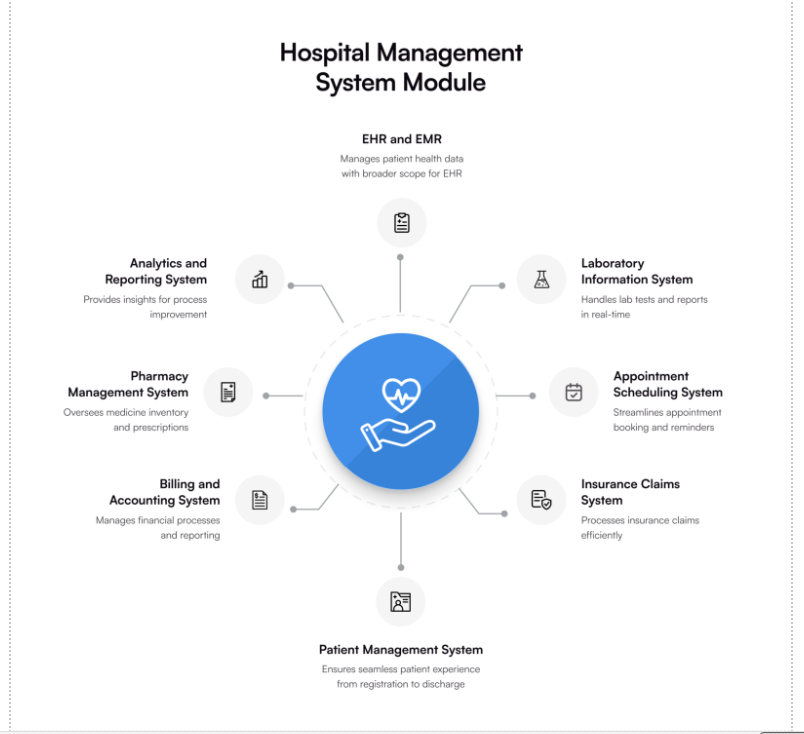
A comprehensive hospital management system is a software solution that entails various components, solving different problems in managing operations. From scheduling appointments to managing medical inventory, there are diverse modules that streamline everything. Let’s understand these modules to develop a robust hospital management system.  

EHR and EMR 

Electronic Medical Records (EMR) and Electronic Health Records (EHR) are two widely used platforms across healthcare organizations. An EHR is a software that helps store and retrieve data related to a patient’s health information, such as medications, lab reports, medical history, diagnoses, and more.  

While an EHR is shared among multiple healthcare providers, an EMR is managed by a single healthcare entity to store, process, and handle patients’ data. Although both do the same function, store and manage patients’ information, EHR has a broader scope.  

Laboratory Information Management System 

Another important module of a hospital management system is the laboratory information management system. This module handles operations related to lab tests, reports, sample collection, and more. It provides real-time for test reports and helps track tests.  

Appointment Scheduling System 

An appointment scheduling system makes booking appointments smooth and hassle-free. With the use of this platform, patients can conveniently book, reschedule, or track appointments. They also get reminders for appointments.  

System to Manage Insurance Claims 

Faster processing of insurance claims is crucial for efficient patient care. This module of a hospital management system streamlines insurance-related processes, minimizing time in treatment and improving patient experience.  

Patient Management System 

This module deals with all the information related to patients. From faster registration to quick admission, this module plays a vital role in ensuring a seamless patient experience. It handles all information related to patient treatment, billing, admission, discharge, etc.  

Billing and Accounting System 

This module helps manage everything related to healthcare billing and accounting. It helps handle invoicing and payment processing. It helps collect data precisely and helps prepare more accurate financial reports.  

Pharmacy Management System 

This module deals with information related to medicine inventory, dispensing, managing prescriptions, and more. This module is vital to ensure a proper stock of various medicines and to dispense the right drugs.  

Analytics and Reporting System 

With this module, a hospital or healthcare provider can get a bird’s eye view of different processes and how efficient they are. It provides data and reports that help identify gaps in processes for improvements. They also help leaders make informed decisions. 

Essential Features for Hospital Management System Development 

Developing hospital management software requires careful planning and execution. You need to understand your organization’s needs to implement the right features. Moreover, the following is a list of the essential features for an HMS.  

  • Appointment Scheduling: This will allow patients to book appointments and get alerts. They can also track progress to reach on time.  
  • Outpatient Registration: This feature ensures that patients who are not already admitted to the hospital can register for treatment or admission. 
  • Reporting: With this feature, patients will be able to access their lab test reports and other documents. 
  • Prescription Management: This will provide a single interface to manage prescriptions created by doctors. 
  • Data Security: Robust security features are essential for protecting patient data. This requires the implementation of encryption, access control, HTTPS, and other security measures. It should also be compliant with HIPAA regulations.  
  • Billing: This feature automates the processing and compilation of payment-related information.  

Final Thought 

Manual processes in hospitals and other healthcare centers are costing them both time and money. This also results in a higher turnaround time for patient care, which is risky for a critical field like healthcare. Therefore, they are now leveraging diverse technologies to boost their efficiency and processes.  

Increasing investments in custom healthcare solutions are a testimony to this change. However, they need the right custom healthcare software development services to make their transformation journey smooth and hassle-free. This is where Galaxy Weblinks steps in. We are a leading digital transformation service provider helping organizations in healthcare and other industries build robust software solutions to enhance and scale up their operations.  

We can help healthcare providers build a cutting-edge hospital management system tailored to their unique requirements. Our development team has experience in developing a wide range of healthcare solutions. We can develop a secure, scalable, and industry-compliant HMS solution for you.  

Contact us for further discussions and queries.  

Frequently asked questions 

How much does it cost to develop a hospital management system? 

The cost of developing a healthcare management system can vary depending on the project requirements, complexity, third-party integrations, features, and more. However, the typical range for the cost is $45,000 – $200,000 or more, depending on the project scope.  

What kinds of challenges can we face in developing an HMS?  

There are a few challenges that may arise in hospital management system development, like legacy systems, outdated tools, regulatory compliance, and cybersecurity.  

Is a custom HMS better than an off-the-shelf HMS? 

Well, the answer to this question mainly depends on your requirements and organization. While a custom HMS solution is best, it offers specific features and fits well with your organization’s existing processes since it’s tailored to it; however, it requires more time and investment to implement. On the other hand, an off-the-shelf HMS is readily available and can be implemented quickly, but lacks organization-specific features and may not fit your processes properly.  

The Role of AI in Telemedicine: From Diagnosis to Treatment

Imagine you woke up with a sudden & unusual headache, and to cure this pain, you simply logged into an app, described your symptoms, and then? Next, you see yourself interacting with an AI-powered expert, who suggests the next steps. 

Well, all of this sounds futuristic, right?

But what if we tell you this is actually a reality, far away from the future? Yes, it’s true, and this is the present reality of telemedicine. In recent years, the telemedicine landscape has accelerated and is growing at an unprecedented rate. 

According to Fortune Business Insights, the global telemedicine market size is expected to reach $334.80 billion by 2032. Behind all this expansion, AI development is one of the biggest driving forces. With the help of artificial intelligence, you can not only enable faster diagnosis but also provide personalized treatment plans and much more. 

The role of AI in telemedicine isn’t just making everything convenient, but smarter. In this blog, we’ll walk you through the 10 powerful and effective ways AI in the telemedicine market is redefining the future of the healthcare ecosystem. 

AI in the Telemedicine Industry: Top Breakthroughs You Need to Know

Incorporating AI into telemedicine is a step closer to revolutionizing the healthcare industry as a whole, making it more accessible, improving individualized care, and much more. The future of AI in telemedicine is bright, ultimately closing the gaps between patients and healthcare professionals.

Let’s have a look at the different ways telemedicine and AI in healthcare are going hand-in-hand and making access to care much easier than ever. 

  1. AI-Powered Virtual Assistants and Chatbots

What if you need urgent medical advice from a doctor at midnight, and you instantly get it from AI-powered chatbots or virtual assistants? With time, AI-driven tools are becoming sophisticated than ever, where virtual assistants can provide you with immediate support. From booking appointments & answering basic queries to giving medicine reminders to patients, AI chatbots have become the first touchpoint in telemedicine. 

  1. Predictive Analytics for Preventive Care

What do you think is much better: reacting after any health issue strikes or predicting it and taking action beforehand? Obviously, the second option sounds much more useful. That being said, AI can help you with the same by understanding patients’ medical history and forecasting risks, like diabetes or hypertension. This way, you can reduce the possibilities of high-risk situations and get a doctor’s attention at an early stage. 

  1. Remote Patient Monitoring with AI

Smartwatches have always been in trend for many reasons, but tracking real-time activity or the count of your steps remains at the top. With AI-enabled RPM, you can trigger a warning and go see your doctor before anything major happens. Wearables and IoT devices in real-time help in analyzing the data, and later, AI detects the unusual activities and alerts the person instantly. 

  1. AI-Assisted Diagnostics & Imaging

IMAGINE: You sent an X-ray to an online platform assisted with AI capabilities and received a diagnosis at lightning speed. Sounds unrealistic, right? But with the presence of artificial intelligence, anything & everything is possible because its models are trained on medical images. Later, these future-ready technologies flag potential concerns with high accuracy by supporting tele-radiologists or dermatologists. 

  1. Personalized Treatment Plans

AI-powered telemedicine equipment should, in general, offer individualized treatment plans for precise treatment planning. Patients may effortlessly traverse every stage, whether they are examining their therapy or consulting a doctor, thanks to a well-crafted UI/UX design. AI-powered customisation can be expanded to examine daily routines and historical medical data, providing individualized treatment regimens.

  1. NLP for Clinical Notes

Doctors say, “The best part is the time spent with patients, not the paperwork.” AI-driven NLP tools are now able to listen and take notes automatically and produce structured notes/documents and summaries (for example, prescriptions) during teleconsultations. It provides as close to a real assistant as possible and allows clinicians to focus on patients rather than typing.

  1. Fraud Detection in Telehealth

In the healthcare industry, security is the key to maintaining the user’s trust while they share their personal information. AI-powered systems are well-trained to identify any unusual activity, like strange billing patterns, information theft, or more. AI in the telehealth and telemedicine market gives innovative solutions that help improve patient safety. In short, the integration of AI in the telemedicine market has significantly improved fraud detection and delivered a seamless user experience. 

  1. Symptom Checkers and Smart Triage Systems

Picture that as a digital nurse who is available 24/7. AI triage systems could ask questions in a structured manner to patients, evaluate the signs and symptoms associated with an illness, and determine whether the patient can self-manage, see their family doctor, or go to the emergency department. Thus, the opportunity to avoid unnecessary visits to emergency rooms, with less chance that a legitimate emergency would be missed.

  1. AI in Mental Health Teletherapy

How great you’d feel if you could talk to someone who could sense your mood instantly? AI is like that; It feels like having a personal therapist anywhere and at any time you want. By simply analyzing your tone, choice of words, or even the type of emojis you have used. After receiving such insights, therapists can easily identify the early signs of stress, anxiety, or depression, and provide the support you need. 

  1. Drug Discovery and Tele-Pharmacy Integration

Drug discovery may not come to your mind when you think of “telemedicine,” but artificial intelligence is making the connections. AI is used by telepharmacy platforms to check for interactions and guarantee the safety of prescriptions, while machine learning models aid in the quicker identification of new medication compounds. Without having to enter a pharmacy, patients can obtain medication more quickly and safely.

  1. Operational Efficiency in Telemedicine Platforms

AI is the silent optimizer that works in the background. It improves the efficiency of telemedicine systems by predicting no-shows, reminding patients, and intelligently allocating doctors according to the complexity of the case. The outcome? Reduced patient wait times and improved physician time management.

What is the Future of AI in Telemedicine

AI in the Telemedicine

The integration of AI in telemedicine can (or will) never replace professional doctors or physicians; it will just double their power, while assisting patients in a timely manner. 

If we look in another direction, the future of AI in the telemedicine market will incline more towards a hybrid approach. That means, doctors will concentrate on empathy, complex cases, and decision-making, whereas AI will do the heavy-lifting, like data analysis, symptom triage, etc. 

In a nutshell, the future of AI in telemedicine is a combination of cutting-edge technology, wider access, and better security protocols. AI being at the forefront will continue to make the healthcare industry modern and convenient. 

Build Your First-Ever Smarter Telehealth Platform with Galaxy Weblinks

The future of digital healthcare looks promising than ever – all thanks to the integration of AI in telemedicine. From diagnostics to helping with real-time monitoring, AI has transformed the landscape of the healthcare sector, making it more accessible, efficient, and personalized. 

However, if you truly want to leverage the potential of AI in the telehealth and telemedicine market, you need custom healthcare software development services to build a tailored solution. A skilful and experienced team that can understand your vision and turn it into reality. 

At Galaxy Weblinks, we have a pool of the right technology partners who can bring their expertise to the table and meet your expectations. They will help you build a scalable and secure telehealth platform. We’ll craft highly intuitive interfaces while ensuring necessary compliance to make your app safe & secure. 

Partner with us and build your dream telemedicine platform now!

FAQs

1. In what ways is AI enhancing telemedicine for patients?

AI makes telemedicine more accessible by providing instant triage, precise diagnosis, and customized care. Patients enjoy faster consultations, proactive health monitoring, and intelligent suggestions—all without ever having to leave their homes.

2. Can AI substitute doctors in telemedicine?

No, AI is not replacing doctors—it complements their abilities. AI performs routine tasks such as documentation, symptom interpretation, and monitoring, while doctors concentrate on high-order decision-making, empathy, and patient care, leading to improved outcomes for both providers and patients.

3. Is telemedicine AI safe and reliable?

Yes, when responsibly developed. Agencies such as the FDA and EU make certain that AI technologies adhere to rigorous safety, compliance, and accuracy protocols. Under proper regulation, AI in telemedicine is extremely reliable and on an upward trajectory of improvement.

4. What are some real-world examples of AI in telemedicine?

From AI-scheduling appointment chatbots to AI readers of X-rays and heart arrhythmias detected by wearables, numerous telemedicine platforms already apply AI on a daily basis. It accelerates healthcare, makes it more accessible, and more patient-focused.

5. What is the future of AI in telemedicine?

The future holds smarter telehealth applications that forecast health threats, link patients worldwide with experts, and provide hyper-personalized treatment. Thanks to continuous innovation, AI has the potential to turn telemedicine into the norm through which people receive healthcare globally.