A Complete P2P Payment App Development Guide: Key Features, Process, Cost, and More

Money moves differently now. Not slowly. Not through paperwork. Just quick taps on a phone.

Someone pays the dinner bill. Another person sends rent. A friend transfers money for a birthday gift. Seconds later, done. No bank visit. No waiting.

That’s the quiet power of P2P payment apps. And people are using them everywhere.

The global P2P payment market is expected to reach $21.42 billion by 2030, growing at a CAGR of 7.2%. That number alone tells you something important. Users don’t just like digital payments anymore; they expect them.

Instant transfers. Clean interfaces. No friction. For fintech startups, banks, and even non-financial businesses, this shift opens a big opportunity. But it also raises a practical question.

What does it actually take to build a P2P payment app people trust?

Because building one is not just about coding a transfer button. It’s about security. Compliance. Infrastructure. User psychology. And a lot of careful decisions in between.

So before jumping into development, first understand its basics:

How these apps work. Why users rely on them. And what features they now consider non-negotiable.

What Is a P2P Payment App?

At its simplest, a P2P payment app lets people send money directly to other people. No middlemen handling paperwork. No long processing times. Just a direct transfer from one account to another.

Usually, the process is simple:

  • Enter a phone number.
  • Choose a contact.
  • Scan a QR code.
  • Confirm the amount.

Done.

Behind that simplicity, though, a lot is happening. Bank integrations. Payment networks. Security checks. Identity verification. All working quietly in the background. What makes P2P payment transfer apps so powerful is how they remove the friction that used to exist in financial transactions.

As a result, Geography becomes less important. Banking hours stop mattering. And even small payments become effortless.

How Do P2P Payment Apps Work?

From the outside, a P2P payment app feels almost too easy.

Tap > Enter amount > Send > Money transferred and done.

But under the surface? A lot is happening. Quietly. Very fast. Good P2P payment app development hides the complexity. Users only see the smooth part. The frictionless part. The part that feels like sending a text message.

But when companies plan to build a P2P payment app, they must understand the full transaction flow. Every step matters. Security. Infrastructure. Banking rails. Compliance.

Let’s slow it down a little.

  • Account Linking

Every P2P payment transfer app starts here. Users connect a funding source. Usually: bank account, debit card, credit card, or a digital wallet. 

During this step, the platform also verifies the user. Sometimes quickly. Sometimes with extra checks. Depends on regulations.

You’ll usually see things like:

  • OTP verification.
  • Phone number validation.
  • Email confirmation.
  • Sometimes, biometric checks.

And then there’s KYC verification. This part is important. Financial platforms must confirm the user’s identity before allowing transactions.

Yes, it adds friction. But skipping it? Not an option.

  • Authentication

Now comes the security layer. A serious P2P payment app cannot rely on just passwords. Too risky. Too outdated. So most apps add extra authentication layers like: Fingerprint login. Face recognition. Device-based verification. Or OTP security.

Some platforms even track device behavior. Sounds complicated. But users barely notice. They just feel protected. And honestly, when money is involved, that reassurance matters.

  • Payment Initiation

This is the part users actually interact with. The sender chooses the recipient. Simple options usually work best: Phone number. Username. Saved contacts. QR code scanning.

Good P2P payment app development makes this step feel natural. Almost casual. Like sending a chat message. No confusion. No complicated forms.

Just select → enter amount → confirm. Done.

The smoother this step feels, the more people use the app. That’s why UX design plays a huge role when businesses build a P2P payment app. Finance should not feel intimidating.

  • Transaction Processing

Now the invisible systems take over. As soon as the user confirms the payment, the app encrypts the transaction data. Immediately. Then the request travels through: Payment gateways. Banking APIs. Card networks. Real-time payment infrastructure.

Depending on the region, the transfer may settle instantly. Or within minutes. Some countries support real-time clearing networks. Others rely on near-real-time settlement. This is one of the most technically demanding parts of P2P payment app development.

Integrations must be reliable. Scalable. Secure. Because if transactions fail, users panic. And they instantly uninstall the app.

  • Fraud Detection

While the payment travels through the network, something else is happening quietly. Fraud monitoring. Modern P2P payment platforms constantly scan transactions in real time. They watch for unusual patterns.

For example: Sudden high-value transfers. Multiple payments in seconds. Login attempts from strange locations. New devices are sending money immediately.

If something feels suspicious, the system may pause the payment. Or request extra verification. Most users never notice these systems. Which means they’re working perfectly.

  • Confirmation and Transaction Records

Once the payment clears, the system sends confirmation to both users. Usually through: Push notifications. In-app transaction updates. Payment receipts. These confirmations matter more than people realize.

When money moves, people want certainty. Not assumptions. Not guesswork. So a good P2P payment transfer app always shows:

  • Transaction history.
  • Time stamps.
  • Payment IDs.
  • Sender and receiver details.

In short, transparency builds trust. And trust is the real currency of digital payments. What actually powers a P2P payment app? Users see a simple interface. That’s intentional. All synchronized. And all working in milliseconds.

This is why companies planning to build a P2P payment app often partner with experienced fintech development teams. The architecture is deeper than it looks.

Key Features Users Expect in P2P Payment App

User expectations in the finance industry are unusually high, and understandably so. When people trust an app with their money, tolerance for friction drops dramatically.

  • Instant Transfers

Speed is foundational. Whether the transfer happens in seconds or minutes, users expect minimal delay and clear confirmation once funds move.

  • Strong Security Measures

Biometric login, end-to-end encryption, and fraud monitoring are no longer premium features. They are baseline requirements.

  • Simple Onboarding

Lengthy registration flows often lead to drop-offs. The strongest apps streamline verification without weakening compliance.

  • Contact-Based Payments

Sending money should feel natural. Phone numbers, usernames, or QR codes eliminate the need for memorizing account details.

  • Transparent Transaction History

Users want visibility. Clear records build confidence and simplify personal finance tracking.

  • Notifications in Real Time

Immediate alerts reassure both sender and receiver that the transaction has been completed.

  • Split Payments

From shared travel expenses to group dinners, built-in splitting features reduce awkward calculations and follow-ups.

  • Multi-Bank Support

Flexibility strengthens adoption. Users prefer platforms that integrate smoothly with multiple financial institutions.

Individually, these features improve usability. Together, they create trust, the currency every fintech platform depends on.

Types of P2P Payment Apps

Not all P2P platforms operate the same way. Their structure often reflects the audience they intend to serve.

  • Bank-Centric Apps

These apps are usually developed by traditional banks or large financial institutions. Stability comes first. Compliance too. Everything is tightly aligned with financial regulations. Users tend to trust these P2P payment apps quickly. 

Why? 

Because the bank already holds credibility. People are already familiar with the brand. That trust shortens the adoption curve. Most bank-centric platforms focus on secure domestic transfers, account-to-account payments, and seamless bank integrations.

  • Standalone Wallet-Based Apps

This is where many fintech startups operate. These digital wallet P2P payment apps allow users to store funds directly inside the platform before transferring money. 

The experience feels flexible. Fast. Sometimes even fun. Beyond basic transfers, these platforms often add features like rewards programs, merchant payments, cashback offers, or small micro-transactions.

  • Social Payment Apps

This category mixes finance with communication. Which sounds unusual at first, but users actually love it.

A social P2P payment app allows people to send money while interacting with friends. Users may attach notes, emojis, comments, or even public payment feeds. Transactions start to feel conversational.

  • Cross-Border Payment Platforms

Then there are platforms built for international money movement. A completely different challenge.

These cross-border P2P payment apps focus heavily on currency exchange, compliance across countries, and transaction cost efficiency. Sending money globally requires more infrastructure. More regulation. More security layers.

How to Build a P2P Payment App

Building a P2P payment app is not just a coding project. A lot of people assume that, actually. Write some code. Connect a payment gateway. Launch the app. Done.

Not really.

Real P2P payment app development includes strategic thinking. Sometimes time-taking. It touches compliance, banking infrastructure, UX psychology, and security architecture, all at once.

Let’s walk through it:
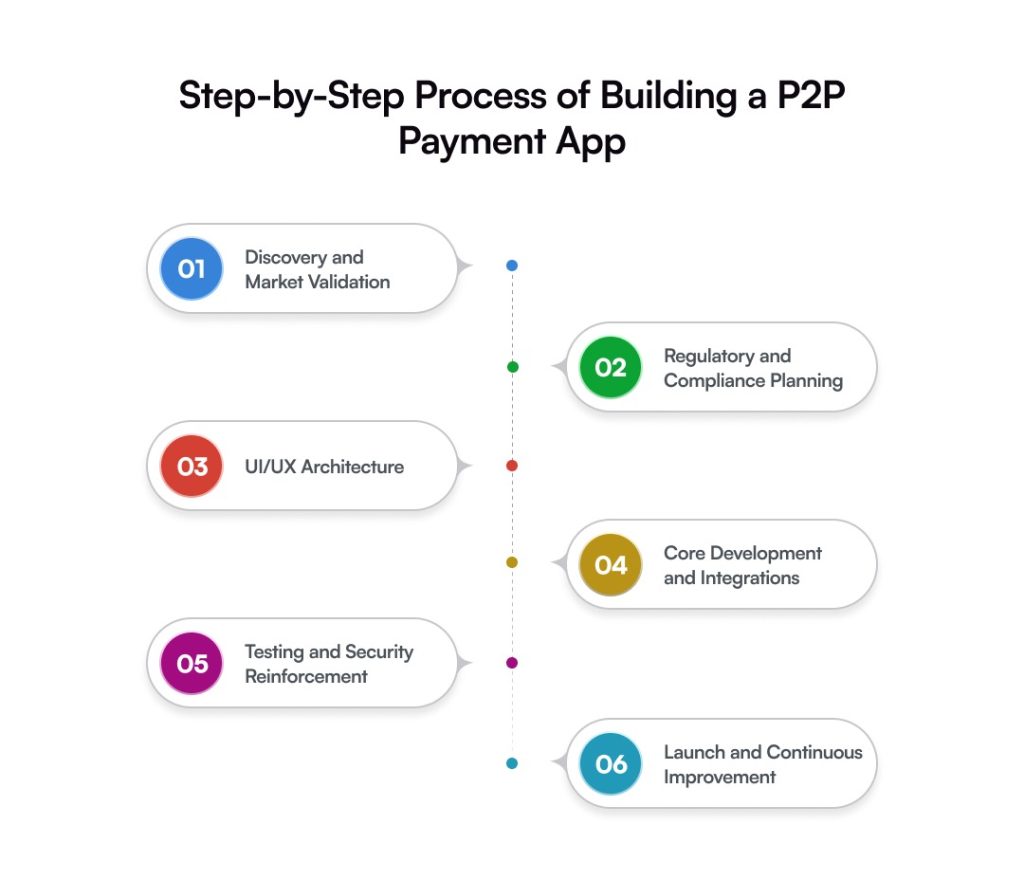
  1. Discovery and Market Validation

Every successful P2P payment app development project begins with clarity.

Simple questions first.

  • Who are the users? Students? Freelancers? Businesses?
  • Local payments or global transfers?

Then the harder question: Why would someone use this app instead of the ten others already available?

This stage often involves: Market research. Competitor analysis. User behavior studies. Business model definition. Because yes, P2P payment transfer apps exist everywhere now. But usage patterns change depending on geography.

Understanding these patterns early helps companies build a P2P payment app that actually fits the market. Skipping this stage usually leads to expensive pivots later.

  1. Regulatory and Compliance Planning

This is the part many startups underestimate. Finance is not like other apps. You cannot just launch and “figure it out later”. Every P2P payment app development project must address regulations from the beginning.

That includes things like:

  • KYC (Know Your Customer) verification
  • AML (Anti-Money Laundering) protocols
  • Data protection laws
  • Financial licensing requirements

Depending on the region, these rules can change significantly. Some countries require strict identity checks. Others impose transaction limits. Some require partnerships with licensed banks.

Compliance isn’t a small step at the end. It’s architectural. If ignored, the entire P2P payment app launch can get delayed. Or worse, blocked. And credibility? That’s very hard to recover once damaged.

  1. UI/UX Architecture

Now comes the user experience. When money moves, people become cautious. Even small confusion can create chaos.

That’s why good P2P payment app development services focus heavily on UI/UX design. User journeys must feel obvious. Not complicated. Not cluttered. Just clear.

The best P2P payment apps focus on reducing steps. A payment flow might look like this:

Select contact > Enter amount > Confirm payment.

That’s it. But behind that simplicity sits careful design thinking. Confirmation screens. Transaction receipts. Error handling. Clear feedback. Good fintech UX is rarely flashy.

  1. Core Development and Integrations

Once the strategy and UX are ready, the real P2P payment app development work begins. Developers start building the core infrastructure. This usually involves integrating several financial systems, such as:

  • Payment gateways
  • Banking APIs
  • Identity verification services
  • Fraud monitoring tools
  • Encryption protocols

These integrations power the P2P payment transfer app behind the scenes. At the same time, engineers build the backend architecture that handles transactions, user data, and payment requests. Scalability becomes critical here. 

An app that works for 10,000 users should still perform smoothly at 100,000 users. Or even a million. Because when payment platforms grow quickly, and they often do, weak infrastructure becomes painfully visible.

  1. Testing and Security Reinforcement

Before launch, the app is pushed to its limits.

Teams simulate transaction spikes, unstable networks, device variations, and potential fraud scenarios. Security audits run alongside performance testing to ensure resilience. Because in fintech, trust is fragile and difficult to rebuild once lost.

  1. Launch and Continuous Improvement

Launching the app feels exciting. But it’s not the end. Honestly, it’s the beginning. Once users start interacting with the P2P payment app, real insights appear. Analytics reveal friction points. Drop-offs show where users get confused. Support requests highlight missing features.

This feedback loop helps teams improve the platform continuously. New security threats emerge. Payment behaviors evolve. Financial regulations change. The best companies treat P2P payment app development as an ongoing process, not a one-time project.

They iterate. Improve. Adapt. Because the digital payments landscape moves fast. And the apps that survive long-term are the ones that keep evolving.

Security & Compliance Requirements in P2P App Development

In most apps, security is important. In fintech, it is foundational.

Users are not just sharing data; they are trusting the platform with their money. One vulnerability can undo years of credibility. That is why security must be embedded into the architecture from the very beginning, not layered on after development.

  • Regulatory Compliance

Financial ecosystems operate under strict regulatory frameworks that vary by region. Depending on your target market, requirements may include:

  • KYC (Know Your Customer): Verifies user identities to prevent fraud.
  • AML (Anti-Money Laundering): Detects suspicious transaction patterns.
  • GDPR or data protection laws: Ensure responsible handling of personal information.
  • PCI DSS compliance: Mandatory for platforms processing card payments.

Compliance may feel like friction during development, but it protects the business from far greater disruption later.

  • Encryption and Data Protection

Sensitive information should never travel unprotected.

End-to-end encryption, tokenization, and secure key management help ensure that even if data is intercepted, it remains unreadable.

Many platforms also adopt zero-trust architectures, where every access request is verified, regardless of origin.

  • Multi-Factor Authentication

Passwords alone no longer provide adequate protection.

Combining authentication layers, OTPs, biometrics, or device-based verification dramatically reduces unauthorized access risks.

From a user perspective, these steps signal seriousness. Security features often double as trust signals.

  • Fraud Detection Systems

Modern P2P payment apps rely heavily on intelligent monitoring tools that flag unusual behavior in real time.

For example:

  • Rapid transaction spikes
  • Logins from unfamiliar locations
  • Suspicious payment patterns

Early detection allows platforms to intervene before damage occurs.

  • Continuous Security Audits

Threat landscapes evolve constantly. What is secure today may become vulnerable tomorrow.

Regular penetration testing, code reviews, and infrastructure audits help platforms stay ahead of emerging risks.

Because in digital finance, prevention is always cheaper than recovery.

How Much Does It Cost to Build a P2P Payment App

This is often the first question stakeholders ask, sometimes before the idea is fully formed.

“How much will it cost?”

The honest answer: it depends on what you are building, who you are building it for, and how ambitious the platform is meant to become.

Scope defines effort. Effort defines investment.

Let’s look at realistic ranges.

  1. MVP Development ($30K – $60K)

This is the starting line for many startups.

An MVP development focuses strictly on core capabilities:

  • User registration and verification
  • Bank or card linking
  • Secure money transfers
  • Transaction history
  • Basic notifications
  • Admin controls

Design remains clean but practical. Integrations stay limited to reduce complexity. The goal here is not perfection; it is validation. Real users. Real transactions. Real feedback. Launching lean allows businesses to learn before scaling.

  1. Mid-Level App ($60K – $120K)

Now the platform begins to mature.

Expect stronger UI/UX refinement, faster navigation, expanded payment options, and improved dashboards. Security layers grow deeper. Infrastructure becomes more resilient.

Additional capabilities may include:

  • Split payments
  • Advanced fraud detection
  • Multi-bank integrations
  • Enhanced analytics
  • Customer support modules

This range often suits growing fintech companies preparing for broader adoption.

  1. Advanced Platform ($120K+)

At this level, the product is built to lead rather than follow.

Architecture is deeply scalable. Compliance frameworks are robust. Automation supports operational efficiency.

Advanced platforms may introduce:

  • AI-driven fraud monitoring
  • Cross-border payments
  • Multi-currency support
  • Predictive analytics
  • Open banking integrations

While the upfront investment is higher, these systems often reduce operational friction over time and position the business for long-term growth.

Hidden Costs Businesses Should Anticipate

Many teams plan for development but underestimate what follows.

Common post-launch expenses include:

  • Ongoing maintenance and updates
  • Cloud infrastructure scaling
  • Security audits
  • Regulatory renewals
  • Customer support operations

Budgeting for these early prevents unpleasant surprises later.

One important perspective: the cheapest build rarely becomes the most economical in the long run. Stability, security, and scalability deliver far greater returns than short-term savings.

When money moves through your platform, reliability becomes your brand.

And that is always worth investing in.

Major Challenges While Building a P2P App

Building a P2P payment app is as much about risk management as it is about innovation. The opportunity is substantial, but so is the responsibility.

Here are some of the most common hurdles businesses encounter.
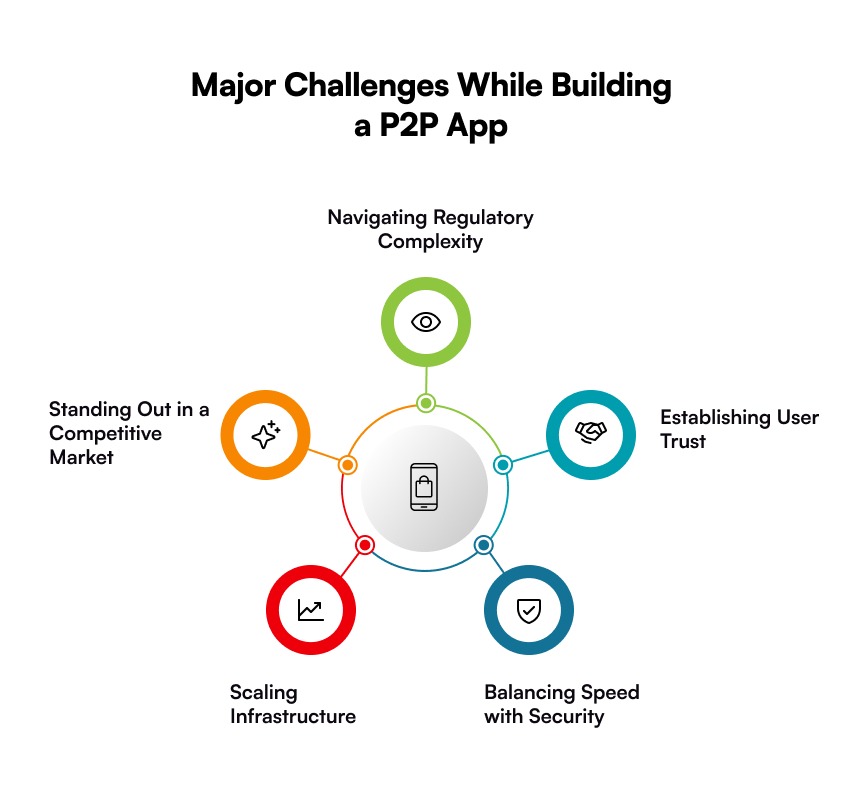
  • Navigating Regulatory Complexity

Financial regulations differ across regions and evolve frequently. Licensing, KYC mandates, AML requirements, and data protection laws demand ongoing attention.

Compliance is not a one-time milestone. It is a continuous operational commitment. Ignoring it can delay launches or worse, invite legal exposure.

  • Establishing User Trust

People hesitate before trusting a new platform with their money. And rightly so. A single failed transaction or security scare can push users toward competitors permanently.

Trust is built through consistency:

  • Reliable uptime
  • Transparent communication
  • Visible security measures
  • Fast dispute resolution

Fintech loyalty is fragile but incredibly valuable once earned.

  • Balancing Speed with Security

Users want instant transfers. Security protocols, however, require careful verification. Striking the right balance is critical. Too many checks create friction. Too few create vulnerability. The strongest platforms make security feel seamless rather than obstructive.

  • Scaling Infrastructure

Transaction spikes rarely arrive with warning; festive seasons, promotional campaigns, or viral adoption can strain systems overnight.

Without a scalable architecture, performance suffers. And in payments, even a few seconds of delay can trigger user anxiety. Planning for growth before it arrives is always cheaper than rebuilding afterwards.

  • Standing Out in a Competitive Market

The fintech space is crowded. New entrants compete not only with startups but also with established banks and global payment giants. Differentiation often comes down to experience, smoother onboarding, smarter features, and faster support.

Technology alone rarely wins. Execution does.

P2P Payment App Monetization Strategies: How These Platforms Generate Revenue

A P2P payment app may begin as a convenience tool, but sustainable growth depends on a clear revenue model.

Interestingly, many successful platforms monetize quietly, ensuring the user experience never feels transactional.

  • Transaction Fees

A small fee on instant transfers, credit-based payments, or cross-border transactions can generate steady revenue without overwhelming users.

The key is transparency. Hidden charges erode trust quickly.

  • Merchant Services

Once adoption grows, enabling businesses to accept payments through the platform opens a powerful revenue stream.

Merchant partnerships often lead to:

  • Processing fees
  • Subscription models
  • Value-added services

It transforms the app from a payment tool into a commerce enabler.

  • Premium Features

Some users are willing to pay for convenience, faster transfers, advanced analytics, higher limits, or enhanced security controls. A freemium model allows broad adoption while creating optional upgrade paths.

  • Interest on Wallet Balances

When users store funds within the platform, those balances can generate interest depending on regulatory allowances. Individually small. Collectively meaningful.

  • Financial Ecosystem Expansion

Over time, many P2P apps evolve into broader financial hubs offering lending, insurance, investments, or budgeting tools. The strategy is simple: once trust is established, adjacent services feel natural. Revenue follows engagement.

Future Trends in P2P Payment Apps

The next phase of P2P payments will not just be faster, it will be smarter, more embedded, and increasingly invisible.

  • AI-Driven Fraud Prevention

Machine learning models are already improving threat detection by identifying suspicious behavior before transactions finalize. Security is shifting from reactive to predictive.

  • Biometric Authentication

Passwords are gradually giving way to fingerprint scans, facial recognition, and behavioral biometrics, reducing friction while strengthening protection. Convenience and security are finally aligning.

  • Embedded Finance

Payments are moving beyond standalone apps into marketplaces, ride-sharing platforms, creator ecosystems, and social environments. Soon, users may not even think of it as a “payment.” It will simply be part of the experience.

  • Cross-Border Simplicity

Global workforces and digital commerce are increasing the demand for low-cost international transfers. Platforms that simplify currency exchange and compliance will gain a strong competitive edge.

  • Open Banking Expansion

As financial institutions expose APIs, fintech platforms gain deeper access to banking capabilities, unlocking innovation that was difficult just a few years ago. Collaboration is quietly replacing competition.

Concluding Words

Building a P2P payment app is not just another software project. It’s bigger than that. A strategic move, actually. Finance, security, infrastructure, and user experience all come here. And yes, scalability too. Because if the platform grows, the system must grow with it. No excuses.

Companies often jump in thinking P2P payment app development is mainly about coding a payment feature. It isn’t. Not even close. It’s about building trust. 

For businesses thinking about entering this space, the opportunity is huge. Digital payments keep expanding. Fintech adoption keeps accelerating. But success doesn’t happen by accident. Companies need a clear strategy. 

This is where working with an experienced P2P payment app development company becomes critical. Not just developers. Real fintech specialists who understand payment infrastructure, banking APIs, fraud prevention, compliance requirements, and the whole system.

At Galaxy Weblinks, we work with businesses that want to build serious fintech products. Not experiments. Not half-ready apps. We help organizations design and develop secure, scalable P2P payment apps built for real-world usage. 

If you’re exploring how to build a P2P payment app or thinking about upgrading an existing digital payment platform, the right development partner can shorten the journey. Less risk. Faster execution. Stronger architecture.

Because launching a fintech product isn’t just about technology. It’s about confidence.

FAQs

1. How long does it take to build a P2P payment app?

Timelines vary based on complexity. A focused MVP may take around 3–6 months, while advanced platforms with deeper integrations can extend beyond that. Structured planning often saves more time than rushing development.

2. Is regulatory compliance mandatory for P2P apps?

Absolutely. Financial platforms must adhere to regional regulations such as KYC, AML, and data protection standards. Compliance protects both the business and its users.

3. Should startups begin with an MVP?

In most cases, yes. An MVP allows businesses to validate demand, gather real user feedback, and refine the product before committing to large-scale investment.

4. What is the most critical feature in a P2P payment app?

Security. Without it, adoption stalls. Users need confidence that their data and money are protected at every step.

5. Can a P2P payment app scale as the user base grows?

Yes, provided scalability is planned early. Cloud infrastructure, modular architecture, and strong backend systems ensure the platform can handle increasing transaction volumes smoothly.

6. How do businesses choose the right development partner?

Look beyond coding ability. Evaluate fintech experience, regulatory understanding, architectural thinking, and post-launch support. A strong partner does more than build; they guide strategic decisions.


How AI in Travel is Transforming Airlines, Hotels & Tourism Platforms

Travel relied on fixed systems for years. Legacy booking engines. Static pricing grids. Manual forecasts are built on historical averages. It worked. Until volatility became constant.

Complexity increased. Competition intensified. Airlines began mirroring each other’s pricing logic. Hotels delivered similar packages. Differentiation narrowed. Margins tightened. Loyalty became fragile.

At the same time, traveler expectations accelerated.

The integration of AI is no longer peripheral in travel operations. It is moving into revenue management, customer engagement, and service optimization. The global AI in travel market is projected to exceed $138.8 million by 2030. Growth at that magnitude indicates structural transformation, not isolated pilots.

Hospitality investment reflects the same urgency. The AI segment within tourism and hospitality is expanding at close to 30 per cent CAGR through 2026. Organizations are embedding personalization engines, predictive analytics, and automated support layers. Purposeful adoption. Not experimentation.

Traveler behavior is shifting in parallel. A substantial share of U.S. travelers already use AI-driven tools for planning and comparison. That being said, AI in travel is becoming foundational infrastructure. It shows clear signs of businesses in the travel industry moving towards AI development for a sustainable future.  

In this guide, you will examine how AI is transforming airlines, hotels, and tourism platforms. And the real business impact AI is creating in the travel industry. Along with top use cases, and much more. 

What Is AI in Travel?

AI in travel refers to the strategic use of artificial intelligence to improve how travel companies operate, price, and engage customers. It extends beyond basic automation. The system learns from data. It identifies patterns. It supports decisions with limited manual input.

At an operational level, AI evaluates booking history, pricing fluctuations, seasonal demand, and traveler preferences. It adjusts fares dynamically. Recommends relevant offers. Forecasts occupancy and route demand with greater precision. The goal is clearer forecasting. Fewer assumptions.

With AI in travel and tourism, adoption spreads across the ecosystem. Airlines apply it to route planning and disruption management. Whereas, AI in hospitality use it to personalize guest interactions and anticipate occupancy changes. Digital travel platforms integrate conversational systems that assist users during search and booking.

Most of this intelligence operates in the background. Machine learning models refine outcomes continuously. Natural language processing supports responsive chat systems. Predictive analytics detects demand shifts before they become visible trends.

AI in Airlines: Operational Intelligence & Revenue Growth

Airlines operate under constant pressure. Margins remain thin. Disruptions escalate quickly. One delay affects multiple routes. One pricing error impacts thousands of seats.

This is where AI in travel begins to matter in practical terms.

It improves operational control. Strengthens revenue management. Supports customer engagement without expanding costs at the same rate.

The shift is measurable.

  1. Predictive Maintenance & Fleet Optimization

Aircraft produce continuous performance data. Engine temperature. Component stress. Fuel patterns. AI systems analyze these signals in real time. They detect irregularities early. Maintenance becomes predictive rather than reactive.

Unexpected groundings reduce. Repair cycles become more controlled. Fleet availability increases. AI also optimizes aircraft allocation. It evaluates route demand, turnaround efficiency, utilization ratios. Scheduling improves. Asset productivity rises.

  1. Dynamic Pricing & Revenue Management

Airfare pricing changes rapidly. Demand fluctuates daily. Competitor adjustments occur within minutes. AI-driven revenue platforms assess booking velocity. Historical demand. Seasonality, and external variables simultaneously. Pricing adapts continuously.

Seats are valued based on demand probability, not static categories. Load factors improve. Yield per passenger strengthens. Revenue leakage declines. With AI in travel and tourism, pricing optimization often delivers early, visible return on investment.

  1. AI-Powered Customer Service & Chatbots

Passenger expectations have evolved. Response time now influences loyalty. AI-powered chat interfaces manage booking changes, flight updates, baggage queries, and disruption support instantly. Natural language systems interpret context. Responses feel more precise.

During operational disruptions, AI scales without delay. High inquiry volumes remain manageable. Operational strain decreases. Customer satisfaction stabilizes. Brand trust improves gradually but consistently.

AI in Hotels: Hyper-Personalization & Smart Operations

Hotels no longer compete only on location. Experience defines loyalty. Guests compare options instantly. Expectations form before arrival.

This is where AI in travel shifts hotel strategy from reactive service to predictive engagement.

It refines personalization. Optimizes revenue. Improves operational visibility, often at the same time.

  1. Guest Personalization Engines

Hotels collect more data than they sometimes realize. Booking patterns. Room choices. On-property spending. Loyalty history. AI systems interpret these signals. They identify preferences. Predict likely upgrades. Recommend tailored packages. 

Communication becomes relevant. Offers feel contextual. Guests sense attention without explicit effort. With AI in travel and tourism, personalization is becoming foundational rather than optional.

  1. Smart Room Automation & IoT Integration

Smart rooms extend intelligence into the physical space. Lighting adjusts automatically. Temperature adapts to occupancy. Energy usage becomes measurable in real time. AI coordinates these systems. It optimizes comfort and efficiency simultaneously.

Maintenance alerts trigger before failures escalate. Staff intervention becomes proactive, not reactive. Operational costs reduce. Guest satisfaction improves. The intelligence remains mostly invisible, but the experience feels smoother.

  1. Revenue Optimization & Dynamic Room Pricing

Room demand shifts quickly. Events, seasonality, competitor pricing, and variables change hourly. AI evaluates booking velocity, historical occupancy, and market demand together. Pricing updates dynamically.

Rooms are positioned based on demand probability rather than fixed seasonal tables. Average daily rate improves. Revenue per available room increases. Unsold inventory declines. For hotels, AI strengthens both service delivery and financial performance. 

AI in Tourism Platforms & OTAs: Intelligent Discovery & Booking

Tourism platforms and OTAs operate in high-volume environments. Thousands of listings. Constant price shifts. Users are comparing multiple tabs at once.

Attention spans are short. Decision windows are even shorter. This is where AI in travel and tourism becomes commercially critical. It simplifies discovery. Personalizes planning. Protects transactions. All while processing data at scale.

  1. Conversational & Natural Language Search

Traditional filters feel restrictive. Travelers do not always search in structured categories. They describe intent. AI-powered search interprets natural language queries. “Beach destination under four hours.” “Family-friendly stay with quiet surroundings.” Systems understand context rather than just keywords.

Search results become more relevant. The time to book shortens. Drop-off rates are reduced. Discovery feels guided, not mechanical.

  1. Personalized Travel Itineraries

Travel planning often overwhelms users. Too many options. Too many combinations.

AI analyzes browsing behavior, booking history, seasonal trends, and budget patterns. It generates tailored itineraries in real time. Recommendations align with traveler interests. Activities, accommodations, and transportation were presented as a cohesive plan.

  1. Fraud Detection & Secure Transactions

High transaction volumes attract risk. Payment fraud. Account misuse. Data breaches. AI systems monitor behavioral patterns continuously. They detect anomalies in booking frequency, payment activity, and user behavior.

Suspicious transactions are flagged instantly. Verification layers activate automatically. Security strengthens without adding visible friction to legitimate users. For tourism platforms and OTAs, AI functions as both a growth engine and a protective layer. 

The Real Business Impact of AI in Travel

Adoption is increasing. Investment is rising. But the real question remains practical.

What does AI in travel and tourism actually change at the business level? The answer is not abstract. It shows up in revenue reports. Cost structures. Retention metrics. Executive dashboards.

Here is where impact becomes measurable.

  • Revenue Growth Opportunities

AI improves pricing precision. It identifies demand signals earlier. It adjusts offers dynamically. Airlines optimize seat yield. Hotels increase average daily rate. Tourism platforms improve conversion ratios.

Upselling becomes contextual rather than generic. Cross-selling aligns with traveler intent. Small pricing improvements scale across millions of transactions. Revenue expands incrementally, then noticeably.

  • Cost Optimization

Operational inefficiencies are rarely visible at first. They accumulate quietly. AI reduces manual forecasting. Automates routine support queries. Detects maintenance risks before failure.

Energy usage declines in smart properties. Staff allocation becomes data-driven. Marketing spend targets higher-probability segments. Cost structures tighten without reducing service quality. Efficiency improves while operational resilience strengthens.

  • Increased Customer Lifetime Value

Retention is often more profitable than acquisition. AI supports continuity. Personalized recommendations encourage repeat bookings. Loyalty programs become more intelligent. Communication feels relevant rather than repetitive.

Satisfied travelers return. They spend more time. Brand trust deepens gradually. Customer lifetime value increases not through volume alone, but through sustained engagement.

  • Faster Decision-Making

Travel markets fluctuate quickly. Demand shifts. External events alter projections. AI converts real-time data into actionable insight. Executives receive predictive dashboards instead of historical summaries.

Pricing adjustments occur faster. Inventory allocation becomes proactive. Risk mitigation improves. Decisions accelerate without sacrificing analytical depth.

In the broader view, AI in travel and tourism transforms fragmented data into operational clarity. It strengthens revenue streams. Stabilizes costs. Supports strategic foresight. Through integrated intelligence applied across the ecosystem.

The Top 6 AI Use Cases Transforming the Travel Industry

AI is moving from experimentation to execution. Travel brands are embedding it across pricing systems, customer interfaces, and operational dashboards. The impact is visible. Revenue shifts. Cost lines adjust. Customer behavior responds.

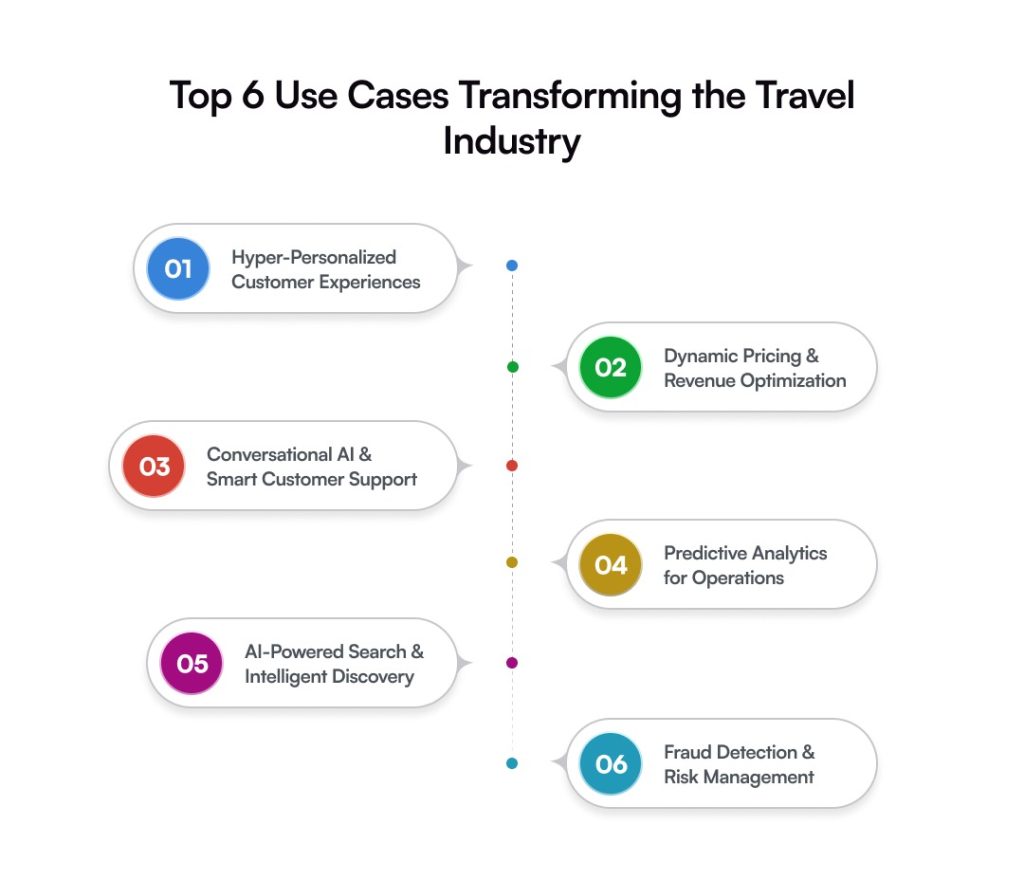
Here are six AI use cases actively transforming the travel industry:

1. Hyper-Personalized Customer Experiences

Travelers expect relevance now. Generic messaging underperforms. AI analyzes browsing behavior, booking history, loyalty signals, and intent patterns. It predicts preferences before explicit selection occurs.

Offers become tailored. Content adjusts dynamically. Communication feels timely. Engagement increases. Repeat bookings improve. Lifetime value strengthens gradually.

2. Dynamic Pricing & Revenue Optimization

Demand changes quickly. Static pricing models struggle. AI evaluates booking velocity, competitor rates, seasonal demand, and market variables simultaneously. Prices adjust in real time.

Yield improves. Revenue per available seat or room increases. Unsold inventory declines. Pricing becomes responsive rather than reactive.

3. Conversational AI & Smart Customer Support

Travel generates constant inquiries. Delays reduce satisfaction.

Conversational AI handles booking updates, cancellations, itinerary questions, and disruption alerts instantly. Natural language systems interpret context with increasing accuracy.

Response time shortens. Operational strain decreases. Service consistency improves. Support scales without proportional staffing growth.

4. Predictive Analytics for Operations

Operational disruption carries measurable cost.

AI forecasts demand shifts, maintenance requirements, occupancy fluctuations, and staffing needs. Leaders receive early insight instead of retrospective data.

Planning improves. Resource allocation tightens. Financial exposure reduces. Decisions accelerate with stronger analytical backing.

5. AI-Powered Search & Intelligent Discovery

Travel discovery often overwhelms users. Too many filters. Limited clarity.

AI interprets conversational queries and behavioral intent. Search results align more precisely with traveler expectations. Time to booking decreases. Abandonment rates decline. Discovery becomes guided rather than mechanical.

6. Fraud Detection & Risk Management

High transaction volume increases financial exposure.

AI monitors behavioral patterns continuously. Anomalies in booking activity or payment behavior trigger immediate review. Revenue leakage decreases. Transaction security strengthens. Trust stabilizes.

Across these use cases, AI shifts travel operations from assumption-based to data-driven execution. Revenue grows more predictably. Costs become more controlled. Customer experience gains consistency.

The transformation is ongoing. Competitive advantage increasingly depends on how effectively these systems are implemented.

Common Mistakes to Avoid While Adopting AI

AI adoption sounds strategic. It often is. But execution gaps weaken results.

Many travel organizations invest in AI technology without preparing the foundation. Expectations rise. Outcomes disappoint.

Here are common missteps that reduce impact.

  • Treating AI as a Trend

AI is not a marketing label. It is infrastructure.

When leadership adopts AI to signal innovation rather than solve defined business problems, implementation becomes fragmented. Tools operate in isolation. Value remains unclear.

AI in travel must align with revenue goals, operational efficiency, or customer experience metrics. Otherwise, momentum fades.

  • Ignoring Data Readiness

AI depends on structured, reliable data. Many travel systems operate on fragmented datasets.

If booking records, customer profiles, and pricing history lack consistency, AI outputs weaken. Predictions lose accuracy.

Data governance requires attention before deployment. Clean inputs produce stronger intelligence. The reverse is also true.

  • No Clear ROI Tracking

Investment without measurable KPIs creates uncertainty.

AI initiatives should connect directly to revenue lift, cost reduction, conversion improvement, or retention growth. Without defined metrics, progress becomes difficult to quantify.

Leadership confidence depends on visibility. AI performance must be tracked with the same rigor as financial indicators.

  • Lack of Internal Alignment

Technology teams may understand AI. Operations and marketing teams must as well.

If departments remain misaligned, adoption slows. Resistance increases. Tools remain underutilized.

Cross-functional collaboration strengthens implementation. AI in travel works best when strategy, data, and execution move together.

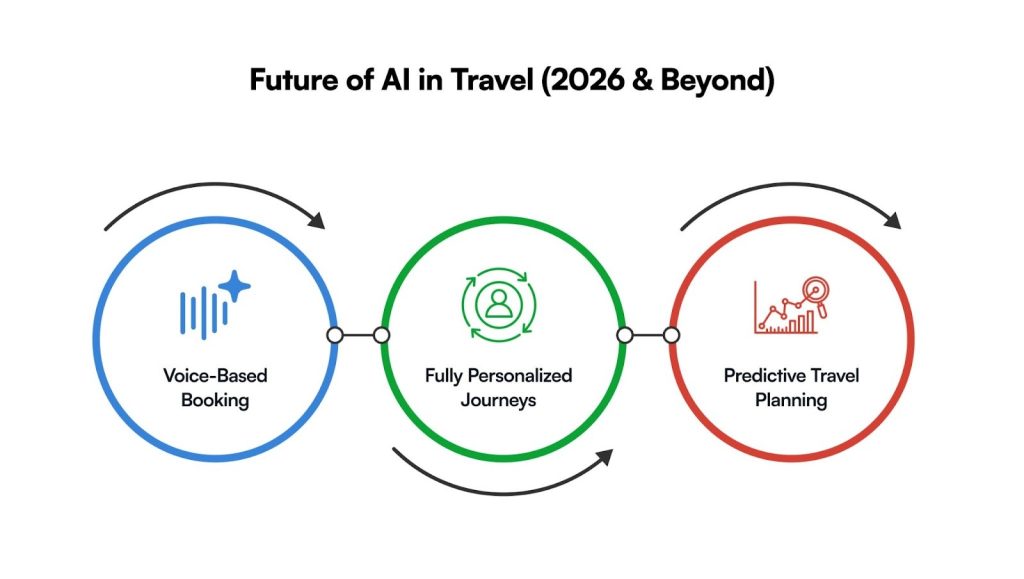
Future of AI in Travel (2026 & Beyond)

The next phase of AI in travel will extend beyond automation. Intelligence will become embedded deeper into the customer journey.

Expect acceleration across these areas:

  • Voice-Based Booking

Voice interfaces are improving rapidly. Travelers will increasingly search and book through conversational assistants.

Natural language processing will interpret intent, preferences, and constraints simultaneously. Friction reduces. Speed improves.

Booking becomes more intuitive.

  • Fully Personalized Journeys

Personalization will move beyond recommendations. Entire travel journeys will adjust dynamically.

AI will coordinate flights, accommodations, activities, and transportation based on real-time context. Preferences will influence pricing, content, and communication automatically.

Experiences will feel curated, not assembled.

  • Predictive Travel Planning

AI will anticipate travel intent before explicit search begins.

Behavioral signals, seasonal patterns, and life events will inform proactive offers. Platforms may suggest destinations before travelers initiate research.

Planning becomes guided by foresight rather than reactive comparison.

Conclusion

AI in travel is moving from enhancement to necessity.

Airlines optimize fleets and pricing. Hotels personalize guest experiences at scale. Tourism platforms guide discovery with intelligence. Revenue improves. Costs stabilize. Decisions accelerate.

The transformation is structural, not temporary.

Organizations that align data, strategy, and technology early will build measurable advantage. Those delaying adoption may face widening performance gaps.

AI in travel and tourism is redefining how the industry operates. The opportunity now lies in disciplined execution.

FAQs

Is AI in travel only relevant for large airlines and hotel chains?
No. Mid-sized travel brands and digital platforms are actively implementing AI to strengthen pricing, personalization, and operational visibility.

How long does AI implementation typically take?
Timelines vary by scope and data readiness. Pilot deployments may take months. Enterprise-wide integration requires phased execution.

Is AI expensive to maintain?
Maintenance costs depend on infrastructure and data management. However, measurable revenue gains and efficiency improvements often offset operational expenses.

Can AI integrate with legacy travel systems?
Yes. API-based architectures and middleware solutions allow AI layers to connect with existing booking engines and operational platforms.

What is the biggest benefit of AI in travel and tourism?
Improved decision-making. AI converts fragmented data into predictive insight, strengthening revenue growth, operational control, and customer loyalty simultaneously.

Why Modern Enterprises Are Investing in Custom App Development in 2026

Enterprises used to run on packaged software. Safe choice. Predictable costs. Quick to deploy.

But uniformity has a downside. When everyone uses identical tools, differentiation fades. Processes start looking alike, and customer experiences too.

That’s exactly why things are shifting.

Custom app development isn’t some big, risky bet anymore. It’s turning into a practical growth strategy. The enterprise mobile app market is expected to touch $338.42 billion, expanding at about 12.33% CAGR through 2031. 

Markets don’t grow like that without a reason. Businesses clearly want more control over their tech. And customers? Their expectations climbed. Quietly, but fast. They want smooth digital transformation, near-instant responses, and zero confusion.

Custom applications give enterprises room to move. Integrate what you need. Scale when growth hits. Pivot without rebuilding everything from scratch. 

In this guide, you’ll see why modern enterprises are investing in custom app development in 2026, what’s driving the urgency, and how the right investment can turn technology into a serious competitive edge.

What is Custom App Development? 

Custom app development for enterprises is pretty straightforward. It is built for your business and workflows, rather than a standardized platform, forcing organizations to adapt to a predefined structure.

No patchwork. No adjusting operations just because the platform says so. Instead, the software adjusts to you. That’s the whole point of custom software development for enterprises: alignment. 

Custom application development is more of a business asset. Something that supports scale without breaking under pressure. As the enterprise expands, the software expands with it. No sudden limitations. No expensive re-platforming panic later.

Why Off-the-Shelf Software is Quietly Failing Enterprises

Off-the-shelf software looks like an easy choice in the beginning because of the lower price tag, faster deployment, and overall, feels like a smart financial move. 

But, as soon as the enterprise starts to scale, the gap starts to appear (even from a distance). Features feel restrictive. Integrations get messy. Teams invent workarounds just to keep operations moving. What once felt efficient slowly becomes friction.

Let’s break down where things actually start going wrong.

  • The Hidden Cost of “Lower Upfront Pricing”

The upfront investment looks manageable. Most stakeholders are on board with that. Procurement teams, too. But the total cost rarely remains predictable.

Soon, expenses begin stacking up. Additional user licenses. Paid feature upgrades. Priority support plans. Integration tools. What once felt “cost-effective” starts stretching the budget. And migrating later? That’s a far bigger financial lift.

In fact, when teams spend extra time working around rigid workflows, the impact compounds. Across departments, business units, and sometimes across global operations.

Software that seemed economical at first can quietly turn into a high-cost commitment, just not right away.

  • Integration Bottlenecks Slow Innovation

Enterprises don’t run on one system. It’s an ecosystem, CRM & ERP, analytics tools, cloud platforms, and internal dashboards.

Off-the-shelf tools weren’t built for your exact stack. So integrations feel forced. Sometimes fragile. One update breaks a connection. Data stops syncing. Teams wait. Innovation pauses while IT fixes pipes in the background.

Not ideal.

Speed matters now. Businesses experimenting with AI development, automation, and real-time analytics can’t afford tech that resists connection. When systems don’t communicate smoothly, decision-making slows, and opportunities pass.

  • Security Limitations in Shared Architectures

Shared platforms mean shared environments. That’s the trade-off many enterprises don’t think about early on.

Vendors handle security, yes. But control is limited. You follow their protocols, their timelines, their response strategies. For enterprises dealing with sensitive customer data, financial records, or compliance-heavy industries, a lack of control can feel uncomfortable. Sometimes risky.

Security isn’t just about protection anymore. It’s about visibility. Custom policies. Faster incident response. When you don’t fully own the architecture, you don’t fully own the safety net either.

7 Strategic Reasons Enterprises Are Choosing Custom Apps in 2026

Enterprises are no longer asking if they should invest in custom app development; rather, they want to know: “How soon can it be implemented without disrupting the growth?”

Here’s exactly what is driving the shift towards enterprise app development in 2026. 

  1. Application Built Around Business Processes

Every enterprise runs differently. Approval chains vary. Data flows differently. Even decision-making structures are unique.

Generic software forces teams to adjust. Custom application development removes that friction. The system mirrors how the business already operates. Fewer workarounds. Less operational drag. Processes feel natural instead of engineered. And when technology aligns with workflows, execution becomes faster by default.

  1. Limitless Scalability for High-Growth Organizations

Growth sounds exciting. Until systems start struggling under the weight.

Many platforms perform well at mid-scale. Then expansion happens, new markets, higher transaction volumes, larger teams, and limitations surface.

With enterprise software development, scalability is planned early. Architecture supports expansion before pressure builds. So when growth arrives, the system keeps pace. No urgent rebuilds. No reactive spending. Just continuity.

  1. Enterprise Level Security & Compliance Readiness

Risk tolerance is lower now. Regulators are stricter. Customers expect data protection without compromise.

Shared platforms offer baseline security. But enterprises often require deeper control, access governance, audit trails, and compliance mapping.

Custom-built applications allow security frameworks to match organizational policies. Do not approximate them. It creates preparedness. Not dependency. And preparedness tends to reduce long-term exposure.

  1. Seamless Integration Across Complex Tech Stacks

Enterprises rarely operate on a single platform. It is usually a layered ecosystem, including ERP, CRM, analytics engines, cloud infrastructure, and internal tools.

When systems fail to communicate, visibility suffers. Decisions slow. Custom app development prioritizes integration from the start. APIs align. Data moves cleanly. Departments stay connected. Technology begins functioning as one environment instead of being separate. 

  1. AI and Automation Compatibility

AI is no longer experimental. It is operational.

Enterprises are embedding predictive analytics, intelligent workflows, and automated decision layers. But many packaged tools were not designed for this level of adaptability. Custom platforms are.

They create space for machine learning models, automation pipelines, and evolving data strategies without structural resistance. Future readiness becomes part of the foundation, not an afterthought.

  1. Superior Customer Experience Through Personalization

Customer expectations rarely stay still. They escalate. Personalized journeys, faster resolutions, contextual interactions, these are becoming standard signals of a mature enterprise.

Enterprise app development allows businesses to shape experiences around user behavior rather than platform limitations. Which often leads to higher retention. Stronger trust. Better lifetime value.

  1. Stronger Long-Term ROI

Custom solutions require higher early investment, and what becomes visible later is the return. It results in lower dependency on multiple vendors, licensing costs stay controlled, and operational friction drops too. 

Over time, enterprise software development stops behaving like a recurring expense. It starts contributing measurable value, stronger productivity, better system stability, and clearer data flow.

Industries Where Custom Enterprise Apps Deliver Maximum Impact

Some industries feel the impact of custom app development faster than others. Usually, because the complexity is higher. Transactions are heavier. Customer expectations rarely pause.

Standard platforms help to a point. Then the limitations surface. That is when custom application development begins to show measurable value.

Here is where the difference becomes difficult to ignore:

  • Fintech: Enterprise mobile app development allows the finance industry to design platforms around compliance frameworks, risk controls, and real-time processing. Fraud detection becomes sharper. Data visibility improves. Customer transactions feel faster and more reliable. And when trust drives revenue, system stability quietly becomes a competitive advantage.
  • Healthcare: For the healthcare industry, delays or inefficiency are never an option because they can result in negative outcomes. Hospitals and care networks manage patient data, diagnostics, billing systems, and compliance mandates, all at once. With custom app development, workflows align better across departments. Patient records move securely. Telehealth integrations feel native instead of layered on top.
  • Manufacturing: Manufacturing runs on coordination. Supply chains, production schedules, equipment monitoring, everything must stay synchronized. That being said, custom app development enables real-time production tracking, predictive maintenance, and tighter inventory control.
  • Logistics: Movement defines logistics. Any delay creates ripple effects across the network. Route planning, fleet tracking, and warehouse coordination each require real-time intelligence. Through custom app development, logistics enterprises gain dynamic routing, predictive delivery insights, and clearer shipment visibility.
  • Retail/eCommerce: Customer loyalty is increasingly experience-driven. Slow platforms or inconsistent journeys rarely get forgiven. Retailers adopting enterprise mobile app development can unify inventory, personalization engines, order management, and analytics into one environment. Shoppers see accurate stock levels. Recommendations feel relevant. Checkout friction reduces.

When Should an Enterprise Invest in Custom App Development?

Timing matters more than most leaders assume. Invest too early, value feels distant, and operational strain becomes visible. 

Certain signals tend to repeat across growing organizations. Notice them early, and see how decisions get simpler.

  1. Rapid scaling: When expansion starts stressing existing systems and performance begins to dip, custom app development creates the structural capacity needed to support sustained growth.
  2. Legacy system limitations: If outdated platforms resist integration, slow teams down, or inflate maintenance costs, modern custom solutions restore agility without constant patchwork.
  3. Complex workflows: When operations involve multiple dependencies and manual interventions, tailored applications streamline execution and reduce process fatigue.

Emerging Trends Shaping Enterprise App Development in 2026

Enterprise technology is moving faster than many anticipated. Expectations keep rising. Systems are no longer expected to just function; they must evolve, almost continuously.

This is exactly where enterprise app development is changing direction.

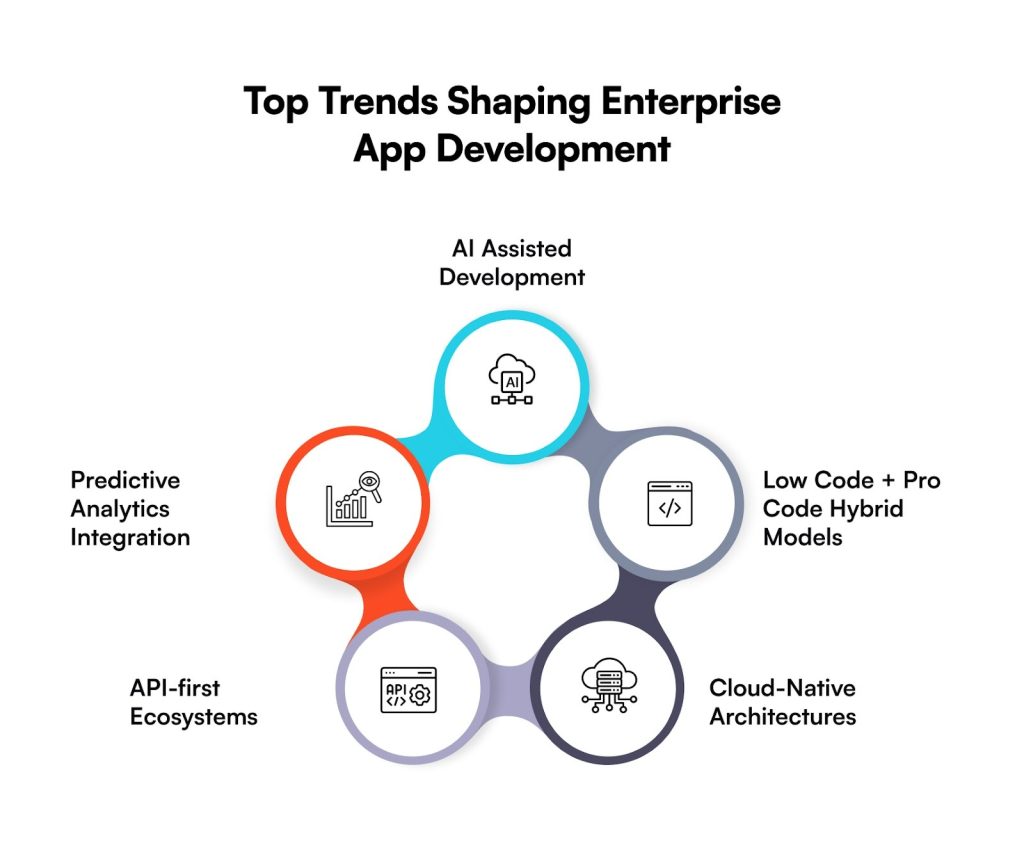
Here are the top emerging trends that are about to transform enterprise app development in the future:

  • AI Assisted Development

Enterprises are leaning on AI to speed up coding and detect risks earlier. Development cycles shorten. Errors reduce before they scale. Delivery feels more predictable, which leadership tends to value.

  • Low Code + Pro Code Hybrid Models

Speed matters, but architectural strength matters more. Hybrid models allow teams to release faster while developers maintain control over complexity. Agility improves without weakening the foundation.

  • Cloud-Native Architectures

Cloud-built applications scale with fewer constraints. Downtime risks drop. Operations stay accessible across locations. Custom application development becomes easier to expand as demand rises.

  • API-first Ecosystems

Applications designed around APIs are cleaner. Systems communicate without unnecessary friction. Expansion feels structured, not reactive. Enterprises gain the flexibility they usually wish they had earlier.

  • Predictive Analytics Integration

Forecasting is moving into the application layer. Leaders see patterns sooner. Decisions shift from reactive to informed. Small advantage perhaps, but it compounds quickly at enterprise scale.

Common Myths About Custom App Development — Debunked

Misconceptions tend to slow enterprise decisions. Especially when the investment feels significant. Many leadership teams hesitate, not because the strategy lacks value, but because outdated assumptions still circulate.

Let’s address a few that deserve reconsideration:

  • Custom apps are only for large enterprises: Custom app development is no longer confined to global enterprises. Mid-sized organizations are investing earlier, often to stabilize operations before complexity expands. It creates clarity, strengthens process control, and prevents systems from getting messy. 
  • They take years to build: That was closer to reality once. Not anymore. Modern development frameworks, cloud infrastructure, and modular architectures allow phased releases. Enterprises deploy core capabilities first, expand gradually, and refine as usage grows. Progress becomes visible earlier.
  • Maintenance is too expensive: Maintenance exists with any software. The difference is control. With custom platforms, enterprises decide when to upgrade, what to optimize, and where to invest. Over time, reduced licensing dependency and fewer operational inefficiencies tend to balance the spend, sometimes more than expected.

How to Choose the Right Custom App Development Partner

The partner you select influences far more than the application itself. It affects scalability. Security readiness. Even the speed at which teams begin trusting the system. This decision requires deliberation. Quick selections often introduce complications later, typically when operations expand.

  • Technical Depth

Engineering strength is essential. Seek teams capable of handling architectural complexity, not only visible features. In custom app development, limited expertise tends to surface during high-demand phases.

  • Industry Experience

Sector familiarity reduces misalignment early. Partners who understand compliance pressures, operational patterns, and user behavior usually design with stronger accuracy. Context reduces costly revisions.

  • Architectural Thinking

Many vendors build applications. Fewer architects for endurance. Scalable structures, integration readiness, and long-term adaptability originate in thoughtful design. Within custom application development, architecture often determines whether the system supports growth or restricts it.

  • Security Expertise

Enterprise systems carry exposure. Protection must be intentional. Assess how the partner approaches governance models, access frameworks, regulatory alignment, and threat prevention. Security should exist within the foundation, not around it.

  • Post-launch support

Release is only a milestone. Applications mature through iteration. Performance tuning, feature refinement, and ongoing monitoring all require continuity. Reliable enterprise app development extends beyond deployment into a sustained partnership.

Custom Apps Are No Longer Optional: They’re Strategic Infrastructure

Enterprises are reaching a quiet realization. Technology is no longer just operational support. It is becoming the structure the business stands on.

Custom app development now sits closer to strategy than IT. It shapes speed. Influences resilience. Determines how confidently an organization can respond to market shifts. Standard platforms still serve a purpose, yes, but differentiation rarely grows from shared systems.

Well-architected applications create something enterprises value deeply: control. Over data. Over workflows. Over security posture. Over future expansion that has not fully arrived yet. The investment may appear significant at first glance, though the long-term operational stability often reframes that perspective.

Execution, however, matters as much as intent. The right development partner brings architectural clarity. Engineering discipline, and the ability to translate business complexity into scalable platforms.

The real question now may be simpler than it seems.

Is your enterprise building systems for where the business is today, or for where it is clearly heading next?

FAQs

Q. Is custom app development worth it for enterprises in 2026?
A. In many cases, yes. Custom app development gives enterprises a tighter operational fit, stronger data ownership, and room to scale without structural strain. The initial investment may seem substantial. Over time, efficiency improves. Vendor dependency reduces. Competitive positioning strengthens.

Q. How much does enterprise custom software cost?
A. There is no single number. Costs shift with complexity, integration depth, compliance needs, and architectural expectations. Enterprise builds often move into six-figure territory, sometimes higher. What matters is cost control over time. Well-planned systems rarely demand expensive reinvention later.

Q. How long does development typically take?
A. Scope defines the timeline. Foundational platforms may take a few months. More layered ecosystems require longer horizons. Many organizations now release in phases, core capabilities first, enhancements after. Progress becomes visible earlier, which leadership tends to prefer.

Q. Are custom apps more secure?
A. They often are. Security frameworks are designed around enterprise policies rather than generalized standards. Access controls stay precise. Governance feels intentional. When executed correctly, risk exposure usually declines.

Q. Can custom apps integrate with legacy systems?
A. Yes. Frequently, that is the objective behind custom application development. APIs and middleware connect older infrastructure with modern layers, improving data continuity without immediate full replacement. Enterprises preserve stability while advancing capability.