How Much Does React Native App Development Cost in 2025?  

Apps are a great way to engage your audience and build a loyal customer base. But creating your dream app can cost you a leg and an arm if you aspire to build a native app. Indeed, it takes a lot of money and time to build native applications for platforms like Android and iOS.   

So, many businesses invest in cross-platform app development that helps them develop a mobile app with a single codebase that can run on both Android and iOS. It not only saves time but also minimizes the overall costs and effort in developing an application.  

While there are several frameworks and technologies to create cross-platform apps, React Native stands out with near-native performance, a strong ecosystem, a reusable codebase, pre-built components, and native modules.  

However, if you are considering developing a React Native app, one thing you would like to know is how much it costs to build one. In this blog, we are going to deep dive into this aspect, providing detailed information on how much it costs to build a React Native app and the factors affecting it.  

Meta Description: Wondering how much React Native app development costs in 2025? Explore pricing by complexity, features, and process steps to plan your mobile app budget. 

An Overview of React Native App Development Cost  

For a rough estimate, the cost of react native app development can range between $10,000 – $350,000. But the actual cost varies with the project requirements, app complexity, features, integrations, and several other factors.  

In fact, the cost can even cross the above range depending on the business requirements and customizations. A highly complex enterprise-grade React Native app is likely to cost more. Apart from this, the developer rates can also affect the cost.  

The following table shows the rough estimates for the React Native app cost based on the complexity level of the app.  

Complexity Level App Cost (Estimates in US$) 
Simple React Native App $10,000 – $30,000 
Medium React Native App $30,000 – $75,000 
Complex React Native App $75,000 – $350,000 

Key Factors Affecting the React Native App Development Cost 

Creating a React Native app requires careful planning, technical expertise, and a professional team. Besides, there are other factors like customization, features, team location, etc, that directly impact the cost of developing a React Native app. Let’s check out all these factors in detail to understand how and how much they impact the cost. 

App Complexity 

Needless to say, the more complex your app is, the more time and effort it will require to be built. App complexity isn’t just about complicated features or design; it includes several factors. Starting with app architecture and the backend. Monolithic application architectures can be complex, but they are not as complex as decoupled or microservices-based architectures that require you to work with diverse technologies and frameworks.  

Further, you may choose to build a custom backend that requires extensive planning and careful execution of the app development process. Therefore, this will increase the overall cost of React Native app development.  

Apart from this, another reason for complexity is advanced apps that involve integration of AR/VR, AI, IoT, and other custom functionalities such as payment and login. In-app purchases also make apps more complex, which increases the React Native app development cost. 

Apps can also leverage native device features such as Bluetooth, Barometers, GPS, etc, that make your app more complex and add more dollars to your mobile app development cost. Integration with legacy systems can add extra complexity in React Native app development.  

Based on this factor, React Native apps can be divided into simple, medium, and complex.  

The following table shows the estimated cost of different features.  

Features Estimated Cost 
API Integrations $5,000 – $6,000 
Push Notifications $1,500 – $3,500 
Social Media Integration $1,000 – $3,000 
GPS Tracking $10,000 – $25,000 
AI Chatbot Integration $15,000 – $35,000+ 
AR/VR $20,000 – $50,000+ 

Team Location and Size 

Another crucial factor that determines the React Native app development cost is the location and size of the team. Software development rates vary across the globe. For advanced economies, the rates are quite high, and they are considerably lower in growing economies.  

For example, a React app development company in the USA charges higher rates than a company in Asia or Europe. So, understanding the developer rates will help you determine the right app development cost for your project. Let’s check the table below for rates.  

Region Rates (Average) 
USA & Canada $100 – $150 
Europe $50 – $80 
Asia $20 – $40 
Australia $65 – $95 
South America $30 – $50 

As you can see in the table, development rates are different for various regions of the world, and they are the lowest in Asia. Therefore, Asia is among the hottest places to outsource app development projects. Developing a React Native app is about 5X cheaper in Asia than in the USA.  

Similarly, it is 2X cheaper to develop your app if your development team is located in Europe. So, your React Native app cost significantly varies depending on where you choose to build an app or where your development team is located.  

Team size also plays a crucial role in the cost of developing a React Native app. The larger the team size is, the higher the cost. A bigger team size depends on the project’s complexity and size.  

Breaking Down the React Native App Development Cost as Per the Development Process 

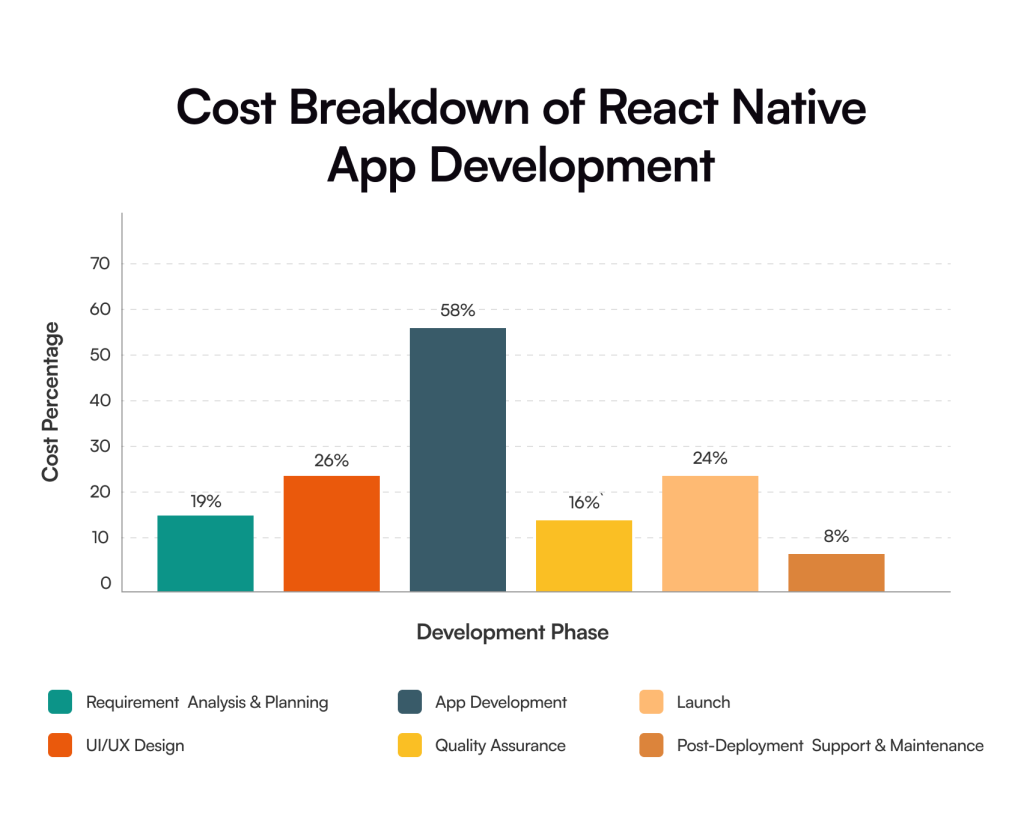
We can do a breakdown of the cost of React Native development based on different steps in the process. Since the development process involves multiple stages, the cost varies for these stages, such as design, coding, integration, and testing. Let’s check out how it varies. 
Meta Description: Wondering how much React Native app development costs in 2025? Explore pricing by complexity, features, and process steps to plan your mobile app budget. 

Requirement Analysis & Planning 

This is the initial phase of your React Native project where brainstorming, team discussions, and the research part take place. In this phase, your tech partner will analyze your business, gather requirements, and define the project scope. It sets the foundation for your React native development and can cost around 5-10% of the total project cost.  

UI/UX Design 

UI/UX design is where stunning visuals meet seamless interactions. This phase entails various tasks like wireframing and prototyping that help visualize the idea of how the app’s UI will look and how users will interact with it. This phase helps build a seamless and engaging user experience paired with a stunning layout, visuals, and elements. The cost of UI/UX design varies depending on an app’s complexity, and it typically ranges from $3,000 – $30,000. 

App Development 

This is the phase where wireframes and prototypes are turned into tangible app solutions. It involves coding the front-end and back-end development. So, there will be a cost for front-end and back-end. Apart from this, your React Native app needs third-party integrations like a payment gateway, authentication, APIs, etc. Hence, the React Native app cost depends on these factors. This phase takes most of the cost in the process, ranging from $15,000 – $100,000 or more as the app’s complexity and scale increase.  

Quality Assurance 

Quality assurance is the phase where your React Native app goes through a stringent testing process to check it for bugs, performance issues, security flaws, and more. This process ensures that your app functions seamlessly on different devices while protecting your data. 10-15% of the total React Native app cost goes into this process, which is usually $2,000 – $20,000.  

Launch 

After development, your app is published on Apple App Store and Google Play Store along with necessary configurations and compliance checks. However, costs are relatively lower in this phase compared to other phases. It is around $500 – $2,000 for every project. Publishing an app on different Google and Apple marketplaces also requires a certain fee.  

Post-Deployment Support & Maintenance 

The development and launch of a React Native app is not the end of the story. Support and maintenance take place after launching an app. This is an essential phase that helps you keep your app up-to-date, secure, and high-performance by eliminating hidden bugs, security loopholes, and updating it to the latest versions of frameworks and technologies. Maintenance is an ongoing process, and it costs around 15-20% of the overall development costs annually, usually in the range of $5,000 – $100,000.  

When is React Native App Development a Good Choice? 

Is React Native the best choice for your mobile app development project? Well, the answer depends on your requirements. React Native is indeed an excellent framework to develop high-end native applications for Android and iOS. It is a reliable framework backed by Meta (formerly Facebook) and powers hundreds of thousands of apps, including top brands like Facebook, Instagram, Microsoft Teams, Amazon Shopping, Shopify, Tesla, PlayStation, and more.  

React Native is the right choice for: 

  • Cross-platform app development: If you want to develop a single mobile app for both Android and iOS, React Native is the right choice. It helps build apps with a single codebase.  
  • MVPs & startups: If you want to test and validate your app idea with an MVP, React Native can be the right choice to do it.  
  • Apps with medium-level complexity: React Native is the best framework to build mobile apps with a medium complexity level. 
  • Frequent updates: React Native is suitable for apps that require regular updates or frequent iteration cycles.  
  • Time & budget constraints: You can choose React Native development for faster time-to-market and cost-efficient development.   

While there are diverse benefits of React Native app development, it is not without its limitations. There are some downsides too. Let’s check them out.  

React Native is not the most perfect app development framework when: 

  • High-performance apps: Apps like gaming, AR/VR, or those that require heavy graphics or 3D rendering.  
  • Apps dependent on native features: React Native isn’t the best choice for developing mobile apps that require access to low-level APIs such as NFC, advanced geolocation, Bluetooth, custom camera, etc. 
  • Extreme UI/UX needs: Mobile apps that require extreme UI/UX needs are also challenging to build with React Native. 
  • Apps with highly complex architecture: React Native isn’t the right choice for creating high-grade enterprise apps that have a very complex architecture. 
Meta Description: Wondering how much React Native app development costs in 2025? Explore pricing by complexity, features, and process steps to plan your mobile app budget. 

To Wrap Up 

Mobile apps are vital for modern businesses to ensure growth and brand engagement. However, when it comes to developing a mobile app, businesses find themselves at the crossroads of native vs cross-platform apps. In this dilemma, app development frameworks like React Native are useful, which help develop cross-platform apps, offering a native experience for each Android and iOS device. 

With this framework, you can create native apps for both Android and iOS using a single codebase. It helps develop mobile apps using a single programming language: JavaScript. Galaxy Weblinks helps you build robust React Native apps with its years of experience and an innovative development approach. Our React Native developers are proficient in this framework with proven experience in developing a wide range of apps for various industries.  

You can discuss your project with us, and we can provide an estimate for the cost of developing a React Native app, putting things into perspective. Contact us now to give us details of your project, so we can offer a precise cost estimate and build a top-notch mobile app.  

Frequently asked questions 

What other frameworks than React Native can be used to develop mobile apps? 

React Native is among the top cross-platform mobile app development frameworks. However, there are many other frameworks to build apps like Flutter, Ionic, SwiftUI, .NET MAUI, Xamarin, and more.  

Why should we choose React Native over other frameworks? 

Choosing React Native for app development offers many advantages: 

  • Cross-platform development that offers a low-cost option for developing Android and iOS apps. 
  • Faster development with a single codebase for both Android and iOS, and a single programming language ensures a quick time-to-market.  
  • App development with React Native requires a smaller team size, as a single codebase is created. 
  • Near-native experience with apps created with the React Native framework. 

Is React Native the best choice for mobile app development? 

The answer is both Yes and No, because it is only a matter of project requirements, business goals, type of business, etc. If you want to develop a fully native app for both Android and iOS separately, then this framework isn’t a feasible choice. Similarly, if you want to create a high-end graphics application, then React Native may not meet your expectations. However, it’s the best choice for MVPs, medium-complex apps, budget-constrained apps, and apps with heavy native dependency.  

Top eCommerce Development Trends in 2025 Redefining the Digital Experience  

eCommerce is constantly evolving with new market trends and technologies accelerated by skyrocketing online shopping. As per GrandViewResearch’s report, the eCommerce market size is expected to reach USD 83.26 trillion by 2030.     

The data shows the immense opportunities that this market segment offers to businesses. However, when it comes to e-commerce development, you should always look for fresh ideas and trends that are shaping the future of eCommerce.  

Over the years, there have been many technological advancements that have shifted consumer behaviors and transformed digital experiences. So, if you are considering developing an e-commerce store, you must look for the top trends in 2025.  

In this blog, we are going to discuss these top ecommerce development trends in 2025 to help you build a cutting-edge online store that will fit modern users’ needs.  

Key eCommerce Development Trends to Watch in 2025 

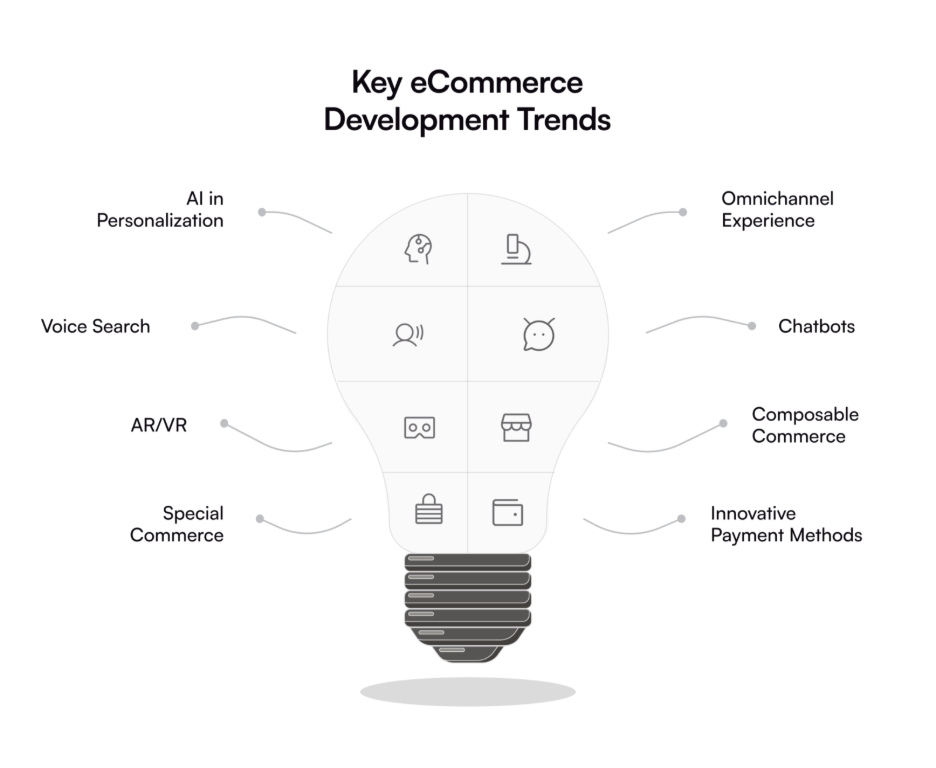
Trends are new features, methods, and online shopping innovations that take ecommerce to the next level. With these trends, you can not only enhance your e-commerce customer journey but also improve your online store to ensure customer retention and loyalty. Let’s check out the key trends for ecommerce development to look for in 2025.  

AI in Personalization & Recommendations 

Artificial Intelligence is now playing a vital role in e-commerce with predictive analytics and recommendation engines. In 2025 and beyond, the use of AI will increase in e-commerce development as investment in AI-based personalization and recommendation engines rises.  

AI-based personalization enables ecommerce businesses to offer a tailored user experience based on their location, preferences, and search history. With the help of AI, recommendation engines can identify patterns in the shopping behaviors of consumers and, based on them, provide product recommendations.  

Personalization helps e-commerce businesses tailor customer journeys right from searching for products to checkout. AI also helps businesses improve operational efficiency by aiding in managing inventory and the supply chain.  

The Rise of Omnichannel Experience 

Another hot trend in ecommerce development is the omnichannel experience that focuses on creating a seamless customer journey across different touchpoints. In simple words, your customers should feel delighted whether they purchase via your mobile app, ecommerce site, offline, or POS. 

You can leverage microservices to cater to different channels, in-store screens, apps, smart TVs, and VR shopping. User expectations differ for every channel, like tapping on a mobile vs. browsing content in detail on a desktop. You need to tailor the digital experience for different channels. This can be achieved with a headless commerce development and building a custom frontend for every channel, like a mobile app, website, web app, etc. It helps you build a seamless digital shopping experience that your customers will love, resulting in higher conversion and sales.  

Voice Search for Easy and Quick Shopping 

Voice search has been around for some time since Alexa, Google Assistant, and Siri voice assistants were launched. People used them not only for information but for shopping too. Moreover, AI-enabled voice search takes this to the next level and enhances the shopping experience.  

By optimizing for voice search, ecommerce businesses can ensure that their store is visible in these searches. People can use voice commands to order a product or food. When your store is optimized for voice searches with physical address, website, business hours, phone numbers, etc, this drives traffic to your site and increases sales.  

Chatbots Help Customers Answer Their Queries 

Chatbots are among the topmost ecommerce development trends in 2025 that allow businesses to automate customer support services. With the help of chatbots, customers can get instant answers to their queries and find solutions to their problems, related to order processing, refund, checkout, or anything else.  

With the integration of AI-powered chatbots, your ecommerce store can manage customers efficiently while ensuring the best shopping experience. AI chatbots can interact with customers just like a human customer executive would and offer assistance based on their queries or issues.  

Your ecommerce business can unlock the potential of chatbots by leveraging Gen AI technology to further enhance the capabilities of these chatbots with sophisticated machine learning models. Such chatbots will analyze data and identify patterns to help customers resolve their queries quickly and efficiently. This will improve the overall digital shopping experience of customers and create brand loyalty.  

AR/VR for Next-Gen Digital Shopping Experience 

One of the major ecommerce development trends today is the implementation of AR (Augmented Reality) and VR (Virtual Reality) functionalities. These technologies take online customer experience to the next level by offering innovative ways to buy products. For example, ecommerce stores can offer virtual try-ons to help customers choose the best outfit for themselves by trying it live virtually while shopping online. 

Similarly, customers can check sunglasses or normal specs in real-time by virtually wearing them online on an ecommerce platform. So, it offers a unique shopping experience that helps them make the right choice before even visiting a store physically.  

Composable Commerce for Scalability 

A notable ecommerce development trend in 2025 is composable commerce, which focuses on developing more scalable and flexible ecommerce stores. To achieve this, it emphasizes creating ecommerce stores that are decoupled and modularized.  

Unlike traditional monolithic ecommerce stores that have frontend and backend intertwined with each other, composable commerce stores are more flexible, built on microservices, and leverage APIs for delivering content to different frontends tailored to each ecommerce channel like PWA, web app, mobile app, etc.  

Such ecommerce stores are highly flexible due to loose interdependence between components and can be tailored to specific user requirements. They are also very scalable because any component or module can be scaled quickly without affecting the functionality of other components or modules.  

Composable commerce enables your business to deliver a seamless e-commerce experience and scale faster. Besides, you can choose the ecommerce technology of your own preference, helping you build a robust ecommerce store.  

Social Commerce Becoming Trending 

Social media is no longer just a platform to connect with friends and family; it’s also a platform to connect with sellers. Indeed, social media has now become a key platform for ecommerce businesses to sell their products, which they can do by integrating it into their shopping journey.  

It is one of the most crucial ecommerce trends in 2025 and enables businesses to expand their sales channels. There are many ways products are featured to users on social media, like live-streamed videos, embedded product pages, influencer videos, brand promotion content, and more.  

Innovative Payment Methods are Emerging 

There is also a trend in ecommerce development related to payments. BNPL (Buy Now Pay Later) is a trending payment method that involves an arrangement to buy something now, while the payment is made later, usually in installments.  

With these payment options, ecommerce sellers can increase their customer base and sales. This flexible payment option attracts even those customers who hesitate to buy due to financial issues. By integrating the BNPL payment method into your ecommerce platform, you can offer more diverse options to buy and pay.  

To Wrap Up 

The ecommerce landscape is changing rapidly with new innovations and trends. Those businesses that are abreast of these changes will lead, and those that fail to adapt will be left behind. Understanding these trends and implementing those that can take your ecommerce business forward is essential for both sustenance and growth.  

E-commerce development trends like AI-enabled personalization, chatbots, composable commerce, and voice search are the next-gen features that you can implement in your ecommerce store and offer a top-notch online shopping experience.   

You can stand out by implementing the top ecommerce development trends 2025 with Galaxy Weblinks. We are a highly experienced ecommerce development company specializing in creating a wide range of ecommerce solutions – website, mobile app, and PWA.  

We help you build cutting-edge ecommerce stores with next-gen features like chatbots, voice search, AR, and more. We have worked with various companies ranging from startups to enterprises, helping them build robust ecommerce solutions, both B2B and B2C.  

Contact us to discuss your project and let’s build a next-gen eCommerce website.  

Frequently asked questions 

Which top trends are shaping the future of eCommerce? 

The key trends that are shaping the future eCommerce include AI-powered personalization, chatbots, omnichannel experience, voice search, and headless commerce. With these trends, brands can deliver a more dynamic, immersive, and flexible eCommerce experience.  

Are data privacy and security becoming more important in eCommerce? 

Yes, considering the rising cost and number of cyberattacks, data security and privacy are becoming among the most important factors in the development process. Therefore, eCommerce businesses are investing in data privacy and security.  

How is AI transforming the eCommerce landscape? 

Artificial Intelligence is being leveraged in eCommerce development to build smart chatbots for product recommendations, predictive analytics, and hyper-personalized shopping experiences.  

AI in Healthcare: Transforming the Future of the Medical Field 

Imagine a world where AI in healthcare catches cancer before symptoms appear or crafts drugs tailored to your DNA. Today’s healthcare struggles with misdiagnoses, doctor shortages, and complex data, but AI-powered medical solutions are changing that.  

From sharper diagnostics to personalized treatments, AI streamlines workflows and boosts access. This guide dives into how AI transforms patient care, research, and delivery for healthcare professionals, tech leaders, and policymakers.  

We’ll explore the role of AI in healthcare, its benefits, and show why AI medical innovation matters now. So, let’s read it for detailed information.  

Understanding the Crucial Role of AI in Healthcare      

In healthcare, AI is not just an intelligent tool; it is a critical solution that can save lives, improve patient care, and streamline workflow. It has transformed the way healthcare specialists and hospitals tackle health challenges.  

From diagnosis to personalized treatment, AI shines in delivering the utmost value for patients while reducing the burden on hospital staff. It is rising like a shining star in healthcare, and if we look at statistics, the size of the global AI in healthcare market is projected to rise with a CAGR of 38.6% in the upcoming five years, as per the MarketsandMarkets report.   

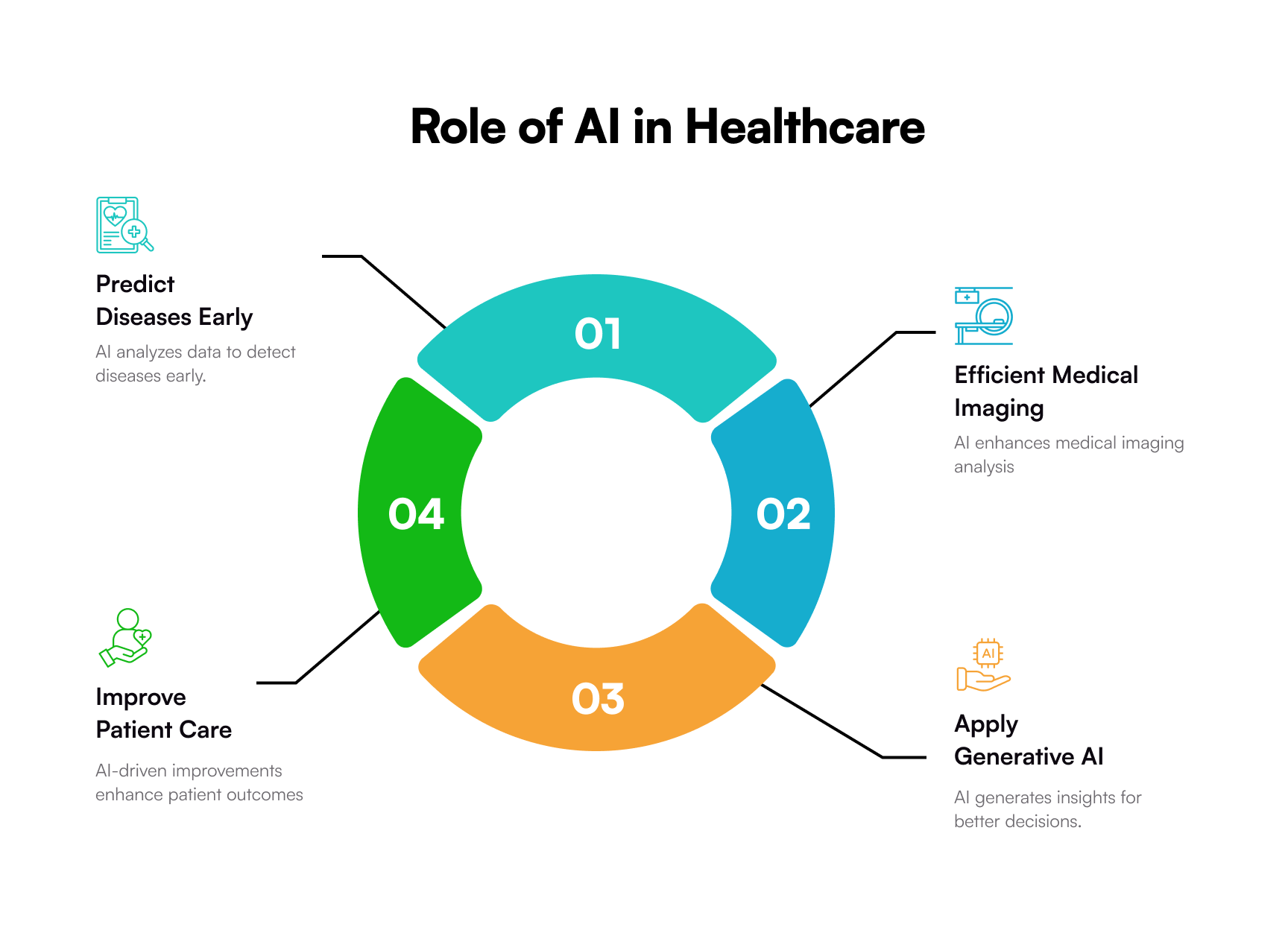
The following points show how Artificial Intelligence is transforming the landscape for healthcare.  

Predicting Diseases Early 

Identifying and treating diseases early can help save lives by offering instant medical care for critically ill patients. This is known as predictive care that you can do with the use of advanced AI-enabled predictive analytics tools. These tools can analyze reports, imaging, and patient history to diagnose a disease, to help doctors treat patients before it’s too late. Early detection also ensures an effective treatment because for many critical diseases, the sooner it is identified, the better the treatment works.  

Efficient Medical Imaging Analysis 

Today, the use of medical devices is widespread in the healthcare sector. Now the use of AI/ML medical devices is expanding across this industry and helping healthcare providers to improve patient care with better and speedier diagnoses, treatments, and therapies. The integration of AI with medical imaging devices offers enhanced analysis of the data that helps track critical diseases early. 

Applications of Gen AI 

Generative AI in healthcare offers enormous benefits, including enhanced medical imaging, drug discovery and development, clinical documentation, synthetic data generation, and more. This enables healthcare providers to make better decisions.  

Improve Patient Care 

Better diagnosis, personalized treatment plans, and accurate imaging analysis ensure enhanced patient care. Besides, healthcare providers can quickly process documentation and minimize the time spent on it, which improves patients’ experience. This will speed up the process to deliver care in the least possible time.  

5 AI-powered Innovations Transforming Healthcare 

Today, healthcare providers are using diverse AI-powered solutions that help them make their processes more efficient and effective. Let’s learn about these innovations in detail.  

1. Chatbots or Virtual Health Assistants  

Now AI in telemedicine, chatbots, and virtual health assistants is transforming the way hospitals, clinics, and other healthcare centers cater to patients. These AI-powered platforms use Natural Language Processing (NLP) to interact with patients providing answers to their queries, educate them, engage patients, and offer scheduled alerts for medicines or hospital visitors. They can even diagnose symptoms and offer recommendations.  

2. Remote Patient Monitoring 

AI-driven RPM and telemedicine systems are now playing a central role in care delivery as they offer healthcare services in remote regions. Consequently, they now reach patients in areas where traditional healthcare met challenges. This made healthcare services more accessible and inclusive.  

3. Real-Time Data with IoT 

Healthcare providers or hospitals can leverage smart AI platforms and apps with IoT to gather health data like blood glucose, BP, heart rate, oxygen level, and more in real time to monitor patient health. This allows doctors to get data immediately and take prompt actions.  

4. mHealth Applications 

These applications are specifically designed for health services that seamlessly run on mobiles, tablets, and smartwatches. They are vital to remote health monitoring, disease prevention, patient-provider communication, and improving care. They help deliver personalized and efficient healthcare services.  

5. Medical Robotic 

More advanced use of AI in healthcare is medical robotics or hospital robots. They guide surgeons through intricate surgical procedures with great accuracy, resulting in reduced risk of complications and minimizes recovery time. These AI robots can dispense medicines, do cleaning work, and move equipment. 

What are the Benefits of AI in Healthcare?  

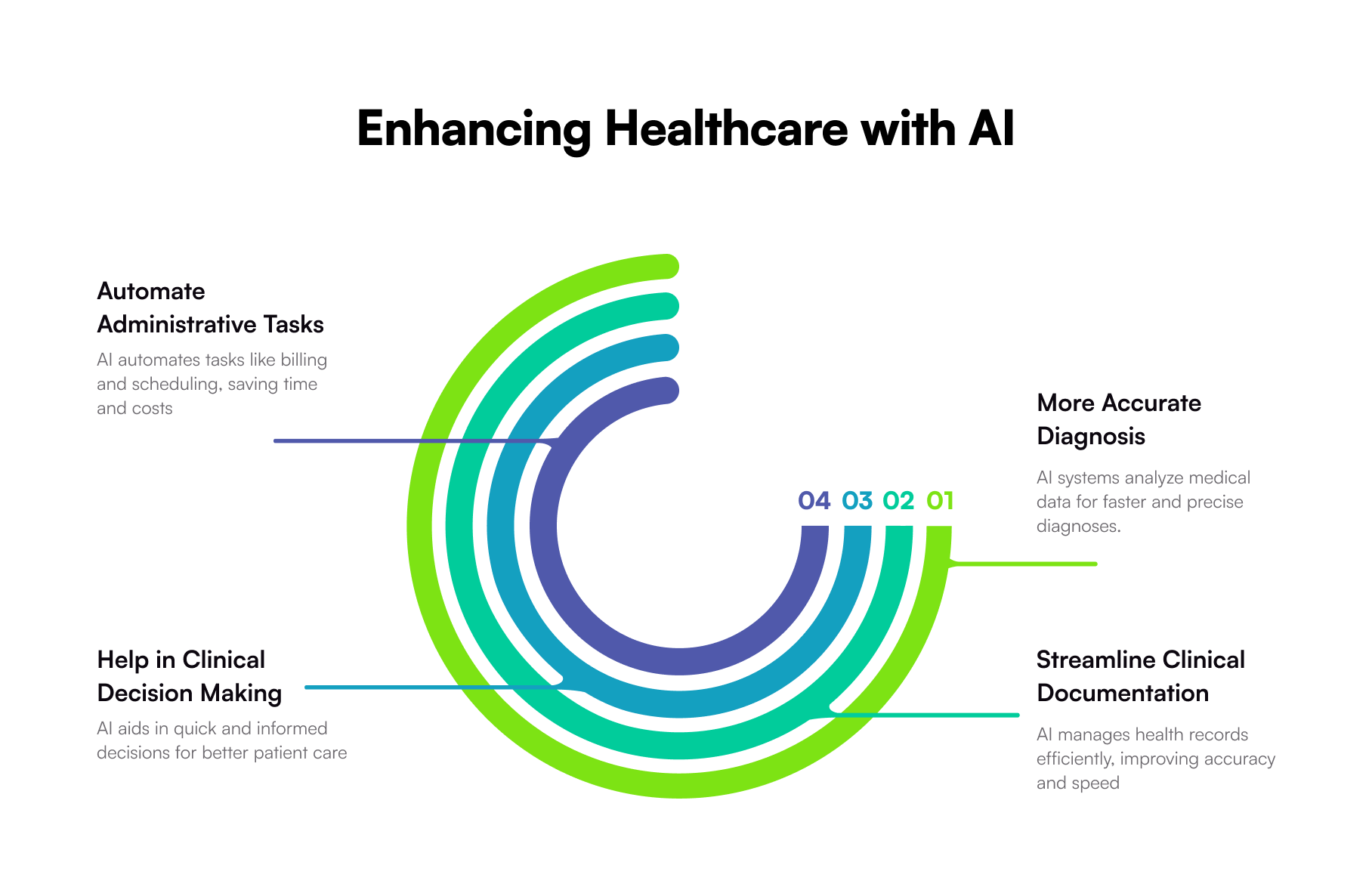
Artificial Intelligence isn’t just about integrating technology into your workflow; but it is more like improving the processes in healthcare that result in better patient care. There are many advantages of using AI in the healthcare industry, as discussed below.  

More Accurate Diagnosis Faster 

It looks like a dream if you can diagnose thousands of patients in merely a fraction of the time that a human specialist would take. This is only possible with the use of sophisticated AI systems that can efficiently analyze medical imaging data like X-rays, MRIs, CT scans, ultrasounds, etc.  

For example, an AI system is capable of identifying micro-fractures or early-stage cancers to help save the lives of patients. Such a system can offer more accurate and faster diagnosis by meticulously analyzing patient records, medical imaging, health history, and other information. It results in faster and better delivery of treatments. However, you need the best custom healthcare software development services to develop efficient AI-powered platforms that can speedily analyze imaging data and offer highly accurate diagnosis.  

Streamline Clinical Documentation 

The use of artificial intelligence in healthcare helps manage clinical documentation more efficiently. It improves accuracy, speed, and makes the process less burdensome. Healthcare specialists and hospitals create various health records of patients, including test reports, patient history, diagnoses, and more.  

Managing these documents manually is a herculean task that AI can help complete in a fraction of that time. Powered by NLP (Natural Language Processing) and speech recognition, AI platforms can make the process faster and convenient.  

For example, doctors can leverage voice-to-text transcription to dictate notes after or during a consultation. They can also be integrated with EHR (Electronic Health Record) systems to increase efficiency.  

Help in Clinical Decision Making 

Prompt decision-making is crucial for doctors and healthcare professionals when it comes to critical illnesses. The integration of artificial intelligence in their healthcare processes can enhance the outcome and reduce the turnaround time for reports, resulting in faster diagnosis and decision-making.  

So, AI in healthcare can help medical practitioners make faster decisions that improve overall patient care. AI solutions improve decision-making by helping healthcare providers deliver efficient, accurate, and personalized clinical care.  

Automate Administrative Tasks 

Artificial Intelligence can help reduce the burden on hospital staff and medical professionals by automating tasks. With the use of advanced AI solutions in the healthcare industry, medical practitioners can improve efficiency and save time by automating tasks like billing, scheduling, and updating records.  

By automating the repetitive administrative tasks with AI, healthcare providers can save time and cut down costs. It eliminates roadblocks in healthcare services by offering well-optimized operations.   

Different Types of AI Solutions in Healthcare 

When it comes to AI in the healthcare market, there are diverse benefits and use cases. There are different types of AI for healthcare that help medical practitioners improve efficiency and speed up their processes for better patient care.  

There are diverse solutions, ranging from AI applications in healthcare to conversational AI in healthcare.   

  • AI-powered Image Recognition Systems 
  • Predictive Analytics 
  • Virtual Assistants in Healthcare 
  • Robotic Process Automation (RPA) 
  • Natural Language Processing 
  • Clinical Decision Support Systems 
  • Internet of Things (IoT) 
  • Machine Learning 

To Wrap Up 

The future belongs to AI, and those who fail to adapt will become the past. This statement perfectly applies to almost all kinds of industries, including healthcare. The choice of AI development is going to transform the future of enterprises regardless of the industry type.  

Moreover, creating the right AI solution for healthcare requires technical knowledge and plenty of experience. We have highly proficient and experienced AI developers to help create complex enterprise-grade AI applications, systems, and multi-device platforms for your healthcare institution. 

You can contact us to discuss your project, and we will help you develop a top-notch solution for you that will offer a transformational shift in your processes and workflows.  

Frequently asked questions 

How is AI used in healthcare? 

There are multiple uses of AI in healthcare that range from diagnosing diseases to streamlining operations and in research. It automates processes and helps create faster, efficient, and more reliable patient care services.  

What is the cost of developing a healthcare application? 

It is not easy to define how much it costs to develop a healthcare app because there are many factors that impact the cost. So, it can vary significantly depending on the project requirements, app complexity, features, and other factors. It might cost between $20,000 – $50,000 if your app is basic with limited functionality. However, a more complex and advanced AI healthcare application costs between $100,000 – $300,000.  

Should we pick custom or off-the-shelf AI solutions for healthcare?  

It depends on your requirements. While off-the-shelf solutions are budget-friendly in the short run and can be integrated in the least possible time, they lack tailored features and benefits for healthcare providers. A custom AI solution is specifically created for a healthcare provider that offers unique features and benefits, as well as aligns with a healthcare provider’s needs.  

Integrating AI in Customer Journeys for Enhanced Interactions 

Discover how AI customer touchpoints, customer interaction AI, and AI engagement strategies are reshaping the modern customer journey.  

In a market where customer expectations pivot faster than product launches, the AI customer journey is no longer an experiment—it’s the engine driving modern brand growth. From predictive recommendations that anticipate intent to service channels that resolve issues before they become pain points, AI is orchestrating the entire customer experience in real time. 

Starbucks is already there. Through its AI platform Deep Brew, the company transforms everyday transactions into personalized journeys—predicting when you’ll crave your next order, surfacing tailored offers, and driving digital sales that now account for nearly half of total revenue.  

With the right type of AI-powered platform, applications are no longer just automates the process, but leverage intuition at scale.  

With integrating AI CX, the question isn’t whether AI belongs in the customer journey—it’s how creatively and intelligently you apply it. Every AI customer touchpoint becomes an opportunity for trust; every customer interaction with AI is a chance to extend loyalty.  

The brands pulling ahead aren’t waiting for the future of CX with AI. They’re building it, now. 

Mapping the Modern AI Customer Journey 

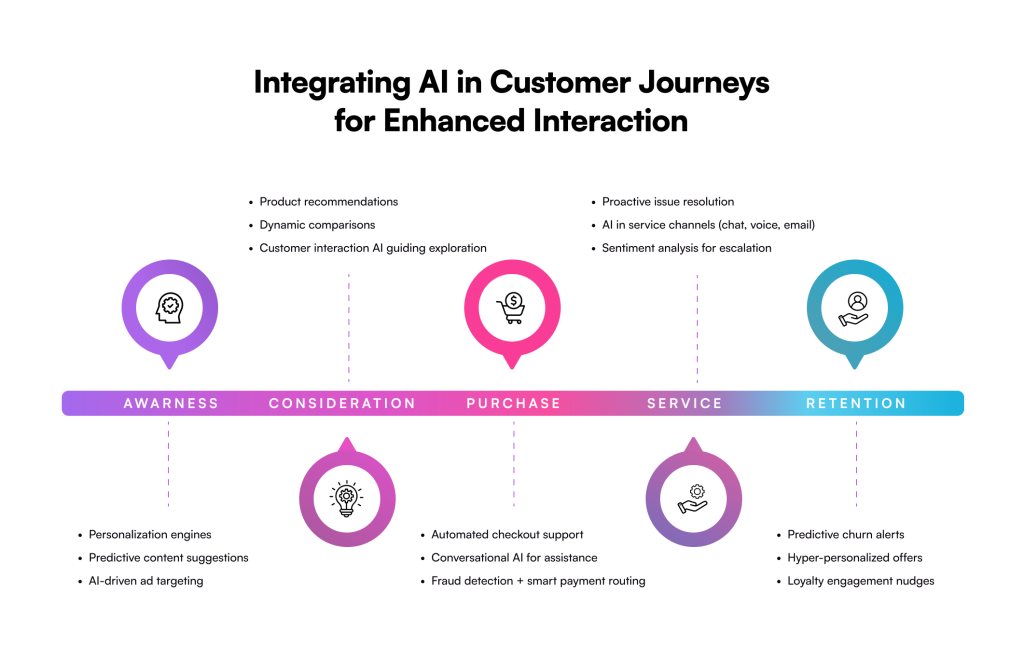
Integrating AI in Customer Journeys for Enhanced Interaction

The customer journey has always followed a familiar arc—awareness, consideration, purchase, service, retention. What’s changed is how intelligence flows through it. Today, AI customer touchpoints are no longer isolated fixes; they’re the hidden infrastructure threading every stage together. 

At awareness, personalization engines surface the right product before a search is even typed. In consideration, predictive nudges reduce friction by narrowing choices to what truly resonates. At purchase, automated support steps in—not as a chatbot answering FAQs, but as customer interaction AI guiding decisions in context. And in service and retention, proactive engagement transforms the after-sale moment from problem-solving into anticipation—resolving issues before they escalate, reminding before a need is felt. 

This is the essence of integrating AI CX: it’s not about layering tools onto touchpoints, it’s about orchestrating a seamless continuum. Each interaction feels less like a transaction and more like an ongoing conversation—AI as the connective tissue that keeps the journey fluid, intuitive, and distinctly human at scale. 

Industry Playbooks: Where AI Transformation CX is Already Delivering 

In boardrooms, the question is no longer if AI creates value in customer experience, but where and how much. Across industries, we’re seeing measurable improvements in retention, revenue-per-user, and cost-to-serve. The playbooks are emerging. 

Retail & eCommerce 

AI isn’t just optimizing clicks—it’s rewriting cart economics. Amazon attributes ≈ 35% of its sales to AI-powered recommendations (McKinsey). Real-time personalization engines reduce bounce rates, while AI in service channels cuts abandonment by stepping in with nudges at checkout.  

Banking & Fintech 

Fraud detection powered by AI models now analyzes millions of transactions in milliseconds—flagging anomalies traditional systems miss. At the same time, conversational AI is reshaping trust as banks facing reduction in response times for routine queries, while customer satisfaction scores climb because agents are freed to focus on high-value advice. The equation is simple: higher retention, lower fraud losses, stronger loyalty. 

Healthcare 

AI is embedding itself into patient journeys—before, during, and after care. Virtual triage reduces unnecessary ER visits; predictive outreach ensures patients don’t miss follow-ups. Hospitals using AI in service channels also report shorter wait times and higher treatment adherence, translating directly into better outcomes and lower costs. 

Travel & Hospitality 

From itinerary planning to post-trip surveys, AI engagement strategies are being used to stitch experiences together. Airlines use predictive AI to reroute passengers before delays cause chaos. The competitive edge comes from orchestrating touchpoints into a continuous, personalized journey. 

B2B SaaS 

Onboarding has always been the leak in the funnel. With seamless AI integration, platforms now proactively detect friction—surfacing help content or routing to support before churn sets in. 

Telecom 

Scaling customer service without exploding cost has always been the telecom paradox. AI-powered predictive issue resolution means providers can now flag and fix network issues before customers call in. For a high-volume, low-margin industry, these metrics compound into significant EBITDA gains. 

Strategic Levers: Where AI Creates Both Advantage & Risk 

In a space where expectations evolve faster than quarterly plans, AI isn’t a side tool—it’s the core lever shaping customer equity. The challenge is to maximize upside without turning automation into a liability. 

Enhancing CX with AI 

  • From hyper-personalization to journey orchestration, AI is enabling brands to anticipate intent, not just react to it. 
  • Done right, it builds loyalty loops that compound lifetime value. Done poorly, it fragments journeys and erodes trust. 

AI User Experience 

  • The real edge isn’t speed—it’s empathy at scale. 
  • A seamless AI user experience means customers feel understood, not processed. Broken flows, irrelevant nudges, or “cold” automation quickly flip advantage into frustration. 

AI Engagement Strategies 

  • Leaders aren’t deploying AI as isolated tools—they’re orchestrating it across touchpoints. 
  • Predictive outreach, proactive engagement, and contextual personalization ensure every moment in the journey adds value. 

Competitive Edge 

  • Speed, scale, and consistency are the raw advantages of AI. 
  • When embedded into service and engagement, these become competitive differentiators measured in margin lift, retention, and reduced cost-to-serve. 

Strategic Risks 

  • Over-automation risks stripping out empathy. 
  • Poorly designed systems create friction and customer churn. 
  • Ethical and regulatory missteps—bias, misuse of data, lack of transparency—aren’t operational issues, they’re brand liabilities that can undermine equity overnight. 

Implementing Seamless AI Integration: What Leaders Must Orchestrate 

In a space where customer expectations move faster than product roadmaps, seamless AI integration isn’t a checklist item — it’s the operating model. Below are the compact levers you need to get right, written as action-first pointers you can use immediately. 

Data alignment (the fuel) 

  • Create a single customer graph so every AI customer touchpoint reads the same truth. 
  • Enforce data contracts, schemas, and real-time streaming so personalization isn’t stale. 
  • Treat privacy and consent as feature requirements — they’re core to trust and to any AI user experience you claim. 

Technology orchestration (the nervous system) 

  • Standardize on API-first models and modular ML services so models are composable, not brittle. 
  • Bake in model versioning, latency SLAs, and CI/CD for ML — scale fails without ops. 
  • Choose platforms that enable seamless AI integration across product, marketing, and support stacks. 

Service channel design (the customer face) 

  • Embed AI in service channels with context persistence: no repeated questions, no lost history. 
  • Design human-in-the-loop handoffs where empathy matters; AI handles scale, humans handle nuance. 
  • Optimize for continuity — the AI that starts a conversation must be able to finish it, across chat, voice, and app. 

Change management (the multiplier) 

  • Run cross-functional squads (data, product, design, ops) accountable for outcomes, not features. 
  • Train teams on interpreting AI signals and on fallbacks — tooling without literacy creates brittle experiences. 
  • Set new KPIs (time-to-insight, automation quality, escalation rates) tied to AI user experience. 

Why implementations fail (and how to avoid it) 

  • Siloed pilots that never integrate into channels — outcome: tools that don’t move metrics. 
  • Chasing point solutions instead of orchestration — outcome: brittle UX and wasted spend. 
  • Ignoring the AI user experience — outcome: automation that feels robotic, not helpful. 
  • No feedback loop from live interactions back into model tuning — outcome: personalization decay. 

Rapid roadmap (4 phases you can run in 90–180 days) 

  • Foundation — unify identity, consent, and event streams. 
  • Pilot & instrument — deploy 1 high-value touchpoint (checkout or onboarding), measure lift. 
  • Orchestrate — connect pilots into channels, enable context handoffs, harden ops. 
  • Scale & govern — rollout across journeys with model governance and ethical guardrails. 

 The Horizon: From Reactive AI to Predictive Journeys 

Customer experience is no longer about responding well — it’s about anticipating what comes next. The horizon for AI transformation CX is staged, and leaders must know where they stand on the curve. 

Near-term: Anticipatory engagement 

  • Shift from reactive bots to AI engagement strategies that predict intent before the click. 
  • Use behavioral signals, historical context, and purchase triggers to reduce friction. 
  • Redefine KPIs around proactivity: fewer tickets, faster resolutions, higher conversions. 

Medium-term: Ambient extensions of CX 

  • Embed AI into AR, VR, wearables, and connected devices — creating continuous touchpoints. 
  • Build for ambient presence: the AI user experience follows customers across contexts without reset. 
  • Treat devices as conduits, not channels — data streams should power one unified journey. 

Long-term: Invisible infrastructure 

  • AI becomes background utility — the “always-on” layer of every customer journey. 
  • Focus on governance, trust, and resilience: invisible doesn’t mean unmanaged. 
  • Leaders who master this phase make AI transformation CX a compounding advantage, not a one-off project. 

Leadership takeaway 

  • The horizon is not about features — it’s about orchestration over time. 
  • Every step compounds: reactive → predictive → ambient → invisible. 
  • Miss a phase, and competitors own the customer journey you failed to design. 

Turning Journeys into Growth Engines With Galaxy Weblinks 

You don’t have to imagine what exceptional CX looks like—we’ve already built it. In a project with NETGEAR for its Orbi mobile app, Galaxy Weblinks worked to: 

  • Modernize architecture (MVVM/MVI, dependency injection) so the app’s foundation could evolve, not stagnate.  
  • Dramatically enhance stability and usability, reducing crashes and frustrations that undermined user trust.  
  • Deliver new features (security tools, parental controls, onboarding) embedded smoothly so users actually use them.  

Those improvements didn’t just refresh the UI—they elevated the AI user experience indirectly, set up seamless AI integration paths for future features, and strengthened brand equity. 

Galaxy Weblinks offer innovation-intensive CX consulting services to bring that same depth to any brand serious about its customer journey. If your challenge is reducing abandonment, scaling support, or architecting AI-enabled experiences that feel intuitive—not intrusive—we already have hands-in work that mirror yours. 

Contact us to build your next leap forward together—where every touchpoint feels considered, every interaction adds value, and AI becomes your brand’s infrastructure. 

Enhancing CX Through Secure, Data-Driven Strategies

A great customer experience with a promise of robust security is the key to a successful business, and in this blog, we’ll learn how you can boost it by leveraging effective data-driven strategies. 

Mobile applications with flashy and interactive interfaces are no longer the focus of businesses hopping. They are resorting to secure, data-driven strategies to protect the confidential information of their customers.

Every company operator is obliged to discover the equilibrium between the two factors: security and personalization, so as to achieve better returns on investment and provide an advantage over the competition. Therefore, the returns on the data security market are forecasted to experience a compound annual growth rate (CAGR) of 8.81% from 2025 to 2030.

In this detailed guide, we’ll walk you through the different ways of enhancing the CX by leveraging different secure data management techniques, and much more. 

Maintaining the Balance Between Personalization and Protection for a Better CX

In recent times, personalization has become a driving force for higher engagement, customer loyalty, etc. And you must know that personalization mostly relies on the customer data that automatically comes with the responsibility of protecting it. 

A brand that promises to maintain trust in digital CX can easily survive in the market, all while maintaining personalization. That is why the advanced-thinkers not only prioritize data security & privacy as a core part of CX design. But also leverage customer experience consulting and competitive analysis to stay ahead of changing customer expectations and industry standards.

When you combine personalization with data security, it is possible to take your enterprise to a whole new level in a number of ways. This will have a positive impact on your business’s success rate. Secure and data-centric methods allow businesses (such as yours) to provide an efficient, smooth, and trustworthy experience.

CTA

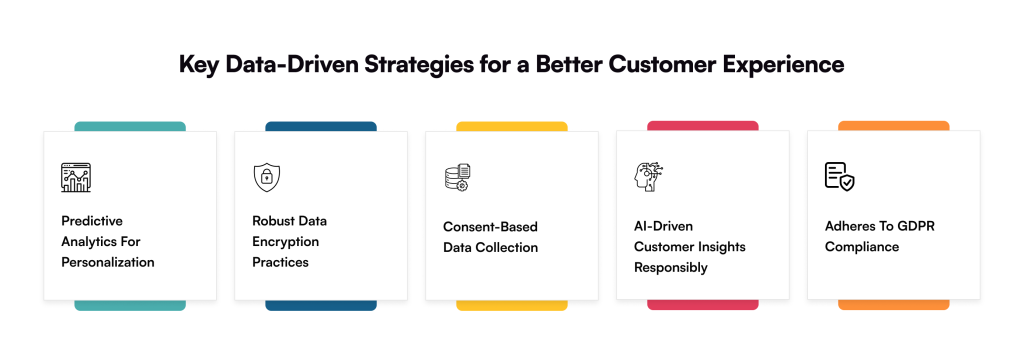
Top Effective Data-Driven Strategies for a Better Customer Experience

CX

Now that you know the importance of cybersecurity in customer experience, it’s time to bring all the theories into action. Here are some of the effective and proven data-driven strategies you can implement for an improved CX:

  • Leverage Predictive Analytics for Personalization

What if you could understand what your customer might require even before they know it or are just thinking about it? Predictive analytics is the answer to that. By analyzing past behaviors, purchase history, or browsing patterns, you can come up with recommendations that are very close to the mark. Just be certain that the data you are dealing with is handled in a responsible manner and is kept secure.

  • Adopt Robust Data Encryption Practices

Encryption is a way of putting your customer’s data in a highly secure and protected place that only you and your customer have access to. Every login, every payment, every click must be protected. Customers will feel a lot safer interacting with your brand when they know that their sensitive details are secure, and that’s when trust becomes loyalty.

  • Implement Consent-Based Data Collection 

Not really liking the feeling that they are constantly being watched is the way people will respond. Asking for consent before gathering data is a big deal; it makes a huge difference. When you are open about what is being taken and for what reason, customers are ready to give you more information, and at the same time, they will feel satisfied.

  • Use AI-Driven Customer Insights Responsibly

AI is a strong asset in figuring out what the customers want the most. It can find the customer’s pain points, predict the behavior, and even propose ways to improve the CX. But here is the rule of thumb: you should not behave like a stalker and, at the same time, use AI in the customer experience enhancement. Let AI assist and not overload the customer journey.

  • Ensure Compliance with GDPR

At first, rules such as GDPR compliance or CCPA can give the impression of a hindrance; however, these laws are really intended to safeguard the customers. Operating in accordance with these laws is not just keeping you within the legal limits, but also establishes a level of confidence in your customers that their privacy is respected. This is a new and unique selling point in today’s world. 

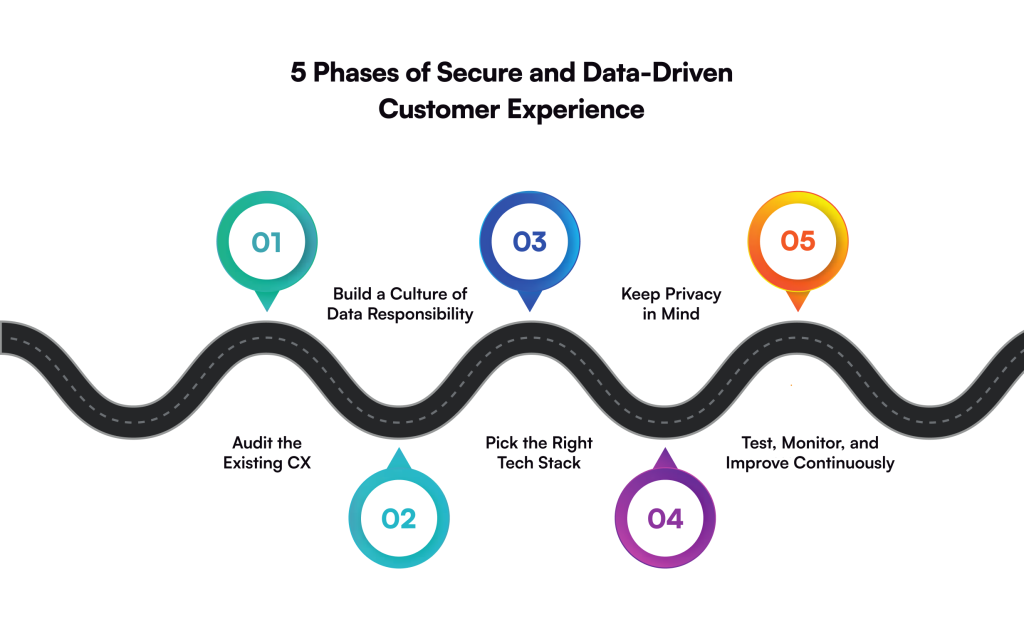
Step-by-Step Roadmap to Secure and Data-Driven CX

CX

After planning out the foolproof data-driven CX strategies, here is a blueprint to design customer experiences that are personalized as well as secure. 

  • Audit Your Existing CX and Data Practices

The first step is to begin by auditing (or understanding) where you stand today. Ask yourself the following questions to get clarity on the gaps, and then prioritize the fixes accordingly:

  1. Are you collecting too much data?
  2. Is there any weak point in your security setup?
  3. Is the collected data being put to use for CX improvements?
  • Build a Culture of Data Responsibility

If you think that CX is the job of your customer support or marketing teams, it’s not because it requires the full-fledged effort of an organization. As a business owner, you must train your teams to handle the customer data responsibly. So, if the sales team or the IT team already knows the true value of data security, protecting it comes from within. 

  • Pick the Right Tech Stack

If you are not picking the right set of technology, there are chances that your efforts to boost the CX will be in vain. You must choose a suitable technology that will maintain the balance between personalization and data protection. To make sure you are making the right choice, always look for built-in encryption, compliance features, and transparent data processing.

  • Design with Privacy in Mind

While crafting an interactive UI/UX design, never neglect privacy because a visually-appealing interface will stand alone not retain the users for long. Always keep the “privacy-first” approach in mind before setting up the signup form, a chatbot, or an app feature. This way, you are reassuring your customers and keeping the business compliant. 

  • Test, Monitor, and Improve Continuously

Customer expectations are always changing, and they continue to evolve as the digital world and market trends change. Be certain that you are operating your systems regularly to discover possible weaknesses or threats, and also to see how customers are reacting to your CX. A roadmap is not a once-only mission but an endless trip. 

How Galaxy Weblinks Can Help You Boost Your CX with Secure Data Management

At Galaxy Weblinks, we understand the importance of customer experience, and also the fact that CX and security go hand in hand. 

 We have skilful professionals, backed by years of experience, who can build secure, scalable, and user-friendly digital solutions. 

By leveraging cutting-edge technologies, we help businesses (like yours) strike the perfect balance between personalization and data protection. So, if you have got the idea, we have a team that can bring your vision into reality by maintaining A1 security. 

With us, you don’t just get a technology provider but a trusted ally that helps you deliver a secure, seamless, and futuristic customer experience. So, what are you waiting for? 

Give us a call now!

FAQs

1. Why is data security important for customer experience (CX)?

A main aspect of data security is the trust of the client. Your application or website can have wonderful features, but customers will not continue to choose you if they see that their data is in danger. Safe CX provides both a customer with a personalized approach and, at the same time, security, which leads to the creation of trust in the brand in the future.

2. How do data-driven strategies improve CX?

Through data-driven strategies, companies could get the inside scoop on customer preferences and preemptively provide needs-tailored solutions. If done right, the security makes customer engagement more relevant, quicker, and more satisfying, thereby ensuring privacy is not at risk.

3. What’s the biggest challenge in balancing personalization and data protection?

Immersing deep into customers’ lives to provide them with real personalization without crossing their privacy boundaries at the same time is the biggest difficulty. Transparency on how the data is taken, respect for the choice of the customer, and good cryptography are the three points a business should address in order to make a client feel secure with them.

4. How can small businesses adopt secure, data-driven CX strategies?

Small companies can start by reviewing the extant modus operandi, selecting ways that have security features as a part of their service, and concentrating on data collection based on previous customer consent. More so, the steps, important as encryption, transparency, and privacy law conformity, can positively impact the business significantly.

5. What are some examples of secure, data-driven CX practices?

They may be predictive analytics utilization in providing more rational suggestions, complete encryption of all communication with customers, carrying out data collection only after getting customers’ consent, employing AI in a responsible manner for gathering insights, and conforming to globally acknowledged privacy regulations such as GDPR and CCPA.

The Role of AI in Telemedicine: From Diagnosis to Treatment

Imagine you woke up with a sudden & unusual headache, and to cure this pain, you simply logged into an app, described your symptoms, and then? Next, you see yourself interacting with an AI-powered expert, who suggests the next steps. 

Well, all of this sounds futuristic, right?

But what if we tell you this is actually a reality, far away from the future? Yes, it’s true, and this is the present reality of telemedicine. In recent years, the telemedicine landscape has accelerated and is growing at an unprecedented rate. 

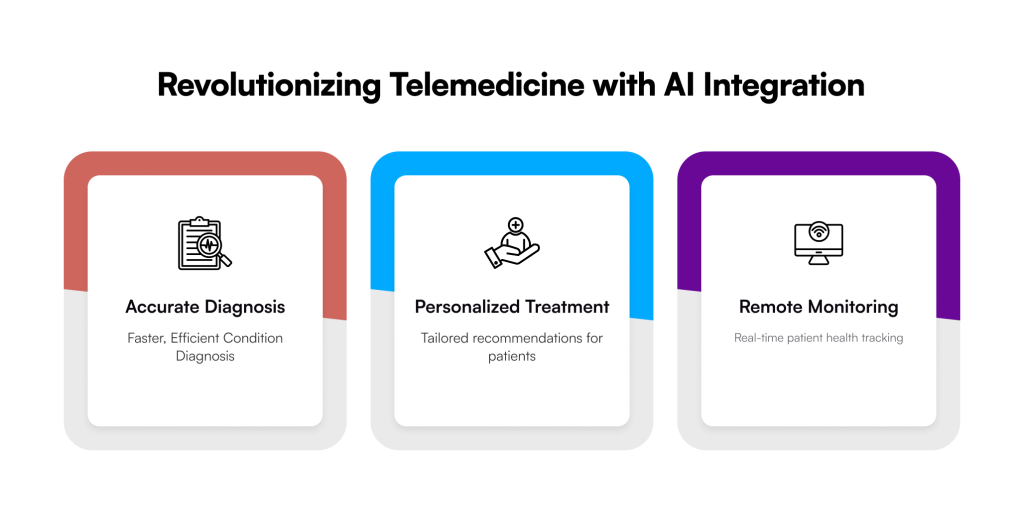
According to Fortune Business Insights, the global telemedicine market size is expected to reach $334.80 billion by 2032. Behind all this expansion, AI development is one of the biggest driving forces. With the help of artificial intelligence, you can not only enable faster diagnosis but also provide personalized treatment plans and much more. 

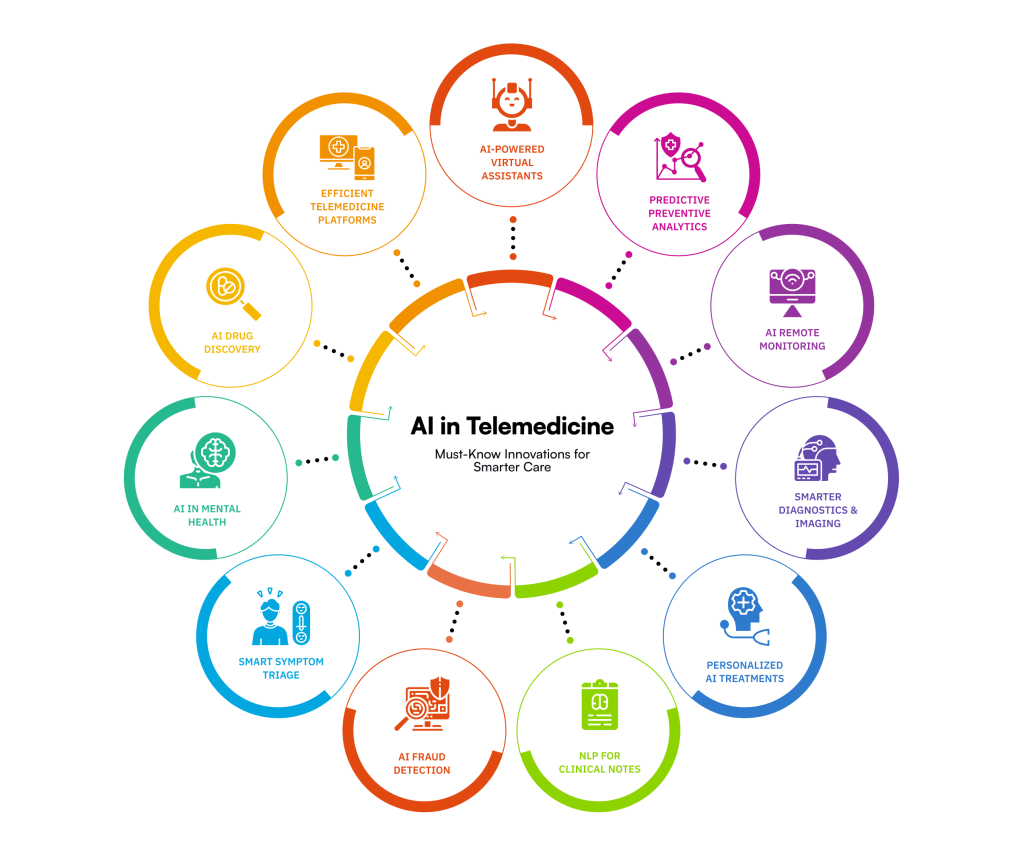
The role of AI in telemedicine isn’t just making everything convenient, but smarter. In this blog, we’ll walk you through the 10 powerful and effective ways AI in the telemedicine market is redefining the future of the healthcare ecosystem. 

AI in the Telemedicine Industry: Top Breakthroughs You Need to Know

Incorporating AI into telemedicine is a step closer to revolutionizing the healthcare industry as a whole, making it more accessible, improving individualized care, and much more. The future of AI in telemedicine is bright, ultimately closing the gaps between patients and healthcare professionals.

Let’s have a look at the different ways telemedicine and AI in healthcare are going hand-in-hand and making access to care much easier than ever. 

  1. AI-Powered Virtual Assistants and Chatbots

What if you need urgent medical advice from a doctor at midnight, and you instantly get it from AI-powered chatbots or virtual assistants? With time, AI-driven tools are becoming sophisticated than ever, where virtual assistants can provide you with immediate support. From booking appointments & answering basic queries to giving medicine reminders to patients, AI chatbots have become the first touchpoint in telemedicine. 

  1. Predictive Analytics for Preventive Care

What do you think is much better: reacting after any health issue strikes or predicting it and taking action beforehand? Obviously, the second option sounds much more useful. That being said, AI can help you with the same by understanding patients’ medical history and forecasting risks, like diabetes or hypertension. This way, you can reduce the possibilities of high-risk situations and get a doctor’s attention at an early stage. 

  1. Remote Patient Monitoring with AI

Smartwatches have always been in trend for many reasons, but tracking real-time activity or the count of your steps remains at the top. With AI-enabled RPM, you can trigger a warning and go see your doctor before anything major happens. Wearables and IoT devices in real-time help in analyzing the data, and later, AI detects the unusual activities and alerts the person instantly. 

  1. AI-Assisted Diagnostics & Imaging

IMAGINE: You sent an X-ray to an online platform assisted with AI capabilities and received a diagnosis at lightning speed. Sounds unrealistic, right? But with the presence of artificial intelligence, anything & everything is possible because its models are trained on medical images. Later, these future-ready technologies flag potential concerns with high accuracy by supporting tele-radiologists or dermatologists. 

  1. Personalized Treatment Plans

AI-powered telemedicine equipment should, in general, offer individualized treatment plans for precise treatment planning. Patients may effortlessly traverse every stage, whether they are examining their therapy or consulting a doctor, thanks to a well-crafted UI/UX design. AI-powered customisation can be expanded to examine daily routines and historical medical data, providing individualized treatment regimens.

  1. NLP for Clinical Notes

Doctors say, “The best part is the time spent with patients, not the paperwork.” AI-driven NLP tools are now able to listen and take notes automatically and produce structured notes/documents and summaries (for example, prescriptions) during teleconsultations. It provides as close to a real assistant as possible and allows clinicians to focus on patients rather than typing.

  1. Fraud Detection in Telehealth

In the healthcare industry, security is the key to maintaining the user’s trust while they share their personal information. AI-powered systems are well-trained to identify any unusual activity, like strange billing patterns, information theft, or more. AI in the telehealth and telemedicine market gives innovative solutions that help improve patient safety. In short, the integration of AI in the telemedicine market has significantly improved fraud detection and delivered a seamless user experience. 

  1. Symptom Checkers and Smart Triage Systems

Picture that as a digital nurse who is available 24/7. AI triage systems could ask questions in a structured manner to patients, evaluate the signs and symptoms associated with an illness, and determine whether the patient can self-manage, see their family doctor, or go to the emergency department. Thus, the opportunity to avoid unnecessary visits to emergency rooms, with less chance that a legitimate emergency would be missed.

  1. AI in Mental Health Teletherapy

How great you’d feel if you could talk to someone who could sense your mood instantly? AI is like that; It feels like having a personal therapist anywhere and at any time you want. By simply analyzing your tone, choice of words, or even the type of emojis you have used. After receiving such insights, therapists can easily identify the early signs of stress, anxiety, or depression, and provide the support you need. 

  1. Drug Discovery and Tele-Pharmacy Integration

Drug discovery may not come to your mind when you think of “telemedicine,” but artificial intelligence is making the connections. AI is used by telepharmacy platforms to check for interactions and guarantee the safety of prescriptions, while machine learning models aid in the quicker identification of new medication compounds. Without having to enter a pharmacy, patients can obtain medication more quickly and safely.

  1. Operational Efficiency in Telemedicine Platforms

AI is the silent optimizer that works in the background. It improves the efficiency of telemedicine systems by predicting no-shows, reminding patients, and intelligently allocating doctors according to the complexity of the case. The outcome? Reduced patient wait times and improved physician time management.

What is the Future of AI in Telemedicine

AI in the Telemedicine

The integration of AI in telemedicine can (or will) never replace professional doctors or physicians; it will just double their power, while assisting patients in a timely manner. 

If we look in another direction, the future of AI in the telemedicine market will incline more towards a hybrid approach. That means, doctors will concentrate on empathy, complex cases, and decision-making, whereas AI will do the heavy-lifting, like data analysis, symptom triage, etc. 

In a nutshell, the future of AI in telemedicine is a combination of cutting-edge technology, wider access, and better security protocols. AI being at the forefront will continue to make the healthcare industry modern and convenient. 

Build Your First-Ever Smarter Telehealth Platform with Galaxy Weblinks

The future of digital healthcare looks promising than ever – all thanks to the integration of AI in telemedicine. From diagnostics to helping with real-time monitoring, AI has transformed the landscape of the healthcare sector, making it more accessible, efficient, and personalized. 

However, if you truly want to leverage the potential of AI in the telehealth and telemedicine market, you need custom healthcare software development services to build a tailored solution. A skilful and experienced team that can understand your vision and turn it into reality. 

At Galaxy Weblinks, we have a pool of the right technology partners who can bring their expertise to the table and meet your expectations. They will help you build a scalable and secure telehealth platform. We’ll craft highly intuitive interfaces while ensuring necessary compliance to make your app safe & secure. 

Partner with us and build your dream telemedicine platform now!

FAQs

1. In what ways is AI enhancing telemedicine for patients?

AI makes telemedicine more accessible by providing instant triage, precise diagnosis, and customized care. Patients enjoy faster consultations, proactive health monitoring, and intelligent suggestions—all without ever having to leave their homes.

2. Can AI substitute doctors in telemedicine?

No, AI is not replacing doctors—it complements their abilities. AI performs routine tasks such as documentation, symptom interpretation, and monitoring, while doctors concentrate on high-order decision-making, empathy, and patient care, leading to improved outcomes for both providers and patients.

3. Is telemedicine AI safe and reliable?

Yes, when responsibly developed. Agencies such as the FDA and EU make certain that AI technologies adhere to rigorous safety, compliance, and accuracy protocols. Under proper regulation, AI in telemedicine is extremely reliable and on an upward trajectory of improvement.

4. What are some real-world examples of AI in telemedicine?

From AI-scheduling appointment chatbots to AI readers of X-rays and heart arrhythmias detected by wearables, numerous telemedicine platforms already apply AI on a daily basis. It accelerates healthcare, makes it more accessible, and more patient-focused.

5. What is the future of AI in telemedicine?

The future holds smarter telehealth applications that forecast health threats, link patients worldwide with experts, and provide hyper-personalized treatment. Thanks to continuous innovation, AI has the potential to turn telemedicine into the norm through which people receive healthcare globally.