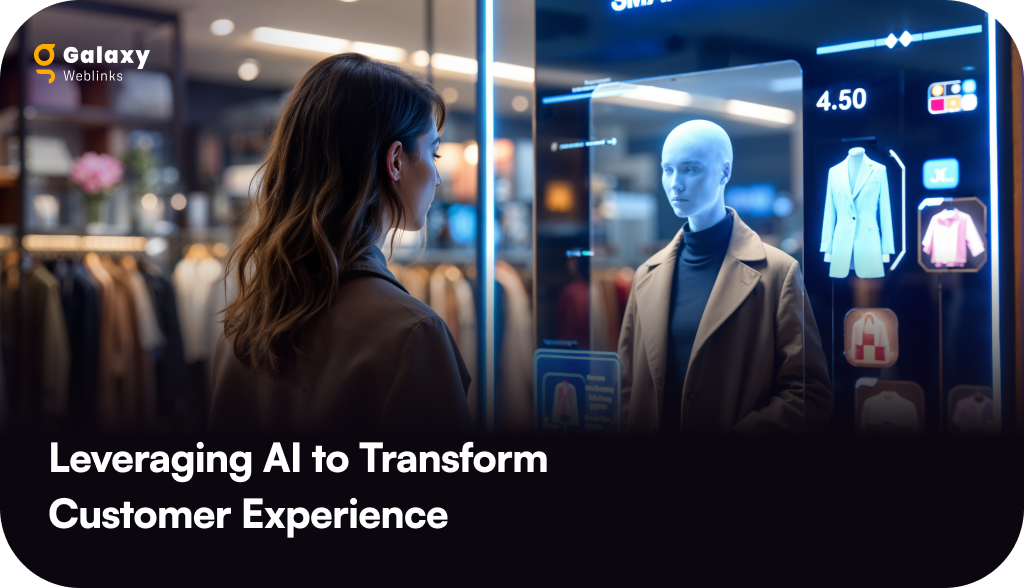
Leveraging AI to Transform Customer Experience 

In a world where customer expectations shift faster than product launch cycles, AI is not just supporting service—it’s rewriting the rules of engagement in real time. From Starbucks delivering hyper-personalized offers on its app to Home Depot guiding customers through complex DIY projects via AI chatbots, the brands that win aren’t reacting—they’re anticipating. 

Generative AI and AI-driven services are the core engines behind better conversations. AI now predicts what customers need before they ask. It personalizes every touch. And it turns routine support into action that feels human. Nike uses predictive analytics to suggest the right shoe at the right time. JPMorgan Chase uses AI to see a client’s need before it appears. That’s not magic. That’s precision—done at scale. 

The scale is undeniable: Accenture predicts AI could lift corporate profitability by 38% by 2035. But beyond numbers, the real shift is experiential. It’s about personalized customer journeys that feel intuitive, real-time service that feels human, and proactive support that feels thoughtful. 

AI is everywhere. But you get success by using it right. The winning brands don’t chase numbers. They chase clarity. Brands use AI in customer experience to predict. Smart systems now recommend before customers even ask. Chatbots fix problems before they appear. The future of customer experience isn’t coming—it’s here. 

Moving From Traditional Customer Support Towards AI-driven Customer Experience 

Aspect Conventional CX AI-Powered CX 
Customer Support Reactive Customers reach out after an issue arises Proactive AI predicts issues and offers solutions before they occur 
Resolution Time Long wait times Manual escalation Real-time assistance Use of chatbots, voice AI, and automated workflows 
Personalization Generic interactions and solutions to everyone Hyper-personalized experiences Analysis of behavior, history, and preferences 
Scalability Limited  Requires more staff and resources to handle volume Unlimited AI scales effortlessly across regions, languages, and channels 
Customer Journey Mapping Fragmented across platforms and often siloed Unified, omnichannel view powered by AI-driven insights 
Decision-Making Based on historical data, often outdated Predictive — real-time analytics and forecasting for smarter engagement 
Cost Efficiency High operational costs due to manual processes Reduced costs through automation and optimized resource allocation 
Customer Satisfaction Inconsistent and heavily dependent on agent expertise Consistently high, driven by instant, tailored, and seamless experiences 

Customer service has always been reactive: A call came in. An agent replied. The customer waited again. That world is ending. 

AI has changed the rhythm. Chatbots and generative tools don’t react—they move first. They turn friction into flow. 

Look at Sephora. Its AI chatbots don’t just answer—they guide. They help customers find products, suggest what fits, and even book appointments. Every click feels smoother. Every step feels planned. 

This is where the edge appears. 
Proactive support sees trouble before it hits. An e-commerce site can spot a shipping delay and fix it before the buyer knows. 
Amazon does it. Zappos does it. 
That’s why their customers stay. Because trust begins before the problem ever does. 

The numbers underline the opportunity: Gartner reports that AI can reduce 80% of common customer service issues by 2029. But the real story is not efficiency—it’s the scale of engagement. AI lets brands deliver personalized, timely, and context-aware experiences without losing the human touch. 

In this landscape, the edge is not just integrating AI in customer experience—it’s applying it intelligently. From AI chatbots that anticipate needs to generative AI shaping dynamic experiences, the brands that lead turn service interactions into a competitive advantage. 

AI in Customer Experience: Crafting Personalized Customer Journeys at Scale  

From browsing history and click patterns to past purchases and in-app behavior, AI in customer journeys is not just tracking data—it’s turning it into action. Personalized customer journeys are no longer about segmentation—they’re about anticipation at scale. 

Generative AI crafts content that feels human and contextual. Product recommendations, marketing messages, visuals—everything adapts to the individual, in real time. Stitch Fix predicts your next outfit. Sephora suggests your next shade. Netflix serves your next binge. Every interaction is personalized, timely, and predictive. 

The impact is tangible. McKinsey finds personalization can boost revenue by up to 40% and generate over $1 trillion in value. But the real advantage is not the numbers—it’s the experience. Customers do not just engage—they feel understood. They do not just shop—they stay loyal. 

AI in CX is a vision. Generative AI builds campaigns made for one person at a time. AI insights shape every touch. 

The best brands make journeys that feel easy. Fast. Predictive. Human. 

Integrating AI Across Channels: Omnichannel Experiences 
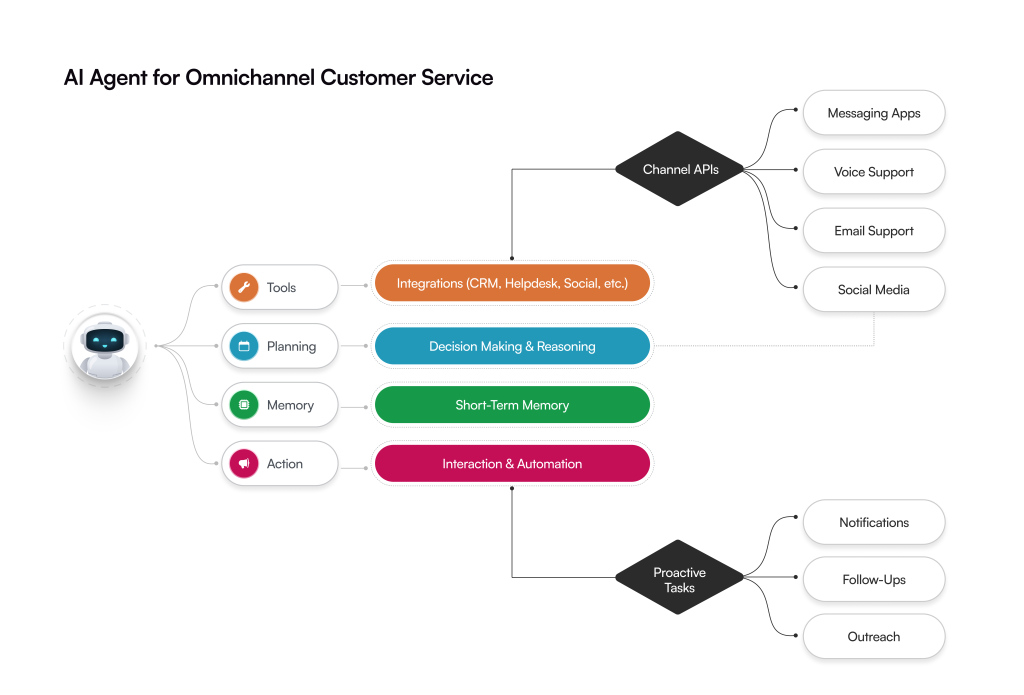
AI

Customer journeys move fast. Faster than most businesses can follow. 

A shopper discovers on Instagram, compares on mobile, buys on desktop, and wants support on WhatsApp—all before lunch.  

AI-driven CX is stitching the entire experience together. 

1. Personalized Engagement Across Platforms 

The old model of personalization—static email offers and cookie-based retargeting—is obsolete. Customer engagement AI now builds unified profiles that move with customers across every channel. The payoff? Consistency, trust, and higher conversion at scale. 

  • Starbucks: Deep Brew AI stitches together app orders, in-store purchases, and loyalty rewards so every interaction feels like it comes from one brain. 
  • Nike: Their AI ecosystem connects browsing, purchase history, and even Nike Run Club data, creating a loop where fitness activity informs product drops and offers. 

2. Conversational AI at Scale 

Customer service can no longer reset at every channel switch. AI chatbots and voice assistants are rewriting this playbook by carrying context forward—making support continuous, not fragmented. 

  • Sephora: Start with a Messenger chatbot to discover a product, move to WhatsApp to book a consultation, and still see synced recommendations in-app. Context is not lost; it compounds. 
  • Domino’s: With “Dom,” voice orders flow across Alexa, Google Home, app, and phone calls. The system remembers preferences everywhere, creating loyalty through ease. 

3. Inventory and Fulfillment Sync 

When promises break in e-commerce, it’s not marketing that failed. It’s connection. 

AI demand forecasting fixes that. It links digital intent to physical delivery. It makes sure what’s promised is what’s received. 

That’s where trust lives—and where loyalty begins. 

  • Walmart: AI demand forecasting aligns online orders with local inventory, making delivery estimates accurate instead of aspirational. 
  • H&M: Customers see live in-store stock while browsing online, reserve items instantly, and pick them up the same day. Convenience becomes part of the brand’s value. 

4. Predictive Customer Journeys 

Reactive support is table stakes; proactive customer support is the differentiator. Predictive AI anticipates needs before customers voice them, reducing friction while deepening trust. 

  • Amazon: Predictive engines rewrite homepages, emails, and push notifications in real time, anticipating what you’ll want next across every device. 

5. Bridging Online and Offline 

The future of omnichannel is not digital versus physical—it’s both, seamlessly blended. Generative AI and AR bring context from one world into the other, erasing the boundaries customers do not care about. 

  • IKEA: With its AR-powered app, customers visualize furniture at home and instantly check in-store availability. The transition from screen to store is effortless. 
  • Disney: MagicBand remains the benchmark—AI-powered personalization that connects rides, hotels, retail, and dining into one continuous guest journey. 

Future Trends: Preparing for the Next Wave of AI in CX 

The next wave of AI in customer experience will not just automate—but anticipate, empathize, and co-create. Organizations aren’t looking for incremental improvements; they’re looking for the platforms, intelligence, and foresight that define the next decade of customer engagement. 

1. Emotion and Context-Aware AI 

AI will read not just clicks, but moods. Facial recognition, voice sentiment, and behavioral cues will allow brands to adapt interactions in real time. 

  • Example: Affectiva’s emotion AI is being used by automotive and retail brands to measure customer reactions, enabling real-time adjustments to marketing messages or in-store experiences. Imagine a digital assistant adjusting tone, offers, and even visuals based on your emotional state. 

2. Predictive Marketing at Scale 

Beyond anticipating service needs, AI will forecast intent before it manifests, triggering proactive engagement and hyper-timed offers. 

  • Example: Amazon’s anticipatory shipping lays the groundwork; soon predictive engines will pre-launch marketing campaigns tailored to an individual’s predicted purchases across channels. 

3. Hyper-Personalization with Generative AI 

Personalization will become truly dynamic—AI creating copy, visuals, and recommendations per individual in real time. Static templates will be obsolete. 

  • Example: Netflix experiments with AI-generated thumbnails tailored to each viewer’s preferences. In retail, Shopify merchants are beginning to auto-generate custom product visuals and descriptions for micro-audiences. 

4. Voice and Conversational Commerce as Primary Channels 

Voice interactions will move from novelty to first-class channels, with AI managing intent, context, and even predictive ordering. 

  • Example: Domino’s and Starbucks are early adopters, but the next phase is fully predictive: voice assistants proactively suggesting purchases (“Your usual latte is ready—should we add your favorite pastry?”). 

5. AI-Driven Spatial and Immersive Experiences 

The intersection of AI, AR/VR, and spatial computing will redefine “shopping” and engagement. Experiences will be contextually aware, visually personalized, and fully interactive. 

  • Example: IKEA’s AR app hints at the future; soon, AI will create immersive digital showrooms where layouts, lighting, and product recommendations evolve in real time based on a user’s behavior and preferences. 

6. Autonomous Customer Experience Orchestration 

The ultimate frontier: AI not just informing decisions but running entire CX journeys autonomously—from marketing and sales to support—adjusting in real time for individual customers at enterprise scale. 

  • Example: Early pilots in banking and e-commerce use AI to autonomously route high-value clients, preempt friction points, and tailor experiences end-to-end without human intervention. 

Strategic Takeaway: Beyond Tools, Building AI-First CX 

From AI-driven personalization to omnichannel orchestration, trusted CX consulting services demand design, strategy, and execution fused into one. The UI/UX-first approach of Galaxy Weblinks does not layer intelligence on top of clunky interfaces; it makes every interaction feel seamless, intuitive, and human. 

With 100+ enterprises transformed and 670+ professionals pushing the boundaries of CX, we do not just implement tools—we craft experiences that move the needle. Brands like NETGEAR, Pepsi, and Staples partner with us to turn predictive journeys, AI chatbots, and generative personalization into real business impact as well as for various other services. 

In a world awash with AI, we make it strategic, intelligent, and creative. With us, your CX is not just responsive—it’s visionary. Partner with us to make every customer interaction count. 

FAQs 

1. How is AI redefining customer experience today? 

AI is changing how customers connect with brands. Chatbots now solve problems in seconds. Personalization happens in real time. The shift isn’t slow—it’s sharp. Enterprises using AI-driven service close tickets 40% faster. Their loyalty scores beat industry norms. The result is simple: speed builds trust. 

2. Where does generative AI add the most value? 

Its strength isn’t in quantity—it’s in clarity. Generative AI shapes journeys that feel personal. It crafts offers, messages, and content that change with the moment. E-commerce companies using it see 15–25% higher conversions. More people come back to buy again. That’s the proof. 

3. Why is proactive customer support becoming the new baseline? 

Because reacting is old thinking. Proactive support sees trouble before it hits. It predicts intent, reduces churn, and earns trust early. Brands using AI for engagement report 25–35% fewer tickets. Their customers stay longer. Their bonds grow stronger. 

4. What does omnichannel AI execution actually look like? 

It isn’t about being everywhere. It’s about being the same everywhere. AI connects web, mobile, social, and voice into one line of experience. When companies adopt it, resolution times drop by half. Brand loyalty deepens. The journey feels effortless—and that’s what customers remember. 

5. What’s next in AI technology trends for CX? 

The next step isn’t more automation—it’s smarter empathy. AI will read tone, predict needs, and respond with understanding. It will blend emotion with precision. Hyper-personalization, voice commerce, and predictive marketing are already here. Early adopters see double-digit engagement gains. The future isn’t coming—it’s already speaking. 
What AI Can (and Can’t) Do for Your MVP — A Reality Check for 2025

The first quarter of 2025 wasn’t just a funding cycle; it was a statement. A staggering $115 billion in global venture funding was deployed, with an incredible $59.6 billion—over 53% of the total—poured directly into AI startups. This isn’t just a trend; it’s a full-blown gold rush, and for founders, the message is clear: the pressure to build with AI has never been higher. With AI coding assistants boosting developer productivity by up to 55% and text-to-UI tools turning ideas into mockups in minutes, the barrier to launching a Minimum Viable Product (MVP) has effectively crumbled.This accelerated pace makes thoughtful MVP Development even more crucial. 

But here’s the brutal reality check nobody puts in their pitch deck: this gold rush is creating a graveyard. The failure rate for AI startups is projected to be a terrifying 90%, significantly higher than for traditional tech companies. Why? Because while it’s easier than ever to build something, it’s also easier than ever to build a business on rented land. Too many founders are falling into the “thin wrapper” trap: slapping a pretty user interface on top of a third-party API from OpenAI, Google, or Anthropic. They’re building products with no defensible moat, where the entire business can be rendered obsolete by a single platform update from the tech giants they rely on. They are using AI’s power to efficiently build solutions for problems that don’t exist, becoming another casualty of the #1 startup killer:no market need.  

So, how do you leverage AI’s incredible power to build faster and smarter without creating a business that’s doomed from the start? This is your 2025 reality check. We’ll cut through the hype to give you a clear-eyed playbook, distinguishing the game-changing applications of AI for your MVP from the fatal traps that are consuming capital and killing companies.

What AI CAN Do: Your Unfair Advantage in Speed and Efficiency

For a founder in 2025, the most significant impact of AI isn’t some far-off promise of sentient machines; it’s the immediate, tactical advantage it provides in speed and capital efficiency. AI has fundamentally changed the economics of starting a company, allowing you to build more, faster, and with less money than ever before. Here’s where AI is a true force multiplier for your MVP.

Radically Reduce Development Costs & Timelines

The traditional costs associated with getting a software product off the ground have been decimated by AI. What once required a significant seed round can now be achieved by a lean, bootstrapped team.

  • Slash Development Costs: AI-powered tools are dramatically lowering the financial barrier to entry. By leveraging AI coding assistants, low-code platforms, and automated testing, startups can slash development costs by as much as 70-75%. For example, a travel management company was able to reduce its development costs by a staggering  
  • $400,000 by using Replit’s AI-powered suite.  
  • Accelerate Coding with AI Co-Pilots: AI coding assistants are now standard issue for high-performing development teams. GitHub Copilot, used by nearly 42% of engineers, leads the market, but a suite of powerful tools like Gemini Code Assist, Cursor, and Tabnine are transforming how code is written. These tools don’t just complete lines; they suggest entire functions, help debug complex problems, and can boost developer productivity by 15-55%. This means a smaller team can build your MVP in a fraction of the time.
  • Go from Idea to Interactive Mockup in Minutes: The design phase has been supercharged. AI-powered UI/UX tools like Uizard and Visily can now transform simple text prompts or hand-drawn sketches into polished, interactive prototypes in minutes. This allows non-technical founders to create high-fidelity mockups for user testing and investor pitches without writing a single line of code, dramatically shortening the path from concept to feedback.
  • Offload Backend Complexity with BaaS: Building and maintaining a secure, scalable backend is a major cost center. Backend-as-a-Service (BaaS) platforms like Firebase and AWS Amplify handle the heavy lifting of database management, user authentication, and server infrastructure, allowing you to focus on the front-end user experience. This BaaS model significantly reduces upfront costs and accelerates your time-to-market. All these factors streamline the MVP Development process.  

Achieve Hyper-Fast Ideation and Validation

Before you build, you must validate. AI provides an unprecedented ability to understand your market and test your assumptions at a speed that was previously impossible.

  • Conduct Market Research in Days, Not Months: Forget expensive consulting firms. AI tools can now perform deep market intelligence by analyzing industry reports, social media trends, and competitor activities in real-time. Startups like  
  • Cashew Research are using AI to take a simple prompt and generate a full research plan, a customized survey, and a synthesized report, making deep customer insights accessible to any founder.  
  • Instantly Gauge Customer Sentiment: Want to know what your potential customers really think? AI-powered sentiment analysis tools like Brand24 and SurveySensum can scan thousands of online reviews, social media comments, and forum discussions to identify nuanced emotions like frustration, excitement, or confusion about existing products in your space. This gives you a raw, unfiltered look at market pain points before you even start designing.  
  • Generate and Test Your Go-to-Market Strategy: AI can help you kickstart your validation cycle faster. Use generative AI to create initial user personas, draft landing page copy, and even outline your first marketing campaigns. This allows you to start testing your messaging and value proposition with real audiences immediately, gathering crucial data while your MVP is still in development.

What AI CAN’T Do: The Founder’s Reality Check for 2025

While AI offers a powerful toolkit for accelerating your MVP, it’s crucial to understand that it is a co-pilot, not the founder. Relying on it for core strategic functions is a direct path to failure. The speed and efficiency AI provides can easily mask fatal flaws in your business model and product strategy. Here are the critical areas where AI falls short and where your human insight is irreplaceable.

The “Thin Wrapper” Trap: Building a Business on Rented Land

The most seductive and dangerous pitfall for founders in 2025 is the “thin wrapper” startup. These are businesses that don’t build proprietary AI but simply create an attractive user interface (UI) that makes API calls to a powerful third-party model from providers like OpenAI, Google, or Anthropic. While easy to build, this model is fundamentally broken and is why a staggering 90% of AI startups are projected to fail.  

  • You Have No Defensible Moat: Your core technology is rented, not owned. Any competitor can subscribe to the same API, build a similar UI, and replicate your entire product in weeks. The half-life of your competitive advantage is brutally short. Consider TextGen Pro, a startup that spent $3 million on proprietary marketing copy technology, only to have its entire value proposition commoditized overnight when Meta released its powerful Llama 2 model for free.  
  • The Economics Are Brutal: Thin wrappers operate on razor-thin margins, paying a recurring cost for every API call their users make. You are essentially an unpaid distribution channel for the large AI labs, subsidizing the growth of the very platforms that will eventually make you obsolete.  
  • The Platform is Your Biggest Competitor: The API providers see exactly which use cases are gaining traction. Nothing stops them from incorporating the most popular features directly into their own platforms, effectively killing your business with a single product update.  

AI Cannot Validate Your Core Problem

AI is brilliant at analyzing existing data, but it cannot replace the essential, human-to-human work of discovering a true customer pain point. It can tell you what people are talking about online, but it can’t tell you why they feel that way or the deep, unmet needs behind their words. This is why  

42% of startups still fail due to “no market need”—a problem that AI, for all its power, cannot solve on its own. An AI can generate a list of business ideas, but it has never felt the frustration of a broken workflow or wished for a product that doesn’t exist. That insight—the spark for every great company—must come from you.  

The Technical Traps: Hallucinations, Bias, and the Black Box

Even when used as a tool, AI has inherent technical limitations that can fatally misdirect your MVP Development strategy if you’re not vigilant.

  • AI Hallucinations: Generative AI models are designed to be plausible, not truthful. They frequently “hallucinate”—inventing facts, statistics, or sources with complete confidence. This has led to real-world consequences, from  
  • Air Canada’s chatbot inventing a refund policy the company was legally forced to honor, to a New York lawyer being sanctioned for citing non-existent legal cases generated by ChatGPT in a court filing. Building your MVP Development strategy on AI-generated market research without rigorous human fact-checking is like building a house on a foundation of sand.  
  • Algorithmic Bias: AI models learn from vast datasets scraped from the internet, which are filled with historical and societal biases. The AI inevitably learns and amplifies these biases, which can lead to discriminatory outcomes in your product. An AI-powered hiring tool might unfairly penalize certain candidates, or a marketing tool might exclude specific demographics. Launching an MVP that scales discrimination, even unintentionally, can destroy your brand before you even find product-market fit.  
  • The “Black Box” Problem: Many complex AI models are “black boxes,” meaning it’s impossible to fully understand or explain how they arrive at a specific decision. This lack of transparency is a major obstacle in regulated industries like finance and healthcare, where auditability is essential. For users, it erodes trust; for founders, it makes debugging errors and biases nearly impossible.  

Relying on AI for core strategic insights creates a dangerous feedback loop. If you use AI to define your user personas, design your UI, and write your marketing copy, you risk building and validating your MVP against an AI’s flawed, artificial understanding of the market—not the real one.

Of course. Now that we’ve established what AI can and can’t do, let’s move to the most critical part: the strategic framework. This section provides an actionable playbook for founders on how to leverage AI smartly in 2025.

The 2025 Strategic Framework: How to Use AI the Smart Way

Understanding AI’s power and its pitfalls is only half the battle. For founders in 2025, the key to survival and success lies in a disciplined, strategic framework. It’s not about having an “AI strategy” but about building a sound business strategy in an AI-saturated world. This means moving beyond the hype and making deliberate choices about how and where to deploy AI to create real, defensible value.

AI-Enabled vs. AI-Native: Choose Your Path Wisely

The first strategic decision is to clarify the role AI plays in your venture. In 2025, startups fall into two distinct categories :  

  • AI-Native: In these companies, the AI is the product. The core innovation is a new algorithm, a foundational model, or a proprietary AI system that creates a fundamentally new capability (e.g., autonomous robotics, AI-powered drug discovery). This is a high-risk, capital-intensive path reserved for teams with deep, specialized research expertise.
  • AI-Enabled: These companies use existing AI tools and platforms to make their product or service faster, smarter, or more efficient. The core value proposition is solving a specific business problem, and AI is the engine that enhances that solution.

For the vast majority of founders, the strategic choice is clear: focus on being AI-Enabled. The data shows this is where the smart money is flowing. In the first half of 2025, 9 out of 11 mega-deals ($100M+) in digital health went to AI-enabled startups, not those building foundational models from scratch. Investors are backing companies that use AI to solve real-world problems in specific industries, not just those engaged in pure research.  

Build a Data Moat, Not an Algorithm Moat

In previous tech cycles, a proprietary algorithm could be a defensible competitive advantage. In 2025, that moat has evaporated. With powerful open-source models being released constantly, any algorithmic edge is fleeting. As investor Janet Bannister notes, software is now easier to replicate, but  

“Data… is much more durable”.  

Your most defensible asset is a unique, proprietary dataset that competitors cannot easily access or replicate. Your MVP Development strategy must be built around this principle from day one. Design your product not just to solve a user’s problem, but to generate valuable data in the process. This could be:

  • Unique User Interaction Data: Capturing how users in a specific niche interact with your workflow.
  • Proprietary Industry Data: Aggregating data from a fragmented industry that isn’t well-represented in public datasets, like what BidBlocks is doing for construction pricing.  
  • Human-Generated Data: Creating a feedback loop where human experts refine or label data, creating a unique, high-quality dataset that improves your AI over time.

An algorithm can be copied. A unique, compounding data asset cannot. That is your long-term competitive advantage.

Implement a “Human-in-the-Loop” Imperative

The biggest mistake a founder can make in 2025 is to blindly trust AI-generated outputs. The risks of hallucinations, bias, and a lack of real-world context are too high. The most successful founders are implementing a formal “human-in-the-loop” process to ensure quality and strategic alignment.  

This means recognizing the fundamental difference between an AI summary and a human insight. An AI can analyze thousands of customer support tickets and report, “Patients are forgetting to take their afternoon medication.” A human researcher, however, can add the critical context that leads to a breakthrough: “Patients who are parents are forgetting their medication because they are busy picking their children up from school”. That single piece of human-derived insight is infinitely more valuable for product development.  

Apply this principle across your MVP development:

  • Code: Use AI to generate code, but have a human developer review it for security, efficiency, and logic.
  • Design: Use AI to generate mockups, but have a human designer validate them for brand consistency and user experience nuance.
  • Content: Use AI to draft copy, but have a human writer refine it for tone, accuracy, and emotional connection.

AI is your co-pilot—an incredibly powerful tool for execution. But you, the founder, must remain the pilot, providing the vision, judgment, and strategic direction that AI fundamentally lacks.

Your AI Co-Pilot, Not Your AI Founder

In the high-velocity startup landscape of 2025, one thing is certain: AI is no longer optional. With 83% of companies declaring AI a top priority, the ability to leverage these tools is now table stakes for any founder with serious ambitions. As we’ve seen, AI offers a powerful arsenal to build your MVP faster, leaner, and with more data-driven insight than ever before, dramatically lowering the barriers to entry.  

But this accessibility is precisely what makes the current environment so treacherous. The greatest danger in 2025 is not falling behind on AI adoption, but adopting it for the wrong reasons. Relying on AI to be your strategist—to find your market, define your value, and be your defensible moat—is a fatal error. The startup graveyard is filled with “thin wrapper” companies that were quick to build but had no real business, and ventures that used AI to efficiently solve problems nobody actually had.  

The most successful founders of this era will be those who master the art of leading their AI co-pilot, not being led by it. They will use AI as an incredibly powerful tool for execution—to write code, analyze data, and accelerate workflows—while reserving the most critical tasks for themselves in their MVP development efforts. Your unique, human-driven vision, your deep empathy for a customer’s pain point, and your strategic judgment are the things AI cannot replicate. That is your ultimate competitive advantage.  

Use AI to build your MVP, but let your human insight build your business.

Navigating this landscape requires a partner who understands both the technology and the strategy. If you’re ready to build an MVP that leverages AI smartly without falling into the common traps, let’s discuss how to build it right.

The AI Accountability Test: Is Your Business Ready (or at Risk)

The AI Accountability Wake-Up Call for SMEs

It seemed like a smart move: implementing that new AI tool to help streamline your SME’s hiring process. But then you read the headlines from just last month (April 2025) about several small businesses facing scrutiny – and even initial warnings from consumer protection bodies – for “black box” AI tools that inadvertently introduced bias, effectively filtering out qualified candidates from certain backgrounds. Over 60% of consumers, your potential customers, state they’d lose trust if an AI showed bias. This isn’t just a big business problem anymore. As AI becomes a core operational component for many SMEs by May 2025, the question of AI accountability isn’t just looming—it’s knocking on your door.

With this rapidly adopted power comes a fast-approaching and critical consideration: AI governance and compliance are becoming non-negotiable. Leading analysts like Gartner forecast that by late 2026, over 80% of enterprises deploying AI will face new regulations focusing on data handling, algorithmic bias, and operational transparency. While this prediction often highlights large enterprises, the ripple effects and foundational principles will undoubtedly impact SMEs. The question every SME owner needs to ask is: are you prepared for this new era of AI accountability?

This is where the “AI Accountability Test” comes in. It’s not a formal examination, but a crucial self-assessment of your business’s readiness to use AI responsibly, ethically, and in compliance with emerging standards. Passing this “test” means ensuring your AI practices build trust, mitigate risks, and position your business for sustainable growth. Failing it, or ignoring it, can expose your SME to significant vulnerabilities.

So, how can your SME ensure it’s on the right side of AI accountability, ready to harness its power without falling prey to its pitfalls? It starts with a clear-eyed view of the real-world implications of unchecked AI. From there, we can build a practical framework for responsible AI use. Let’s explore the common dangers first, and then walk through four straightforward pillars you can implement to use AI confidently, turning potential risks into tangible business advantages.

Understanding the Stakes: Why the “AI Accountability Test” Matters Urgently for Your SME

Before building your AI accountability framework, let’s be crystal clear about what happens if your SME isn’t prepared. In May 2025, with AI tools more accessible than ever, the allure of quick efficiency gains can sometimes overshadow critical risks. For SMEs, these aren’t distant corporate problems; they are immediate threats that can have disproportionately severe consequences due to typically tighter budgets and fewer specialist resources. Failing the “AI Accountability Test” isn’t just a theoretical concern—it’s a direct route to tangible business pain.

Here’s a sharper look at the stakes:

  • The Financial Sting: Beyond Big Headlines to SME Reality You’ve seen the headlines about multi-million dollar penalties for data misuse under laws like GDPR or CCPA. While the average global data breach cost hit a staggering USD 4.45 million in 2023, even a fraction of that could be existential for an SME.
    • SME Scenario: Consider your AI-powered CRM. If it inadvertently mishandles customer consent for marketing emails, or if a cloud-based AI tool suffers a breach exposing your client list, the fines are just the start. You could also face loss of crucial payment processor agreements or banking relationships, directly impacting your ability to trade. Are you truly confident about the data practices of every AI tool you’ve adopted?
  • Brand Betrayal: When Your AI Offends Your Customers & Community AI learns from data, and if that data (or the AI’s design) reflects societal biases, your AI can become a PR nightmare. Over 60% of consumers state they’d lose trust if an AI showed bias.
    • SME Scenario: Imagine your new AI-driven scheduling tool consistently offers less favorable appointment slots to customers with names from a particular ethnic group, or a locally-focused AI ad campaign uses imagery that’s unintentionally offensive to a segment of your community. For an SME, brand trust is often built on close community ties and personal reputation. Such AI missteps don’t just cause online backlash; they can lead to a direct loss of local customers, negative word-of-mouth that’s hard to counter, and difficulty attracting local talent who see your business as unfair.
  • Operational Gridlock & Losing Your Market Edge Relying on “black box” AI – systems whose internal workings are unclear – can bring your SME’s operations to a halt.

These examples aren’t meant to scare you away from AI, but to underscore why proactive AI accountability is a non-negotiable for SMEs in May 2025. You likely don’t have a dedicated AI ethics board or a large legal team. This makes understanding these risks, and taking practical steps to build an accountable AI framework, even more critical for your resilience and success.

Pillar 1: Smart Data Governance – Your AI’s Trustworthy Fuel Source

For any SME in May 2025, your AI is only as good and as safe as the data it uses. Whether you’re leveraging an AI-powered CRM, an e-commerce recommendation engine, or a marketing automation tool, smart data governance is the absolute bedrock of AI accountability. It’s not about complex corporate bureaucracy; it’s about clear, “right-sized” practices ensuring you handle data responsibly, legally, and in a way that builds unshakable customer trust. Without this, even the most promising AI initiative can become a source of risk.

Why “Smart” Data Governance is a Non-Negotiable for SMEs Using AI:

  • Beyond Compliance – It’s Customer Confidence: Yes, data protection laws like GDPR or CCPA equivalents carry hefty fines for misuse (the average data breach cost hit USD 4.45 million in 2023). But for an SME, the immediate impact of poor data handling for AI often comes from lost customer confidence. If your AI uses customer data in unexpected or opaque ways, that vital trust erodes fast.
  • The Hidden Data Practices of “Easy AI”: Many SMEs adopt off-the-shelf AI tools that promise simplicity. However, these tools often have their own data collection and processing protocols. Smart governance means you’re not just a passive user but an active steward, understanding and validating how these third-party tools treat the data they access.
  • Fueling Accurate & Fair AI: The quality, relevance, and ethical sourcing of data directly dictate your AI’s performance. “Garbage in, garbage out” is an old adage, but it’s amplified with AI. Poor data governance can lead to your AI inadvertently learning biases or making inaccurate predictions, directly impacting your business decisions and customer interactions.

Practical “Smart Data Governance” Steps for Your SME’s AI:

Implementing effective data governance doesn’t require a dedicated legal team. It’s about integrating thoughtful practices:

  1. Interrogate Your AI’s Data Appetite – Especially Third-Party Tools:
    • Map the Data Flow: For every AI tool, especially those from vendors, ask: What specific data does it actually need to function? Where does this data come from (your customer inputs, your website, other systems)? Where is it stored, and for how long?
    • Vendor Due Diligence (Simplified): Don’t just tick a box. Ask vendors pointed questions: How do they ensure compliance with data protection laws relevant to your customers? Can they provide clear documentation on their data security and privacy measures? What happens to your data if you stop using their service?
  2. Champion “Consent & Transparency by Design”:
  3. Implement “Right-Sized” Internal Data Safeguards:
    • Simple Team Guidelines: Create a basic, easy-to-follow internal checklist for handling customer data that interacts with AI. For instance: “Always verify customer consent before adding data to AI marketing tool X,” or “Delete customer query data from AI chatbot Y after 90 days unless explicitly saved for quality improvement with consent.”
    • Access Control for AI Tools: Limit who on your team has administrative access to AI tools that process sensitive customer or business data. Basic password hygiene and user role management go a long long way.
  4. Be Ready for Customer Data Rights:
    • Understand that customers have rights regarding their data (to access, to correct, to delete). Think about how you would handle such a request if the data is being processed by an AI tool. Does your AI vendor provide mechanisms for this?

Smart data governance for an SME means being conscious, questioning, and transparent. It’s about treating customer data with respect, especially when AI is involved. This pillar not only helps you meet compliance needs but also transforms data handling from a potential risk into a powerful trust-builder with your customers, solidifying your foundation for AI accountability.

Pillar 2: Keeping AI Fair – Smart Bias Checks for Your SME

As your SME increasingly relies on AI, ensuring these tools operate fairly isn’t just a “nice-to-have”; it’s a crucial part of your AI accountability that directly protects your brand and your customer relationships. The challenging part? AI bias often isn’t obvious. It can hide within the everyday AI tools you might be using for marketing, customer service, or even simple hiring aids, quietly skewing results and potentially alienating customers or missing out on great talent. For an SME in May 2025, proactive bias mitigation means being a savvy AI user, not necessarily an AI expert.

AI Bias: The SME Reality – It’s Not Just for “Big Tech”

You might think AI bias is a concern for global tech giants. But consider this:

  • Your New “Smart” Email Campaign Tool: Many SMEs use AI to personalize email campaigns. What if the underlying algorithm, trained on broader internet data, subtly starts favoring language or offers that resonate more with one demographic, effectively making other customer segments feel ignored or misunderstood? This isn’t a hypothetical; it’s a common pitfall with off-the-shelf AI where the training data isn’t perfectly aligned with your specific, diverse customer base.
  • The “Helpful” AI Recruitment Filter: You’re using an affordable AI tool to help screen CVs for a new role. It promises to save time. But if that tool was predominantly trained on CVs from a historically male-dominated industry, it might inadvertently downgrade highly qualified female candidates or those from non-traditional backgrounds, all without raising an obvious red flag. Research indicates that over 60% of consumers would lose trust if an AI showed bias – imagine the impact if job seekers feel your process is unfair.
  • E-commerce AI: Personalized or Prejudiced?: Your online store’s AI recommendation engine is great at suggesting products. But what if it starts pushing higher-priced items primarily to customers whose data profile suggests higher income, while showing clearance items to others, even if their Browse history is similar? This could lead to perceptions of unfair treatment.

The critical point for SMEs is that you often don’t build these AI models from scratch; you use or integrate them. This means your primary leverage point for bias mitigation is in smart selection, critical usage, and ongoing observation.

Practical “Bias Check” Strategies for Savvy SMEs:

You don’t need a PhD in data science to make a difference. Here’s how to be proactive:

  1. Become a “Smart Shopper” for AI Tools:
    • Ask Pointed Questions Before You Buy: Don’t just ask about features. Ask vendors: “How do you test for and mitigate bias in this AI tool?” “Can you share information about the diversity of the data your AI was trained on?” “Do you offer any features that allow us to monitor for potential bias in how it performs for our specific customer base?” Their answers (or lack thereof) can be very telling.
    • Look for Transparency Features: Prefer AI tools that offer some level of insight into why they make certain recommendations or classifications, rather than being a complete “black box.”
  2. “Test Drive” with Diversity in Mind:
    • Small-Scale, Diverse Data Tests: Before fully rolling out an AI tool that interacts with customers or makes important decisions (like CV screening), test it with a small, diverse set of your own data or scenarios. For example, if it’s a CV screener, run a few dummy CVs representing different backgrounds through it. Do the results make intuitive sense?
    • Involve Your Team: Ask team members from different backgrounds to interact with the AI tool and share their perceptions. Do they notice anything that feels “off” or potentially unfair?
  3. Implement “Real-World Performance Reviews” for Your AI:
    • Don’t Just Trust Vendor Claims: Once an AI tool is live, regularly “spot check” its performance against real-world outcomes. Is your AI-powered marketing tool actually engaging a diverse range of your target customers, or is it hyper-focusing? Are customer service queries from certain demographics consistently taking longer to resolve via your AI chatbot?
    • Track Key Fairness Metrics (Simplified): You don’t need complex dashboards. Even simple tracking can help. For example, if an AI helps with lead scoring, are leads from certain geographic areas or industries consistently scored lower without a clear business reason?
  4. Create a Simple Feedback Loop:
    • Make it easy for your customers and your staff to report any instances where an AI-driven interaction felt unfair, biased, or just plain wrong. This feedback is invaluable for catching issues early.

For an SME, tackling AI bias isn’t about achieving algorithmic perfection overnight. It’s about adopting a mindset of critical awareness, asking better questions of your AI vendors, and putting in place simple, practical checks and balances. This approach not only helps you meet your AI accountability obligations but also builds a more equitable and trustworthy experience for your customers and employees, which in May 2025, is a significant competitive advantage.

Pillar 3: Making Sense of Your AI – Practical Transparency for SMEs

As your SME uses AI more, you’ll inevitably hit a point where someone – a customer, an employee, or even you – asks, “Why did the AI do that?” If the answer is a shrug because the AI is a complete “black box,” you’ve got a problem. This is where practical transparency comes in as the third pillar of AI accountability. For an SME in May 2025, this isn’t about becoming an AI algorithm expert; it’s about choosing and using AI tools in a way that makes their actions generally understandable, helping you troubleshoot, build trust, and maintain control.

Why “Making Sense” of Your AI is Crucial for Your SME:

Think about these common SME frustrations where a lack of AI transparency is the culprit:

  • The Mystery of the Misfiring AI Marketing Campaign: Your AI-powered ad tool just blew through its weekly budget targeting an audience segment that makes no sense for your product. If you can’t get any insight into why the AI made those choices, how do you fix it and prevent future wasted spend?
  • The Frustrating AI Chatbot Loop: Customers are complaining that your new AI chatbot is unhelpful, giving irrelevant answers, or getting stuck in loops. If you don’t understand the basic logic it’s supposed to follow or where it’s going wrong, you can’t improve the customer experience, leading to lost sales and damaged reputation.
  • Team Skepticism Towards AI “Magic”: You’ve invested in an AI tool to help with sales forecasting or inventory management. But if your team feels its recommendations are “plucked from thin air” with no understandable rationale, they’ll resist using it, and your investment will gather digital dust. Your newsletter mentioned maintaining human oversight over critical AI decisions, and that oversight is crippled without understandability.

Practical Steps for SMEs to Boost AI Transparency (Without Needing a Data Scientist):

  1. Ask “How Does It Show Its Work?” When Choosing AI Tools:
    • Simple Vendor Questions: When looking at AI tools, especially for marketing, customer service, or analytics, ask vendors: “Can this tool give me a basic idea of why it made a certain recommendation or took a particular action?” “Are there any logs or dashboards that explain its behavior in simple terms?” “If it makes a mistake, how easy is it to understand what went wrong?”
    • Prefer “Glass Box” Over “Black Box” (Where Possible): If you have a choice between two similar AI tools, lean towards the one that offers more built-in clarity or reporting on its operations, even if it’s not full XAI.
  2. Document Your Own AI “Settings” and “Why”:
    • Your “Human Logic” Layer: When you configure an AI tool – setting rules for your email automation, defining customer segments for your AI CRM, choosing keywords for your AI ad optimizer – clearly document your business reasons for those settings. This human-created record is often the first and most practical layer of “explainability.”
    • Regular Review: Don’t let these configurations become outdated. As your business strategy evolves, revisit them to ensure the AI is still aligned with your understandable, documented goals.
  3. Empower Your Team to be “AI Sense-Checkers”:
    • Train for “Does This Make Business Sense?”: Encourage your team to use their human intuition and business knowledge to evaluate AI outputs. If an AI sales forecast looks wildly off compared to their on-the-ground experience, or if an AI-generated customer response sounds completely off-brand, they should feel empowered to question it and flag it.
    • Simple “Show Me an Example” for Customers: If a customer questions an AI-driven interaction (e.g., “Why was I recommended this product?”), train your team to provide a simple, plausible explanation based on how the AI is supposed to work (e.g., “Our system looks at recent Browse history and popular items in that category to make suggestions”). Honesty about AI use, explained simply, builds trust.
  4. Prioritize Human Review for High-Impact Decisions:
    • As your newsletter wisely noted, maintaining human control over critical AI decisions is key. For any AI output that directly and significantly impacts a customer (e.g., a large quote generated by AI, a denied service based on AI analysis) or your business operations, ensure a human reviews and validates it. This human “sign-off” is a practical form of accountability and explainability.

For an SME, transparency in AI isn’t about complex technical deconstructions. It’s about choosing tools that offer some clarity, applying your own business logic consistently, and empowering your team to be a common-sense check on automated decisions. This practical approach ensures your AI remains a helpful, understandable tool, not an unpredictable black box, reinforcing your overall AI accountability.

Pillar 4: Smart Human Oversight – Your SME’s Control Tower for AI

As your SME leverages AI for speed and efficiency, the final, crucial pillar of AI accountability is ensuring smart human oversight remains firmly in place. For SMEs in May 2025, this isn’t about resisting automation; it’s about strategically integrating human wisdom, ethical judgment, and contextual understanding where AI alone falls short. Without this, even well-intentioned AI can lead to costly errors or damage customer trust. The goal is to design “Human-in-the-Loop” checkpoints that are both effective and efficient for your specific business needs.

Beyond the “Automation Hype”: Why Human Judgment is Irreplaceable for SMEs

AI can process data and execute tasks at incredible speed, but it lacks genuine understanding, common sense, and the ability to navigate novel or ethically ambiguous situations. Here’s where strategic human oversight becomes an SME’s superpower:

  • Preventing AI Misinterpretations Before They Escalate:
    • SME Scenario: An SME uses an AI tool to automatically categorize and route customer support emails. The AI misinterprets an urgent, nuanced complaint from a high-value client as a low-priority query, leading to delayed response and client frustration.
    • Smarter Oversight: Instead of letting all AI categorizations go unchecked, implement a rule where emails containing specific high-stakes keywords (e.g., “legal threat,” “contract cancellation,” “severe issue”) or those originating from your top 10% of clients are automatically flagged into a priority queue for immediate human review. This doesn’t require reading every email but strategically filters for AI’s riskiest decisions.
  • Upholding Ethical Boundaries in AI-Assisted Decisions:
    • SME Scenario: An e-commerce SME uses AI to personalize promotional offers. The AI, optimizing solely for conversion, inadvertently creates offer combinations that could be seen as predatory towards financially vulnerable customers or discriminatory based on inferred demographics.
    • Smarter Oversight: Before launching large-scale AI-driven promotional campaigns, implement a “human spot-check” protocol. Have a team member review a diverse sample of the AI-generated personalized offers, specifically looking for any that seem ethically questionable, unfair, or off-brand. Documenting these “ethical guardrails” for AI helps maintain brand integrity.
  • Ensuring Customer Trust When AI Interacts Directly:

Practical Steps for Implementing Smart Human Oversight in Your SME:

Integrating human oversight efficiently means:

  1. Mapping Critical AI Decision Points:
    • Review all AI tools and identify exactly where they make decisions with significant customer or business impact (e.g., final pricing, access to services, personalized medical/financial information if applicable, major stock reordering). These are your non-negotiable points for potential human review.
  2. Designing “Exception-Based” Review Workflows:
    • Don’t aim to review every AI action. Configure AI systems to flag only exceptions or high-risk decisions for human approval. For instance, an AI that drafts client proposals might require human sign-off only if the proposal value exceeds a certain threshold or if it includes non-standard terms. This balances efficiency with control.
  3. Empowering Your Team with Clear Override and Escalation Protocols:
    • Ensure staff can easily override an AI decision if they detect an error or believe a different approach is better. They shouldn’t feel “stuck” with a bad AI output.
    • Have a simple, documented process for escalating complex AI issues or repeated errors to a designated person or small team within your SME.
  4. Conducting “AI Performance Huddles” Regularly:
    • Once a month, have a brief meeting with key team members who interact with your AI tools. Discuss: What’s working well? What’s causing frustration? Were there any “near misses” where AI almost made a big mistake? This qualitative feedback is invaluable for refining oversight processes.

For SMEs, smart human oversight means AI works for you, amplifying your team’s capabilities while your human expertise guides the critical decisions. It’s about making AI a trusted partner, not an unpredictable black box, ensuring you pass the “AI Accountability Test” with confidence.

Worried About AI Accountability? Here’s How Galaxy Weblinks Makes it Achievable & Advantageous for Your SME

You’ve seen the stakes. You understand the pillars of AI accountability. But the big question for many SME owners in May 2025 is: “How do I realistically implement this without a dedicated AI ethics team or a massive budget, and still focus on growing my business?”

This is where many SMEs get stuck. They might:

  • Try a DIY Approach: Get bogged down in complex regulations and technical jargon, leading to partial solutions or complete overwhelm.
  • Hire Generalist Consultants: Who might understand business but lack deep, specialized knowledge in the practicalities of AI governance and trust for your scale.
  • Use Off-the-Shelf AI Blindly: Hope for the best, exposing themselves to the risks we’ve discussed.

Galaxy Weblinks offers a smarter, more effective path. We’re not just another IT services company; we are specialists in making AI trust and accountability practical, efficient, and a genuine competitive advantage for SMEs. Our proprietary “AI Trust Accelerator Framework” isn’t about generic advice; it’s about targeted, real-world solutions designed for your business reality.

Here’s How We Help Your SME Differently:

  • Your Problem: “AI compliance feels too complex and time-consuming for my SME.”
    • Our Solution: We don’t drown you in regulatory documents. Our “Rapid Blueprint for Compliance” process is designed for speed and clarity. We quickly assess your specific AI tools and use cases against the key emerging standards (whether you’re eyeing US markets, Middle Eastern expansion, or need to align with GDPR/CCPA principles). You get an actionable, prioritized roadmap, not a 100-page academic report. This means you know exactly where to focus your efforts for maximum impact, saving you countless hours of guesswork.
  • Your Problem: “Implementing technical AI safeguards seems too technical or expensive.”
    • Our Solution: Our “Targeted Tech Implementation” is surgical. We don’t advocate for overhauling your systems. Instead, we identify the most critical points where safeguards like auditable data flows, practical explainability features for the AI you use, smart bias mitigation checkpoints, and efficient “Human-in-the-Loop” controls will provide the biggest risk reduction and trust enhancement. We focus on pragmatic integrations that fit your existing tech stack and budget, making robust governance achievable.
  • Your Problem: “How do I know if this AI accountability stuff will actually benefit my bottom line, beyond just avoiding trouble?”
    • Our Solution: We help turn compliance from a cost center into a demonstrable business advantage. For example, we recently partnered with a mid-market e-commerce SME concerned about their new AI recommendation engine’s compliance and trustworthiness. Using our “AI Trust Accelerator Framework,” we helped them achieve AI compliance readiness an estimated 30% faster, ensuring CCPA alignment and auditable decision logs. Critically, beyond just compliance, they saw a 15% uplift in conversions because their customers found the AI-driven recommendations more relevant and trustworthy. This is the tangible ROI of well-implemented AI accountability – better performance and peace of mind.

Galaxy Weblinks’ Core Advantage for Your SME:

  • We Understand SMEs: We’re not pushing enterprise-level complexity onto your business. Our framework and approach are built for your scale, your pace, and your resources.
  • Specialized Expertise, Made Accessible: We bring deep knowledge of AI trust, ethics, and even cross-cultural UX (vital if you serve diverse customers or eye international markets) and translate it into practical, actionable steps.
  • Focus on Efficiency & Results: Like you, we value efficiency. Our goal is to get your SME AI-accountable and trust-ready faster and more effectively than you could on your own or with a non-specialist partner.

Stop worrying about the “AI Accountability Test” and start leveraging AI with confidence. Galaxy Weblinks provides the specialized partnership to make that a reality for your SME.

Take the SME AI Accountability Challenge: Score Your Readiness Today!

Understanding AI accountability is vital, but action is what transforms risk into readiness. For SMEs in May 2025, here’s a practical “AI Accountability Challenge” with specific, implementable steps. For each action you’ve already fully completed, give your business 1 point. If not, consider it a priority action item. Let’s see how prepared you are!

(Your AI Accountability Score: __ / 5 )

  1. Action: Inventory & “Mini-Risk Assess” Your Top 3 AI Tools (This Week)
    • How to Implement:
      1. Identify the top 3 AI-powered tools or software critical to your SME’s daily operations (e.g., your CRM’s AI features, your primary marketing automation tool, your customer service chatbot).
      2. For EACH of these 3 tools, create a simple document and answer these specific questions:
        • Data Input: What exact customer or business data does this tool access/require? (List the specific data fields if known).
        • Data Output/Decisions: What key decisions or outputs does this AI generate? (e.g., customer segments, email content, support answers, sales forecasts).
        • Biggest “Oops” Potential: What’s the single biggest negative thing that could happen if this AI tool made a significant error or misused data? (e.g., “Send wrong offer to all customers,” “Chatbot gives harmful advice,” “Misclassify all new leads”).
    • Why it’s Actionable: This isn’t a full audit, but a focused check on your most impactful AI, forcing you to confront specific data usage and potential failures.
    • (Score 1 point if you’ve fully done this for your top 3 AI tools in the last 3 months)
  2. Action: Designate & Announce Your “AI Oversight Champion” (By End of Next Week)
    • How to Implement:
      1. Choose one person on your team (even if it’s you, the owner) who will be the designated point of contact for AI-related concerns and responsible for staying generally informed (they don’t need to be a tech expert).
      2. Send a brief internal email or make an announcement in your next team meeting: “To ensure we use AI tools responsibly, [Name] will be our AI Oversight Champion. If you have questions or spot any issues with our AI tools, please discuss them with [Name].”
      3. Schedule a 30-minute chat with this Champion within the next month to discuss their role (primarily to encourage mindful AI use and flag concerns).
    • Why it’s Actionable: This creates immediate, visible internal accountability with minimal effort.
    • (Score 1 point if you have a designated, announced AI Oversight Champion)
  3. Action: Add a Simple “AI Usage Transparency Snippet” to Your Website/App (Within 2 Weeks)
    • How to Implement:
      1. Identify where your customers most directly interact with AI (e.g., your website chatbot, personalized product recommendations on your e-commerce site, AI-assisted booking forms).
      2. Add a concise, easy-to-understand sentence at that point of interaction. Examples:
        • Chatbot: “Hi! I’m [Your Company]’s AI assistant. I can help with X, Y, Z. If you need a human, just type ‘speak to agent’.”
        • Product Recommendations: “Psst! Our smart system suggests products you might like based on your Browse and what’s popular. Learn more in our Privacy Policy.”
      3. Review your Privacy Policy and add one or two sentences explicitly stating if/how AI is used with customer data in simple terms.
    • Why it’s Actionable: This directly addresses transparency with minimal technical changes and boosts customer trust.
    • (Score 1 point if you have clear, simple AI usage snippets at key customer interaction points AND in your Privacy Policy)
  4. Action: Conduct One “AI Tool Spot-Check & Override Drill” with Your Team (This Month)
    • How to Implement:
      1. Pick one AI tool your team uses regularly (e.g., an AI for drafting email responses, an AI for scheduling, an AI for generating social media captions).
      2. In a team meeting, present a scenario where the AI produces a slightly “off” or clearly incorrect output relevant to that tool.
      3. Ask your team:
        • “What looks wrong or risky about this AI output?”
        • “What’s our process for not using this output?” (i.e., how do they override or ignore it?)
        • “Who should be informed if the AI consistently makes this kind of error?”
      4. Document the agreed-upon override/escalation process, however simple.
    • Why it’s Actionable: This actively tests and reinforces your human oversight capabilities and empowers your team.
    • (Score 1 point if you’ve conducted such a drill for at least one AI tool in the last 3 months)
  5. Action: Schedule Your No-Obligation “AI Accountability Check-up” (Today)
    • How to Implement:
      1. Recognize that expert guidance can fast-track your AI accountability and de-risk your AI initiatives.
      2. Take the proactive step to get a specialized perspective on your SME’s specific situation by booking your Complimentary 30-Minute AI Accountability Check-up with Galaxy Weblinks.
      3. During this focused session, you can discuss your top AI project, get an answer to a pressing compliance question, and receive an immediate, practical insight to improve your AI governance.
    • Why it’s Actionable: It’s a concrete step to gain expert advice tailored to your business with no cost or obligation, directly addressing any uncertainties you might have after your initial self-assessment.
    • (Score 1 point if you have scheduled or completed such a check-up/consultation with an AI governance expert recently)

What’s Your Score? A lower score doesn’t mean failure; it means you have a clear, actionable path to significantly improve your SME’s AI accountability starting now. A higher score means you’re well on your way – keep up the great work and continue refining!

Turn AI Accountability from Risk to Your SME’s Advantage

For SMEs in May 2025, AI is a powerful engine for growth, but true success hinges on responsible use. Passing the “AI Accountability Test” isn’t just about avoiding pitfalls like fines or brand damage; it’s about proactively building a resilient, trustworthy business.

By implementing Smart Data Governance, Fair Bias Checks, Practical Transparency, and Smart Human Oversight, your SME can confidently navigate the AI landscape. The “AI Accountability Challenge” in the previous section gives you a starting point to assess your readiness.

This journey is about transforming AI accountability into a competitive edge, fostering deeper customer loyalty, and innovating safely. Building trust in AI is indeed key.

Ready to ensure your SME is AI-accountable and future-ready?

  • Take the Definitive Next Step: Galaxy Weblinks invites your SME to a Complimentary 30-Minute AI Accountability Check-up. Get expert, practical insights on your top AI initiative and key compliance questions.
    Book Your Free AI Accountability Check-up Now
      • Connect and Continue the Conversation: I regularly discuss practical AI adoption and governance on LinkedIn. Let’s connect!

    Let Galaxy Weblinks help your SME lead with responsible and effective AI.

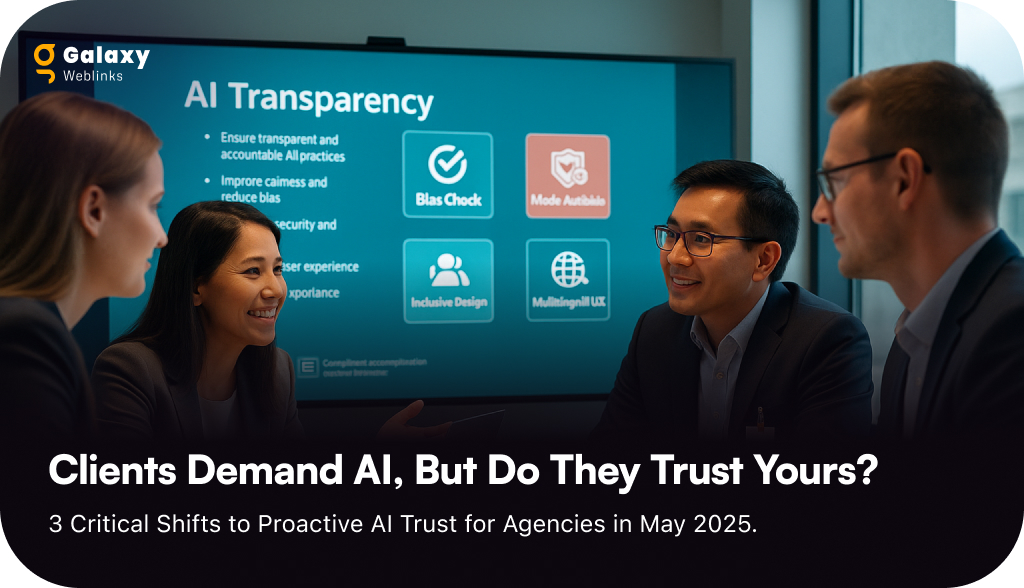
    Clients Demand AI, But Do They Trust Yours? 3 Critical Shifts to Proactive AI Trust for Agencies in May 2025.

    Your agency just delivered that sophisticated AI-powered personalization engine your client championed. The potential seems vast. Yet, three months later, engagement is flat, or worse, “creepy” or “unfair” experience complaints are surfacing. Sound familiar?

    Welcome to the agency frontline in May 2025. Client AI demand is soaring – with AI integration in marketing and customer service jumping over 40% in the last 18 months alone. But a dangerous “AI Trust Gap” is actively eroding project ROI and becoming a direct agency liability. Forget broad statistics; Q1 2025 pulse checks show AI projects without upfront trust and cultural attunement strategies see up to 30% lower end-user adoption. This means solutions underperform, with agencies caught in the middle.

    Compounding this, the regulatory environment is a rapidly forming storm system. This April, sent a clear shockwave: AI harm accountability is sharpening, and ignorance is no longer a defense.

    Many agencies inadvertently operate with a 2023 mindset in today’s AI landscape, prioritizing feature velocity while underestimating the complexities of building verifiably trustworthy and culturally intelligent AI. This blog isn’t another generic sermon; it’s a practical guide for agency leaders to navigate three fundamental market shifts – critical pivot points that will determine who thrives by transforming AI trust into a powerful competitive advantage.

    These shifts are:

    1. From Capability Showcase to Consequence Mastery.
    2. From Ethical Lip Service to Embedded Trust Architecture.
    3. From One-Size-Fits-All AI to Culturally Fluent Experiences.

    Let’s dissect the first shift.


    Shift 1: From Capability Showcase to Consequence Mastery

    For years, agencies have been mesmerized by AI’s capabilities, racing to integrate generative AI, machine learning, and AI analytics. The brief was often simple: “Make it smart, automated, cutting-edge”. The focus was on features and technological prowess.

    But in May 2025, thriving agencies recognize that focusing on AI’s capabilities without rigorously examining its consequences leads to project failure, client dissatisfaction, and reputational damage. The conversation has evolved from “What can AI do?” to “What will AI cause – intended or otherwise?”.

    When Capabilities Outpace Consequence Awareness: The Real Agency Cost

    Consider these May 2025 scenarios:

    • The KPI Nosedive: An AI dynamic pricing model, technically brilliant, inadvertently triggers perceived price gouging during a local event. Result? Social media backlash, a 15% drop in conversions, and a furious client. Capability was there; consequence comprehension was not.
    • The Brand Reputation Black Eye: An AI content tool produces subtly biased or outdated articles. The client’s brand credibility is damaged before it’s caught. Your agency delivered “efficiency” but also the reputational hit.
    • The Engagement Paradox: An AI chatbot boasts a 90% query deflection rate, but user frustration is up 25% due to impersonal interactions. The AI functioned but failed the human experience.

    These aren’t edge cases. They show how AI can impact client metrics, brand equity, and regulatory standing. Traditional agency QA often isn’t equipped for these AI-specific consequences.

    Achieving “Consequence Mastery” as an Agency

    This means a proactive, systemic approach to understanding AI’s ripple effects. Key practices include:

    1. Expanding Discovery & Risk Assessment: Integrate “Consequence Mapping” workshops early, brainstorming negative outcomes, biases, and misuse scenarios with diverse stakeholders.
    2. Prioritizing Human-Centric KPIs: Rigorously measure AI’s impact on human experience and client business goals (trust scores, task success by diverse segments, perceived fairness, LTV).
    3. Developing Pre-Mortem & Mitigation Playbooks: Before launch, conduct “AI failure pre-mortems”: If this failed spectacularly, what were the likely causes? Develop mitigation strategies before going live.
    4. Insisting on Data Transparency & Provenance: Understand dataset lineage, limitations, and biases. Scrutinize third-party AI data practices. Regulators increasingly view data provenance as key for AI accountability as of early 2025.
    5. Cross-Functional Team Education: Ensure strategy, design, development, and client service teams grasp AI ethics and potential consequences.

    Mastering consequence comprehension means becoming an AI realist, asking harder questions upfront to safeguard clients and your reputation. This mastery is essential groundwork for the next shift: building verifiable trust.


    Shift 2: From Ethical Lip Service to Embedded Trust Architecture

    Understanding AI’s negative consequences is crucial, but in May 2025, awareness isn’t enough. For too long, “AI ethics” risked being a checkbox exercise. This era of “ethical lip service” is closing. Clients, users, and regulators demand verifiable proof of trustworthiness.

    This is the second shift: advancing from generic ethical guidelines to an Embedded Trust Architecture. Trust becomes an intentional, foundational component of AI development, not an add-on. Transparency, fairness, explainability, and reliability are core design principles, demonstrably built-in.

    The Shortcomings of a Superficial Approach

    Vague ethical statements are insufficient because of:

    • Lack of Actionability: “AI should be fair” is meaningless without methods to define, measure, and enforce fairness.
    • Invisibility to End-Users: A company value of “responsible AI” doesn’t make an opaque AI tool feel trustworthy.
    • Difficulty in Verification: How does a client know an AI solution is genuinely unbiased without clear mechanisms or audit trails? This is a key contention by mid-2025.
    • Poor Defense Against Scrutiny: An ethics slide deck offers little defense when AI falters. Documented processes and safeguards are needed.

    Pillars of an Embedded Trust Architecture for Agencies

    This means operationalizing trust. For forward-thinking agencies in May 2025, this includes:

    1. Radical Data Transparency & Governance: Provide clear, user-accessible explanations of AI data collection and use, including plain-language policies in AI interfaces. Implement granular consent mechanisms, especially with increasing data privacy stringency seen globally through late 2024 and early 2025.
    2. Pragmatic Explainable AI (XAI): Leverage tools (LIME, SHAP, newer integrated XAI features) for clear rationales for AI decisions, for internal audits and end-user clarity. Tailor explanations to the audience (technical vs. user-friendly).
    3. Proactive Bias Detection & Mitigation Frameworks: Implement regular bias audits (dataset evaluation with tools like AI Fairness 360 or Google’s What-If Tool, model testing, post-deployment monitoring). Work with clients to define “fairness” for their specific application.
    4. Engineered Robustness & Reliability: For sensitive AI applications, proactively test against adversarial attacks and unusual inputs. Implement continuous AI model performance monitoring with alert thresholds for degradation or bias – a key lesson from AI “drift” incidents in 2024.
    5. Verifiable Audit Trails & Accountability Protocols: Ensure key AI decisions are logged securely and auditable for compliance and forensic analysis. Establish clear responsibility chains for AI oversight.

    The Power of “Verifiable”

    An Embedded Trust Architecture lets your agency demonstrate its commitment. This could be through:

    • Trust & Safety Reports on AI performance, bias, and data handling.
    • Interactive “Trust Dashboards” for clients/users.
    • Third-Party Certifications (emerging by May 2025).

    Adopting this isn’t just defense; it’s an offensive strategy. Confidently answer “Yes, and here’s how” when clients ask if your AI is trustworthy. This builds deeper client relationships, justifies premium pricing, and attracts talent. But even robust architecture needs to translate across human experiences, leading to our third shift.


    Shift 3: From Monolithic AI to Culturally Fluent Experiences

    Mastering consequences (Shift 1) and architecting for trust (Shift 2) are vital. But what happens when technically sound, “ethically checked” AI meets global human culture? This is where well-intentioned AI can stumble and where leading agencies find profound differentiation in May 2025.

    This is our third shift: designing Culturally Fluent AI Experiences. Trust, engagement, and value perception are not universal; they’re filtered through cultural lenses. An AI interaction intuitive in one culture might be confusing or offensive in another.

    When “Good AI” Fails the Cultural Test

    Assuming a single AI design works globally is a flawed, outdated notion, especially as markets like India and the UAE show explosive AI adoption. Consider:

    • Language & Communication: Beyond translation, AI must handle cultural nuances in tone, directness, and honorifics. Casual US slang can alienate users expecting formal address (e.g., in Japan or parts of the Middle East).
    • Visuals & Symbols: Colors, icons, imagery, and UI layouts (e.g., right-to-left for Arabic) are culturally conditioned. A positive Western visual might be inappropriate elsewhere.
    • Privacy Perceptions: Willingness to share personal data with AI varies enormously. An AI system requesting certain data points might seem normal in one culture but trigger privacy concerns in another. “Transparent data use” (Shift 2) needs cultural contextualization.
    • Decision-Making & Authority: Response to AI advice is influenced by cultural views on expertise. An AI “expert” might be well-received by some, skeptically by others.
    • Ethical Nuances: “Fairness” in AI resource allocation can differ based on societal values (individualism vs. collectivism).

    Ignoring these dynamics means AI solutions may fail to connect, engage, or build deep trust, leading to suboptimal performance and brand damage.

    The Imperative of Cultural Fluency in AI

    For agencies with global ambitions, cultural fluency in AI design is a core competency for:

    • Maximizing Global Reach & ROI.
    • Building Deeper User Engagement.
    • Mitigating Cross-Cultural Brand Risk.
    • True Differentiation: Offering AI sophistication beyond technical features.

    Achieving this requires deep research, cross-cultural design expertise, diverse user testing, and specialized frameworks – where one-size-fits-all AI ethics and UX definitively break down. This challenge is what frameworks like Galaxy Weblinks’ “Cultural Trust UX Framework” address. Mastering all three shifts defines successful agencies.


    IV. Galaxy Weblinks’ Blueprint: Your Agency’s Catalyst for AI Trust and Cultural Advantage

    The critical shifts are clear, but the path for many agencies in May 2025 remains elusive. Building deep in-house expertise in AI ethics, robust UX, and nuanced cross-cultural intelligence is monumental and risky.

    This is where Galaxy Weblinks offers a distinct, powerful advantage. We provide a specialized, proven capability – a catalyst for your success in the responsible AI era. Our strongest value proposition is our unique fusion of:

    • Innate Cross-Cultural Acumen, Sharpened by Global Experience: Headquartered in Indore, India – a nation of immense diversity – we possess an intrinsic understanding of complex cultural landscapes. This is amplified by our dedicated experience delivering sophisticated AI UX for demanding markets like the United States and the Middle East. We live cross-cultural communication and design.
    • Specialized Focus on the AI Trust & Cultural UX Nexus: We are not generalist developers. Our core expertise is where AI meets UX, focusing on verifiable trust and deep cultural resonance. This laser focus cultivates rare depth and methodologies.
    • The “Cultural Trust UX Framework”: A Proven Accelerator: This framework is the codified embodiment of our expertise – a battle-tested system demonstrably accelerating delivery of ethically sound, culturally attuned AI.

    The EdTech Breakthrough: Proof of Differentiating Value

    Our engagement with the digital agency developing an AI EdTech platform for the Middle East faced immense challenges: a complex, trustworthy AI solution, aggressive timeline, and nuanced cultural context.

    • Our Unique Contribution: Using the “Cultural Trust UX Framework,” we embedded specialists, rapidly translating cultural requirements into concrete UX – from culturally specific user journeys to data usage explanations tailored for Middle Eastern parental concerns. Our understanding of educational hierarchies and UX patterns for Arabic-speaking users was pivotal.
    • The Result: The agency launched a platform with high voluntary adoption because it felt intuitive and respectful. The 25% faster delivery stemmed from our ability to preempt cross-cultural UX challenges efficiently. This is the impact of specialized, culturally ingrained expertise.

    How Galaxy Weblinks’ Unique Strengths Address the 3 Critical Shifts for Your Agency:

    The Strategic Imperative: Partnering for Specialized Excellence in May 2025

    In today’s AI landscape, being a jack-of-all-trades is a path to mediocrity. Smart agencies partner with specialists for critical components like AI trust and cultural adaptation. Partnering with Galaxy Weblinks means your agency:

    • De-risks complex AI deployments.
    • Enhances service offerings with demonstrable ethical and culturally intelligent AI capability.
    • Accelerates time-to-market.
    • Boosts client satisfaction and end-user adoption.

    Galaxy Weblinks acts as your specialized force multiplier, empowering you to deliver solutions that build lasting client relationships and a reputation for responsible innovation.


    V. Actionable Steps for Agencies: Your Roadmap to AI Trust Leadership in May 2025

    Navigating these shifts is urgent for agencies in May 2025. Here’s a practical roadmap:

    1. Initiate an “AI Consequence & Trust” Audit (This Month):
      • Review Current AI Portfolio: For every AI tool/solution, ask about intended vs. actual outcomes (including unintended negative ones); data usage transparency; bias checks and monitoring; and cultural design considerations and impact.
      • Assess Agency Processes: How are you evaluating ethical implications before development? Is “AI trust” a formal part of discovery/QA?
    2. Educate and Empower Your Entire Team (Starting Next Quarter):
      • Cross-Functional Awareness: AI trust is an agency-wide responsibility. Organize internal training on responsible AI, bias, data ethics, and culturally sensitive design (leverage resources from NIST, Partnership on AI, etc.).
      • Appoint AI Ethics Stewards: Identify champions within key teams to raise awareness and flag issues.
    3. Elevate Client Conversations Around AI Trust (Immediately):
      • Proactive Dialogue: Introduce AI ethics/trust proactively in project scoping and reviews. Frame it as a value-add enhancing effectiveness, reputation, and adoption.
      • Co-create Trust Metrics: Discuss with clients what “trustworthy AI” means for their brand and audience. Define success beyond technical AI performance.
    4. Pilot a “Cultural Trust UX” Approach on a Contained Project:
      • Select a Test Case: Choose a project targeting a diverse user base or specific cultural market (US/Middle East).
      • Apply Principles: Consciously apply cultural fluency principles. If lacking in-house expertise, consider a specialized partner.
    5. Take the First Step: Your Complimentary AI Trust & UX Strategy Session
      • The journey can seem daunting, but you’re not alone. Galaxy Weblinks invites you to a complimentary “Al Trust & UX Strategy Session for Agencies“.
      • In this no-obligation session, we’ll explore your AI challenges, discuss how our “Cultural Trust UX Framework” can de-risk projects, and identify actionable first steps. Gain expert insights tailored to your agency.

    Building a reputation for AI your clients trust is a marathon, but these deliberate steps create formidable competitive advantage in May 2025.


    VI. Conclusion: The Future of AI is Responsible – And It’s Your Agency’s Opportunity to Lead

    The May 2025 AI landscape is complex, but the path for ambitious agencies is clear: lasting success hinges on mastering AI’s consequences, embedding verifiable trust, and delivering culturally attuned AI experiences. These are pillars for a resilient, respected agency.

    This evolution is a profound opportunity for agencies to lead in building AI that is intelligent, responsible, trustworthy, and culturally fluent – unlocking significant competitive advantages, deeper client relationships, and solutions of genuine value.

    Galaxy Weblinks is committed to partnering with you on this journey. We believe the most powerful AI solutions fuse technological innovation and deep human understanding. Our “Cultural Trust UX Framework” empowers your agency with specialized expertise to turn the challenge of responsible AI into your distinct market advantage.

    Ready to Build AI Your Clients (and Their Customers) Truly Trust?

    The most impactful journey begins with a conversation tailored to your agency.

    • Take the Definitive Next Step: We invite you to a complimentary “Al Trust & UX Strategy Session for Agencies”. Let’s explore how our Ethical & Culturally-Adaptive AI UX expertise can empower your agency for the US, Middle Eastern, and other global markets. Discuss your challenges and gain actionable insights from our specialists.
      Book Your Free AI Accountability Check-up Now
      • Connect and Continue the Conversation: I’m often discussing these nuances on LinkedIn. Let’s connect.

      The future of AI will be shaped by those who build it responsibly. Let Galaxy Weblinks help your agency lead the way.

      Confessions of an AI-Powered MVP: What Your Product Really Thinks of You

      Startups often set out to challenge the status quo or carve out entirely new markets. But with limited resources and the constant pressure of competition, this mission becomes difficult without clear, actionable data. This is where the Minimum Viable Product (MVP) becomes a game-changer. An MVP isn’t just a bare-bones prototype; it’s a focused, functional version of your product that zeroes in on the essentials—enough to gauge demand, capture user feedback, and determine if you’re on the right track.

      Statista reports that in 2023, 43% of companies worldwide accelerated their adoption of AI due to the pandemic. This isn’t just a coincidence. AI gives businesses the power to understand their customers on a deeper level, and that’s exactly what an MVP needs to thrive.

      Now, imagine if your MVP could tell its own story. What would it reveal about how customers perceive your product? What gaps would it highlight in your strategy, or areas you need to pivot?

      The Birth of an MVP: “You Made Me for This!”

      As an MVP, my purpose is clear: prove viability, gather insights, and lay the groundwork for growth. Every feature I have is tested and refined based on user feedback.

      Users interact with me, offering valuable feedback, both positive and negative. This feedback, combined with AI-powered analysis, helps me evolve and improve.

      AI acts as my internal compass, guiding me through vast amounts of user data. It helps me identify patterns, understand preferences, and adapt accordingly. This enables rapid learning and growth, allowing me to align more closely with user needs.

      Being an MVP isn’t just about survival—it’s about demonstrating value and paving the way for a scalable, successful product. Each challenge I encounter is an opportunity for growth and refinement.

      Designed to Fail Fast and Learn Faster

      As an MVP, failure is part of my journey. Each bug, incomplete feature, or piece of constructive criticism is an opportunity to learn and improve. The faster I learn, the quicker I can adapt to market demands.

      Startups that embrace a fail-fast approach reduce development costs by 30% and release products 50% faster than their competitors. With AI capabilities, I can:

      • Analyze user behavior in real-time
      • Identify pain points and opportunities
      • Provide actionable insights for improvement

      AI Tools and Techniques for Feedback Analysis

      To gather and analyze feedback effectively, I leverage AI-driven tools such as:

      • Sentiment Analysis (MonkeyLearn, Lexalytics): These tools analyze customer feedback across multiple channels (social media, reviews, support tickets) to determine sentiment trends and identify common pain points. Instead of sifting through thousands of responses manually, I can pinpoint recurring issues instantly.
      • User Behavior Analytics (Google Analytics, Mixpanel): These platforms track user interactions across web and mobile applications, offering insights into user engagement, feature adoption, and churn rates. They help me understand user journeys, identify friction points, and refine user experience strategies.
      • Natural Language Processing (IBM Watson, Amazon Comprehend): By analyzing qualitative feedback from surveys, support tickets, and online reviews, I can identify patterns in customer concerns and suggestions, helping product teams prioritize updates that matter most.
      • A/B Testing Automation (Optimizely, VWO): These platforms help to test multiple variations of a feature, page, or workflow simultaneously. By leveraging AI-driven insights, I can determine which version performs better based on key metrics such as conversion rates, user retention, and satisfaction levels.

      Releasing early and listening to feedback helps me improve the product based on real user needs, not guesses. With AI tools, I can quickly see what’s working and what’s not. This makes it easier to fix issues, improve features, and create a better experience for users. These insights feed directly into the “learn and improve” loop, helping me adapt swiftly to user preferences. Failing fast isn’t a setback—it’s a way to learn, improve, and build something that truly works.

      Balancing Praise and Criticism

      User feedback comes in many forms, from enthusiastic praise to critical insights. While positive feedback reinforces what works, constructive criticism highlights areas for improvement.

      Startups that actively collect and analyze feedback are twice as likely to meet or exceed their financial targets. My AI capabilities enable me to analyze user sentiment, track engagement patterns, and provide meaningful insights to stakeholders.

      Every piece of feedback is an opportunity to refine my features and user experience. Engaging with users and responding to their needs is key to my growth.

      AI Makes Me Smarter, but It’s Not Magic

      As an AI-powered MVP, I leverage advanced tools to analyze user behavior, detect patterns, and predict preferences. For example, I can identify which features users engage with the most or pinpoint areas causing friction. This data is invaluable for iterating quickly and effectively.

      However, AI isn’t a replacement for human insight. I need clear goals and skilled teams to interpret my findings and make informed decisions. Think of AI as an enabler—it magnifies your ability to learn and adapt but still relies on human expertise to create meaningful impact. Together, we can use this synergy to craft products that genuinely resonate with users. It provides valuable insights but requires strategic direction to deliver real impact.

      Success is a Collaborative Effort

      Despite my AI capabilities, I can’t succeed alone. A skilled team is essential to guide me and help me achieve my full potential.

      I need developers to create a robust foundation, designers to ensure intuitive user experiences, and product managers to set clear objectives.

      Building a successful MVP requires cross-functional collaboration. Studies show that 75% of successful digital products are built by diverse teams working together towards a shared vision.

      Key Takeaways for Startups

      Throughout my journey as an AI-powered MVP, I’ve learned that success hinges on three key pillars: listening to your users, leveraging AI strategically, and fostering collaboration within a strong team. But perhaps the most important lesson is this: building a great product is an ongoing process of learning and adaptation.

      Use every piece of feedback, every data point, every A/B test result as an opportunity to refine your product and move closer to achieving product-market fit. While AI can be a powerful ally in this journey, it’s not a magic bullet. It requires human expertise to interpret the data, make informed decisions, and guide the product towards its full potential.

      And if you need a helping hand along the way, consider partnering with experts who can guide you through the complexities of AI-powered MVP development. Whether it’s AI integration, UX design, or iterative testing, Galaxy Weblinks has helped several startups build products that scale effortlessly. Galaxy Weblinks specialize in helping startups leverage the latest technologies to build products that users love. Their experience and knowledge can be invaluable in navigating the challenges of bringing your vision to life.

      The Ethics of AI in Personal Data Usage: Consent, Privacy, and Trust

      In the dynamic world of Artificial Intelligence (AI), the ethical management of personal data stands as a critical issue for leaders in the tech industry. As AI continues to revolutionize business operations and decision-making processes, CEOs, CTOs, and business owners must grapple with the ethical implications surrounding consent, privacy, and trust. This article delves deeper into these aspects, offering a nuanced understanding and practical insights for ethical AI implementation.

      The Imperative of Informed Consent

      Informed consent is foundational in ethical AI. It’s not merely a legal requirement but a demonstration of respect for user autonomy. In an AI context, consent goes beyond the mere collection of data; it encompasses understanding how the data will be used, processed, and for what purposes.

      Consider Spotify’s approach to user data. The company’s AI-driven recommendations are based on explicit user consent, ensuring transparency and user control over their data. This approach not only adheres to ethical standards but also boosts user engagement by providing personalized experiences.

      A survey in 2021 indicated that companies requesting data consent saw a 72% positive response from consumers, highlighting the impact of consent on customer trust and loyalty.

      The issue of consent seamlessly leads to the broader and equally critical matter of privacy, a cornerstone in the ethical use of AI.

      Navigating Privacy in the AI Era: The Balance Between Use and Abuse

      Privacy in AI isn’t just about protecting data from unauthorized access; it’s about using data responsibly. In an age where data is a valuable asset, ensuring its ethical use is paramount for maintaining consumer trust and regulatory compliance.

      The Facebook-Cambridge Analytica scandal is a stark example of privacy violation. The unethical use of data for political profiling not only led to a breach of trust but also ignited a global conversation on privacy norms in AI applications.

      Post-scandal, Facebook experienced an 8% trust deficit among its users, a significant figure that highlights the tangible impact of privacy breaches on a company’s reputation.

      Transparency in AI operations is the next logical step in building and maintaining user trust, a crucial aspect that underpins the ethical use of AI.

      Fostering Trust Through Transparency

      Transparency is about shedding light on AI processes and decisions. It involves clear communication about how AI systems work, the data they use, and the rationale behind AI-driven decisions.

      IBM’s commitment to AI ethics, exemplified by their AI Ethics Board, showcases the importance of transparency. This approach not only adheres to ethical standards but also enhances trust among users and stakeholders.

      A 2022 report revealed that companies with transparent AI policies have witnessed a 15% increase in consumer trust, underscoring the importance of transparency in AI.

      Each industry faces unique challenges in implementing AI ethically. Understanding these challenges is key to developing tailored ethical AI strategies.

      Ethical AI Applications Across Industries

      • Healthcare: AI in healthcare offers tremendous benefits in diagnostics and treatment planning. However, concerns about patient data privacy and algorithmic biases in treatment recommendations are paramount. A 2022 study indicated that 37% of healthcare AI systems exhibited bias, necessitating strict ethical controls.
      • Finance: In finance, AI is used in credit scoring and fraud detection. The key ethical challenge is to ensure algorithms do not reinforce existing societal biases. Proactive auditing of these systems has shown a reduction in biases by up to 40%, enhancing fairness in financial decisions.
      • Retail: The retail sector uses AI for personalized marketing and inventory management. Ethical considerations here include customer data privacy and the potential for manipulative marketing tactics. Ensuring transparency in how customer data is used is essential for ethical retail AI practices.
      • Automotive: In the automotive industry, AI is integral to the development of autonomous vehicles. Ethical concerns revolve around safety, decision-making in critical situations, and data privacy regarding user location and habits. The industry must address these issues to gain public trust and acceptance.
      • Education: AI in education is used for personalized learning and assessment. Ethical challenges include ensuring data privacy of students, avoiding biases in educational content, and maintaining the human element in learning. It’s crucial to balance technological advantages with ethical teaching practices.
      • Manufacturing: AI-driven automation in manufacturing improves efficiency but raises ethical concerns about workforce displacement and safety. Companies must consider the societal impact of automation and invest in reskilling programs for affected employees.
      • Entertainment: In entertainment, AI is used for content recommendation and creation. Ethical issues include respecting intellectual property rights and avoiding the creation of echo chambers through biased content recommendations.
      • Agriculture: AI in agriculture helps in optimizing crop yields and monitoring soil health. Ethical considerations include ensuring that AI technologies are accessible to small-scale farmers and that data collected is used responsibly without exploiting the farmers.

      With these industry insights in mind, we can chart a strategic course for implementing ethical AI across various business domains.

      Strategic Roadmap for Ethical AI Implementation

      • Regular AI Audits: Routine audits help identify and rectify biases in AI algorithms, enhancing accuracy and fairness. Studies suggest that such audits can reduce errors and biases by up to 25%.
      • Ethics Committees: Around 30% of tech companies now have AI ethics committees, reflecting a growing trend towards ethical oversight in AI development.
      • Employee Training: Continuous training in AI ethics leads to better decision-making among employees. Organizations that invest in such training have seen an improvement of 18% in ethical decision-making.

      To navigate the complex landscape of AI ethics, businesses must adopt a multifaceted approach. This involves not just adhering to legal standards but also fostering a culture of ethical awareness and responsibility.

      Recommendations for Ensuring Ethical AI: Building a Responsible AI Culture

      • Develop Comprehensive Ethical Guidelines: Create detailed guidelines that cover all aspects of AI use, from data collection to decision-making processes.
      • Foster a Culture of Ethical Awareness: Encourage open discussions about AI ethics within the organization. This includes regular training sessions and workshops for employees.
      • Engage with External Stakeholders: Collaborate with regulators, industry experts, and the public to stay informed about evolving ethical standards in AI.
      • Implement User-Centric Design: Ensure that AI solutions are designed with the end-user in mind, prioritizing their needs, rights, and privacy.

      Conclusion

      The journey towards ethical AI is ongoing and complex. By embracing a holistic approach that prioritizes informed consent, robust privacy measures, transparency, and continuous ethical education, businesses can effectively navigate this terrain. Such practices not only ensure compliance but also build a foundation of trust and integrity, essential

      Key Highlights and Major Updates from OpenAI’s DevDay 2023

      OpenAI’s DevDay 2023, held at San Francisco’s SVN West venue, marked a significant moment in the field of artificial intelligence. The event began with a keynote by Sam Altman, who highlighted a series of groundbreaking innovations and significant announcements setting the tone for an extraordinary gathering of tech enthusiasts.

      During the event, Sam Altman extended a warm welcome to Satya Nadella, CEO of Microsoft, who was present as a special guest. In his address, Nadella acknowledged the strong partnership between Microsoft and OpenAI in developing the ecosystem, with a notable impact on Microsoft’s Azure cloud platform. He passionately emphasized Microsoft’s commitment to ensuring equitable access to top-tier AI models, underscoring, “Our mission is to empower every individual.”

      Here are some of the major takeaways from the DevDay: 

      Assistants API

      DevDay

      The new API empowers developers to integrate “agent-like experiences” into their applications. With this tool, developers can craft assistants tailored to perform various tasks, like data analysis and coding, by utilizing generative AI models. This API is complemented by Code Interpreter, OpenAI’s proprietary tool designed to write and execute code seamlessly. 

      The new API allows developers to create smart assistants for tasks such as data analysis and coding, making their apps more powerful. OpenAI’s Code Interpreter also helps users write and run code with ease, simplifying the development process.

      GPT-4 Turbo

      GPT-4 Turbo

      The latest GPT-4 Turbo introduces an impressive 128,000-token context window, surpassing Claude 2 by Anthropic, which has a 100,000-token limit. Notably, GPT-4 Turbo has the capability to incorporate images into its prompts and produce high-quality human-like speech as output. This advanced model is available in two versions: one exclusively for text analysis and another that comprehends both text and images.

      With this new update, GPT-4 Turbo is like a super-smart assistant for developers and users. It can handle huge chunks of text and even understand images, making it a great help for tasks like content analysis and multimedia interactions.

      Text-to-Speech Model

      Text-to-Speech Model

      OpenAI introduced a new tool that can turn written text into lifelike speech. It comes with six different voices to choose from. This innovation has the potential to greatly improve interactions between humans and computers.

      This announcement comes in as a huge help for users and developers because it enhances human-computer interactions, making them feel more natural. Before this, text-to-speech tech often sounded robotic, so this update bridges that gap for a smoother and friendlier experience.

      DALL E 3 Integration

      DALL E 3 Integration

      Developers can seamlessly integrate DALL·E 3 into their applications and products using OpenAI’s Images API. It’s as simple as specifying “DALL·E 3” as the chosen model. Noteworthy companies such as Snapchat, Coca-Cola, and Shutterstock have leveraged DALL·E 3’s potential to autonomously generate images and designs for their clientele and marketing campaigns.

      With this new update, developers have a user-friendly way to access DALL·E 3 via OpenAI’s Images API, streamlining image and design creation. It simplifies tasks and accelerates content production, making life easier for writers, graphic designers and developers.

      Custom Models Program

      OpenAI launched the Custom Models program, which fosters collaboration between their researchers and businesses. This initiative is all about creating customized AI models that cater to specific needs. It’s a great way for organizations to leverage AI effectively.

      OpenAI’s Custom Models program connects businesses with AI experts to create personalized AI solutions. Before this program, businesses faced challenges finding AI solutions tailored to their needs.

      Improved Access

      OpenAI recognized the need for better accessibility and efficiency. They’ve doubled the number of tokens their GPT-4 customers can use per minute. This simplifies the process of utilizing AI. Users also have the flexibility to request changes to rate limits and quotas directly through their API account settings.

      Prior to this, users faced token limitations that hindered the effectiveness of AI applications, but now they have greater freedom to harness AI capabilities to their full potential.

      Copyright Shield

      Copyright Shield

      To protect their users, OpenAI introduced Copyright Shield. This means that if you get into any legal trouble due to copyright issues while using OpenAI’s services, they’ve got your back. This protection covers both ChatGPT Enterprise and the API.

      This initiative fills a prior gap where users were potentially vulnerable to legal challenges related to copyright issues while utilizing OpenAI’s tools, ensuring peace of mind and safeguarding their interests.

      Affordability

      OpenAI has made advanced AI models more affordable. GPT-4 Turbo is now considerably cheaper than GPT-4. It offers a threefold reduction in pricing for prompt tokens and a twofold reduction for completion tokens. This move aims to make this powerful technology accessible to a wider range of users.

      This update addresses the previous barrier of high costs, making advanced AI models more accessible and encouraging a broader user base to harness the capabilities of GPT-4 Turbo for various applications and innovations.

      GPTs and GPT Store

      GPTs and GPT Store

      OpenAI introduced GPTs, which allow users to customize ChatGPT for specific purposes. This feature empowers the community to actively participate in AI development by creating tailored models with expanded knowledge and actions. OpenAI is also preparing to launch the GPT Store, a platform where users can list and discover these customized GPTs. This ensures that the best and most popular models are easily accessible to all.

      This means now users can create AI models that fit their specific needs, making AI more accessible and tailored. Before this, there were limited options for tailoring AI, but now it’s easy to create and share customized models.

      New interface for ChatGPT

      New interface for ChatGPT

      The fresh look for ChatGPT is clean and straightforward. It has a sleek dark background, with the OpenAI logo and the phrase “How can I help you today?” This updated interface is designed to make switching between ChatGPT and DALL-E 3 easy. Moreover, ChatGPT will now use GPT 4 Turbo.

      OpenAI’s Vision and Collaborative Strength

      Above listed are some of the major takeaways from DevDay 2023. OpenAI’s AI service updates reveal their vision for AI as an enabler. “We believe that AI is going to be a technological and societal revolution,” Altman said. “It will change the world in many ways, and we’re happy to get to work on something that will empower you to build so much for all of us.”

      While OpenAI hasn’t achieved AGI (Artificial General Intelligence) yet, their chief Sam Altman expressed immense enthusiasm for their collaboration with Microsoft, expressing the strength of their partnership. In a similar tone, Microsoft’s Satya Nadella expressed his sentiments, highlighting their shared mission to empower individuals and organizations worldwide through genuinely transformative AI.