What Are the 6 Core Elements of Digital Transformation? 

By 2028, global spending on digital transformation will reach $4 trillion. Yet, 78% of initiatives still fail to meet their goals. 

Most failures don’t come from weak technology. They come from weak execution — unclear goals, rigid structures, and missing alignment between people and purpose. 

Digital transformation is more than technology. It is a change in how a business thinks and acts. 

It touches every part of an organization. The way people work. The way products are built. The way customers are served. 

It asks simple but difficult questions: 

  • What still works? 
  • What must change? 
  • What creates real value? 

Transformation is not about speed. It is about direction. It is about doing the right things, not just doing things faster. 

The businesses that last are the ones that adapt with intent. They see digital not as a tool but as a mindset. 

Six core elements form the heart of this change. Together, they turn vision into action and action into growth. 

Here’s a closer look at these six elements and how they shape true digital transformation. 

What Digital Transformation Truly Means 

Digital transformation touches every part of a business. Not just the tools. Not just the systems. The way work flows. The way decisions are made. The way value is created. 

Its aim is simple: 

  • Make work faster. 
  • Make customers matter. 
  • Make ideas real.  

It is not enough to change technology. People must change. Processes must change. Culture must change. 

Those who adapt thrive. They respond quickly. They act with insight. They move before others catch up. 

What Are the Key Elements of Digital Transformation? 
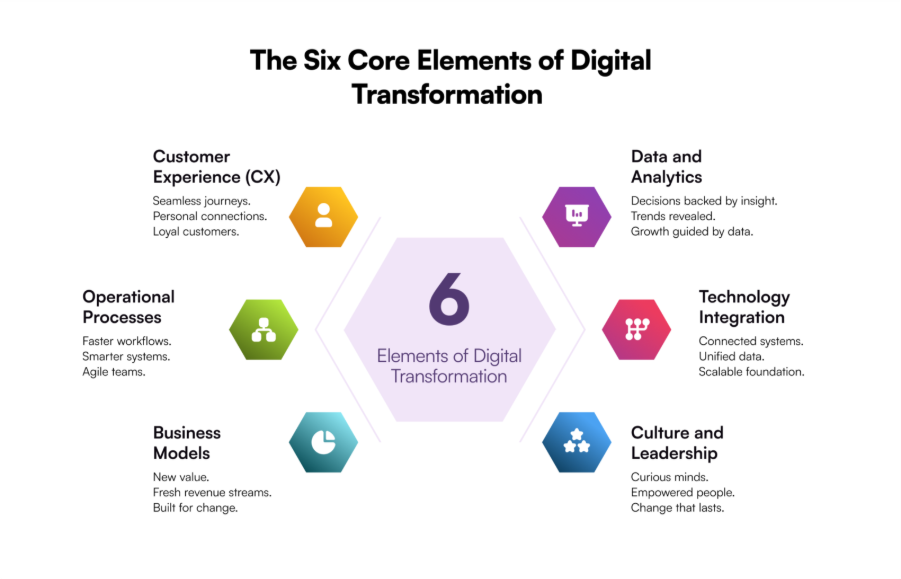
Element 1: Customer Experience (CX) 

Customer experience is how every interaction feels. It is planned, yet natural. Digital tools extend reach but do not replace judgment. 

Where every touchpoint sends a signal. Each decision shapes trust. CX consulting services connect work, process, and outcome into a seamless journey. 

Significance 

  • It builds loyalty. It earns trust. 
  • It keeps people returning. 
  • It turns casual users into advocates. 

Key Focus Areas 

  • Map the journey from first contact to ongoing engagement. 
  • Listen and observe. Act on what customers show, not just what they say. 
  • Every interaction must add value. Clear. Relevant. Memorable. 
  • Decisions in one area must reinforce the experience in all others. 

Suggesting to read: How AI in Customer Journeys can Enhance Interactions 

Element 2: Operational Processes 

Operational processes are how work moves inside an organization. They are planned, yet flexible. Digital transformation shapes them to flow faster, with fewer errors and less friction. 

A smooth operational process connects people, tasks, and information so the organization can respond quickly. Each step shapes speed, accuracy, and resilience. Therefore, CI/CD automation is one of the core steps of digital transformation. 

Significance 

  • It allows faster decisions. 
  • It responds to change without chaos. 
  • It lowers cost and error. 
  • It makes the organization stronger and adaptable. 

Key Focus Areas 

  • Find tasks that are repetitive or slow. Simplify or remove them. 
  • Connect systems so information moves freely across teams. 
  • Encourage collaboration across functions for decisions that are timely and informed. 
  • Align processes with the overall goals of transformation. 

Element 3: Business Models 

Business models define how a company creates value and earns from it. In digital transformation, they evolve. Technology becomes a means, not the goal.  

Value shifts from product to experience, from ownership to access. It is about seeing what others miss — finding new ways to serve customers, new paths to growth, and new forms of revenue. A transformed model is built to change, not to last unchanged. 

Significance 

  • It opens new markets and reaches new customers. 
  • It keeps innovation alive. 
  • It builds a foundation that can scale and endure. 

Key Focus Areas 

  • Look beyond what is sold. Focus on how value is delivered. 
  • Revisit offerings to uncover digital potential. 
  • Experiment with models — subscription, platform, or data-led. 
  • Design for movement. Let the model evolve with time and demand. 

Element 4: Data and Analytics 

Using data as a strategic driver for decisions, performance evaluation, and business growth. A mature data culture requires governance, accessibility, and cross-departmental collaboration — ensuring that decisions are consistent, timely, and insight-driven. 

Significance: 

  • Turns insights into informed decisions. 
  • Improves forecasting accuracy and operational efficiency. 
  • Enhances understanding of customer behavior and preferences. 

Key Focus Areas: 

  • Build reliable data collection and governance frameworks. 
  • Encourage data-driven decision-making across all levels. 
  • Use analytics to identify trends, measure progress, and guide future strategy. 

Element 5: Technology Integration 

Technology integration is how systems, platforms, and applications speak to each other. In digital transformation, it turns scattered tools into one working whole. The goal is not more technology, but smarter use of it. Integration creates clarity, speed, and control — a digital backbone that supports every function without slowing it down. 

Significance 

  • It builds flexibility and scale. 
  • It allows information to move freely across teams. 
  • It removes silos and waste. 
  • It lets people focus on outcomes, not systems. 

Key Focus Areas 

  • Modernize old systems to fit the new vision. 
  • Ensure platforms work together and share data without barriers. 
  • Build an infrastructure that grows with the business — secure, stable, and ready for change. 

Element 6: Culture and Leadership 

True transformation begins in mindset — in the belief that progress is constant and learning never stops. Culture is the force that holds transformation together. A strong culture does not wait for change; it creates it. It shapes how people think, act, and respond to change.  

Leadership sets the tone. It builds trust, gives direction, and keeps momentum when challenges rise.   

Significance 

  • It decides how long transformation lasts. 
  • It builds ownership, clarity, and courage. 
  • It helps people accept change and move with it. 

Key Focus Areas 

  • Lead by example. Encourage curiosity, experimentation, and open thought. 
  • Give teams the tools and knowledge to adapt and grow. 
  • Celebrate progress — it turns change into shared purpose. 

Implementing the Elements of Digital Transformation 

Digital transformation is seen in outcomes. It moves people, processes, and priorities together. Only deliberate action, aligned strategy, builds something lasting. 

Assess Current Maturity 

Scrutinize everything from systems, workflows, and mindsets. Find gaps that slow progress. Measure not just technology, but readiness — skills, culture, and trust. 

Define Clear Objectives 

Tie goals to value — revenue, experience, resilience. Share them widely. Clarity prevents wasted effort. Your objectives should guide every move. 

Prioritize High-Impact Areas 

Look for quick wins that demonstrate value and build confidence. Focus on areas that reduce friction, unlock revenue, or improve customer trust. Early results can reveal what works and what doesn’t. 

Develop a Roadmap 

A roadmap is more than a plan. It is a sequence of choices that keeps the organization moving in unison. 

  • Map actions, resources, and timelines. 
  • Align people, processes, and systems. 
  • Anticipate dependencies and obstacles. 

Measure and Optimize 

Metrics are mirrors. They reflect the reality and status of your digital transformation process. Based on that, decide what matters. Track it. 

Refine constantly. Repeat what works. Drop what slows progress. 

Embed Through Culture 

Change sticks in daily practice, not in memos. Encourage curiosity, experimentation, and ownership. Reward visible progress. Reinforce behaviors that align with transformation. Culture is the vessel that carries every other element. Without it, transformation drifts. 

Why Galaxy Weblinks is Your Strategic Digital Transformation Partner 

Galaxy Weblinks works with enterprises across finance, healthcare, retail, and manufacturing. We guide strategy, execution, and adoption through our digital transformation services and deliver measurable value. 

We connect people, processes, and technology. We modernize operations. We improve engagement. We create outcomes that last. 

With NETGEAR, we optimized the Orbi Mobile App to ensure it ran smoother with improved user experience. With our solutions, the interface became simple and clear. Legacy code was refactored. New features could be added without delay.  

This is the kind of impact our digital transformation services create. Deliberate. Measurable. Built on experience. 

Partner with Galaxy Weblinks. Achieve results. Scale with confidence. 

How to Reduce Complexities in Software Product Development? 

When it comes to developing a software product, one critical challenge that enterprises face is managing complexities. It becomes even more vital because it directly affects costs and efficiency. In fact, complexity is among the biggest reasons for software project failures.  

As per Gartner’s estimates, 55% to 75% of ERP projects fail to achieve their goals. Moreover, these complexities in software product development put businesses under stress, not only financially but also with regard to the future of their investments.      

Sometimes these complexities in a software project arise due to frequently changing market needs, or wrong decisions, or technological mismatches, or sometimes accidentally arise because of unavoidable factors.  

Fortunately, there are ways that businesses can reduce complexity and build software products successfully – choosing DevOps and Agile is one of them.  This blog sheds light on the complexities of software product development and ways to overcome them to build the right solution. It is your guide to successful software development for your business.   

So, let’s get started! 

Understanding the Complexities in Software Product Development 

We are all aware of what complexity is, but this isn’t the usual case with software products. Complexities in developing software solutions are multifaceted. So, in software product development, complexity refers to how difficult it is to design, build, and maintain a software solution.  

It involves the following complexities: 

  • Code complexity: this entails the intricacy of the code of the software.  
  • System complexity: this is also architectural complexity that defines how many components interact and their dependence on each other. 
  • Domain complexity: it is about the complexity of the real-world that the software tries to solve. 
  • Process complexity: challenges related to syncing teams, tools, and workflows. 

The complexity in software engineering can affect the quality, sustainability, performance, and longevity of the software. Businesses need to tackle the complexity smartly to build an efficient, secure, and high-performance software solution. Choosing the right software development process, tech stack, and architecture helps reduce the complexity and build the best quality software for your business.    

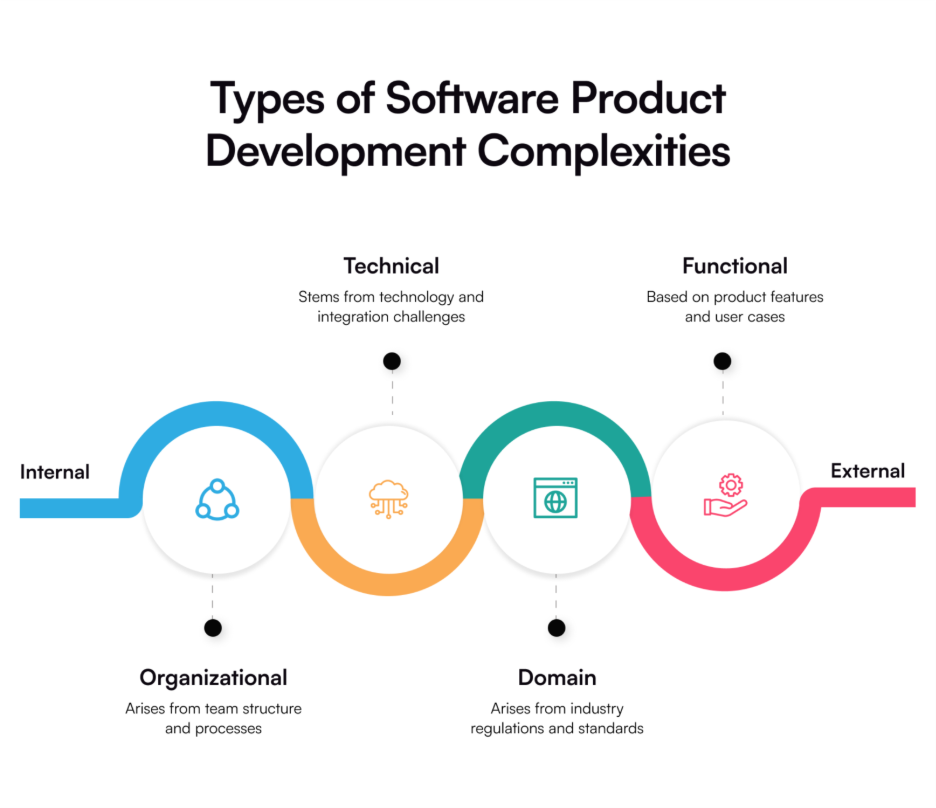
Types of Software Product Development Complexities  

Software product development usually encounters various types of complexity that affect cost, quality, and delivery times. Technical complexity is one of the most significant types, resulting from the application of complex technologies, interfacing with several platforms, and providing performance, scalability, and security.  

The example of creating a system that integrates cloud services, IoT, and mobile applications involves high technical complexities.  

The other important type is functional complexity, based on the demands of the product itself. When software has to provide numerous features, serve more than one workflow, or cover a wide range of user cases, its design and its testing become much more challenging.  

Domain complexity is the difficulty that arises from the industry or issue the software is solving. It also includes complexity related to software alignment with industry standards or regulations. For example, there is strict compliance for healthcare, finance, and aerospace with regulations like GDPR, HIPAA, and PCI DSS. It results in complex business rules that add an extra level of complexity.  

Lastly, there are complexities that directly arise from an organization and its processes, like managing distributed teams, adhering to development processes, and team alignment. Additionally, miscommunication and unclear processes can also affect a project’s success.  

So, these are the important complexities related to software development. By identifying and tackling these software development complexities early on, you can form realistic expectations, choose the right development approach, and use the best practices to develop a top-notch product that will align with your business expectations.  

Challenges in Finding Software Complexity  

It is not always easy to identify and quantify complexity when it comes to software product development. Perhaps the most significant reason is the subjectivity of complexity—that which is complex to one developer may be obvious to another, based on the experience and knowledge of the developer and the domain or technology area. This complicates the ability to define a universal measure.  

Yet another challenge is latent dependencies in the code. Intricate interactions between modules, APIs, and third-party integrations might not be apparent on the surface, but can raise maintenance and debugging work considerably. Likewise, legacy codebases tend to have improper documentation, so it is hard to determine their actual complexity level.  

Changing needs also bring ambiguity. As functions are added or changed, the complexity of the software dynamically alters. Often, metrics change; they are not the same all the time. Some metrics considered useful at one point in time may be inappropriate at a later time.  

Apart from this, balancing the quantitative measures (like cyclomatic complexity, lines of code, or function points) against qualitative factors (like readability, modularity, and usability) is also difficult because there can be no single measure to present the complete picture.  

Lastly, development teams feel immense pressure and struggle to meet deadlines with the time and resource limitations that make them bypass an in-depth analysis for complexity, which undervalues the risk in the end.  

So, these are the various challenges faced in developing software products. By being aware of these challenges, you can pick superior tools, measures, and cooperation strategies that help you tackle software challenges. 

Key Indicators of Software Product Development Complexities 

Software development complexity can sneak up like a plot twist in a thriller, derailing even the best-laid plans. Understanding its layers—technical, management, process, and strategic—gives your team the ability to tackle these complexities smartly. So, let’s check out these indicators of complexity to build the best software peacefully.  

Structured Indicators 

Technical issues, such as difficult integrations or performance requirements, can bring development to a standstill if not addressed. Project management obstacles, such as confusion around scope or stakeholders out of sync, inject chaos into schedules.  

Process mistakes, such as the selection of the wrong method, cause workflow tangles, while strategic threats require advanced mitigation. Identifying these software development issues upfront is your key to staying ahead. It’s like finding your way through a maze—you require a map, not a flashlight.  

Practical Indicators 

Software development best practices begin with identifying certain signs: intricate architecture, resource bottlenecks, or deployment issues.  

Actual conditions, such as an expedited schedule or communication breakdown with stakeholders, indicate where it all falls apart. A software development firm can assist by providing actionable models to evaluate and control these situations, making your software development process seamless. 

Process Specific Indicators  

For developers, this means catching red flags like tangled codebases early. Project managers gain tools to streamline resources and align teams. Stakeholders get clear communication to tackle software development challenges head-on.  

Risk mitigation strategies, like early warning systems, let you adjust before small issues become project-killers. By monitoring these complexity categories, you’re not just reacting—you’re planning smarter.  

Complexities in software product development can hamper your project’s success and delay the launch. You need to follow an optimal approach that promptly identifies these indicators of software development complexities and acts on them by guiding your team, optimizing the development process, and turning these pitfalls into an opportunity to innovate.  

Ways to Reduce Complexities in Software Product Development 

There are many strategies that organizations can leverage to reduce software complexities and build better software products frictionlessly. These strategies help you build scalable and flexible software that can be managed seamlessly. Let’s summarize these strategies below. 

Ensure Clean Code 

Code quality is the primary technical factor in software complexity. A well-structured code is vital to reducing complexity and building a manageable codebase. To make your code readable, use names for functions and variables that are meaningful.  

Follow the SRP (Single Responsibility Principle) when creating functions to keep them focused on a specific task and make them shorter. As a result, this will make testing and maintenance easier for your software product.  

Choose a Modular Architecture 

Another reason for complexity in software is choosing an architecture that is way more complex to implement. It makes testing and maintenance difficult. Besides, in such architectures, the components are tangled, and each of them has higher interdependence.      

Choosing a modular architecture helps you reduce the complexity and avoid interdependence on too many components. For example, microservices-based architectures can have separate modules that can be tested and maintained independently.  

Use Design Patterns 

Using design patterns can help you make your software product more understandable, maintainable, and reusable. They offer solutions to a generally occurring software development problem, adaptable to different situations.  

You can use design patterns like Singleton, Observer, and Factory to address complexities in your software development project. You can also combine different patterns to make it more effective.  

Code Reviews 

With regular code reviews, you can ensure it meets the best practices and avoid complexity in the long term.  Often, developers write code that is over-engineered. Code review can help detect such code early in software engineering to replace it with a more manageable and maintainable alternative. 

Code reviews also implement a standard approach for coding and help avoid developers creating shortcuts that might increase the complexity in software development.  

Use Version Control Systems 

Using version control systems like Git, Bitbucket, and Subversion can help manage and track code changes. VCS helps track changes, reduce bugs, and avoid confusion. With the use of branches, multiple developers can work on different features and bugs, which helps avoid chaos.    

In a Nutshell 

Complexities in software development are a key roadblock to successful project delivery. So, managing the complexity is crucial to building software products that are easy to maintain, scale, and implement into your business processes.  

Understanding the complexities, their types, challenges, and ways to reduce them, as we discussed in this blog, helps you overcome these challenges in software development and build the best solutions. You can reduce these complexities by taking proactive steps.  

At Galaxy Weblinks, we are aware of the common software development pitfalls and have handled various challenges for our clients, which enable us to build the best software solutions. We can help you build the right software product and guide you through complexity.  

Contact us to help you reach your goals and develop software while addressing the complexities.   

From Idea to Reality: Navigating the Entrepreneurial Journey For New Entrepreneurs

Picture this: A flash of inspiration in the dead of night sparks a business idea. It’s not just any idea, but one that resonates with innovation and potential. As the sun rises, however, so do your doubts. How do you transform this idea into a successful venture?

This is a familiar scenario for many now-successful entrepreneurs. The transition from an idea to a successful business is often laden with challenges, especially for first-time entrepreneurs. This article aims to demystify this journey, providing a step-by-step guide complete with specific action steps, relevant metrics, and contextualized real-world examples, designed for those embarking on their first entrepreneurial venture.

The Genesis of an Idea: Identifying Market Gaps

Understanding Market Needs: The genesis of a successful business is rooted in identifying and fulfilling a specific market need. For instance, when Airbnb was launched, it didn’t just offer lodging; it tapped into a deeper desire for authentic, local experiences, which traditional hotels weren’t providing. This insight was critical in Airbnb’s trajectory to becoming a company with a valuation reportedly over $100 billion as of 2021.

Action Steps:

  • Conduct Extensive Market Research: Dive deep into understanding consumer behavior and market trends. Airbnb, for example, started by targeting big events with a shortage of local accommodation, an approach informed by meticulous market analysis.
  • Analyze Competitors and Industry Trends: Airbnb’s founders looked at the existing hotel industry and found a gap in the market for more personal, home-like accommodations.
  • Define a Unique Value Proposition: Your UVP should address the gaps found in your market research. Airbnb’s UVP was not just about finding a place to stay, but about ‘living like a local’.

Crafting a Business Plan: The Blueprint for Success

The Power of Planning: A well-thought-out business plan is a cornerstone of success. According to the U.S. Small Business Administration, a business plan significantly increases the odds of business survival and growth. Take the example of Spanx. Its founder, Sara Blakely, started with a clear vision and a $5,000 investment. Her strategic planning involved identifying a niche market, understanding the product’s unique appeal, and devising a plan to bring it to market, which led to Spanx becoming a billion-dollar company.

Action Steps:

  • Detail Your Business Model: This includes your product or service, target market, and revenue model. Spanx’s direct-to-consumer model disrupted traditional retail channels.
  • Develop a Comprehensive Marketing Strategy: Spanx’s success was partly due to innovative marketing strategies, such as leveraging influencer marketing before it was mainstream.
  • Prepare Financial Projections: Include realistic cost estimates, pricing strategy, and revenue forecasts. Spanx’s lean approach to expenses and reinvesting profits was key to its financial planning.

Financing Your Dream: Navigating the Funding Landscape

Securing Capital: Adequate funding is critical for business growth. Kickstarter, a crowdfunding platform, has seen remarkable success stories, like the Pebble Time smartwatch, which raised over $20 million. These platforms demonstrate the potential of community-based funding for innovative products.

Action Steps:

  • Determine Your Funding Needs: Evaluate your startup’s financial needs realistically, considering both initial and operational costs.
  • Explore Diverse Funding Sources: Research and choose from options like bootstrapping, angel investors, venture capital, or crowdfunding. Pebble Time’s crowdfunding success showcases the power of community support for innovative ideas.
  • Develop a Strong Investment Pitch: Your pitch should succinctly explain your business idea, market potential, and financial projections, much like how Pebble Time captured the imagination of thousands of backers with its clear value proposition and technological innovation.

Execution: Turning Plans into Action

The Art of Execution: Effective execution is the bridge between an idea and a successful business. Dropbox is a prime example of this. Starting as a simple cloud storage service, Dropbox focused on solving a specific problem – easy file sharing and storage. Their execution strategy, which included a user-friendly interface and a clever referral program, led to rapid user growth, with the company now boasting hundreds of millions of users.

Action Steps:

  • Build a Minimum Viable Product (MVP): Dropbox started with a basic yet functional MVP, allowing them to test their concept and gather early user feedback.
  • Implement Feedback Loops: Regularly gather and integrate user feedback, as Dropbox did, to improve and refine your product.
  • Assemble the Right Team: Surround yourself with a team that shares your vision and complements your skill set, which is crucial for effective execution.

Scaling Up: Managing Growth

Sustainable Growth: Controlled, sustainable growth is key to long-term success. Instagram’s journey is a perfect example. Starting as a simple photo-sharing app, Instagram focused on delivering a great user experience, which led to its exponential growth and eventual acquisition by Facebook for $1 billion. Instagram scaled its operations without compromising on the user experience, which was crucial in its success.

Action Steps:

  • Evaluate Your Business Infrastructure: As you grow, ensure your business infrastructure, including technology and human resources, can handle the increased demand, as Instagram did.
  • Expand Market Reach Carefully: Instagram’s gradual addition of features and expansion into new markets was strategic and calculated.
  • Maintain High Quality and Customer Service: Even during rapid growth, maintaining the quality of your product/service and customer satisfaction is crucial, as seen in Instagram’s journey.

Embark on Your Entrepreneurial Journey with Galaxy Weblinks

Turning your entrepreneurial dream into a successful business is an exciting, yet challenging, venture. By understanding your market, crafting a solid business plan, securing the right funding, executing your strategy effectively, and scaling your business wisely, you can transform your vision into a successful reality.

Galaxy Weblinks specializes in supporting entrepreneurs at every stage of this journey. Our expertise in technology, digital strategy, and business development is tailored to help you navigate the complexities of starting and growing your business. Whether you need help refining your idea, developing a digital platform, or scaling your operations, our team is ready to assist.

Contact Galaxy Weblinks today, and let us help you turn your entrepreneurial dreams into a thriving business success.

4 Benefits of Digital Transformation in Healthcare

Technology continues to deliver excellence and performance to modern-day businesses. Enterprises globally are keen to adopt technology to scale their business.

Digital transformation results in improved processes, better customer experience, growing revenues, and so on. It enables businesses to stay competitive and relevant.

After the pandemic, the healthcare sector has jumped on the digital bandwagon.

  • Hospitals, pharmaceutical companies, and diagnostic centers have tapped into the digital health market, which is expected to hit 426.9 billion (USD) by 2027.
  • Telemedicine, AI-enabled medical devices, and blockchain electronic healthcare records are all examples of digital transformation in healthcare.
  • Healthcare providers have transformed the way they interact and share the data with service providers, and how they make decisions about treatment plans.

Healthcare institutions and pharmaceutical companies have reaped the benefits of digital transformation to further their businesses.

Here are some of the compelling reasons why healthcare services should seek digital transformation.

1. Improved safety

Ensuring the safety and sanctity of digital medical records is a big concern area for healthcare providers. The digital service providers deliver custom solutions that help reduce human errors and minimize risks. For example:

  • Instant sharing of medical records between doctors and facilities can make the emergency room experience less traumatic.
  • Physicians get easy access to patients’ medical histories in one place makes their work easier and more convenient.

We all know that medical data needs to be extremely secure, and that’s a major reason why so many doctors and hospitals are still reluctant to adopt digital health solutions.

With a carefully crafted digital strategy and transformation, there are minuscule opportunities for hackers to get into your data.

2. Reduced costs and enhanced value

Going digital can reduce your costs on activities including marketing, training programs for employees, and maintaining an IT infrastructure. These savings can be passed on to patients.

Moreso, a company that’s technology-friendly has a higher value vis-a-vis competitors who aren’t. Don’t forget that it could also make you more attractive to investors and lenders.

3. Increased Accuracy

The chances to determine the illness increases exponentially when digital systems are involved. Digital systems and connected devices can host patients’ entire medical records, including lab results, physical exams, even x-rays.

Additionally, dependencies on third parties — like a specialist or lab — for information can be eliminated.

4. Reduced Waiting Times

Digitalization reduces waiting time dramatically. People used to take appointments weeks in advance. However, it is increasingly common for doctors now to operate on a walk-in basis, or even remotely.

This is great news for both patients and providers, who can operate more efficiently as a result.

Some other common benefits digitalization can offer to the healthcare industry:

  • Seamless coordination (between doctor-patient)
  • Automated administrative tasks
  • Access to real-time information
  • Collaborative studies and research
  • Ease of online appointments
  • Improved patient management
  • Supercharged hospital evaluations
  • Improved clinical conclusions

We’ve only touched on a few benefits here. Digital transformation can create far more efficiencies and cost savings. Everything from patient engagement to hospital operations will be changed by digital transformation; it truly is an exciting time to be alive.

Innovation is the key when it comes to digital transformation. The main goal is to streamline physicians’ work, optimize systems, improve patient outcomes, reduce human error, and lower costs through incredible web and mobile experiences.

That said, it can be overwhelming to keep up with the digital transformation of healthcare. It is difficult for healthcare businesses to determine which emerging technologies are worth investing in. It is even hard to get the staff on board with the change.

You need to be flexible and open to taking risks to adapt to the digital age. It is important to let go of old business practices and believe that disruption will bring about big changes.

If you have any questions or comments, feel free to leave them below! If you want to embark on the journey of transformation and take your healthcare business to the next level, fill out this form.

A Comprehensive 9-Step Guide to Manual Testing

Manual testing is a time-consuming, but thorough process. The primary objective of manual testing is to test the product against defined requirements or user stories to identify problem areas. After identifying the bugs, the application is then reviewed and handed over to the development team where they resolve the problem areas. This leads to the development of a flawless product.

Manual testing helps us understand the entire problem and explore other angles of tests with flexibility. While Test Automation helps save precious time, it comes with its own limitations. Test Automation can never ever substitute manual testing in its entirety. 

A step-by-step approach to Manual Testing

Software Testing generally falls into two categories – Manual and Automated. While the process may differ, the steps in both these testing methodologies overlap. 

Here are the most common Manual testing steps – 

Step 1. Requirement Gathering

As the name suggests, this stage is all about understanding what the client’s requirements are and curating them.  Requirement gathering is done through 

  • Reviewing available documentation
  • A thorough study of existing systems and their integrations
  • Interactions with stakeholders to understand business goals

The gathered information then guides the testing strategy and the implementation plan. In this stage, the live demos from developers help greatly. Development and QA share a symbiotic relationship, in a way that directly impacts the quality of the tests and ultimately the product. 

Step 2 – Sharing and Discussion

After gathering the data, you can consolidate and prioritize the information inside into usable components for creating test cases and scenarios. While making test cases, you will also have to consider several factors like types of testing, scope, and time needed for the tests. At this point, the QA team needs to understand the software inside out. This will facilitate knowledge sharing and discussions about the current state with the stakeholders.

In software testing, mind maps are becoming increasingly popular. They provide a visual picture of the software testing project with all the cases and detailed workings. This makes life easier, especially for the team leaders as they can use it to share test planning and accountability with the team.

Step – 3 Test Environment and Resources Setup

Manual testing largely focuses on the end-user experience. Testing in a dedicated environment standardizes the product’s performance under lab conditions. A basic framework of the test environment is prepared based on the requirements. Manual testing tools, hardware, resources, and assets are also procured and set up. 

Step 4 – Creating Test Scenarios and Test Cases

A quick analysis of requirements and user stories will clear up any doubts about what and how to test. Like other aspects of development, documentation is crucial including writing the test cases. Review the specification documents in detail, gather knowledge about the scope of testing, and create high-level test scenarios, once the documents have been shared with the team.  Along with the what and how of the test, the cases also provide expected outputs.

Step 5 – Test Execution and Defect Reporting

In the execution stage, the test cases are performed by one or more people, who follow the instructions detailed in the test cases. Their focus is to achieve the said objective while being vigilant about any mismatch between expected and actual cases. Things that do not fit in the definition of normal in requirements are flagged as bugs in the report, to be conveyed to the developers. Then the Test case status for the concerned action is marked as failed.

Step 6 – Defect Retesting and Closure

The job of a tester is not just to identify and report bugs. They also need to ensure that the reported problems are addressed. The testers are accountable for the defects and verifying the fixes, and ultimately updating the status of the defect in the concerned test case.

Step 7 – Feedback and Recommendation

The software is put through a final round of tests so that everyone involved can learn about the quality of the product. The manual testing process is said to be completed when the test report is delivered to all the stakeholders. The test results go through a feedback and recommendations process. This is the final point where the team can point out any areas of improvement if any.

A testing report should have:

  • Testing status of the product tested
  • Testing metrics
  • Areas tested
  • Areas out of scope
  • Non-testable items

Step 8 – Product Release, Test Cases, and Repository Maintenance

When your product functions as per the expectations, it is handed over to a release manager and scheduled for release. Even though the product has technically passed the QA, it may just come back to the testers in the case where something fails after reaching the marketplace or any updates have been made to the product following review.

Step 9 – Updating Test Cases

As a best practice, update and maintain the test cases on file and keep good version control so that no obsolete test cases are run or cause any previous bug to resurface.

Conclusion

Unlike automation testing, manual testing is easier to adopt but the quality and output depend heavily on the thought process of the testers and best practices employed. This blog highlights the manual testing process and how testers should approach it for the best possible quality of the product.

About Galaxy Weblinks

We specialize in delivering end-to-end software design & development services and have hands-on experience with automation testing in agile development environments. Our engineers, QA analysts, and developers help improve security, reliability, and features to make sure your business application and IT structure scale and remain secure.

A Guide To Choose The Best Software Development Partner

Having a good product idea for building a custom application or software is the first step towards achieving your organization’s desired business goals. However, the path to success will be determined by the skill and experience of your software company that develops the application. 

You will have several software development companies to select from. You can decide based on cost, size, experience, location, and several other parameters. Hence, choosing the right company is difficult and confusing. 

How to identify the best-suited software development vendor is an important question. Here are a few important considerations that will help you make the right choice. We have also compiled ten important questions later in this article to help you make the right decision. 

1. Alignment

The software development vendor is an extension of your organization, not only for your current needs but also for future requirements. They need to act like a long-term partner and be aligned with your objectives. Your vendor should understand your business requirements, help focus on priorities, advise from a technical perspective, and execute work efficiently. Selection of the vendor should be done keeping in mind both organizational alignment and project alignment. Additionally, alignment is the most crucial factor to consider while going forward with a software development company or with freelancers. 

2. Expertise 

While the software development company specializing in a certain domain and technology is crucial, it should also have expertise across the wider technology spectrum – front-end, UI/UX design, back-end, server, security, et al. For complex and bigger projects, having a team with diverse understanding and experience across technologies allows the vendor to understand the functional requirements holistically and to come up with cost-effective solutions. 

For offshore partners, leveraging the knowledge of your vendor is more cost-effective than developing all technology expertise in-house. This is because developing all technology expertise in-house is expensive, as it would involve hiring several employees with specialized technology expertise, training them, and making sure that they are utilized efficiently for the long term even after the project is completed.  

3. Best Practices

A gap in understanding of the requirements can cause the complete failure of your project. Hence, the software development company must follow best industry practices across communications, execution, documentation, budgeting, quality assurance, security, etc. Project management methods can vary greatly between companies and for a successful engagement with a software development company, it is crucial that they follow a process that is organized, consistent, and supports quality control. For offshore partners, good communication is a must to understand requirements correctly and efficiently coordinate for smooth and timely execution. 

4. Pricing

Cheapest isn’t the best option while selecting a software development vendor, so always look at the bigger picture. Typically, the hourly rates are very standard based on regions – 

  • Asia/Eastern Europe: $15-$30
  • South America: $30-$45
  • North America: $80+

We recommend that you do not choose a vendor purely based on their rate. Rather look at the approach they came to the pricing. The best way is to review a few proposals and compare the project plans and time estimates for each phase. Understand the # of hours, resources each vendor is proposing, and then compare their total costs.

Additionally, most vendors provide support/maintenance services, and their pricing can vary. Look at the monthly support hours each vendor is proposing and at what cost. Usually, it’s a good idea to pick a lower-cost vendor for support for smaller enhancements.

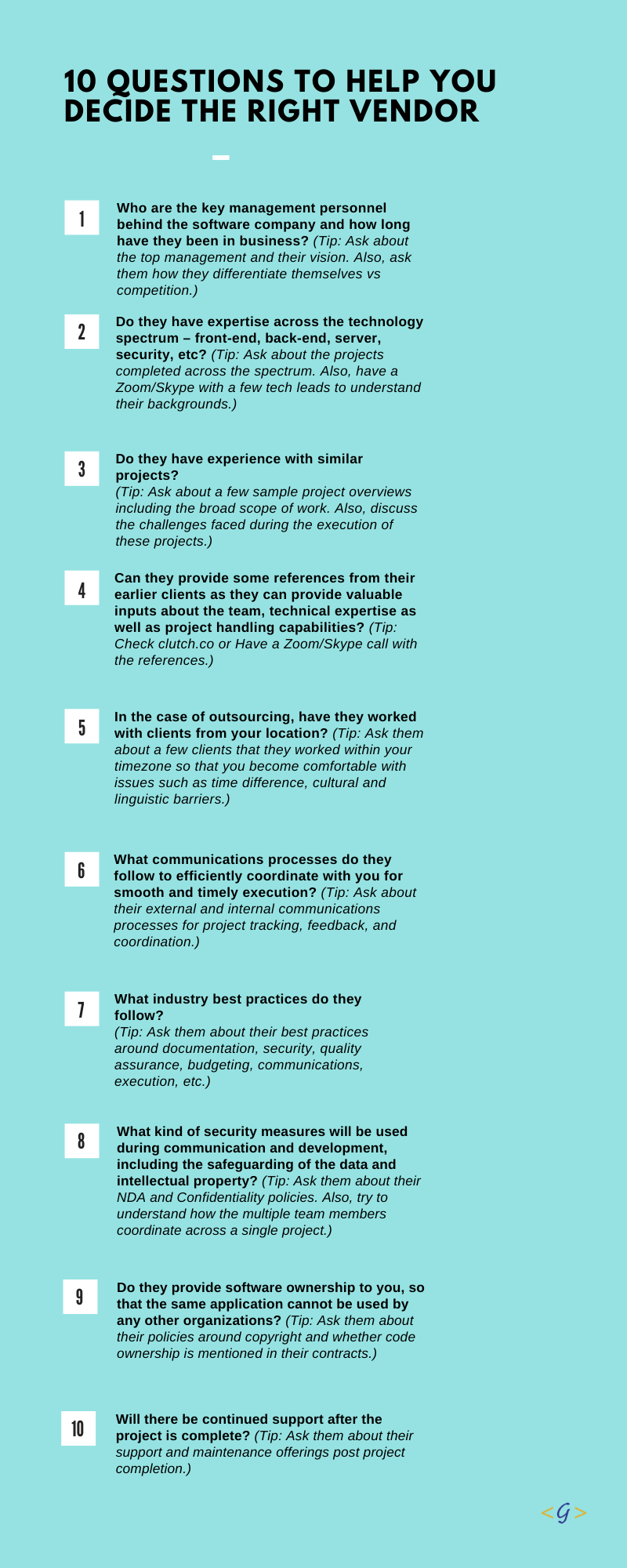
10 questions to help you decide the right vendor

Based on the above considerations, here are ten important questions for which you need clarity to select the right software development company. 

  • Who are the key management personnel behind the software company and how long have they been in business?

(Tip: Ask about the top management and their vision. Also, ask them how they differentiate themselves vs competition.)

  • Do they have expertise across the technology spectrum – front-end, back-end, server, security, etc? 

(Tip: Ask about the projects completed across the spectrum. Also, have a Zoom/Skype with a few tech leads to understand their backgrounds.)

  • Do they have experience with similar projects?

(Tip: Ask about a few sample project overviews including the broad scope of work. Also, discuss the challenges faced during the execution of these projects.)

  • Can they provide some references from their earlier clients as they can provide valuable inputs about the team, technical expertise as well as project handling capabilities?

(Tip: Check clutch.co or Have a Zoom/Skype call with the references.)

  • In the case of outsourcing, have they worked with clients from your location?

(Tip: Ask them about a few clients that they worked within your timezone so that you become comfortable with issues such as time difference, cultural and linguistic barriers.)

  • What communications processes do they follow to efficiently coordinate with you for smooth and timely execution?

(Tip: Ask about their external and internal communications processes for project tracking, feedback, and coordination.)

  • What industry best practices do they follow?

(Tip: Ask them about their best practices around documentation, security, quality assurance, budgeting, communications, execution, etc.)

  • What kind of security measures will be used during communication and development, including the safeguarding of the data and intellectual property?

(Tip: Ask them about their NDA and Confidentiality policies. Also, try to understand how the multiple team members coordinate across a single project.)

  • Do they provide software ownership to you, so that the same application cannot be used by any other organizations?

(Tip: Ask them about their policies around copyright and whether code ownership is mentioned in their contracts.)

  • Will there be continued support after the project is complete?

(Tip: Ask them about their support and maintenance offerings post project completion.)

infographic

A careful selection of the software development company is crucial for realizing your company’s vision and we know how important it is for you to get things right as your business is in question. If you’ve any doubts related to software development and if you need assistance developing one then feel free to talk to us here.

About Galaxy Weblinks

We specialize in delivering end-to-end software design & development services and have hands-on experience with software development tools. We have expertise in developing custom software and system applications for multiple business requirements, be it IoT, enterprise application, or a customized machine learning platform. Contact us for your project discussion today.

How to choose the right development partner?

The need for digital products and services is on the rise and will keep on going up. A good development partner can make the journey of digital transformation smooth for you. In this blog, you’ll discover how aligning the project expectations and organizational ethos is the key to finding the perfect development partner.

Project Alignment

There are four parameters within which you can achieve project alignment with your development partner. Those parameters are Budget, Technology, Timeline and Implementation, and Future state of the product. 

Budget

First and foremost, the client and the vendor need to agree on a budget that the project requires. If a client thinks that it’s a $15000 gig vs the partner’s estimate of $30,000, then there is a misalignment of expectations. As a best practice, the client must disclose the budget from the very beginning. 

If you don’t know how much your project should cost, a ballpark range would help set expectations right for the budgets and scale of the project.

Technology

Technological alignment is all about ensuring that your partners know what existing infrastructure you have in place and what compatible technologies they can utilize for your new project. For example, your application might be a better fit when built on React and deployed on AWS as determined by your IT team. Convey the same to your partner before starting your development.

Timeline & Implementation

Well-planned timelines with space for unavoidable setbacks can significantly reduce overheads. Understand and communicate your terms of timelines with your potential partner. Hard deadlines, desirable launch dates, and tolerance are important discussions to be had before you proceed. If you can’t get on the same page regarding timelines, consider it a red flag.  

Besides timeline discussions, you will also need to align on the implementation part of the project. If you have limited and well-defined requirements along with a strictly allocated budget then a Waterfall shop is your best friend. On the other hand, if you’re treading into the unknown with dynamic requirements and a flexible budget then an Agile partner might be a better bet.

The Future State

A lot of development and handover depends on the future of your project. Answer questions like is it a launch and leave a one-off thing or a multi-year engagement? Will your in-house team take over or you’re going to seek further support for patches and new features? 

Aligning on the future state of the product will ensure that you’re in a good position concerning your project in the future as well. As it’s difficult to find the right expertise and resources on short notice when something breaks down, deprecates, or needs to scale. 

Organizational Alignment

In contrast to project alignment, organizational alignment is more interpersonal and can be pivotal for long-term relationships and success. When looking for a development partner you’d want them to be a perfect cultural fit for you. Apart from that, you’d also want them to share your values and ideology. 

Organizational Alignment can be achieved across these segments: Core Values, Organizational maturity, People fit, Expertise, and Strengths

Core Values

These are the fundamental principles your organization swears by and essentially guides and influences all the decisions. Your potential partner need not be a perfect match for your organization’s values but complement them.

Organizational Maturity

The potential partner that you’re looking for should be at least on the same plane of your growth phase, if they’re way smaller or bigger than you then it’s going to be problematic. Take an early-stage startup’s example. If it approaches a well-established branding firm, there may be a mismatch in costs, approach, and perception of value. 

You can identify the right level of maturity with how your potential partner approaches data security, the depth of engineering solution, and the complexity of the proposed solution—is it over or under-engineered? Alignment in these areas is a good sign of organizational maturity.  

People Fit

In most of the engagements, the declaration of organizational alignment happens too early on when only the sales and procurement people have met. Whereas a partner should be declared fit only after your teams have met with the implementation team. After all, they are the ones who are going to be working together on the project, if they are not on the same page, it’s a red flag. 

Expertise & Past Successes

Lastly, this goes without saying that expertise and past projects are influential for organizational alignment. Your potential partner should have relevant experience in your industry or another industry with similar scope. Go through their projects and judge if it’s on par with your standards. 

While looking for the right development partner you might also have questions regarding offshore design/development and costs. Here are a couple of blogs to curb your doubts: 

Moving Ahead

Let this alignment guide be a blueprint for you to make the right choice and not a pursuit of something perfect. In case there are some manageable gaps to fill, you can try the following solutions:

  • Subcontracting technical requirements (In case of a technological gap)
  • If your vendor fits all requirements but lacks relevant experience, we recommend that you give them an opportunity after a thorough risk analysis. 
  • Control for the future state – If you’re not on the same page concerning the future state of the software, you can rectify that through detailed requirements specification, repository access, code commenting, a handoff plan.

Some partnerships might be worth working for while some might feel like an outright misfit due to huge alignment gaps. Steer clear of those and keep looking for better options. 

And when you’ve evaluated a potential partner on the project and organizational grounds and found them to be in alignment with almost everything mentioned here in this blog, then proceed with small engagements, and see if it is working for you. 

Wrapping up

When looking for potential development partners, it’s natural to have multiple options. Having them evaluated based on the alignment principles mentioned here you’ll be able to choose partners that are motivated by mutual growth and success. Contact us for a free consultation of your technical requirements.

About Galaxy Weblinks

We specialize in delivering end-to-end software design & development services and have hands-on experience with mobile app and site design in agile development environments. Our designers, engineers, and developers help improve security, reliability and features to make sure your business application and IT structure scale and remain secure.

DesignRush Lists Galaxy Among the Top Software Developers in Boston

We are elated to announce that DesignRush has recognized Galaxy Weblinks Inc as one of ‘The top software development companies in Boston’. A heartfelt thanks to our clients,  employees, and the DesignRush team for this recognition. 

Galaxy is a web and mobile app development firm that’s been in the industry for over two decades. With over 1000 projects under our belt, we have the technical expertise and know-how to help your business achieve its goals. Our clients appreciate us for our dedicated project management style and open communication channels. 

In light of our accomplishments, we’ve been considered one of the top companies for software development in Boston by DesignRush, a B2B market research authority.  DesignRush’s work helps interested buyers find and partner with the ‘right’ vendors. The evaluation is done by industry experts based on quality, attention to deadlines, fairness of cost, and overall ability to drive results. 

“This recognition is the fruit of our labor and of our commitment to providing unmatched Software Design, Development, DevOps and QA Services and dedication to the business objectives of our clients. We attribute our success to the Galaxy team’s creativity, perseverance, and technical skills.” 

Varun Bihani, Partner at Galaxy Weblinks

We’re grateful to DesignRush, our clients, and our team for this recognition. It’s only through the trust of our clients, collective efforts of our partners, and dedication of our teams that we’ve been named among the best in Boston.

At Galaxy Weblinks, we are committed to delivering robust, performant, and easily scalable solutions. Get in touch with us to know how we can help you achieve your business goals through our proven expertise, unmatched skillset, and effortless communication.

How to Ensure Success in Your Next Software Release?

The release of a new upgrade is typically a stressful time for software companies. It is all too easy to overlook some of the necessary steps or to fail to communicate something to another department. Developing an effective plan is a critical component of any release.

A successful plan integrates all departments, including engineering, quality assurance, marketing, sales, technical support, and training. Everyone must have a common goal and be moving in the same direction. In addition to developing the next release strategy, you must also plan for backward compatibility, effectively communicating with your customers ahead of time, minimizing and controlling bugs, ensuring users can install your product, and much more.

In our article, you will learn about:

  • Why is it sometimes important to curb your enthusiasm and wait for the right time before your next software release?
  • Our list of 4 major tips for planning a successful next software release.

When the software release rush isn’t in your favor?

Software update for the Nest ‘smart’ thermostat (owned by Google) went wrong in 2016 and left users in the cold. When the software update went wrong, it forced the device’s batteries to drain out, which led to dropping in the temperature. Customers were unable to heat their homes or use any amenities as a result.

Nest claimed that the problem was caused by a firmware update in December 4.0 and other issues such as old air filters or incompatible boilers. Later, it issued a 4.0.1 software release, which resolved the problem for 99.5 percent of the affected customers.

Each new release carries a high risk of failure or detection of serious defects by the end-user. These may cost us the trust of our customers. So, how can you avoid the losses that may result from the poor quality of a new version of your product?

#1 Automate the processes with CI/CD

Continuous Integration (CI) comes in handy here. It is a DevOps tool that starts the compilation process, unit tests, and any static analysis tools used after each commit/merge process. Any other quality-related tests that are automatable are also carried out. Whereas, Continuous Delivery (CD) allows you to automate the entire process from the development environment to the production environment. Learn about the best CI/CD practices here.

But what if you don’t have an experienced person on hand and/or don’t have enough budget or time to implement the entire CI and CD process?

Then you should put your money on people who will look after the quality of our product and will not be afraid to obstruct the next issue.

Working in an agile environment, the Product Owner always makes the final decision on the release of a new version. The individual should have a complete picture of the current situation in terms of work progress and product quality.

#2 Prioritize bug fixing list

As the product manager, go over the outstanding bug list with the testing team regularly. Examine the status of each open (unresolved) bug and comprehend the scenarios that led to their discovery.

If you find high-level bugs that need to be fixed, you can choose to postpone the release date. In the case of low-level/cosmetic bugs, you may wish to address them in a later release.

As an example, suppose you have the following bug list:

  • There are no show-stopping bugs
  • There are no high-level bugs
  • Two moderate-level bugs
  • The user is unable to access the address book without receiving an error message
  • When a user imports an address, the “country” field is filled with unreadable characters
  • 10 cosmetic/low-level bugs

In this case, you may decide that unreadable characters in the country field are an acceptable bug because the user can easily delete them. However, you acknowledge that you do not want to alert the user with an error message when they access the address book.

Place bugs in priority order, just as you did when you prioritize your product requirements, and make trade-offs as needed.

#3 Explain your test strategy

How will you carry out these tests? Go into as much detail as possible.

  • What rules will your tests adhere to?
  • What metrics will you collect and at what level?
  • How many different configurations or environments are you going to put through their paces?
  • Are there any special requirements or procedures that you must put to the test?

You must also be aware of the results of your test. To put it another way, what are the pass/fail criteria for each test? 

Thus, lack of access to the test environment may cause issues with the release infrastructure. It is critical, paradoxically, to be able to roll back our changes and restore the previous version of the system. Sometimes the test environment, in which the system performed flawlessly, differs significantly from the production environment, where undesirable effects may occur, necessitating a rollback to the previous version of the system.

#4 Introduce and test new functionalities

Critical paths are equally important because they serve as the foundation for the entire process that our users will follow, and they should not encounter any gaps or problems along the way. It is also a significant risk to release a new version without thoroughly testing the functionality associated with this path. 

Similarly, failure to provide end-users and the maintenance team with sufficient knowledge about new functionalities. Remember to notify stakeholders about the new functionalities that will be included in the next version so that they are not caught off guard by changes in the processes.

Conclusion

There are numerous reasons why your software should not be released as soon as possible and at any cost. It’s a good idea to weigh the “pros and cons.” Nonetheless, the development team must inform the Product Owner whether it is reasonable to proceed with the most recent software release launch. As a result, if you notice that something isn’t working properly, take the call to block a release. Also, proceed with the release when the Quality Assurance team approves the release as well.

Choosing the best Software Architecture for your Enterprise App

Planning on starting a greenfield software project? Or ever wondered how large enterprise systems are designed? Before major software development starts, we have to choose the right architecture that will offer us the desired functionality and quality attributes. 

Choosing the latest or most popular technology in the market will not always mean that it would bring the best results. However, this does not imply that you opt for legacy technologies.

For example, if there is a project that involves building a regular data capturing form (with less than 15 fields) for a survey, which will be used only once by less than 100 users, then it will be an utter disaster if you will be using highly complex architecture patterns like Microservices. 

Thorough planning must be done when selecting an architecture pattern and the following features must be taken into account:

  • Cost
  • Time to Market
  • Number of users (current and future)
  • Level of isolation (ie: integration with other platforms/systems)
  • Toleration time for system unavailability

What is a Software Architecture Pattern?

Software structures are composed of software elements that function as a blueprint, and design teams depend on these software architectural patterns to a great extent.

“An architectural pattern is a general, reusable approach to commonly appearing problems in software architecture. Whereas, software architecture is the process of converting software characteristics such as flexibility, scalability, etc. into a structured solution that meets the business and the technical expectations.”

For example, when a product owner says they are competing in a rapidly changing market, and they should adapt their business model quickly. The software should be scalable, modular, and maintainable if a business deals with urgent requests that need to be completed successfully in a matter of time. A software architect would then note that the performance and low fault tolerance, reliability, and scalability will be the key characteristics.

What happens with a system without any architecture pattern? 

Whenever you will change the behavior or structure of one class, a ripple effect would follow where multiple other classes would break. Is your software like this? The best way to find out is by using a software design reverse engineering tool like hex-ray that studies your class/component structures. On the other hand, if we are not using a pattern, then we will end up putting in the effort in solving the problems that can be easily solved with one of the patterns.

To help you, we will skim through the fundamentals of a few main software architectural patterns along with the pros and cons of each pattern. Besides, we will explain what architecture pattern would be the best fit for a given scenario.

1. Layered Architecture

One of the most efficient and common models deployed by enterprises is the Layered Architecture. The layers of this model are not interdependent, yet interconnected to each other. This is the conventional approach to designing most software.

For example, if you’d want to switch from an Oracle database to an SQL. This switch may cause you to excel in the database layer but will not have a domino effect on any other layer, hence avoiding any crashes.

What does it solve?


It allows the software to be segmented in such a way that the modules can be evolved and developed separately with little dependencies among the parts, supporting reuse, modifiability, and portability. The layered pattern divides the software into units called layers. Each layer is a grouping of modules that provides a cohesive set of services.

Benefits

  • This architecture helps those enterprises that don’t want to go overboard with experimenting and want to stick to the conventional software architecture design patterns. 
  • Testing components become relatively easier as inter-dependencies are negligible in this format of software development engineering.

Caveats:

  • Larger applications tend to be resource-intensive if based on this format, therefore for such projects, it’s advised to overlook the layered pattern. 
  • The entire version of the software is installed as a single unit irrespective of independent layers. So, you will have to re-install the entire device all over again, even if you update a single layer. 

Best for:

  • New applications that need to be built quickly.
  • General desktop applications.
  • Teams with less experienced developers who don’t understand other architectures yet.
  • Applications needing strict testability and maintainability standards.

2. Event-driven Architecture

The event-driven architecture helps in building a central unit that accepts all data and then assigns it to the separate modules that handle the particular type. This handoff is said to generate an “event,” and is assigned to the code delegated to that type.

Take an example of this pattern from a web page:

When a user clicks a button, the browser interprets the event and surfaces the programmed action, such as video playback, matching the input with the right output. Contrary to the layered architecture where the code must flow top-down and filter through all the layers, event-driven architectures implement modules that are activated only when there is a generation of an event connected to them.

What does it solve?


Sometimes it’s hard for many enterprises to build distributed systems that can service asynchronous arriving messages associated with an event, and that can scale from simple and small to complex and large. This architecture helps in building such systems as it is very adaptable to real-time changes and is suited to asynchronous systems that run on asymmetric data flow. 

Benefits

  • This architecture is suited to applications that tend to scale. It improves the response time of an application, eventually leading to better business outcomes. 
  • It plays a huge role in defining how IoT works. This architecture is widely applicable across networks and applications where devices are part of the IoT and requires exchanging information between even consumers and producers in real-time.

Caveats:

  • If the modules can affect each other then testing can be complex. While individual modules can be tested independently, the interactions between them can only be tested in a fully functioning system. 
  • Sometimes it is harder to understand the architecture due to its high complexity.

Best for:

  • Asynchronous systems with the asynchronous data flow.
  • Building applications with few modules to interact with the individual data blocks.
  • User interfaces.
  • IoT-based applications.

3. Microservices Architecture

Microservices are an independent and self-regulating codebase that can be written and maintained even by a small team of developers. Microservices architecture consists of independent services with each service responsible for the implementation of its related business logic. 

These independent services are separated from each other based on the nature of their domains and belong to a mini-microservice pool. Enterprise mobile app developers leverage the capabilities of this architecture, especially for complex applications. 

What does it solve?

Monolithic applications become too complex and large for efficient support and deployment for a distributed resource utilization such as in cloud environments.

Microservices help in building applications as suites of services. Each service is independently scalable and deployable and has its API layer. Different services can be developed by different teams, manage their database, and written in different programming languages.

Benefits

  • This architecture design pattern makes the system highly fault-tolerant as the services are segmented into pools. In other words, the whole software won’t crash on its end even if some microservices stop functioning. 
  • It allows applications to scale. The independent services lead to scale individually rather than overloading the entire system with the need to expand. 
  • Services can be merged into any application depending upon the work scope. 

Caveats

  • Harder to understand due to its complex logic. Requires deep analysis in service decomposition.

Best For

  • Websites with small components.
  • Corporate data centers with well-defined boundaries.
  • Rapidly developing new businesses, e-commerce, and web applications.

Conclusion

While the above-enlisted architectures signify the most favored design choices for organizational software development, there are plenty of others, equally interesting and perhaps more befitting to your project.

It’s always important to understand the pattern clearly, as applying the wrong pattern can lead to a lot of problems like inappropriate designs and implementations. A development expert would have a sound judgment that would help you understand when a pattern is not appropriate in a particular business scenario. 

Contact us if you need a team of such developers, engineers, technical architects, and PMs who can understand the ramifications of software design and the future growth of the product.

About Galaxy Weblinks

We specialize in delivering end-to-end software design & development services and have hands-on experience with large, medium, and startup business development requirements. Our engineers also help in improving security, reliability, and features to make sure your business application scale and remain secure.