Agencies that Build #4 – Interactivity & Connectivity | Phillip Tiongson

This time we’ve got a rather intense session on interactivity and connectivity. Joining us in the ATB virtual booth is Phillip Tiongson, Founder and CEO of Potion, an independent studio dedicated to transforming the world of interactivity. The team of ATB comprised Varun Bihani and Casey Cheshire.

Philip shared some great insights about the world that exists at the intersection of physical and digital. We’ll get to that part but first, let’s bust some myths.

Myths

  • We have just as much value and connection from miles away as opposed to being in a physical place at the same time.
  • If it’s free, it ain’t valuable

Phillip started with how he got into the business of designing interactive experiences. He tells us with his personal stories that determined his trajectory to become the founder/CEO, Potion, one of the most unconventional agencies in New York.

Unlike the agencies that have shown up on our previous episodes, Potion’s sites exist in a physical plane rather than a digital one. Which presents a different set of challenges in every aspect of running a business during a pandemic.

Varun was quick to get the ball rolling with one of the ATB classics.

So, how do you acquire new clients in a socially distanced pandemic?

To which Phillip added:

It’s all about the existing relationships; with your partners, competition, and clients. When starting a new and important project, you always turn to the people you trust the most. You have to nurture these relationships and invest in them. Because like we all say in this pandemic, we did business with people with whom we have engaged on some level, instead of a stranger.

Apart from the business side of the topic, the trio went on to discuss the present use cases and the future of interactivity.

And did we tell you that Casey, Phillip, and Varun love Rock Climbing and if you’re into that, you’re in for a treat! Find yourself among the fellow climbers discussing business.

There are some interesting analogies about interactions and connectivity throughout the podcast which is better heard or watched on our podcast and YouTube channel.

TL;DR | Takeaways for Interactivity and Connectivity

  • How do we communicate our unique value in a way that scales, is surprising, is reciprocal, and truly accessible? These four qualities are important to keep in mind with the call for connection in a technologically demanding environment.
  • The physical world is rich with sensory interactions. However, that does not mean the digital world does not have a deep impact as well. Digital interactions have the power to cultivate metamorphic experiences through design and storytelling.
  • The relationships that you build with partners, whether they are collaborators, competitors, or clients, are where new business comes from.
  • In the future, how we relate to each other is going to evolve. “I think of Zoom right now as the iPhone 1. This is going to explode into many different special use cases and expressions…on how we send ourselves [digitally].”
  • Career advise from Phillip Tiongson – It is easy to mistake achievement for enjoying your work. Take time to appreciate everything and everyone around you.

Agencies that Build #3 – Flexibility and Focusing Forward | Carl Smith

In this episode of Agencies That Build we are in conversation with Carl Smith, Owner, The Bureau of Digital. This organization trains upcoming leaders and supports agencies. Their focus on Digital Leadership, Business Development, Design Leadership, Operations, and Project Management has been invaluable to the digital agency landscape.
Before diving further into the session Casey brought out the Mjölnir for some classic myth-busting. Here are some of the myths that Carl busted for us:

Myths

  • There’s no work out there
  • If you show them how to do it, then they won’t need you
  • Clients only want to hear what’s great about their product
To start this goldmine of a session Carl ‘The Agitator’ opened with how it’s not true that there’s no work out there and people can’t get projects. He said that there’s tons of work, you just have to be flexible according to the current scenario and adapt. Especially the agencies that specialize in a particular domain, if they’re doing only one thing for one group and that group doesn’t offer new requirements. They are left with only two choices.
  1. Bounce and find somebody who needs you
  2. Find a new way to do things for the same audience. Reinvent yourself
Experimenting and taking up different things out of your specialization doesn’t necessarily make you a generalist because most successful shops are generalists, but they like to identify as specialists. About focusing forward Carl added Don’t put online the company that you are, put online the company that you want to be. Ask your clients how you can fit in or help them. Talk. Don’t make money the first priority. The money will come. Money is the by-product of awesome. Create awesome and make your clients happy. When the clients are happy that’s when the work starts. “The clients you’ve right now will get you close to the clients you want” Just don’t do something because other people are doing it. You have to look inside yourself. Find it is what you want to do, what you’re able to do and then find the mix right in the middle. And just go forward and be honest and talk to people. Carl closed with some personal stories that we think would be a better experience on the podcast or YouTube because the energy on this session is infectious.

TL;DR | Takeaways for Flexibility and Focusing Forward

  • In today’s climate, it is important to cater to your clients’ evolving needs and be flexible with them. How can you create a better relationship in the current world?
  • Generalists are what everyone wants out of individuals, but Specialists are what they want out of organizations. The most successful companies are those that are generalists but promote themselves as specialists.
  • Position yourself as who you want to become versus who you are right now. This will help grow your business, company, and community.
  • If you have to change the fabric of who you are to accomplish something then you have lost part of yourself.” Double down on what makes you different as a company and an individual.
  • Don’t always tell clients what is great about what they have. Sometimes it is better to show them the stuff they don’t want to hear.
  • Career advise from Carl Smith, Nothing matters as much as it feels like it does. Leslie Peters said, “Life is a quest, not a text.”

CPaaS and UCaaS | What is the difference?

The current times have brought with them a paradigm shift in the way we communicate and conduct our business. Companies are starting to migrate from on-premise to cloud-based communication technologies. The question remains, as with other technologies; what and how to build an effective communication stack?

The choices:

An allrounder off the shelf communication solution such as UCaaS.

or

CPaaS for building new and highly specific functionality into existing technology.

UCaaS or Unified Communications as a Service comes neatly packed under a single ready-to-use toolkit. Via UCaaS, business owners like you can select the desired tools and features suited for your business model.

These can include messaging services, voice and/or video calling, setting the lower and upper limit of attendees, etc.

CPaaS or Communications Platforms as a Service takes a different approach here. CPaaS offers flexibility to business owners via handing them the Software Development Kits and the required communications APIs, which they can build upon or configure with their existing business model.

From this point onwards, it’s on the inhouse development team to build their own real-time communications platforms for being in touch with their stakeholders around the globe. CPaaS gives the option to start from level 1 instead of scratch in case you opt for it.

I would like to point out here that UCaaS comes in the category of SaaS whereas CPaaS comes under PaaS. They both have some shared features and some distinct set of benefits. Let’s focus on the similarities first which will then be followed by the differences.

Shared Benefits of CPaaS and UCaaS

RGB stripes on a screen

Now that we have introduced both the platforms, let’s look at some of the legit commonalities that the two share:

Variety of Customization options

Both are cloud delivery models and can be highly customized based on business requirements. You may opt for audio calls only, add extra security layers for internal and external communications, set up passcodes for meetings, etc.

Cost Efficient Solutions

You don’t have to pay for the features that you know are of no use to you. Perhaps you are looking for a solution for a small team of 15-20 members. You don’t have to shell out extra dollars for a higher number of attendees if that is not your current need.

Easy Scalable Models

All cloud based models come with great flexibility, UCaaS and CPaaS are no exceptions. You can scale up or down as per your requirements. You can configure chatbots, team messaging and collaboration options, embedded communications, etc all on the cloud which can eliminate the need for internal infrastructure and its maintenance.

Enhanced Connectivity

Since both these models are cloud based, they can connect your teammates anywhere anytime and with any device. This ensures that devices, geographic proximity, and even network bandwidths are not an issue for smooth collaboration.

So, how do these two differ?

two pigeons on a roof

Well, to begin with, UCaaS represents the plug and play model whereas CPaaS requires custom development before you can reap its benefits.

The UCaaS model offers two options namely Single-Tenancy model and Multiple-Tenancy model. In the Single-Tenancy model, every customer can customize the solution as per their needs. And in the Multiple-Tenancy model, multiple customers use the same software making this model a little less reliable.

The CPaaS leaves the development and deployment to the clients and lets them work with the SDKs and APIs as per their needs. Clients can add features according to their requirements.

Another point here is that UCaaS does not necessitate skilled and experienced developers whereas if you are to work with APIs and SDKs, this is a default requirement.

UCaaS completely focuses on leveraging cloud infrastructure. CPaaS can be used as an extra layer of features to complement the on-premise systems.

So what’s the ideal scenario for using these technologies?

Experts believe that these technologies can be used complementary to each other. When your business needs are highly customizable, you can opt for CPaaS, but you need to have the expertise to customize it. CPaaS also lets you secure your communications in your way. You also have the option of integrating AI and ML into your products.

For more generic communication (mainly external ones) with stakeholders where the plug and play option suffices, you can go for UCaaS. It is more time saving and you need not hire highly skilled developers for its implementation.

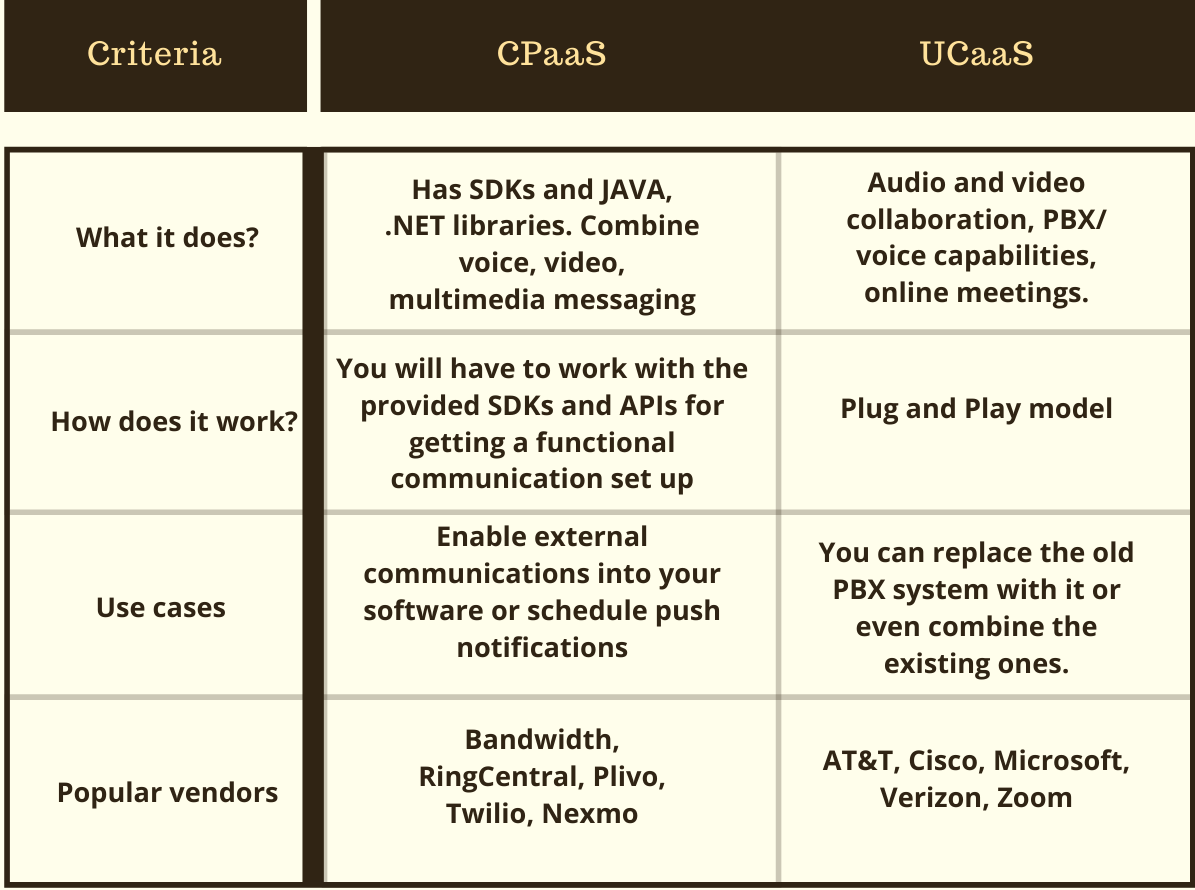
So here is a summarized version that you can present to your team for making the right decision.

A comparison chart

UCaaS and CPaaS are certainly not the different sides of a coin, rather they both have their respective places in the industry. In case you are looking for further clarity on these said models or wish to opt for one, we can help you with it. Feel free to contact us here.

How a developer can shine as an effective team player?

Unless you’re the only developer on your team, you must be spending a lot of time in technical discussions or communicating about design docs, and code reviews with other developers and non-developers.

No matter how great your technical skills are, they alone just wouldn’t cut it! To develop winning software, you have to be an effective team player.

It’s not always easy to work and collaborate efficiently with people in your team. People have different temperaments and varied perspectives, opinions, or experiences. However, it takes empathy, maturity, and acceptance, along with superior technical skills and a winning attitude to be a value-add to your team.

Read our blog to know how you can be the best team player.

Here is how you can shine on as an effective team player that everyone would look up to – whether you are coding in a physical office or remote work environment.

Appreciate suggestions and feedback

Research indicates that the ideal ratio of criticism to positive comments should ideally be 1:5.

You must try to build a rapport and trust within your team. This would ensure that any suggestions made you would be taken in the right spirit and not as blatant criticism. Offering genuine praise along with constructive feedback will help you make inroads within the team.

Is your teammate killing it with the feature they’re working on?
Did they square away some part of the codebase as part of their peer review that they didn’t have to?
Did they slog through your 800-line code review with you?

Tell them you appreciate it!

Whereas, while receiving the feedback or criticism, avoid triggering a fight-or-flight reaction by asking, “How could we achieve a mutually desirable outcome?”

In its Aristotle Project, Google explains the first team effectiveness pillar, psychological safety as:

Within team members, it matters that they should feel safe in terms of offering a new idea, seeking clarification, asking a question, or admitting a mistake or weakness.

Such behavior helps you and your team members build the ability to take risks and be vulnerable in front of each other.

Anticipate your coworkers’ questions

At some point in time, you’ve all had to commit code that you’re not proud of or must have thrown problems over the wall to QA.

If you are asked to read your own after a few months, you may find several flaws in it. Perhaps working with a rough API or an impending deadline made you do some questionable things.

That’s a habit of making excuses which may lead you to a series of questions while code review from QA and other senior or junior developers, like —

“Does this code comply with client specified coding standards?”
“How does the system behave in this particular scenario? Will failure be logged for this particular scenario?”

You can anticipate other’s questions. For this, you need to be in their ‘proverbial shoes’ to understand the other person’s perspective and then asking yourself the questions beforehand like –

“What would be the stage where my code may not work?”
“Should I be reviewing pull requests?”

“Coding is a form of communication. Communication is rooted in empathy. So software engineers have a lot to gain from leveraging empathy as tactical skill.” — Andrea Goulet

As a good team player, the responsibility of basic level bug checking rather than passing chaos. Be proactive in documenting the sacrifices in code quality you’ve had to make, and why. Leave comments with answers to questions that you know your reviewers will have.

So, we can say that proper documentation with high-quality/maintainable code is a by-product of being an empathetic developer.

Be the go-to person for ‘that’ topic

Whether teaching yourself a new framework, availing an online course, or reading over an answer on Stack Overflow, your brain is consuming knowledge nonstop.

You constantly try to become an expert in your field, and if you’re really good, then through sharing it, you can become the go-to person for other developers.

“In today’s environment, hoarding knowledge ultimately erodes your power. If you know something very important, the way to get power is by actually sharing it.” — Joseph Badaracco

Exchange more creative ways to add to a project, be it through pull-request reviews, project management, facilitating discussions about GitHub issues, documentation, design, or code walk-throughs for other contributors.

The same opportunities can be offered to remote developers.

In fact, to make the most out of remote working, you can give them the updates on virtual developer conferences, write tech blogs, or split the costs of technical workshops or webinars, depending on common career paths you and your team members want to take.

You can also create a community or group to do remote mentoring sessions together in place of in-person mentoring. Encourage conversations and creative thinking to become a much more valuable team member.

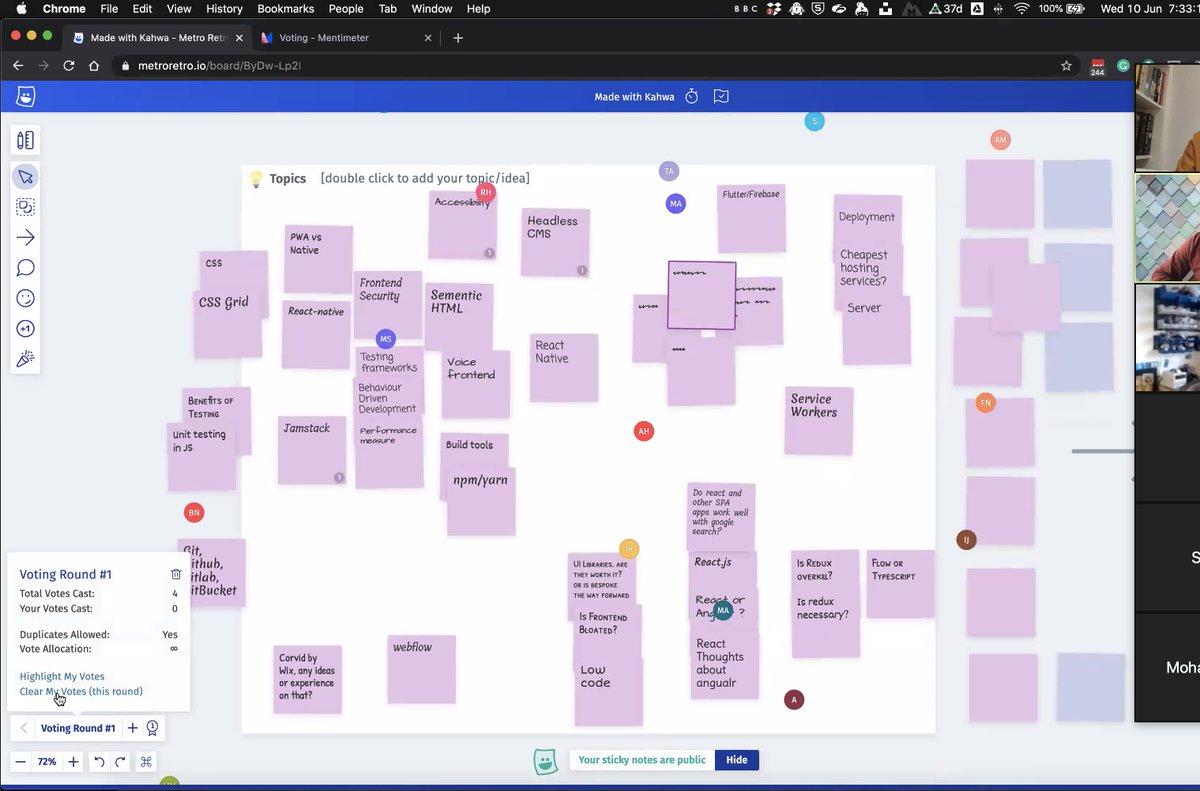
One of the recent examples we’ve seen around knowledge sharing is where developers, UX designers, and product owners came together to vote on the topics they wanted most to discuss around frontend development — Enjoying their hot beverage at the same time!

screenshot of screen with sticky notes opened

Take a humble approach to other’s bad code

Developer’s work on another developer’s code – this is done all the time in every organization. Either mostly working on legacy code or as a peer review.

Most of us are guilty of writing it ourselves from time to time. How do you flag that up when the bad code was written by your teammate or your senior?

video of a space diver

The issue with code, in general, is that there are multiple ways to write it. There isn’t a right or wrong way to do it. So, evaluate what is wrong in the code before you approach your colleague.

You’ll be building a supportive work environment by giving reasons and opening the discussion, instead of just expecting the developer to follow your word blindly.

Ask for their opinion on their code by asking questions in the most possible humble manner.

Would it be better to structure the code like this?
I don’t understand this section of code, could you explain it to me?

Incorporate all the code review best practices that offers a great opportunity to suggest fixes or changes.

Best team players treat fellow team members with courtesy and consideration – without needing a push.

If you create such a sense of support for your own team starting now, you can expect to see more learning and development opportunities, and better performance for you and as a team as well.

Migrating your Legacy Apps to Cloud

Cloud usage has increased by many folds over the past few years. Public clouds have become the goto choice of enterprises for enhanced scalability, disaster recovery, reduced maintenance costs, remote collaboration and flexibility.

Moving your enterprise app and infrastructure to the public cloud instead of making it obsolete and declaring it’s EOL is an efficient decision according to many executives.

The most relevant example in the current scenario is Netflix. Long before Netflix went cloud, it was locked in a struggle with Blockbuster to dominate the video rental market.

Then the Netflix executives saw the opportunity and made two favorable decisions.

  • First – Moving their online streaming service to cloud.
  • Second – Without making their legacy app and infrastructure obsolete.

As the benefits were clear when they considered the abilities needed to transform their business model.

Man throwing pile of money off of table

As a result, Netflix was among the first companies to go cloud during that time. They spent $40 million in the mid-2000s to build its data centers and pay for the license fees to stream just 1% of their movie catalog.

However, there is uncertainty when it comes to migrating legacy applications to cloud. It’s given that legacy apps have served business over the years very well. There is a lot of data, business algorithms, backend, and frontend architecture here.

But, these on-premise data centres are proving to be expensive in expansions and maintenance terms. And many of these applications run on technology that is outdated with no further updates and any active community support.

Thus stakeholders are pushing towards legacy apps migration to cloud. There are many more reasons which may be specific to your organization like:

  • Your on premise data centre has reached it maximum storage capacity
  • You need to scale due to mergers or acquisitions
  • You are facing security threats
  • Unanticipated growth in short span of time
  • New compliance guidelines
  • Looking to optimize your apps from ground up

If any of the above reasons resonate with you, it’s time to take the call and start migrating your legacy app to cloud. Listed below are the several ways of carrying out this process

Lift and Shift Approach

Cranes lifting heavy stuff

In this approach, you will be migrating your app without any changes done. It will be a simple, untouched migration, very much like cut-copy-paste strategy. This approach is most suited for apps that have a simplified architecture and thus can be migrated as they are. Any well defined commercial apps or apps having less functionalities can go by this strategy.

Refectoring/Rearchitecting

Old building restoration

Many applications are bound to fall in this category. Firstly, legacy apps are built using older frameworks and technologies that have deteriorated to a point where they can not be revived and thus are obsolete. Secondly, once these apps start crashing frequently, developers will eventually have to work harder than usual to find a long term solution.

Prior to migration, these applications are given a makeover which is suitable for uploads on cloud platforms and also simplifies their structure.

They are then written in a way that they don’t fall under the legacy application category any time soon. This is very much similar to when people shift their homes, they discard many household things and make space for advanced, newer items.

When applying this to legacy apps, you will be able to remove redundant information, irrelevant functionalities, etc for making it cloud ready.

Retiring the Legacy App

lock and chain on an old rusty gate

In some odd scenarios, legacy app optimization for cloud may not fruitful at all. You should think of rebuilding it from scratch instead. This is often because of the fact that designing, developing and deploying a new application will be much more time saving and easier than working on the legacy application.

It can be attributed to functionalities that are no longer required and can be removed. This gives a new perspective and ensures that you will utilize the optimum cloud services and storage facilities. You will be freeing up assets which will be used for your redesigned app.

Outsourcing your migration

endeavor riding piggyback on a 747

External vendors are happy to take this migration task off your hands. They are experts in this and can thus do it more effectively and use less time for the whole process. Your outsourced partners can provide insights into which approach to take from the ones mentioned above.

You can also let them manage your cloud for you. They will take the responsibility of your servers, ensuring that they are up and running at all times. Any security breach can be handled by them within a short duration and even help you in switching cloud service providers in the future.

There is no one size for all approach anyway. You can always use a mix of the strategies mentioned above.

Before you jump into migration, make sure that you take into account the possible obstacles and prepare accordingly. These issues can be related to security troubles, unaccounted costs, little differences in requirements, etc. You should involve all your team members, including designers, testers, engineers before going ahead with the final decision.

We at Galaxy Weblinks work around the clock for giving best services to all clients and managed cloud services is one among them. For any consultation, drop us your contact here and we will get in touch.

Offshore UX | An option or need of the hour?

The world of business is changing dramatically. Real-time data and advanced analytics tools allow companies to adapt their strategy instantaneously and, as the COVID-19 outbreak showed, technology now also allows us to communicate instantly with workers no matter where they are located.

As businesses all over the world had to rapidly adapt their technology stacks to a remote work environment, many are considering whether to allow employees to work at home post-pandemic. But there’s another option available to business owners who have suddenly found that managing workers remotely isn’t as bad as they had imagined — offshore contractors.

While many job roles have been contracted out for a while now, some have always remained in the realm of on-premise talent. One of those roles is the UX designer. In this post, we’ll talk about why it makes sense for your business to hire offshore contractors to handle your next UX design.

UX design has become a requirement

Notebook with UX designs

With the increase of technology in our daily lives comes increasing demands from consumers. Interfaces must be able to compete with the increasing standards. More products will begin to need UX designs. Being a market leader in your space, or even just staying afloat, will require it.

Even if you haven’t needed a UX designer in the past, there’s a good chance you will in the future. With that in mind, let’s talk about why offshore UX is a good business decision for your current or future UX designer needs.

Local talent can be hard to find

Sign board

Because of the demand for UX designers, it can be hard to find local talent that is also available for full-time work. This is especially true if you want to hire top talent, which will command a higher price and be harder to keep on staff without some other company coming along with a better offer.

Thankfully, some of the same skills you look for in a full-time employee are what you’d look for in a remote employee. For both, you want someone who is a self-starter and will get the work done on time and on spec with minimal oversight on your part. As top UX designers realize they can make more working for themselves and taking on multiple jobs at multiple firms throughout the year, it becomes easier to find a qualified person for the job without having to commit full year’s salary.

The economics of developing nations

Flags

In nations where costs are low, the highest-paid professions may pay little more than you would pay a UX designer. This means that UX designers in those nations can price themselves very competitively compared to western nations and still live a very comfortable life relative to their peers.

Of course, you’ll have to put some effort into finding the right candidate when you look outside English-speaking countries. Residents of most countries learn English as a second language, but you want to make sure that they speak it well enough that no language barriers exist. With offshoring, you’ll save money and provide someone with a better income than they could get in their economy alone.

Technology breaks down boundaries

people working

Because it is such a visual art, there was a time in the past when doing UX work remotely would have been extremely difficult. This may be why there is still a reluctance on the part of many to embrace outsourced UX designers.

We now have technology that allows us to video conference and share our screens easily. There are cloud-based solutions, such as Miro and Invision, that allow for collaboration on even the most advanced projects so you’ll be able to give feedback to designers in a professional manner and ensure that nothing gets lost in the translation.

Combine that with the fact that all but the poorest of countries have access to high-speed internet, it is now possible to engage in real-time feedback even for visual projects like UI and UX. The boundaries that once stood in the way of taking UX design off-premise have now been torn down by technological advances.

Offshoring is flexible

If you’re a large business, you already have a design department with competent directors and senior designers. In that case, it will be the additional workers that take the vision of the senior members and help implement it that would make prime candidates for offshore workers.

For small businesses, it is impossible to hire a full-time staff to do your design work. Offshoring makes finding someone for a one-off job even more affordable.

Conclusion

For most companies, hiring designers local is the way it’s always been done. With the coronavirus pandemic teaching us that remote work is not only possible but very practical, it may be a good time to consider the more affordable option. Now that we know situations can arise to force us into our homes, it would be a good time to take what we’ve learned from the outbreak and use that to experiment with new, cost-effective, and disaster-resistant forms of business.

Galaxy Weblinks Acquires Biz Solutions 365; Expands Its Position in the Microsoft Technologies

Galaxy Weblinks, a leading technology consulting firm, acquired Biz Solutions 365, last month. The much expected announcement came amid the news of partial lift of lockdown in India. Biz Solution 365, was previously a technology backend partner for Kalmstrom. Since their recent split, Biz Solutions 365 was looking for new partnership when the offer came in from Galaxy Weblinks about 4 months ago.

Galaxy Weblinks is a technology consulting firm that helps companies accelerate their ability to innovate, grow, and deliver better digital products and services. It specializes in software development services across the entire product development lifecycle;  strategy, design, engineering, QA, training & support.

They have now acquired Biz Solutions 365 that had a niche market for SharePoint plugins and expertise in cross-platform applications within other Microsoft Technologies including Outlook, Azure and Office 365. According to market sources, Business Productivity Tools (including SharePoint) make up ~30% of Microsoft Business Division’s revenue, resulting in an exclusive need for plugins and service experts.

With this acquisition, Galaxy Weblinks has diversified into SharePoint development and its plugins. The company has absorbed most employees that were working for Biz Solutions 365 into its fold to be able to take on the larger projects. The organization structure, says Anand Damani, the CEO of Galaxy Weblinks will remain the same and there will be no changes in the roles of the top officials as well.

This acquisition has brings a new adventure for Biz Solutions 365. It brings in 10+ years of SharePoint experience and expertise to the table. Galaxy Weblinks has an established team in Java and PHP and welcomes this expertise. It is indeed a win-win for both companies. Since the lockdown, all employees will continue to work from home and the on-boarding will also be virtual.

Sources are pretty tight-lipped regarding the amount of settlement and this information has not been made public. According to Varun Bihani, the Managing Partner, more acquisitions are planned over the next few years, to further enhance its sales and revenues.

Efficiently tackling complexities with Docker and Kubernetes

It all started with taking on the monolith code by microservices, and shaping the final product into a lego-like software.

Services like shopping carts or the payment option began to be written as separate pieces of software. Technologies like orchestration (K8s) and containerization (Docker) are helping companies in outstripping profitable parameters from making easy-to-deploy applications to handling the huge rush on a big sale day.

K8s and similar technologies like Docker Swarm, are technically known as container orchestration platforms designed to support large and distributed systems, and the sales pitch is:

Run billions of containers a week, Kubernetes can scale without increasing your operation team. Well, even if you have 10-100 containers, just imagining we are not all Google size…still it’s for you.

If you are at the beginning of the journey or just considering adopting K8s and Docker containers for your cloud infrastructure, this post will hopefully help you evaluate some of the major advantages offered by these technologies.

Squeezing every ounce by avoiding vendor lock-in

Migrating to the cloud can bring a lot of benefits to your company, such as increased cost savings, flexibility, and agility. But if something goes wrong with your CSP (Cloud Service Provider) after your migration, moving to another cloud vendor can incur substantial costs. No portability support and the steep learning curve are a couple of the reasons why it becomes harder to switch vendors.

Kubernetes and Docker containers make it much easier to run any app on any public cloud service or any combination of public and private clouds.

Container technology helps isolate software from its environment and abstract dependencies away from the cloud provider. And it should be easy to transfer your application to a new cloud vendor if necessary, since most CSPs support standard container formats. Thus easing the transition from one CSP to another making the whole process more cost-effective.

Rolling back the deployment cycles

There is an increasing demand to decrease the delivery time and be able to ship more number of features at a time. Manual testing and complex deployment processes can cause post release issues which worked in testing, but failed in production, resulting in delays in getting your code to production.

K8s and Docker containers help you shrink the release cycles through declarative templates and rolling updates.

It is the default strategy to update the running version of your app. You can deploy such updates as many times as you want and your user won’t be able to notice the difference. Moreover, with its production readiness, you can ensure zero-downtime deployment when you wish not to interrupt your live traffic.

Adapting the infrastructure to new load conditions

When the workload to perform a particular business function suddenly increases, the entirety of a monolithic application has to be scaled to balance the workload. This results in consumption of computing resources. And in the world of cloud, redundant usage of resources costs money.

Especially, in the case when you have a 24/7 production service with a load that is variable in time, where it is very busy during the day in the US, and relatively low at night.

Docker containers and Kubernetes allow scaling up and down the physical infrastructure in minutes through auto-scaling tools.

Scaling is typically done in two ways with Kubernetes:

Horizontal scaling:

When you add more instances to the environment with the same hardware specs. For example, a web application can have two instances at normal times and four at busy ones.

Vertical scaling:

When you increase your resources. For example, faster disks, more memory, more CPU cores, etc.

Kubernetes and Docker container technologies are now seen as the de facto ecosystem. It can lead to great productivity gains if properly implemented into your engineering workflows, and adopted at the right time.

You can make the move especially when…

  • Your team is facing trouble managing your platform because it is spread across different cloud services.
  • Your company has already moved its platform to the cloud and has experience with containerisation, but is now beginning to have difficulties with scale or stability.
  • You have a team that already has significant experience working with containers and cloud services.

But what about tons of configurations and setup that is required to maintain and deploy an application, you will ask.

Well to be honest, the amount of benefits it offers deserves a little bit of complexity.

Why should you outsource Digital Production?

When everybody is fighting for online presence and consumer’s limited attention, quality and scale of digital assets becomes time sensitive. You might have in-house digital production to address such needs.

But the question you need to ask yourself is, can they do it well on a large scale and in a time crunch? It’s a job for the specialists!

With the fields and scope of digital media and digital agencies ever increasing, it is highly improbable that an agency has individuals that are skilled in each field – expecting to get a large firm at your disposal!

Apparently, traditional titans in every industry continue to be disrupted by digital-first competitors. What most of the companies do not typically have is the expertise to build software and digital products at the quality and velocity that Silicon Valley-backed digital start-ups do.

Digital product agencies help such existing players “disrupt the disruptors”.

While at it, there are many questions and doubts that arise in the minds of entrepreneurs planning to outsource their product development. If you can also relate to this situation, this write-up covers everything you might want to know about outsourcing digital product development.

The first question that arises- Should I outsource digital product development or not?

Well, the answer lies in what you actually mean by outsourcing. If your definition of outsourcing is to just hire a company, share your idea, and expect them to come up with the final product quickly, we would recommend you to abort the idea of outsourcing at the very moment.

However, if your idea of outsourcing starts with explaining your product idea, doing the initial R&D around it, analyzing your target audience, and then approaching an outsourcing company for the product development work, you might just be on the path to success.

But apart from this, your understanding of the problem can help you decide when and why you need to outsource digital product development.

Common issues businesses often see:

  • Critically, how customers engage is different with digital; it’s unpredictable because customers are closely coupled to the “Digital Product”.
  • It may look like print media – but the development needs are very different, and needs to be approached in a different way.
  • Digital runs on IT but it doesn’t run like many internal business systems.
  • It’s difficult to allocate the in-house time and talent while supporting the agile culture, required to build the calibre of application needed.
  • Internal teams tend to look at their business and users from the sidelines, lacking the connotation of being a true outsider with a different perspective.

How outsourcing digital product development can benefit you?

As software complexity increased, businesses started employing methods to emphasize control of development – expecting predictable outcomes. The process was: Start with a specification so you know what you will get, plan the sequence of development, integrate the components and then test.

Digital product development also involves best practices in design thinking and lean development of projects.

Analytics & Optimization

A digital production agency can help you advertise, commercialize and promote your product. Their work doesn’t end after wrapping up the development, they’ll continue to provide support with SEO and other guidance post launch.

Technology

All sorts of technology manipulations and implementations on the product including the software, mobile and web development, machine learning, computer engineering, etc.

User Research

It’s important to identify the users you’re making the digital products for. User research helps you know the users on a somewhat personal level.Thus, you will have the opportunity to understand your customers beforehand in an individualized way.

Consulting

By examining your business operations, a digital product agency can give you guidance when it’s not enough updating, promoting and building a digital product.

Strategy

They are involved in concept creation, planning, implementation, development, release, update, marketing, and maintenance. In short, an entire practice for the digital product.

Design

A digital product agency can maintain all the experience and visual processes (UI/UX design), apart from, visual design and art direction.

Inside the working of a Digital Product Studio….

Most of the modern digital product studios are helping turn ideas into products. And are using ‘Collaboration’ as a catalyst with the idea that good products and collaboration go hand-in-hand.

To get a real-world outlook and working process of a digital product studio, let’s talk about their USPs that can ultimately ensure scalability for your business.

Internal collaboration

Collaboration has always been an area of prime interest. Whether that is collaboration between agencies and clients, or designers and developers.

On the whole, different teams like developers and designers have their own working space but they also work together closely in project groups. The degree of collaboration between designers and developers is influenced by what kind of project the team is working on.

For projects that only include designing mocks or user research, concept development, the developers are less involved. However, they do advise the design team on the technological scope and intricacies of the project.

Design principles they follow

Their design decisions are coherent because they set up design principles – a set of statements that define what they want the project to be.

Design principles come in handy when working on micro decisions like UI interactions. It helps the team to stay aligned with their goals and on the same page. In order to maintain this vision across the project, decisions are discussed within the context of the principles agreed upon earlier. Other considerations are reliability, maintainability, and very importantly, how future proof would the approach be.

Project workflow: Advantage of modularity

Since digital product studios work with clients on different kinds of projects, having a modular methodology helps tailor the process to the needs of the client.

For each project type, they have some set deliverables and activities, but they mix and match the activities depending on what’s right for the project.

Having different project types is more flexible for their clients – you can work with them when you need them most instead of a “gotta buy the whole package” deal.

Working with clients

When it comes to working with clients, digital product studios adopt a clear and open channel of communication. Clients are invited for in-person meetings when needed and a dedicated online communication channel is setup for them. Having a tight loop for collaboration helps avoid misunderstanding and ambiguity.

They tend to avoid the process where you send off a chunk of design for formal approval and feedback. Most of the time they feel it’s better to bring some sketches and sit down with the client, bringing up questions and showing how you’ve reached conclusions. It’s important to get more valuable input from the client.

They make sure to pass on their knowledge to the clients’ in-house team so that they’re positioned to manage their product after their engagement has ended.

Emphasis on scalability

One of the points that digital product studios emphasized is the scalability that hiring the correct design and development agency can bring to a team. This is what makes them separate from a “app development firm”.

“Let’s assume you wanted to build an in-house tech team. A designer, minimum. You would need 2 developers, at least. An IT engineer, a CTO if you’re not technical, a project manager, etc. And that is a considerable investment for any company because you need all of these things to run a technology arm to your company, if not an entire technology company.”

A digital product studio doesn’t only build one aspect of the tech side or a product. They aim to fill the technical gap that creates an entry barrier for budding startups and established enterprises to scale up their operations.

Choosing the right digital studio is crucial to your bottom line!

Reputable studios seek to establish a strong track record and longstanding relationships with clients.

The wrong one can quickly drain your budget and negatively impact your product development process. So, here are some recommended strategies for finding a digital product agency that can help your business grow.

  • When choosing the right digital agency for your business, full transparency should be the first criterion. Review an agency’s website and, if you don’t see a client list, bios and an address, then this agency is likely not worth your time.
  • Be sure to determine the agency’s experience and credibility. Read through client testimonials on B2B rating and review sites and its website. Ask for client references, including one from an account that did not go so well, to get the idea how they dealt with it.
  • When evaluating a studio, consider not only its portfolio, but the collective experience of its team. Are its team leads accomplished professionals with backgrounds in product development, design, and strategy?
  • Ask to get a comprehensive insight on how they manage their project scope and budget with timelines, as speed-to-market should be a priority for any product studio looking to create a competitive advantage for their clients.

Although, a digital product agency’s job doesn’t end with a great product launch, but how to drive users to the product, and how to ensure there is data available to continuously innovate. Once your product strategy framework and user experience research are in place, the next thing they are involved in is to design a process that would ensure that legendary user experience and attractive customer experience are a core part of your product delivery.

Whether this is your first rodeo or you are expanding your product offering, expert digital product designers can steer you in the right direction as it’s always important to get the right guidance on a certain aspect of design. Having a team of diverse, professional experts with both theoretical and practical knowledge has been critical to the success of a product.

Moreover, you could be overlooking something that someone else would catch. They say that a writer can’t edit his own work because he’s too invested in it. You can apply that principle to product design too.

If you treat the development process as an investment, and expect the best quality and team collaboration from your next digital product studio, contact us.


Galaxy recognized as a top B2B service provider by Clutch

Here at Galaxy Weblinks, we know it’s difficult to promote and sustain your brand-new company’s success while also creating new and innovative solutions for your clients. That’s why we’ve been specializing in building high quality web and mobile apps since 1998. Our first and most important job is to help our clients understand and actualize technology and harness its power to support solutions that fit their needs.

We have over 1000 projects delivered and have over 200 happy clients around the globe. We provide technical expertise 24/7. We specialize in creating mobile apps, open source development, web development and design, as well as network support and maintenance. We stick to your budget to help your company strive against its competition.

In recognition of our efforts, we’ve been named a top B2B service provider in India, according to Clutch! Clutch is a market research firm that leverages a unique ratings methodology to compare and contrast global leaders in industries across the world.

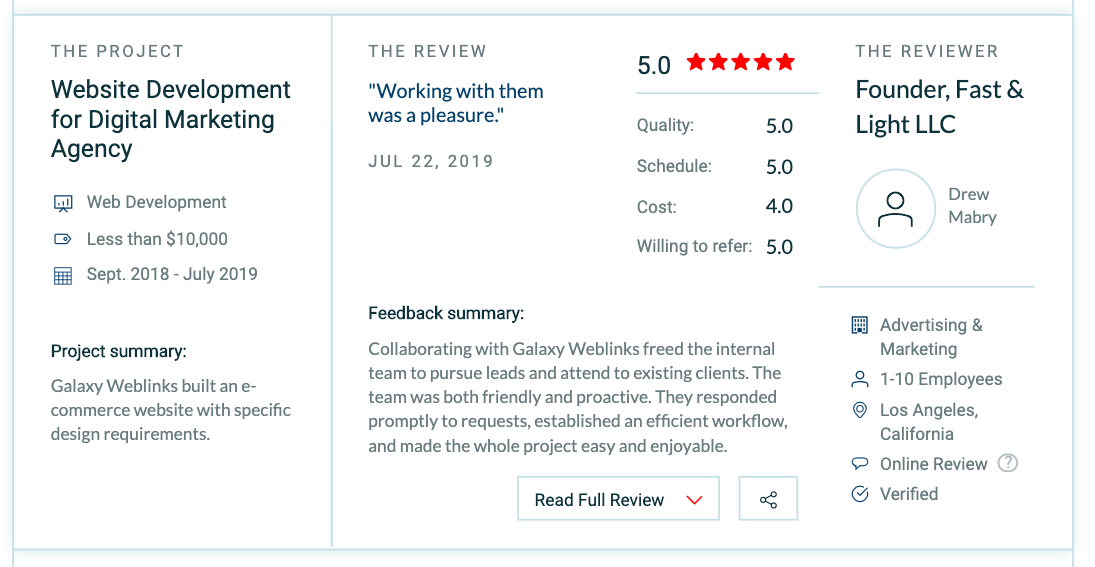
We recently received a five-star review on our profile from Fast & Light LLC, a digital marketing agency. They needed us to build an e-commerce website, which we completed on time and within budget. Our efforts freed their internal team to attend to other company matters. They especially loved our efficient workflow and proactive team dynamic. Please take a look at their recent review below:

We love receiving feedback in all forms from our clients. It helps us strengthen our processes and improve our services. We especially love when clients leave us client interviews on our Clutch profile. They take the time to engage with business analysts to gauge our impact and rate us according to our cost-effectiveness, attention to project timelines and overall quality of service. In reflection of our efforts, we’ve garnered an impressive 4.8 out of 5-stars.

In addition to Clutch, we’ve also received acclaim from The Manifest and Visual Objects, two of Clutch’s sister sites. The Manifest, a platform that highlights projects and business data, lists us as a top web development agency. Visual Objects, a source of online research for visual portfolios, names us in their directory on top web development agencies.

Drop us a line if you’d like to start a project with Galaxy Weblinks today.