10 Best CMS to Build Secure and Scalable eCommerce Stores 

Today, eCommerce is a multitrillion-dollar industry and retail commerce sales could exceed USD 4.3 trillion by this year end. Apparently, there is humongous opportunities in this domain and as an entrepreneur you are eager to get a slice of the pie. But the road ahead is bumpy.  

One critical challenge in creating your online storefront is the selection of the right eCommerce Content Management System (CMS) platform. Choosing the right CMS is crucial for your investment and building a robust scalable and secure eCommerce store.  

The right CMS will help you easily manage your product catalog, simplify adding, updating, or removing content (like product images, descriptions, etc), enables you to launch seasonal offers or campaigns faster, and do other tasks without any hassle.  

It helps you seamlessly manage hundreds or thousands of products from a single interface and provides best features to build a scalable, secure, and lightning-fast online store. In this blog, we have listed the ten most reliable, high-performance, and trusted eCommerce CMS that you can leverage to build top-notch websites.  

Top 10 CMS Platforms for eCommerce Development 

Making a choice for a CMS to build your eCommerce store can be confusing given so many options. However, selecting the right CMS is crucial to build a secure, scalable, and user-friendly eCommerce site that will attract customers, and drive conversions.  

1. WordPress + WooCommerce 

One of the best CMS and most popular options for eCommerce is WordPress with WooCommerce plugin. With more than 4 million eCommerce stores using WooCommerce and WordPress holding 60.8% of the CMS market share, the duo dominates the game.    

As a user-friendly platform, WordPress allows you to create any website within a few minutes even with zero technical know-how. Plus, managing websites is also hassle-free with a simple, clean, and clutter-free dashboard. It’s a useful CMS for eCommerce development.  

The bonus: a huge library of different website themes and plugins allows you to build engaging websites, and the open-source nature makes it highly customizable.  

Pros Cons 
Open source, no license fees Too many plugins can affect performance 
Highly customizable  Advanced customization requires developer support 
Convenient admin panel Not a dedicated eCommerce platform 
Quick and easy installation on any web hosting   
Abundant resources for learning and support  

2. Adobe Commerce 

Adobe Commerce is a comprehensive eCommerce platform that also includes a CMS to manage content for all B2B and B2C websites. It is a proprietary platform for eCommerce development that was formerly Magento.  

It is a suitable eCommerce CMS platform for large, enterprise-grade companies that need a flexible and customizable solution.  As a cloud-native platform, Adobe Commerce enables you to build multi-brand, multi-lingual, and high-performance storefronts in the cloud.  

Creating an eCommerce site is quick and convenient with its integrated tools and features. It offers content creation with Gen AI and prebuilt storefronts with integrated commerce functionality.  

Pros Cons 
Highly suitable for enterprise-grade storefronts High costs of development and license 
Adequate options for customization Set up and website management isn’t beginner-friendly 
Advanced features for B2B and B2C experiences Costly integrations and extensions 
Robust analytics and marketing tools  
Support for multi-currency, multi-language, and multi-store  

3. PrestaShop 

PrestaShop is another popular CMS for eCommerce development that offers a freemium model – both free and paid versions. It is considered among the best CMS for eCommerce website for startups and small businesses.  

With more than 250k eCommerce platforms using PrestaShop, it is a reliable choice to build your store with the best features and security. It is fully customizable with diverse website templates, modules, and extensions.  

As a versatile and lightweight CMS, it is well-suited for small to mid-size eCommerce stores. However, it’s not beginner-friendly – building and setting up your eCommerce requires tech expertise.  

Pros Cons 
Both open source and premium version Technical knowledge is required for customization 
Full customization with themes and modules Paid add-ons are needed for advanced features 
Support for multiple currencies and languages  Not best-suited for large enterprises 
User-friendly admin interface Limited support 
Wide range of payment plugins  

4. OpenCart 

OpenCart offers everything you need to run, scale, and manage your eCommerce business. It is one of the top open-source CMS for eCommerce development. It is an ideal platform for those that are starting eCommerce business with a small budget.   

With a variety of extensions and templates, you can customize your store as per your preferences. Additionally, the OpenCart marketplace offers a wide range of add-ons or modules for payments, shipping, and more.  

Pros Cons 
Lightweight and fast CMS Limited built-in features 
Many themes and extensions Complex customization 
Open source and freeCompatibility issues with multiple plugins
Multi-store support Limited scalability 
Multi-currency and multi-lingual   

5. Drupal 

Now this CMS isn’t an eCommerce platform out of the box. It’s a usual CMS like WordPress. However, in a similar way, you can build pleasing and efficient eCommerce sites even on Drupal with extensions (plugins).  

Drupal is a powerful and feature-rich CMS which is suitable for developing complex websites. But it’s not user-friendly and requires technical expertise to build even a basic site.   

Moreover, as an open-source CMS platform, it is ideal for creating highly customizable websites. Since there aren’t any license costs, it is also suitable for small businesses and startups.  

Pros  Cons 
Customizable and scalable platform Steep learning curve 
Open source and free Extensive development 
Strong integration capabilities Limited prebuilt themes 
Strong security Relatively higher maintenance costs 
Great headless development   

6. Joomla 

Joomla is another CMS platform that you can use for creating eCommerce websites. Though it is also not a dedicated eCommerce CMS, you can build an appealing storefront by integrating plugins. It is an open-source CMS for creating web applications and eCommerce sites.  

It is a free and open-source platform that is customizable with full coding possibilities. It is a flexible CMS that can be used to create a wide range of websites. Additionally, there is good community support to help website owners get solutions to problems. 

Pros Cons 
Versatile and flexible Moderate learning curve 
Strong user management Dependency on extensions for advanced features 
Multilingual and multi-currency Limited templates and extensions 
Built-in SEO features  
Thousands of extensions   

7. Shopify 

Shopify is a comprehensive eCommerce platform that allows businesses to easily build and manage online storefronts. It offers a wide range of features including AI-powered store builder. There are lots of quality website themes that you can use to build top-notch eCommerce stores. 

With its easy and user-friendly dashboard, managing content is no brainer and can be done without any technical knowledge. It provides a consolidated dashboard where you can manage everything from inventory to payment processing.  

What makes Shopify stand out from other CMSs is its omnichannel and multi-channel capabilities that allows businesses to offer a consistent user experience across multiple customer touchpoints such as smartphones, desktops, social media, and in-personal shopping. It offers Shopify Plus which is an enterprise to build high-performance and scalable stores for large businesses.  

Pros  Cons 
Easy and user-centric interface High subscription costs 
Customizable themes Extra transaction fees when not using Shopify Payments 
Hosted solution, no need to manage servers  Some advanced features depend on paid apps 
Strongest security and performance  
Scalable and extensive marketplace  
Multiple payment options  
24/7 customer support  

8. BigCommerce 

It is another eCommerce platform with an integrated CMS that allows users to manage website content easily. It is a flexible and powerful solution to build even complex eCommerce sites. BigCommerce is a SaaS platform with an open API.  

It is possible to integrate BigCommerce with other platforms to easily sell on multiple platforms. BigCommerce offers basic website building features such as drag-and-drop page design that helps small businesses to create pretty websites. 

Pros Cons 
Smoothly handles large product catalogs and traffic If revenues cross a certain threshold, plans upgrade automatically and cost more 
Built-in features for multi-currency, product reviews, SEO, and other essentials Advanced features aren’t beginner-friendly 
No transaction fees Limited themes and high-quality themes require a purchase 
Strong security with HTTPS, automatic updates, and PCI DSS Level 1 compliance Native marketing tools are limited 
Flexible, customizable, and supports headless commerce Backend could be a bit complex for non-tech individuals 

9. Squarespace 

As an all-in-one SaaS-based eCommerce platform, Squarespace stands out with its unique functionalities and benefits. It offers an integrated CMS that allows businesses to manage their stores, product catalogs, payment gateways, themes, and everything without any hassle.  

With drag-and-drop functionality, Squarespace allows you to build beautiful and functional eCommerce sites without any technical skills.  

Pros Cons 
Visually attractive and mobile-friendly website templates Not very scalable and not suitable for very large enterprises 
Its drag-and-drop platform makes it beginner-friendly Supports limited payment gateways 
No transactional fees like many other platforms Challenging in international selling due to no multi-currency support 
Built-in marketing tools Limited customization 
Round-the-clock customer support  

10. Magento Open Source 

It is an open-source dedicated CMS platform for eCommerce. It is built to develop various types of eCommerce stores whether B2B or B2C. Currently, there are 100k+ eCommerce stores running on this platform.  

A wide range of themes and extensions allow you to customize your eCommerce website easily to build engaging storefronts. As a free eCommerce CMS, Magento helps you avoid costly subscriptions and license fees to build and manage a full-fledged online storefront.  

Pros Cons 
Scalable for large online stores Steep learning curve for beginners 
Extensive customization Costly development and maintenance 
Robust options for managing inventory and products Extensions can be expensive 
Multi-language and multi-store support  Managing regular updates and patches isn’t easy
Tools for marketing   

To Wrap Up 

Choosing an eCommerce platform or CMS isn’t just about creating an eCommerce store, it is more about ensuring frictionless growth, customer satisfaction, security, and ease of managing content. You can effortlessly run, manage, and update your website with a good CMS without any deep technical skills.  

At Galaxy Weblinks we help you build feature-rich eCommerce websites choosing the best CMS that fits your business requirements the best. We build high-performance, intuitive, scalable, and secure eCommerce websites that complies with essential standards like GDPR, PCI DSS, and more.  

Whether you want to build your website on monolithic architecture or a decoupled architecture with a headless CMS, we take care of your needs with our years of expertise and experience. With the right CMS paired with our exceptional skills, we help create future-ready eCommerce stores. Contact us to discuss your requirements now!   

Frequently Asked Questions 

Q1. What is a CMS in the context of eCommerce?  

A CMS or Content Management System is a software that allows you to manage, create, and update content on your eCommerce site. For example, if you have to upload product images, add new features, or update product descriptions, a CMS makes it easy.  

Q2. Why is choosing the right CMS important for my eCommerce store?  

The right CMS not just makes it easy to manage content and features of your eCommerce site, but it also ensures hassle-free growth and expansion of your store over time. 

Q3. Which CMS is best for large-scale eCommerce businesses?  

There are many popular and reliable CMSs like Adobe Commerce), Shopify Plus, and BigCommerce for enterprise eCommerce stores as they efficiently handle large traffic and huge product catalogs. 

Q4. How does a CMS improve store security?  

The right CMS offers role-based access control, SSL, security updates, and other essential features to protect your customers’ sensitive data. 

Q5. Can I switch CMS platforms later?  

Yes, it is possible to change a CMS for eCommerce. However, switching later can be complex, costly, and time-consuming.  

Q6. Do all CMS platforms support scalability?  

Not every eCommerce CMS provides scalability on an equal level. Some CMS for eCommerce can have better scalability than others and vice-versa. 

Q7. What features should I look for in a CMS for eCommerce?  

The following are some essential features that you must look in a CMS for eCommerce to pick the best one: 

  • Tools for managing products  
  • SEO capabilities  
  • Mobile-responsive themes 
  • Support for third-party integration  
  • Customizability of templates 
  • Strong security measures and compliance.

Q8. Is open-source CMS better than a hosted solution for eCommerce?  

Hosted solutions are simple and requires little or no technical knowledge to set up and maintain sites. On the other hand, open-source platforms offer high-level customization but they require technical expertise to manage and maintain eCommerce stores. So, it depends on your choice.
Mobile App Development Cost: Your Complete Guide for 2026

You have a brilliant app idea, but failing to estimate the overall mobile app development cost can be a barrier to your success – do not let it happen to you! Read this guide to get a complete app development cost breakdown. 

Have you ever wondered why most of the apps fail even before they come into the marketplace? Because many entrepreneurs overlook the financial realities that might make or break the app. 

However, an app development cost is not just a number that you can simply Google because it heavily depends on various factors, including app complexity, features, platforms, and more. An average app development cost with basic features starts from $40,000, while others might charge even more. 

This confusion often leads business owners to a dead end, where they just end up abandoning their app idea or compromising on the quality, only to pay more later. To save you from facing such a situation, we have put together a guide to the mobile app development cost. 

After reading this blog, you will be able to cut unnecessary spending and make smarter financial decisions.

Let’s dive into the details!

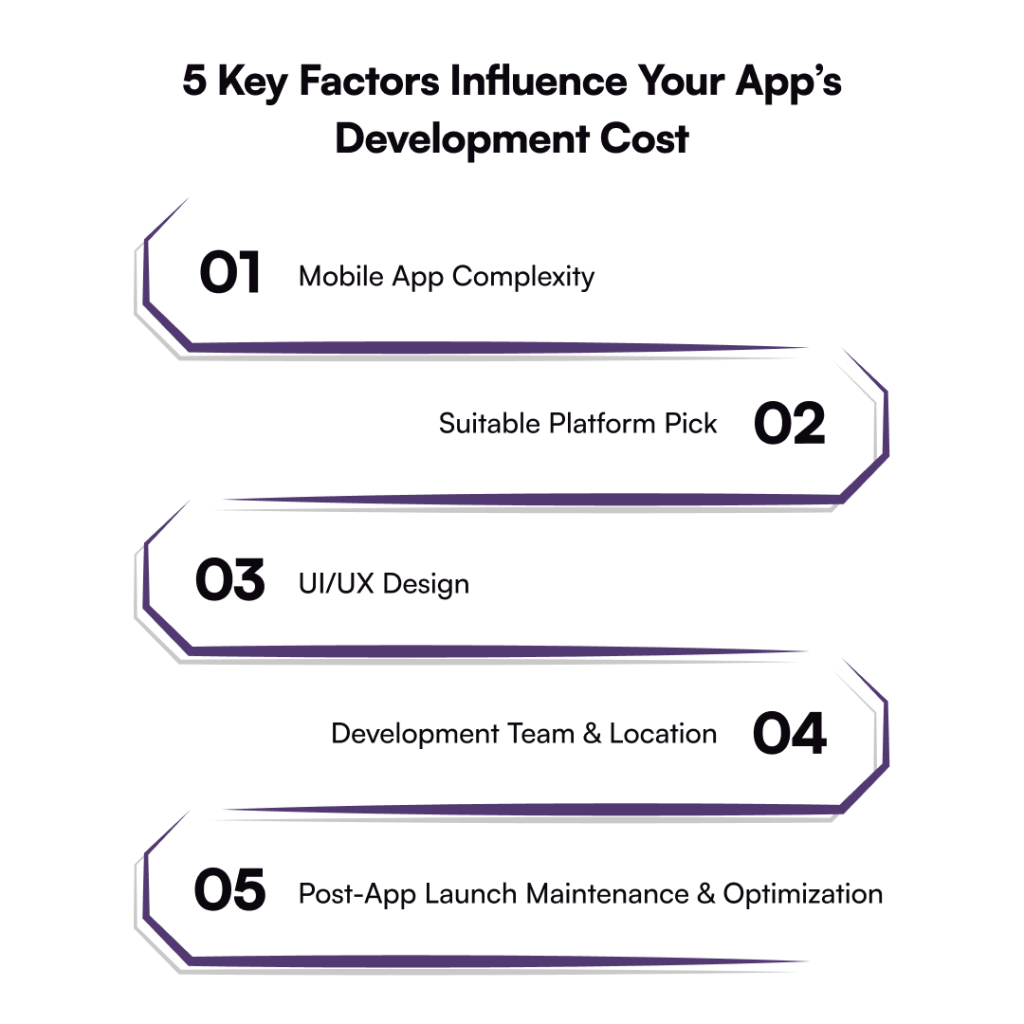
Top 5 Factors Affecting the Cost to Develop an App

How much does it cost to create an app? 

Well, the answer to this question is not as direct as you might expect because every mobile app is unique in its way, which ultimately affects the overall development cost. Here is a list of the top factors that influence the app development price. 

  1. Mobile App Complexity

A mobile app with basic features might be a cost-effective option for your business, but it will not be suitable for the long run. However, if you have a complex app idea with advanced features, like payment gateways or AI development, your wallet will definitely feel the weight. On the bright side, it will give you a competitive edge in the market. Furthermore,  the app complexity also includes the backend architecture and scalability requirements that automatically raise the price. 

  1. Platform Choice – iOS or Android

Choosing a suitable platform for your mobile app development is another influential factor, affecting the overall cost to develop an app. For instance, if you want native app development for iOS and Android, two different code bases will be required. Do you know what that means? The pricing will skyrocket, but the investment will pay off higher in stability and long-term success. 

  1. UI/UX Design

Ever since the low-code development market is expected to reach $264.4 billion by 2032, businesses are inclining more towards this approach for cost-effective mobile application development. But low-code alone cannot help you achieve your results; you would want an aesthetically pleasing app, which ultimately affects the cost of app development. In short, it will cost you money, but it is a necessary investment. 

  1. Development Team & Location

Another factor affecting the app development cost is the team you hire and the location they are based in. For example, app developers based in North America or Western Europe charge premium rates ($120-$200/hour). Whereas, skilled team of developers may cost significantly less (starting from $50-$110/hour). Beyond this, hiring freelancers or a set of experienced developers also affects the overall app development price. 

  1. Post-Launch App Maintenance & Optimization

Once the app development is completed, post-launch maintenance comes into the picture, which includes regular updates, bug fixes, integrating new features, etc. With that being said, the cost of optimization and maintenance starts from 15% to 20% of the actual app development price. So, if you want to keep your app operational all the time, invest your money and ensure long-term success. 

App Development Cost Breakdown Across Platforms & Industries

The cost to develop an app varies significantly depending on the platform you choose (whether it is Android, iOS, or cross-platform). Additionally, which industry you are catering to is also an affecting factor of the app development cost. 

Here is the breakdown of the average cost to develop an app, specially designed for you:

App Development Cost by Platform

App PlatformBasic AppMid-Level AppComplex App
Android App Development$5,000 to $15,000$15,000 to $30,000$72,000 and increasing
iOS App Development$5,000 to $25,000$25,000 to $75,000$75,000 to $150,000+
Cross-Platform Development$5,000 to $20,000$20,000 to $70,000$70,000 to $250,000+

App Development Cost by Industry

Industry Estimated Cost Range
Healthcare App $20,000 to $500,000+
eCommerce App$10,000 to $250,000+
Fintech App$30,000 to $250,000
Social Media App$10,000 to over $120,000+
On-Demand App $25,000 to $150,000+

How to Estimate Mobile App Development Cost?

Now that you know the cost breakdown of a mobile app development across platforms and industries, it’s time to focus on the factors to consider while estimating your app development cost. 

Do You Want to Hire an Agency or a Freelancer?

Choosing the appropriate development team plays a vital role in figuring out the overall mobile app development cost. You can either hire a freelancer or a mobile app development agency to turn your dream project into reality. And, to be honest, hiring any of them will indeed profit your business; however, both options have their own pros & cons. 

However, many organizations choose an agency over freelancers because developing a mobile app is not just about writing a line of code. There are a hundred other things as well, like offering post-launch support & maintenance services. 

Hiring a freelancer for your next big project might cost you around $20 per hour, but that’s it. Outsourcing to a full-time app development agency is considered a more reliable option because they will offer you:

  1. Accountability
  2. Smooth project management
  3. Easy communication
  4. Quality assurance
  5. Efficient involvement 

What Is Your Mobile Application Type?

Another influencing factor we have is the type of app you want to build for your business. There are tons of options that you can choose for your project that will ultimately impact the overall development cost. For instance:

  • On-Demand Services App: These types of apps have features, like geolocation, payment integration, and service provider management. As a result, an on-demand app can cost you between $60,000 – $1,20,000. 
  • Social Networking Apps: Building a high-performing social media app with features, like real-time notifications, AI personalizations, or advanced-level privacy controls, ranges anywhere from $30,000 to $1,00,000. 
  • Data-Driven Apps: Developing a data-driven app might cost you from $25,000 to $80,000 since it relies on data processing and analysis. These apps include calendars, weather forecasting, and maps that ultimately increase the cost. 

Hidden Factors Affecting the Overall Cost of Mobile App Development

Here, you’ll learn about the top hidden factors that also influence the mobile app development cost. Let’s have a look at them in detail:

  1. Quality Assurance

Quality assurance is something you can’t ignore because it is important to ensure your app is bug-free, has no glitches found, and more. It includes a variety of tests, like functional, usability, performance, and security. If you are ignoring this phase for now to save some money, remember it’ll definitely cost you in the future. 

  1. Infrastructure & Backend Cost

Infrastructure powers your app with monthly expenses, whereas backend development comes with an upfront cost. It includes the recurring costs for data storage, server maintenance, and app hosting. With time ,your app’s user base will expand so that your app can handle more data & traffic. As a result, it ultimately increases the cost. 

  1. App Security

Your mobile application contains the user’s sensitive information that you cannot compromise on. To ensure the app’s security, you must spend a good amount of money to avoid costly data breaches, regulatory fines, or reputational damage. 

  1. App Publishing Costs

Publishing a mobile application on the Google Play Store or App Store comes with an additional publishing cost. If you want to release your app on the Play Store, the one-time cost will be $25, and the App Store will charge $99 per year. 

  1. IT Support Costs

If you want to maintain the exceptional performance of your mobile app, you need technical support. The IT team will help you resolve the issues (or glitches) before the end users encounter them. When you spend your money on IT support, you get bug fixing, API maintenance, cloud services, application security, and more. 

Effective Strategies to Lower Your Mobile App Development Expenses

To maximize the cost of app development, a business owner must employ the appropriate combination of tactics and make wiser financial choices.

  • Code Reusability

Code reusability lowers app development costs by allowing developers to reuse or recycle certain features or components of the app. In comparison to creating each component from scratch, it can also increase productivity, save development time, and improve overall quality.

  • Pick the Right App Development Approach

Which development approach, native or hybrid, is ideal for your company is up to you. Because native apps are created specifically for the iOS and Android platforms, they can offer superior performance and user experience. However, compared to hybrid app development, which allows you to construct an app using cross-platform frameworks, it takes twice as much work.

  • Better Communication Flow

Facilitating improved communication and teamwork within the development team is another crucial consideration.  In addition to cutting down on development time and lowering cost, it will guarantee improved oversight of the process and clarity for all parties involved.

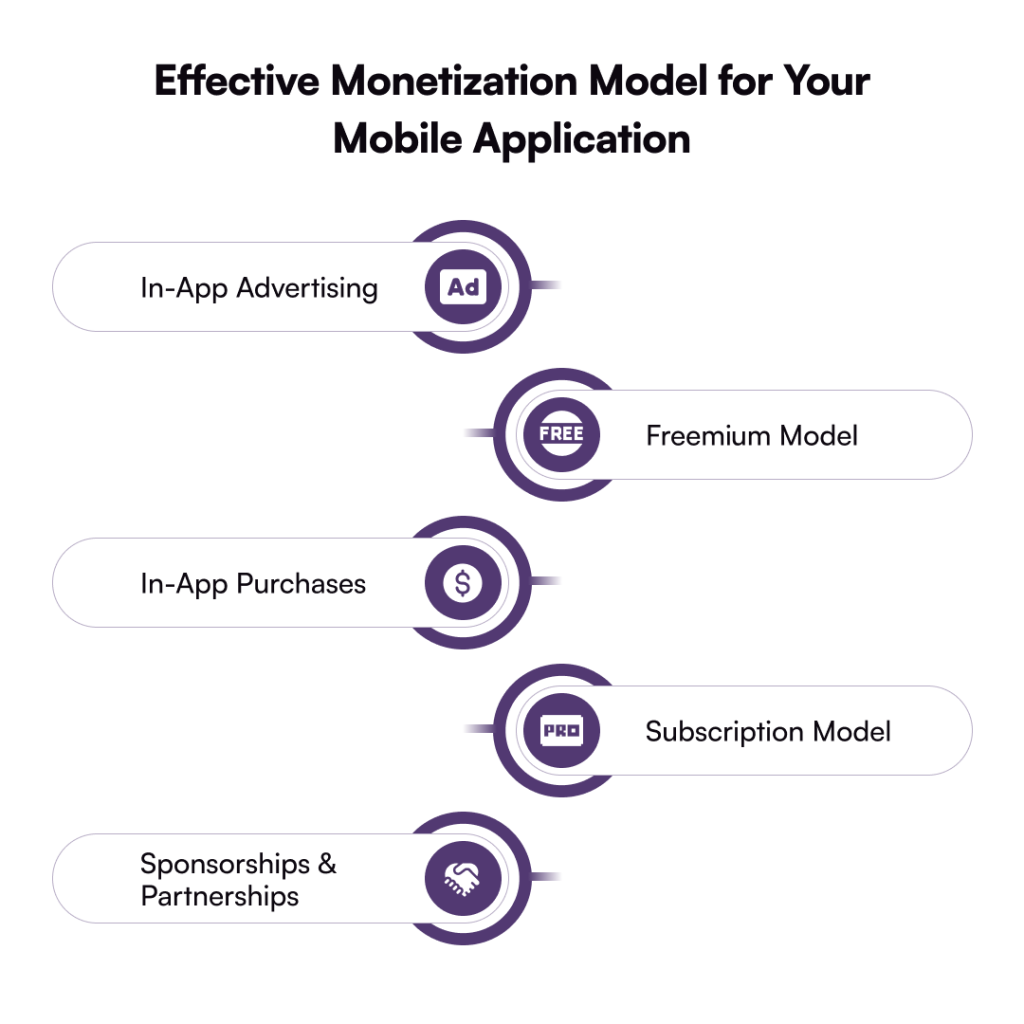
Proven Monetization Models That Actually Work for Your Mobile App

Congratulations on building a highly intuitive and user-friendly mobile application! But now what? 

Have you thought of ways to make your mobile application profitable? Well, you certainly need an effective monetization strategy to generate revenue. Here is a list of proven models you can choose from:

  • In-App Advertising

The first and foremost effective monetization model is in-app advertising, where advertisements are displayed inside the app only. You can make money through interactive ads, videos, or native ads. Remember that earning through ads is an excellent option, but too many displays of ads might frustrate users. So, maintain a balance. 

  • Freemium Model

Another interesting model through which you can get a higher ROI is leveraging the freemium model. You can attract the users and provide them with the basic features for free, and in case of utilizing the advanced features, you can charge them. Such a model is highly useful for apps like Spotify and LinkedIn that give users a wonderful experience before committing to paid features. 

  • In-App Purchases

In-app purchase is another way to monetize. This lets users buy extra content or features. It works well for gaming apps where users can buy virtual items or exclusive content. This model is also common in lifestyle, education, and entertainment apps for unlocking premium features.

  • Subscription Model

On the other hand, if in-app purchases or a freemium model don’t suit your app, a subscription model could be the answer. With this, users pay a recurring monthly or yearly fee for premium features or an ad-free experience. Many successful apps like Netflix, Amazon, and Spotify use this model effectively. If your app provides high-quality content or unique features, a subscription is a solid option.

  • Sponsorships & Partnerships

Sponsorships and partnerships are another good way to make money with your app. This works really well if you have a loyal and active user base in a specific market. You can then team up with brands that want to reach your audience, which benefits both you and the brand.

Which Is More Cost-Effective: Hiring an In-House Team or Offshore?

When it comes to developing a mobile application, one of the thoughtful decisions entrepreneurs have to make, whether to hire an in-house team or an offshore team. While the average cost of app development can give you a rough idea, it’s important to recognize that the choice between these two approaches significantly influences both your expenses and long-term outcomes.

Let’s find out which is the suitable choice:

  • In-House Development Team

If you are thinking of hiring an in-house team, get ready to have more control, easier communication, and better alignment with your company’s goals. However, it will come with a price because, on average, the app developers based in Western Europe can cost as much as $150,000+ per year. Just know that we haven’t mentioned the cost of designers, QA testers, and so on. 

  • Offshore Development Team

Investing your money in hiring an offshore development team is a cost-effective option, giving you access to a pool of talented & experienced developers. This gives you relaxation from overpaying and lets you focus on maintaining an in-house staff. 

However, it completely depends on the type of business and budget you have. For startups or businesses with a small budget, an offshore development team is definitely the right choice. But if your enterprise is on a large scale and has enough money, go for an in-house development team. 

Just remember, cost matters, but the right team matters the most!

How Galaxy Weblinks Helps You Build Apps Within Budget

At Galaxy Weblinks, we have a team of developers who specialize in crafting mobile applications that balance cost, quality, and scalability. 

From creating a simple MVP to developing a complex enterprise-level application, we will ensure you receive a higher return on investment. Our team will also help you choose the right tech stack to optimize UI/UX and deliver advanced features without breaking your bank.

The outcome:

  • Cost-effective development that never sacrifices quality.
  • Applications engineered for scalability and sustained, long-term expansion.
  • A reliable partner committed to supporting you at every phase of your project.

Ready to turn your app idea into reality? Contact our expert team!

Frequently Asked Questions

Q1. How much does it cost to create an app in 2025?

The cost of developing an app in 2025 typically ranges from $40,000 to $150,000+, depending on factors like app complexity, features, design, and platform choice. A simple MVP can be more budget-friendly, while complex enterprise-grade apps require a higher investment.

Q2. What factors influence the cost of app development the most?

The biggest cost drivers are app complexity, chosen platform (iOS, Android, or cross-platform), UI/UX design, developer location, and post-launch maintenance. Each of these adds layers of effort, impacting the final price tag.

Q3. Is it cheaper to build a cross-platform app than two native apps?

Yes. Cross-platform development allows you to reuse a single codebase for both iOS and Android, saving development time and costs. Native apps, while offering better performance, usually cost more because they require separate builds.

Q4. Are there hidden costs in mobile app development?

Many businesses overlook post-launch expenses, such as hosting, app store fees, bug fixes, feature updates, and marketing. These can add 15–20% of the initial development cost annually, so budgeting for ongoing maintenance is crucial.

Q5. Should I hire an in-house team or outsource app development?

It depends on your goals and budget. In-house teams give you full control but are more expensive (salaries, tools, benefits). Outsourcing or hiring an offshore team can be more cost-effective while still ensuring quality if you partner with the right vendor.

A Strategic Guide to Headless Commerce for Enterprises: Everything You Need to Know 

Suppose you’re launching your business across multiple geographies, integrating newer sales channels, and constantly tweaking the customer experience but your systems can’t keep up. What should be a seamless rollout turns into months of coordination between frontend teams, backend engineers, and third-party vendors. Every minor update, be it a product carousel or a localized payment method triggers a domino effect of dependencies. Managing digital commerce at scale was never meant to be this disrupted. 

For many enterprises, this rigidity is no longer just a tech problem—it’s a growth blocker. 

Traditional commerce architectures were designed in an era where customer journeys were linear, and touchpoints were predictable. That era is over. Today, users jump from app to web to in-store within hours. And they expect consistency, speed, and personalization at every point. 

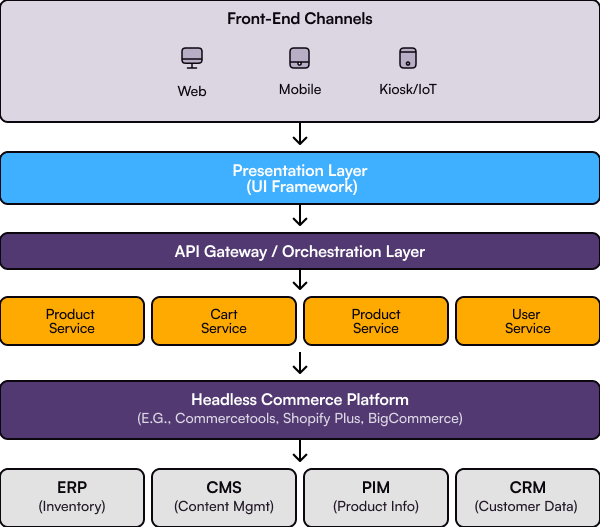
Headless commerce emerged not as a trend, but as a response to this very problem. It decouples the customer-facing layer from the backend engine—giving enterprises the ability to move fast on the frontend, while keeping backend logic stable and secure. 

But transitioning to headless is not a plug-and-play job. It’s a strategic shift. It demands clarity on architecture, business needs, integration maturity, and long-term scalability. 

That’s what this guide will help you with—a complete blueprint to understand, evaluate, and plan your enterprise headless commerce journey. 

What Is Headless Commerce and Why Enterprise Leaders Are Choosing It 

Definition: 

Headless commerce refers to a decoupled architecture where the frontend (what users see) and backend (where business logic and data live) operate independently, connected via APIs. This separation gives enterprises the flexibility to build fast, scalable, and personalized user experiences without being constrained by legacy systems. 

How Headless Commerce Came to the Picture? 

Traditional commerce platforms were built to centralize control, not to support agility. As customer expectations shifted toward faster, personalized, and cross-platform experiences, these systems started showing their limits. 

Every team in an organization has a separate goal, but leads to a cohesive business success: 

  • Marketing wants to experiment across channels. 
  • Developers need to release front-end improvements without waiting on backend changes. 
  • Business teams are looking for ways to enter new markets without rearchitecting the core.

But when every update requires a backend overhaul, speed becomes a bottleneck. 

Headless commerce changes that. Separating the presentation layer from the backend using APIs, it provides a flexible structure where the backend remains stable and secure, while the front end can be customized and scaled as fast as the market demands. 

This shift is already underway. The global headless commerce market is expected to estimate at $1.74 billion by 2025. Moreover, this market is anticipated to reach $7.6 billion by 2032, showing a compound annual growth rate (CAGR) of 22.4% in the growth period. 

For enterprise teams navigating global operations, omnichannel delivery, and AI integrations, this approach offers the adaptability that legacy systems can’t. Headless isn’t just another architecture. It’s how modern commerce stays competitive. 

So, what makes this architecture worth betting on? 
That’s what we explore next. 

Top Enterprise Benefits of a Headless Commerce Architecture 

Enterprise commerce is no longer about just building an online storefront. It’s about building a responsive, intelligent, and integrated digital ecosystem that evolves with market demand. Headless commerce architecture enables that shift by improving technology and realigning how teams work & systems scale. 

Here’s a closer look at how enterprises are seeing value: 

1. Speed that Impacts Core Business Metrics 

Performance isn’t just a technical KPI. It’s a business outcome. Studies show that conversion rates drop by up to 7% for every one-second delay in page load time. By decoupling the front-end from the back-end, headless commerce allows developers to optimize each layer independently, leading to various lucrative outcomes: 

  • faster load times 
  • better Core Web Vitals 
  • significantly improved performance across global regions

2. Front-End Agility for Real-Time Iteration 

With a headless setup, front-end teams are no longer bound to the release cycles of backend systems. Want to launch a new landing page, test a microinteraction, or localize content for a new region? You can ship those updates without waiting for back-end dependencies to be resolved. This kind of speed to iterate directly supports business agility. 

3. Modular Scaling and Lower Total Cost of Ownership 

Legacy systems often require scaling the entire application stack, even when the demand spikes are limited to specific services. Headless architecture allows enterprises to scale services independently—whether it’s the CMS, product catalog, or checkout logic. Over time, this modularity reduces infrastructure waste and lowers maintenance overhead. 

4. Seamless API-Driven Integrations 

Enterprise commerce doesn’t run in isolation. It has to plug into ERP systems, CRMs, inventory databases, CMS platforms, analytics dashboards, and more. A headless architecture, built on APIs, allows smoother integrations with existing tools while future-proofing the stack for new ones—whether it’s a PIM solution or a Gen AI-powered analytics engine. 

5. AI-Ready Personalization at Scale 

Personalization today means more than product recommendations. It includes dynamic pricing, real-time content adaptation, and behavior-based journeys. Headless architecture enables tight coupling with AI/ML engines that operate outside the commerce platform, ensuring these features don’t slow down core workflows. According to a McKinsey study, companies that personalize digital experiences see 10 to 15% increases in revenue. 

6. Developer Productivity and Engineering Velocity 

Because each component in a headless system can be built, tested, and deployed independently, engineering teams move faster. This modularity supports modern CI/CD workflows, shortens sprint cycles, and reduces time spent managing dependencies. As a result, innovation becomes continuous—not scheduled. 

Key Architecture Patterns and Platform Examples 

Modern commerce infrastructure isn’t just about having the right tech—it’s about how that tech is structured to respond to evolving needs. As customer expectations shift and personalization becomes the norm, businesses are turning to composable approaches that allow flexibility without compromising speed or stability. 

MACH: The Framework That Powers Modern Commerce 

At the core of headless commerce lies the MACH architecture, which stands for: 

  • Microservices:Instead of monolithic platforms, every function (search, checkout, pricing, etc.) operates as an independent service. This means you can update or scale just one component without touching the entire system. 
  • API-first: Every service communicates via APIs, making integration with other tools, platforms, and custom interfaces seamless. 
  • Cloud-native: Built to run in distributed cloud environments, allowing automatic scalability, global availability, and cost efficiency. 
  • Headless: The front-end is decoupled from the back-end, so you can build interfaces for web, mobile, kiosk, or even smart TVs without constraints. 

This architecture is becoming the baseline for future-ready digital commerce. It’s what powers personalization engines, omnichannel delivery, and lightning-fast deployment cycles. 

Platforms Putting MACH Into Practice 

Several enterprise-grade platforms have translated MACH principles into full-fledged products. Here are a few leaders that teams across industries rely on: 

1. commercetools 
One of the pioneers in true MACH architecture, commercetools is entirely API-driven and built for composability. Enterprises use it to roll out localized storefronts, integrate AI-driven pricing engines, or even deploy voice-based commerce features, all without altering their core logic. 

2. Shopify Plus (Headless Mode) 
While Shopify is traditionally known for its all-in-one model, Shopify Plus offers headless capabilities that give enterprise teams full control of the front-end experience. With its Storefront API and Hydrogen framework, developers can create highly customized experiences while relying on Shopify’s battle-tested commerce engine. 

3. BigCommerce (API-first Capabilities) 
BigCommerce offers 90% of its platform via APIs, making it a reliable option for businesses looking to go headless without building from scratch. It integrates well with CMS systems, payment gateways, and personalization tools, and supports multi-region scaling right out of the box. 

4. Spree Commerce 
An open-source framework that developers love for its flexibility. Spree is built on Ruby on Rails and is ideal for teams that want full control over customization, hosting, and third-party integrations. It’s often used by mid-size businesses or fast-scaling DTC brands looking for ownership and performance. 

These platforms don’t just enable front-end freedom—they allow businesses to create tailored experiences across channels, backed by a robust API infrastructure and scalable cloud setup. They’re also well-suited for future enhancements like integrating Gen AI models for product discovery. 

When to Choose Headless: Use Case Scenarios & Migration Triggers 

Not every business needs headless. And not every team is ready for it. That’s why identifying when and why to make the shift is a strategic step. 

Understanding the right use case scenarios isn’t just helpful; it’s essential. Because without that clarity, teams risk: 

  • Over-engineering when a simpler stack could’ve scaled 
  • Missing out on performance gains when legacy tech throttles growth 
  • Locking in cost-heavy migrations without matching ROI

The goal here isn’t to follow a trend. It’s to align architecture with business reality, whether that means serving five markets with distinct buyer journeys or building the agility to launch on a new touchpoint in two weeks. 

So, instead of asking “Is headless commerce better?” ask “Is headless commerce better for us, right now?” 

Let’s break down the scenarios where the answer starts leaning towards yes. 

Global Expansion with Local Nuance 

If your enterprise is growing across markets, each with its own language, currency, and buying behavior, then monoliths start to strain. Headless commerce lets you localize experiences without rebuilding the core logic. Front-end teams can tailor interfaces for Southeast Asia while backend systems remain untouched in the EU region. 

Case in Point: Enterprises with multilingual storefronts (like Nestlé or Unilever) often use headless for regional brand autonomy without platform-level chaos. 

Peak Traffic Isn’t Just Black Friday Anymore 

Brands are no longer defined by product drops—they’re defined by how they scale when everyone shows up at once. 
From flash sales to influencer-fueled spikes, headless ensures backend stability and front-end performance even at increased traffic. 

Peak periods—such as launches, holiday sales, or viral campaigns—expose architectural weaknesses. Retailers like Nike and John Lewis have faced site outages during high traffic days. With headless architecture, front-ends scale autonomously, minimizing downtime risk and safeguarding revenue. 

Multi-Frontend Strategy is Now Default 

You’re not just selling via a website anymore. There’s a mobile app. A marketplace storefront. A smart kiosk. Maybe even a wearable. Headless gives each touchpoint its own front-end freedom—without creating 5 different platforms to manage. 

Real-World Parallel: Think of a headless setup like a centralized kitchen serving multiple restaurant counters—different dishes, same core. 

Omnichannel + Personalization at Scale 

Headless plays well with Gen AI and real-time engines. It allows instant adaptation to user behavior, integrating LLM-based recommendation systems, dynamic content rendering, and consistent brand presence across web, voice, and in-store screens. 

For Advanced Teams: This is especially critical for those building composable experiences or integrating with CDPs, AI chat assistants, or CRM-linked content engines. 

Headless vs Traditional vs Composable Commerce: A Strategic Comparison 

Choosing the right commerce architecture isn’t about chasing the most modern-sounding term. It’s about aligning your tech stack with how your business needs to operate, scale, and innovate. 

Here’s how Traditional, Headless, and Composable commerce architectures compare across real enterprise demands 

Traditional Commerce 
A monolithic platform where the front-end and back-end are tightly connected. Any change in customer experience, functionality, or UI requires code-level updates across the entire system. It’s predictable but rigid—fine for early-stage use, but limiting when growth demands agility. 

Headless Commerce 
This model decouples the front-end and back-end, allowing each to evolve independently. APIs act as the bridge. It gives brands more control over user experience and speed of delivery across channels, without being tied to a single system’s release cycle or templated structure. 

Composable Commerce 
A modular, API-first approach where you build your stack using best-in-class solutions—CMS, checkout, search, payments—all integrated through orchestration layers. It’s designed for enterprise-grade flexibility, enabling teams to plug and play components based on evolving needs and innovation goals. 

Parameters Traditional Commerce Headless Commerce Composable Commerce 
Architecture Monolithic (Tightly coupled front-end & back-end) Decoupled (Front-end and back-end communicate via APIs) Modular (Built from interchangeable best-of-breed services) 
Flexibility Low (Rigid structure, slow to change) Medium (Allows independent front-end changes) High (Full control over every component, swap as needed) 
Speed to Market Slower (Long development cycles) Faster (Parallel development enables quicker rollouts) Fastest (Composable blocks streamline deployments) 
Performance Often limited under load; dependent on full-stack stability Optimized for faster front-end performance Highly performant (Choose best tools per function) 
Omnichannel Support Minimal (web-first, hard to extend) Good (Supports multi-touchpoint experiences) Best (Designed for seamless omnichannel orchestration) 
Developer Control Limited (Developers constrained by platform) More control over UI/UX, but backend is often fixed Maximum control (Each service is an independent choice) 
Integration Complexity Minimal (Everything’s baked in) Moderate (Requires API integrations) High (But pays off in flexibility and innovation) 
Total Cost of Ownership Initially lower, higher in long run due to limitations Balanced (Less maintenance, faster iterations) Potentially higher upfront; long-term cost savings with scale 
Best For Small businesses with simple needs Fast-scaling D2C/B2B brands, focused UX teams Enterprises building future-proof, innovation-first ecosystems 

Preparing for Headless Migration: Tech, Team & Timeline 

Headless isn’t just a technology shift—it’s an operating model change. Use this checkpoint-driven toolkit to assess readiness across tech stack, team maturity, and long-term business goals. 

Self-Assessment: Are You Ready for Headless? 

Before you commit, answer these baseline questions internally: 

Question Why It Matters 
Do your marketing and dev teams often clash over release timelines? Headless separates front-end and back-end ownership. 
Are you planning to launch new digital channels in the next 12–18 months? A headless architecture supports omnichannel rollout without backend rework. 
Are slow site updates impacting campaign performance or SEO? Traditional CMS bottlenecks are removed in a headless model. 
Do you have the internal capability (or partner support) to manage microservices and APIs? Headless adds flexibility—and complexity. 
Is your current platform vendor limiting speed, customization, or integrations? Time to reconsider architecture neutrality. 

“Is Headless Right for Us?” Criteria Matrix 

Evaluate headless suitability across five dimensions.  

Dimension Low Suitability  High Suitability  
Content Deployment Frequency Monthly or ad hoc Daily or real-time 
Channels in Play Just website Web, mobile, kiosk, IoT 
Marketing Autonomy Needs dev help for updates Owns content workflows 
Tech Team Maturity Monolith-oriented Comfortable with APIs and decoupling 
Business Growth Roadmap Stable product mix Frequent launches, market expansions 

Vendor & Partner Evaluation Toolkit 

When shortlisting CMS or MACH vendors, don’t just go by demos. Ask: 

Evaluation Criteria Key Questions 
Architecture Fit Does it support true decoupling or just headless-lite? 
Editorial Experience Can non-tech teams preview and publish easily? 
Scalability Is the system optimized for geo-redundancy and API performance under load? 
Support & SLAs What’s the uptime guarantee? How fast is dev support during critical deployments? 
Integration Flexibility Are APIs open, well-documented, and compatible with your stack (ERP, CRM, PIM)? 
TCO What’s the true 3–5 year cost of ownership, including training, upgrades, and support? 

Note: Avoid vendor lock-in under the “headless” label as true composable systems allow you to replace individual components without replatforming again. 

5-Step Enterprise Headless Migration Guide  

Moving to headless or composable architecture? Here’s how successful digital-first enterprises de-risk and drive value across the migration lifecycle. 

1. Define Business Drivers, Not Just Technical Bottlenecks 

Too often, architecture decisions are made in isolation by IT. Instead, bring business and tech leads to the same table. 

Ask: 

  • Is performance slowing down during campaigns or sale peaks? 
  • Are front-end changes delayed due to backend limitations? 
  • Are new channels (voice, apps, kiosks) hard to deploy? 

2. Select Your Frontend Stack & CMS Based on Use Case, Not Trends 

Avoid the trap of picking “modern” stacks for the sake of it. Your front-end framework (React, Vue, Next.js, etc.) and CMS (Contentful, Strapi, Storyblok) should align with how frequently content is updated, who’s managing it, and how fast pages need to load across geographies. 

Example: If your marketing team is launching multiple micro-campaigns weekly, a headless CMS with visual editing capabilities is non-negotiable. 

3. Map Out Integrations with ERP, CRM, and Inventory Systems 

This is where most migrations stall and i.e., integrations. Your new architecture must communicate seamlessly with legacy systems like SAP, Microsoft Dynamics, Salesforce, or Netsuite. 

Note: Build middleware or use API orchestration tools like MuleSoft or WSO2 to manage third-party dependencies without overloading your commerce stack. 

4. Run Controlled Pilots—Not Full Swaps 

A smart migration doesn’t flip the entire system overnight. Start with one region, one product category, or a specific channel (e.g., mobile-first store). 

Monitor: 

  • Load times under peak 
  • API response accuracy 
  • Conversion shifts post-UX overhaul 

5. Iterate, Observe, and Optimize 

Your architecture isn’t “done” after launch. 

  • Set up observability dashboards (Grafana, DataDog) 
  • Monitor P95 response times, cart latency, and funnel leaks 
  • Establish a quarterly roadmap for component upgrades and refactoring 

Note: Make feedback loops between engineering, product, and business part of your operating model—not a one-off check-in. 

Enterprise Controls: Security, Compliance & Best Practices 

Modern commerce stacks aren’t just about speed and flexibility, they must also defend trust. Especially in headless and composable architectures, where APIs proliferate and multiple front-ends interface with a shared backend, governance and security are no longer backend concerns alone. They’re enterprise-wide mandates. 

API Security: Your First Line of Defense 

When your entire ecosystem relies on APIs, from checkout to content delivery, you’re opening multiple doors to your digital store. Implementing token-based authentication, rate-limiting, and zero-trust policies becomes non-negotiable. 

Best Practice: Use API gateways like Kong or Apigee to centralize security policies and ensure observability across distributed services. 

Data Governance & Identity Management 

With consumer privacy laws tightening across regions (think GDPR, CCPA, and upcoming APAC equivalents), organizations must ensure that customer data isn’t just protected, but responsibly managed. 

  • Role-based access control (RBAC) 
  • Single sign-on (SSO) across admin systems 
  • User activity logging for audit trails

Cloud Compliance and Infrastructure 

If you’re running headless on AWS, Azure, or GCP, compliance needs to be continuous, not quarterly. Whether it’s ISO 27001, SOC 2, or HIPAA (for med-commerce), automated compliance monitoring through tools like Lacework, Prisma Cloud, or AWS Config can ensure your cloud setup meets audit-readiness 24/7. 

SLAs & Vendor Accountability 

When you stitch together services, from content platforms to payment gateways, every dependency matters. Make sure every vendor you integrate comes with transparent SLAs, clear uptime guarantees, and support tiers that match your incident response expectations. 

How Galaxy Weblinks Engineered Headless Commerce for Enterprise Brands 

With our modernization-ready Headless commerce services at Galaxy Weblinks, we help enterprise brands unlock agility, performance, and long-term digital scalability. 

Whether it’s decoupling legacy platforms or building new front-end experiences, our team has delivered high-impact solutions tailored to modern commerce needs. From integrating with enterprise-grade ERPs and CRMs to launching multi-site storefronts across geographies, our migrations are built for resilience and speed. 

The outcome: 

  • Faster time-to-market 
  • Unified customer experiences 
  • Architecture that evolves with your business

Ready to reimagine your commerce stack? Contact Us 

FAQs 

1. What does headless commerce architecture actually solve? 
Headless commerce services decouple the presentation layer from the backend, enabling product, content, and engineering teams to operate in parallel. The result: faster releases, performance-first delivery, and architecture that scales with complexity. 

2. Why are traditional eCommerce platforms becoming a bottleneck? 
Coupled architectures constrain flexibility. Enterprise brands pushing omnichannel or modular content strategies often find traditional stacks unable to deliver dynamic experiences, integrate with modern CMS, or adapt fast enough to changing market conditions. 

3. How does headless architecture affect SEO, performance, and uptime? 
Handled right, it improves all three. Pre-rendered pages, CDN-level delivery, and granular control over APIs enable near-instant load times and stable rankings. SEO only takes a hit when frontend frameworks are misconfigured—not because of the architecture itself. 

4. How do you select the right CMS for a headless setup? 
Start with business velocity. Contentful and Strapi are flexible for large teams; Sanity offers real-time collaboration. For highly governed ecosystems, hybrid CMSs with GraphQL layers allow backward compatibility. The CMS should reflect your editorial and deployment workflows—not just tech preferences. 

5. What’s the hidden cost of headless commerce migration? 
Architecture debt, if not handled proactively. Enterprises that skip orchestration layers, API governance, or integration design often trade one bottleneck for another. The cost isn’t in the build—it’s in the rework. 

6. What’s the average migration timeline for a mid-to-large enterprise? 
3 to 6 months for a structured migration—assuming discovery is handled upfront, and there’s alignment on CMS, design system, and API contracts. Parallelizing integrations and front-end work is key to speed. 

From Vendors to Venture Allies: Offshore Teams That Think With You, Not Just for You

The ambition across the Gulf Cooperation Council (GCC) in Q3 2025 is palpable. Grand national strategies like Saudi Vision 2030, the UAE Centennial 2071, and the Qatar National Vision 2030 are not just policy documents; they are blueprints for a future powered by technology, innovation, and a diversified, knowledge-based economy. Giga-projects are reshaping skylines, and sovereign wealth funds are fueling a surge in venture capital, positioning the region as a global hub for the future.

But beneath the gleaming headlines of multi-million dollar funding rounds and state-led initiatives lies a different reality for the bootstrapped founder. For you, the 2025 landscape presents a stark paradox. The opportunities are immense, but the ground-level challenges are more acute than ever. Consider the whiplash of the MENA funding market: after a 105% surge in April 2025, investment plummeted by a staggering 82% in June, highlighting extreme volatility. A fierce regional “talent war” for specialized skills in AI and data science has sent salaries soaring, with 41% of the UAE workforce needing to transform their core skills by 2030. Furthermore, navigating the fragmented regulatory landscape—where a license in the UAE doesn’t grant automatic access to Saudi Arabia’s vast market—adds layers of cost and complexity. All of this unfolds against the backdrop of the universal startup killer: 42% of ventures still fail because they build a product with no market need.

In this high-stakes environment, the traditional view of an offshore development team as a simple, cost-saving “vendor” is not just outdated—it’s a liability. A team that merely takes orders and executes tasks cannot help you navigate the complexities of the 2025 GCC market. To succeed, bootstrapped founders need more. You need a “Venture Ally”—a true strategic partnership with an offshore team that thinks with you, not just for you. This ally challenges your assumptions, contributes to business strategy, and helps you build a product that is not only technically sound but also culturally relevant and commercially viable across the region. This post will explore why this shift from vendor to Venture Ally is critical for survival and provides a founder’s guide to identifying and cultivating a true offshore development team that acts as a strategic partner.

The 2025 GCC Gauntlet: Why Your Old Offshoring Playbook Is Broken

For a bootstrapped founder in the GCC, the ambition of the region’s grand visions is met with a sobering set of on-the-ground challenges. In this high-stakes environment, relying on a traditional offshoring playbook—where an offshore development team is treated as a low-cost, task-based vendor—is not just inefficient; it’s a direct path to failure. Here’s why that model is fundamentally broken for the 2025 GCC reality.

The Capital Efficiency Crisis in a Volatile Market

While MENA’s venture capital scene shows incredible resilience, it is also defined by extreme volatility. In 2025 alone, the market saw a 105% month-on-month funding surge in April followed by a staggering 82% drop in June. For a bootstrapped founder, this isn’t just a headline; it’s a stark warning that access to capital is unpredictable. Compounding this, investors have shifted their focus dramatically. The old “hypergrowth” model is out; a clear path to profitability is in. Top investors now recommend that early-stage ventures secure a 24-36 month cash runway as a safety net, a significant increase from the previous 18-24 month standard.

  • Where a Vendor Fails: A traditional vendor operates on a task-based model. They build what you ask and bill for the hours, burning through your precious runway without contributing to strategic capital efficiency. They are an expense, not an investment in optimization.
  • The Venture Ally Imperative: In a market demanding extreme capital efficiency, you need a partner obsessed with maximizing the value of every dollar spent. A venture ally helps you prioritize features that will achieve critical validation milestones faster, making your limited capital work harder to attract the region’s increasingly cautious investors.

The Regional “Talent War” vs. Global Skill Pools

The economic diversification push across the GCC has ignited a fierce “talent war.” With Saudi Arabia’s Public Investment Fund creating companies at a remarkable pace and the UAE’s focus on becoming a global AI hub, the demand for specialized tech talent has soared. A 2018 study projected a skilled worker shortage of 663,000 in Saudi Arabia by 2030, and more recently, it was reported that 41% of the UAE workforce will need to transform their core skills by 2030. As a bootstrapped startup, you are in direct competition for talent with government-backed giga-projects and established corporations offering salary packages that are often 60% higher than market rates.

  • Where a Vendor Fails: A simple vendor provides bodies to fill seats. They offer manpower but lack the integrated, high-level expertise needed to compete technically. They are a temporary fix for a deep strategic problem.
  • The Venture Ally Imperative: A true offshore development center acting as a venture ally gives you immediate access to a cohesive, world-class team of specialists in AI, cloud architecture, and data science without the crippling cost and time sink of local recruitment. This isn’t just about finding a developer; it’s about embedding a high-performing tech unit into your startup from day one.

The “No Market Need” Epidemic Meets Regulatory Fragmentation

Globally, the number one startup killer is building a product nobody wants (42% of failures). In the GCC, this risk is amplified by market and regulatory fragmentation. A product that finds traction with 9.5 million people in the UAE doesn’t automatically have access to the nearly 37 million in Saudi Arabia. Each country has a distinct regulatory framework, and navigating cross-border approvals can take over a year, creating a significant drain on a bootstrapped startup’s limited resources.

  • Where a Vendor Fails: A vendor will build precisely what you specify, even if the architecture isn’t optimized for cross-border adaptation. They are not incentivized to question whether your product can be efficiently scaled from Dubai to Riyadh to Doha.
  • The Venture Ally Imperative: A strategic partnership with a venture ally involves proactive planning. This offshore development team helps you architect a modular MVP that can be efficiently adapted and validated for different regulatory environments and cultural nuances, turning a major regional obstacle into a potential competitive advantage.

The Litmus Test: Differentiating a Vendor from a Venture Ally in the GCC Context

In the high-pressure environment of the 2025 GCC startup scene, choosing the right offshore development partner is one of the most critical decisions a bootstrapped founder will make. The distinction between a transactional vendor and a true Venture Ally can mean the difference between burning through your runway and building a resilient, scalable business.

A vendor simply executes tasks. A Venture Ally, however, becomes an extension of your core team, contributing to strategy and sharing accountability for your success. They understand that for a bootstrapped startup in the Middle East, success isn’t just about clean code; it’s about navigating a complex ecosystem to achieve tangible business outcomes. Here is a practical litmus test to help you differentiate between the two.

Litmus Test AreaThe Traditional Vendor (Task-Taker)The Venture Ally (Strategic Partner)
Core FocusOutputs: Delivers lines of code, completes tickets, and bills for hours spent. Their job is to build what is specified.Outcomes: Focuses on achieving your business goals, such as validating product-market fit in the Saudi market, reducing churn in your UAE user base, or building features that attract regional VCs.
Communication StyleReactive: Waits for your instructions and detailed specifications. Questions are typically limited to clarifying technical tasks.Proactive: Asks “why” behind the features. Suggests leveraging technology that aligns with the UAE’s AI Strategy 2031 or warns about potential data sovereignty issues when planning for KSA expansion.
Success MetricsOn-Time, On-Budget Delivery: Success is measured by their ability to complete the assigned work within the agreed-upon timeframe and budget.Your Business Success: Considers their success tied to yours. They aim to help you achieve the traction needed to secure a seed round from a regional investor or prove the positive unit economics that VCs now demand.
Technical ApproachBuilds to Spec: Follows your technical roadmap precisely, even if it’s not optimized for the region’s unique challenges.Architects for Regional Scale: Understands the GCC’s regulatory fragmentation. They will architect your MVP in a modular way, making it easier and more cost-effective to adapt for different compliance and cultural needs in the UAE, Saudi Arabia, and Qatar.
Talent ContributionProvides Developers: Offers access to developers to fill seats and augment your capacity. They are a human resource solution.Solves the Talent Gap: Acts as your strategic answer to the fierce regional “talent war”. This offshore development center provides a cohesive, high-performing team with specialized skills in AI, cloud, and data science that are scarce and expensive to hire locally.
Problem SolvingIdentifies Technical Blockers: Will inform you when they hit a technical wall or cannot proceed with a task as assigned.Anticipates Business Risks: Will flag potential business risks, such as a feature that might not resonate with cultural nuances in the Saudi market or a technology choice that could hinder future scalability.

Choosing your offshore development services is no longer a simple procurement decision; it’s a core part of your venture-building strategy. A vendor will help you build a product. A Venture Ally will help you build a business. For a bootstrapped founder in the 2025 GCC market, making the right choice is everything.

The Strategic Advantages of a Venture Ally Partnership in 2025

For a bootstrapped founder in the GCC, every decision must be a force multiplier. Choosing your offshore development partner is no exception. Moving beyond the outdated vendor model to embrace a strategic partnership with a Venture Ally unlocks critical advantages that directly address the region’s most pressing challenges. This isn’t just about building a product; it’s about building resilience and a competitive edge.

Accelerated Time-to-Validation Across a Fragmented Market

The GCC is not a single market. A significant barrier to growth is the fragmented regulatory environment, where a license in one country doesn’t grant access to another, often requiring a costly and time-consuming approval process that can take over a year. For a bootstrapped startup, this can be fatal. A Venture Ally tackles this head-on by architecting your product for regional scale from day one. Instead of a monolithic build, they help create a modular MVP. This approach allows you to efficiently adapt and deploy features that comply with the specific data sovereignty laws, consumer protection regulations, and business requirements of the UAE, Saudi Arabia, and Qatar. This dramatically shortens your validation cycle across borders, allowing you to gather crucial market data faster and more cost-effectively, directly combating the #1 startup killer: building a product with no market need.

Winning the Regional Talent War

The economic ambitions of the GCC have ignited a hyper-competitive “talent war.” With Saudi Arabia facing a projected skilled worker shortage of over 663,000 by 2030 and 41% of the UAE workforce needing to transform their core skills, the demand for expertise in AI, data science, and cybersecurity has sent salaries soaring. As a bootstrapped founder, you are competing for talent against government-backed giga-projects and established corporations offering salary premiums of up to 60%.

A Venture Ally is your strategic solution to this talent gap. It provides immediate access to a cohesive, pre-vetted offshore development center of world-class specialists. This isn’t about hiring a freelancer; it’s about embedding a high-performing technology unit that brings deep expertise in the very technologies—like AI, which can boost productivity by up to 40%—that are essential for competing in 2025. This allows you to punch above your weight, matching the technical capabilities of much larger, better-funded competitors without the crippling costs and delays of local recruitment.

Navigating Cultural and Business Nuances

Success in the Middle East requires a deep understanding that the region is not a monolith. Consumer behaviors, business etiquette, and cultural expectations can vary significantly between Riyadh, Dubai, and Doha. A simple vendor, focused only on technical tasks, will miss these critical nuances, leading to products that feel foreign and fail to gain traction.

A Venture Ally invests the time to understand this complex context. They work with you to ensure your product’s user experience, features, and messaging are not just translated, but culturally adapted. This proactive approach helps you avoid costly missteps, such as a user interface that doesn’t feel intuitive to a local user or a marketing message that doesn’t resonate. For a bootstrapped founder with limited capital for mistakes, this cultural attunement is invaluable. It leads to better product-market fit, higher user adoption, and a stronger foundation for sustainable growth across the diverse markets of the GCC.

Finding and Cultivating Your Venture Ally: A Founder’s Guide to Offshore Team Management

Identifying and integrating a true Venture Ally is one of the most strategic moves a bootstrapped founder in the GCC can make in 2025. This process goes far beyond reviewing a portfolio or comparing hourly rates. It requires a shift in mindset from delegation to deep integration. Here is a founder’s guide to effective Offshore team management—from vetting to cultivating a partnership that drives real business results.

The Vetting Process: Asking the Questions That Matter

When evaluating potential offshore development services, look past the polished sales pitches and dig into their strategic capabilities. A true Venture Ally will welcome these questions because it shows you understand the value they aim to provide.

  • Probe for Regional and Cultural Acumen:
    • Instead of asking: “Have you worked with clients in the Middle East?”
    • Ask: “Can you provide a case study where you helped a client navigate the regulatory differences between the UAE and Saudi Arabia? How did you architect the product to account for this?”
    • Ask: “How do you approach UX/UI design for a primarily Arabic-speaking audience? Can you show us examples of your Right-to-Left (RTL) design implementation and how you’ve adapted for local cultural nuances?”
  • Test Their Strategic Mindset:
    • Instead of asking: “What is your development process?”
    • Ask: “Our goal is to align with the UAE’s AI Strategy 2031. If we came to you with a feature request that didn’t align with this, how would your team handle it? Describe your process for challenging a client’s assumptions.”
    • Ask: “Given the ‘talent war’ in the GCC, how does your offshore development center provide a competitive advantage beyond just cost savings?”
  • Verify Their Focus on Business Outcomes:
    • Instead of asking: “How do you ensure projects are on time and on budget?”
    • Ask: “How do you measure success for a client’s MVP? Can you share an example where your team’s contribution directly helped a client achieve a specific business metric, like improving their LTV:CAC ratio or securing a seed round?”

Integration, Not Delegation: The Core of Offshore Team Management

Once you’ve chosen your partner, the real work begins. The most common mistake founders make is treating their offshore development team like a separate, siloed unit. To unlock their full potential as a Venture Ally, you must integrate them into the very fabric of your startup.

  • Share the “Why,” Not Just the “What”: Don’t just send a list of features from your product roadmap. Share your overarching business goals. Explain why a feature is important. If your target is the Saudi market, explain how your startup fits into the broader goals of Vision 2030. If you’re in Qatar, connect your mission to the Qatar National Vision 2030‘s focus on building a knowledge-based economy. This context transforms them from coders into strategic contributors.
  • Establish Unified Communication Channels: Treat your offshore team as you would your in-house team. Include their lead developers in your core strategy meetings. Give them access to the same communication tools (like Slack or Teams) and project management platforms. This fosters a sense of shared ownership and eliminates the “us vs. them” mentality.
  • Empower Proactive Contribution: Explicitly create a culture where your Venture Ally is encouraged to be proactive. Ask for their input on your technology roadmap, feature prioritization, and even your go-to-market strategy. A true partner will have valuable insights from their experience with other ventures, and empowering them to share those insights is a critical aspect of effective Offshore team management.

Aligning on Goals: Measuring What Truly Matters

For a bootstrapped founder in the 2025 GCC market, success is not just a functioning app; it’s achieving the metrics that prove viability to increasingly cautious investors. Your success metrics with your Venture Ally must reflect this reality.

  • Move Beyond Technical KPIs: While metrics like “sprint velocity” and “bug count” are important for project management, they don’t measure business success.
  • Establish Shared Business-Centric KPIs: Work with your Venture Ally to define and track metrics that matter to your bottom line. Examples include:
    • Time to First 1,000 Users: A clear measure of market validation.
    • LTV:CAC Ratio: Aim for a ratio of 3:1 or higher to demonstrate a profitable and scalable business model.
    • User Engagement & Retention Rates: Proving that your product solves a real problem and keeps users coming back.
    • Cost Per Validated Learning: A metric that frames development spend as an investment in de-risking your business model.

By aligning on these outcomes, you transform the relationship. Your Venture Ally is no longer just building software; they are a strategic partner committed to helping you win in the competitive and complex 2025 GCC startup gauntlet.

Your Offshore Team is Your Strategic Co-Pilot, Not Just a Passenger

The path for a bootstrapped founder in the GCC in Q3/Q4 2025 is one of immense promise, set against a backdrop of unprecedented national ambition. The goals of Saudi Vision 2030, the UAE Centennial 2071, and the Qatar National Vision 2030 are actively reshaping the region into a global hub for innovation and investment. However, this opportunity is intertwined with the stark realities of a volatile funding climate, a fierce regional talent war, and the complexities of a fragmented market.

In this high-stakes environment, the old offshoring playbook is no longer sufficient. Treating your offshore development partner as a simple, task-based vendor is a critical misstep—one that burns through precious capital and fails to address the strategic challenges of building a resilient venture. The evidence is clear: to succeed, you need more than a service provider; you need a Venture Ally.

This is a strategic partnership with an offshore team that thinks with you, not just for you. A Venture Ally helps you navigate the demand for capital efficiency that now dominates investor conversations. They provide the specialized technical expertise needed to compete in the regional talent war. And they architect your product with the foresight required to scale across the diverse markets of the Middle East.

Ultimately, in the dynamic 2025 GCC ecosystem, your offshore development team is one of your most critical strategic assets. They are not just passengers on your journey; they are your co-pilots, helping you navigate turbulence, identify opportunities, and accelerate toward your destination. The smartest founders in the region will be those who recognize this shift and choose their partners not based on cost alone, but on their ability to contribute to the venture’s long-term success.

Your vision is ambitious. The region’s vision is transformative. Ensure you have a partner who can help you realize both.

Is your offshore partner a true Venture Ally? If you’re ready to build a strategic partnership designed for the unique challenges and opportunities of the 2025 GCC market, let’s talk.

Beyond ‘Minimum Viable’: Articulating the ‘Brilliant Promise’ of Your Lean ME MVP to Early Adopters and Investors (Q2 2025)

A recent Q1 2025 report from ‘Gulf Digital Insights’ revealed a brutal truth for new apps in the region: for every $1,000 spent acquiring new users in major hubs like Dubai and Riyadh, an estimated $650 is incinerated within the first minute of use. Users are not just abandoning apps; they are rejecting them with ruthless efficiency. This isn’t a marketing problem; it’s a product philosophy problem.

The cause is a plague infecting the startup world: the “Minimum Disappointing Product” (MDP). An MDP is an MVP that technically works but feels cheap, uninspired, and disrespectful of the user’s time. It’s the tragic result of founders misinterpreting the lean startup MVP philosophy as a license to deliver a frustrating first experience. In a market where users are accustomed to the world-class polish of super-apps, this is a fatal error.

The only rational response is to stop building MDPs and instead deliver a “Brilliant Promise.”

A “Brilliant Promise” is not about adding more features. It is the disciplined art of using strategic UI/UX design for startups to make your lean product feel like a small, focused piece of a much bigger, high-quality vision. It is the tangible difference between a product that feels “unfinished” and one that feels “purposefully minimalist,” communicating deep respect for the user and unshakeable confidence in your future.

To survive now, your MVP development process must be redefined. You must learn to articulate a “Brilliant Promise” that wins the immediate trust of a skeptical audience and proves to investors you understand what quality truly means in 2025.

Why a ‘Viable’ MVP is No Longer Enough in the 2025 Gulf Market

In other markets, a clunky-but-functional MVP might get a pass. In the Middle East, it is a critical strategic failure. Three regional realities have created an environment where a superior user experience is no longer a “nice-to-have,” but a fundamental requirement for survival.

1. The World-Class User Expectation The average digital user in Dubai, Riyadh, or Doha has been trained by the best. They manage their lives through the seamless super-app experience of Careem, they shop with the sophisticated e-commerce power of Noon, and they handle their finances with the polished, secure banking apps from Al Rajhi Bank or FAB. This is their baseline. When they encounter your MVP, they are not comparing it to other startups; they are subconsciously comparing it to these world-class products. A clunky, confusing interface doesn’t just look bad—it positions your product as amateurish and unworthy of their time.

2. The Trust-Deficit Multiplier As we’ve discussed previously, every new startup in the region begins with a “Trust-Deficit.” A poor user experience acts as a powerful multiplier for this deficit. It provides tangible evidence that confirms a user’s worst fears. A slow-loading screen, a confusing layout, or a buggy button are not just technical flaws; they are red flags that signal a lack of professionalism and stability. This amplifies the “Insha’Allah Risk”—the user’s rational fear that your company is not a serious, long-term venture. A polished UI/UX is one of the fastest ways to start paying down that trust deficit.

3. The Investor Signal Discerning investors in 2025 look beyond the pitch deck; they look for proxies of founder quality. The importance of UI/UX for startups has grown because it is now seen as a direct signal of the founding team’s standards and capabilities. A thoughtfully designed MVP, even with just one feature, proves you are obsessed with the customer, detail-oriented, and capable of executing at a high level. Conversely, an MVP with a poor user experience signals to an investor that you are willing to cut the wrong corners, which is a major red flag for any business hoping to scale.

The ‘Brilliant Promise’ Playbook: Three Plays for a High-Impact MVP

Knowing you need a premium feel is not enough. The challenge is achieving it within the tight constraints of a lean startup MVP. This requires a ruthless focus on what truly matters. Instead of spreading your limited resources thin, you will execute three specific, high-impact plays designed to engineer a “Brilliant Promise” into your product from day one.

Play #1: The “First-Touch” Polish (Mastering the First 30 Seconds) The highest ROI in early user experience design for startups is found on the very first screen a user sees. This is where their trust is either won or lost.

  • The Play: You will invest a disproportionate amount of design effort into the login/signup screen and the initial loading animation. This is not about adding features; it’s about signaling quality. Use a clean layout, a high-quality font, and a single, smooth micro-interaction—like a button that animates satisfyingly when tapped.
  • The Use Case: Imagine a user downloads your health-tech MVP. Instead of a generic, default-font login form, they are greeted by a beautifully designed screen with a calming color palette, a clear and confident headline, and an elegant loading animation. This small, focused effort does not change the product’s function, but it instantly communicates professionalism, builds trust, and lowers their skepticism before they even use the core feature.

Play #2: The “Magic Moment” Engineering (Delivering One ‘Wow’ Interaction) A prototype demonstrates a function, but a “Brilliant Promise” MVP delivers an emotional payoff. This play involves identifying the single most valuable moment for your user and making it feel exceptional.

  • The Play: Map out your user’s journey and pinpoint the one moment they feel the most relief, accomplishment, or value. This is your “magic moment.” You will invest your design and development resources in making this specific interaction feel seamless and delightful.
  • The Use Case: Consider a fintech app for international remittances. The user’s moment of highest anxiety is right after they hit “send.” Your “magic moment” is the confirmation screen. Instead of a bland “Transaction Complete” message, the screen comes alive with a reassuring animation—perhaps a paper plane flying across the screen—and clear, comforting text: “Success! Your 5,000 AED has been securely sent to Priya.” This transforms an anxious moment into a delightful and memorable one.

Play #3: The “Vision-Casting” Copy (Articulating the Future, In-App) Your lean MVP will, by definition, be incomplete. The key is to frame this as a deliberate choice, not a lack of resources. This play uses the UI itself to tell the story of your future vision.

  • The Play: Instead of simply disabling or hiding unbuilt features, you will use confident “vision-casting” copy. A greyed-out button in the dashboard becomes a signpost for your roadmap.
  • The Use Case: Your MVP for a social media management tool might only allow posting to one platform. In the menu, other platform icons are disabled. Next to them, the copy doesn’t say “Coming Soon.” It says, “Next Up: LinkedIn Integration (Est. August 2025)” and “Phase 3: Analytics Suite.” This small detail transforms early adopters from users of an incomplete product into insiders on an exciting and credible journey. It shows them you have a plan, building their confidence in your long-term vision.

Articulating the Promise: Tailoring the Message for Two Audiences

A well-designed MVP that delivers a “Brilliant Promise” is a powerful asset. But its value is only fully realized when you articulate it correctly. The story you tell your first users is different from the one you tell potential investors. Both are true, but they emphasize different outcomes.

For Your Early Adopters: Sell the Experience and the Exclusive Journey

Your first users are not buying a finished product; they are buying into your vision and the feeling of being an insider. Your messaging to them should be passionate, inclusive, and focused on the premium quality of their immediate experience.

  • What You Say: “We are obsessed with getting the details right. We believe the future of [your industry] should be effortless and delightful. Experience the first step of this journey with a product that focuses on doing one thing perfectly. Join our small circle of founding users and help us shape what comes next.”
  • Why It Works: This language reframes the MVP’s limited feature set as a deliberate focus on quality, not a lack of resources. It positions them as pioneers, not beta testers, and makes them feel valued and integral to the product’s evolution.

For Your Investors: Sell the Founder Quality and the Strategic Insight

Investors are betting on your ability to execute and scale. They see your MVP as a direct reflection of your standards, strategy, and understanding of the market. Your messaging to them must connect the “Brilliant Promise” to business acumen and de-risk their investment.

  • What You Say: “We intentionally built this lean MVP with the same design discipline and user-centric obsession that we will apply to the full, scaled-out platform. The quality of this product is the first piece of hard evidence that demonstrates our ability to execute at a high level. It proves we understand the importance of UI/UX for startups in the competitive Gulf market and that we know how to build a product that can win the trust of discerning users.”
  • Why It Works: This articulation frames your excellent user experience design for startups as a strategic decision, not just a cosmetic choice. It tells investors that you are a founder with high standards who knows how to mitigate risk (the “Trust-Deficit”) and build a product that can create a sustainable competitive advantage. It positions your approach to MVP development as a sign of maturity and a predictor of future success.

Viability is the Floor, Brilliance is the Goal

The old philosophy of “move fast and break things” has given way to a new reality in the Middle East. In the selective 2025 market, where users are discerning and trust is paramount, the era of the “good enough” MVP is definitively over. Your product’s viability is now merely the starting point, not the destination.

The “Brilliant Promise” is not about adding more features, more code, or more complexity. It is about a ruthless obsession with quality, a deep respect for the user’s time and intelligence, and a clear, confident vision for the future. It is the understanding that your MVP is not just a tool to test a hypothesis; it is your single most important piece of marketing and your first, best chance to prove you are a founder capable of building a world-class company.

Your MVP is not a test of your idea; it is a demonstration of your standards.

Is your MVP just viable, or does it articulate a brilliant promise?

Contact Galaxy Weblinks to discuss how strategic UI/UX design can transform your minimum viable product from a simple test into your most powerful asset.

The Q2 2025 ME Investor Shift: Why ‘Evidence-Based Solution Articulation’ is Now Make-or-Break (And How Bootstrappers Can Prove Their ‘Answer’ Resonates).

You’ve seen the headlines. A new report from the research firm ‘Venture Insights MENA’ just confirmed that Q1 2025 was a record-breaking quarter, with regional startups raising over $1.2 billion. On the surface, it seems like the best time to raise money. But buried in that same report is a number that should concern every early-stage founder: 78% of that capital went to just 20 later-stage, Series A and B companies.

For you, the founder preparing a seed-stage pitch, that number is a stark warning. The game has changed. The days of securing a check with a brilliant presentation about a large, painful problem are over. Investors, having funded a wave of “problem-solvers” that failed to gain traction, are no longer writing checks for ideas. They are writing checks for evidence.

Welcome to the new reality of “Evidence-Based Solution Articulation.”

This is the make-or-break discipline for 2025. It’s the ability to prove, with undeniable, user-generated data, that your specific answer to a problem is understood, adopted, and valued. For a bootstrapper, this isn’t a disadvantage; it’s your opportunity to outmaneuver slower, less efficient competitors. You don’t need a massive budget; you need a product that is engineered to be an evidence-generation machine.

To get funded or achieve sustainable growth now, your startup growth strategy must revolve around a new form of MVP development—one designed specifically to produce the hard proof that investors and the market now demand.

Why the Bar Was Raised: The Three Forces Driving the Q2 2025 Investor Shift

This shift from funding problems to funding proof is not a temporary trend; it is a permanent market correction driven by three powerful forces. Understanding them is crucial to navigating the new landscape.

Force 1: The “Series A Crunch” Echo The global venture capital market has become more disciplined. As it became significantly harder for startups in mature markets to raise large Series A rounds, a “quality cascade” effect began. Investors at the seed and pre-seed stages in the Gulf are now acutely aware that for their portfolio companies to survive, they must be strong enough to clear a much higher bar at the next funding stage. As a result, they are applying later-stage thinking earlier, demanding the kind of traction and proof of resonance that was once reserved for a Series A pitch.

Force 2: A Graveyard of “Problem-Solvers” The funding boom of 2021-2023 saw immense capital invested in charismatic founders who were adept at identifying and articulating large, painful problems. However, many of these companies ultimately failed, not because the problem wasn’t real, but because their proposed solution was clunky, failed to change user behavior, or couldn’t find a viable business model. Investors have paid for this expensive lesson. They are now deeply skeptical of pitches that are heavy on the problem’s severity and light on hard evidence that the proposed answer actually works and resonates with users.

Force 3: The Maturation of the Market The Middle Eastern startup ecosystem is no longer nascent. For any given problem—whether in fintech, logistics, or e-commerce—there are now likely multiple well-funded startups competing to solve it. In this more crowded environment, the competitive advantage is no longer about being the first to identify the problem. The advantage now lies in being the first to prove you have the right answer. Evidence of a solution that is genuinely sticky and valued by users has become the new moat, separating the serious contenders from the sea of “me-too” problem-solvers.

The Evidence-Generating MVP: A Bootstrapper’s Playbook

So, how do you create the hard evidence that will satisfy the new, higher bar set by investors? You don’t need a massive budget or a data science team. You need to stop thinking about your MVP as just a product and start thinking of it as an evidence-generating machine.

This playbook provides three low-cost, high-impact plays to build into your MVP development process. Each play is designed to produce a specific, undeniable proof point.

Proof #1: Evidence of Narrative Resonance (The “15-Second Clarity” Test) Before investors or customers can believe in your solution, they must first understand it. This play tests if your core message is clear.

  • The Play: Create a simple landing page. At the top, place your one-sentence value proposition or a 15-second, silent explainer video. Spend just $50 on highly targeted ads to drive the first few hundred visitors. Your goal is not to get sign-ups. Instead, after a visitor has been on the page for 20 seconds, trigger a simple one-question survey: “In your own words, what problem does this product solve for you?”
  • The Metric: This gives you your “Clarity Score”—the percentage of respondents who can accurately describe what your product does. If this score is below 80%, your messaging is too complex, and your solution articulation is failing. You must refine your message before writing a single line of code. This test provides foundational data for your startup business plan.

Proof #2: Evidence of Behavioral Adoption (The “Core Loop” Test) This play proves that your solution’s workflow is intuitive and effective at solving the core problem. It is the ultimate test of user-centric design.

  • The Play: Your minimum viable product development must be ruthless in its focus. The product should do only ONE thing. If it’s a scheduling tool, the only goal is to successfully book one appointment. If it’s a fintech app, it’s making one successful transaction. Strip out all other features, settings, and distractions.
  • The Metric: Track your “Core Action Completion Rate” (CACR). This is the percentage of new users who successfully complete that single, critical action during their first session. A high CACR (ideally over 50%) is hard evidence that your answer to the user’s problem actually works in practice.

Proof #3: Evidence of Commercial Intent (The “Wallet” Test) This is the most powerful evidence you can generate as it directly proves people will pay for the value you promise. It’s a key part of validating your go-to-market strategy for startups.

  • The Play: Within your free-to-use MVP, display a powerful, upcoming premium feature. Make it visible but inaccessible. Next to it, place a button that says, “Get Priority Access.” When clicked, it leads to a simple checkout page offering users the chance to pre-purchase that specific feature for a significant discount (e.g., “$10 now for a feature that will cost $10/month”).
  • The Metric: This generates your “Pre-Sale Conversion Rate.” Even a seemingly low rate of 1-2% is an incredibly strong signal to an investor. It proves you have found a pain point so significant that users are willing to pay money to solve it, transforming your financial projections from a guess into a data-supported reality.

From Evidence to Scale: Building Your Growth Narrative

The evidence you generate from these plays does more than just validate your MVP; it becomes the credible foundation for your entire startup growth strategy. Each proof point directly answers a critical question about your company’s future viability and your potential for scaling a startup. When you speak to investors or partners, you are no longer presenting a plan based on hope; you are presenting a narrative backed by data.

Narrative Resonance -> A Predictable Go-to-Market Strategy Your “Clarity Score” is not just a communications metric; it is the leading indicator of your future marketing efficiency. A high score proves you have achieved message-market fit. This means every dollar you eventually spend on your go-to-market strategy for startups will be significantly more effective, dramatically lowering your projected Customer Acquisition Cost (CAC) and shortening your sales cycle. You can confidently state that your message works because you have the data to prove it.

Behavioral Adoption -> A Foundation for Product-Led Growth Your “Core Action Completion Rate” (CACR) is the bedrock of a scalable product. A high CACR is tangible proof that your product can onboard and deliver value to users without extensive hand-holding from a sales or support team. This is the fundamental requirement for a product-led growth model, which is the most efficient path to scaling. It answers one of the key questions any startup scalability consulting expert would ask: “Can this product grow on its own?”

Commercial Intent -> A De-Risked Business Model Your “Pre-Sale Conversion Rate” transforms your financial projections from fiction into a data-supported forecast. It is the ultimate proof that you have a viable business, not just a popular product. This single metric de-risks your entire startup business plan in the eyes of an investor. It proves that you have identified a pain point so significant that customers will open their wallets to solve it—the most challenging and important hurdle for any new venture to clear.

Stop Pitching the Problem; Start Proving Your Answer

The shift in the Middle Eastern investment landscape is clear and irreversible. The era of speculative funding based on the size of a problem is over. In the demanding market of 2025, capital flows not to the best-articulated problems, but to the best-proven answers. Evidence is the new currency.

For a bootstrapper, this new environment is not a threat; it is your greatest advantage. Your resource constraints enforce a natural discipline, forcing you to be more efficient, more creative, and closer to your customer than your well-funded competitors. Your need for proof is not just an investor requirement; it is your path to survival and success. You are uniquely positioned to build an Evidence-Generating MVP that can create more compelling, authentic proof with 100 users than a bloated competitor can with 10,000.

You don’t need permission or a big check to start generating evidence. You just need the right strategy.

Is your MVP just a product, or is it an evidence-generating machine?

Contact Galaxy Weblinks to structure an MVP development process that produces the undeniable proof that will define your startup growth strategy and open doors to your next phase of growth.

The ‘Digital Trust Threshold’ in the Gulf: Is Your ‘Validated Problem’ Urgent Enough to Overcome ME User Hesitancy with New Tech in 2025?

The raw numbers paint a picture of explosive growth. According to official data from Saudi Arabia’s Ministry of Commerce, new business registrations surged by 48% year-over-year in the first quarter of 2025, with tens of thousands of new enterprises launching in Riyadh alone. This boom creates a massive, hungry market for new digital tools.

Your team, like many others, launched its SaaS MVP to serve this incredible demand. Your product discovery process was rigorous, confirming that the problem you solve is real and costly. You did everything by the book.

But you are met with a deafening silence. Why?

This is the great disconnect in the 2025 Gulf market. While the creation of new businesses is at an all-time high, so is the user’s skepticism. This is where we must introduce the “Trust-Deficit Score”—a practical concept for every founder in the region. A new, unknown technology product does not start at a neutral position of zero trust; it starts with a negative score, born from a potent combination of regional business culture and a high sensitivity to risk.

To succeed, your strategy cannot be based on features alone. Your success depends on your ability to systematically lower this Trust-Deficit Score until the proven, undeniable urgency of the problem you solve finally outweighs it. This requires a new approach to MVP development—one that prioritizes building measurable trust at every step.

Calculating Your Trust-Deficit: The Four Factors Working Against You

Before you can lower your Trust-Deficit Score, you must understand its components. These are not vague cultural traits; they are active, commercial forces that create real-world friction for new technology adoption in the Gulf. Your startup’s initial negative score is calculated from the following four deficits.

The “Wasta” Deficit (The Relationship Barrier) The first hurdle is that in a region where personal connections are paramount, your new product has no established relationships. This isn’t just an observation; it’s a commercial reality. A 2025 survey by the Gulf Marketing Association found that 68% of B2B procurement managers in the UAE and Saudi Arabia listed “an existing relationship with the vendor” as a top-three consideration, even for digital products. This plays out in a common scenario: an Emirati founder develops a superior logistics SaaS, but her cold outreach is ignored by a large trading company. Meanwhile, a legacy competitor with a clunky interface renews their contract, not because their product is better, but because their sales director has a decade-long personal relationship with the operations manager. Your product’s technical superiority is irrelevant until you overcome this relationship barrier.

The “Majlis” Deficit (The Social Proof Barrier) Next, your product must overcome the social proof barrier. In the modern business world, the majlis is the trusted professional network where ideas are vetted, and your product is an unvetted outsider. The data supports this barrier’s height: according to a 2025 report from Pearl Research Group on GCC consumer behavior, 76% of professionals are “much more likely” to try a new business tool if it is recommended by a peer within their industry. Just 18% would try it based on a vendor’s own marketing. Consider a founder launching a FinTech app for accountants in Dubai. She can spend a fortune on digital ads, but if the app isn’t mentioned positively in the private WhatsApp group of 200+ finance professionals where real opinions are shared, it remains an invisible, untrusted entity.

The “Insha’Allah” Risk (The Stability Barrier) Users also perceive a significant stability risk when dealing with an unknown startup. This is the rational fear that your company may not exist tomorrow to support the product they’ve integrated into their operations. Experienced managers in the Gulf are acutely aware that with roughly 20% of new businesses failing in their first year, adopting a startup’s core software is a gamble. This leads to scenarios where a small e-commerce owner in Jeddah demos two inventory systems. One is a slick app from a new startup, the other from an older, established regional provider. He will often choose the established player despite its inferior features, reasoning that “at least we know they will answer the phone next year.”

The Simplicity Premium (The ‘Good Enough’ Barrier) Finally, your “smarter” solution is often competing with the universal simplicity of tools like WhatsApp, not rival software. A 2024 study on SME digitalization in the MENA region revealed just how dominant these simple tools are, with over 85% of small businesses using WhatsApp for internal coordination and supplier communication. This is because the mental effort required to learn and trust your new system is a significant deterrent. Imagine a restaurant manager in Doha who is shown a powerful new staff scheduling app. He may be impressed, but he will likely stick to his existing process of posting schedules in a WhatsApp group because every single employee is already there, it’s instant, and it requires zero training. The friction of switching outweighs the benefit of your new features.

The Trust-First MVP Playbook: Four Unconventional Plays to Win the Gulf Market

A standard MVP is designed to test a function. Your MVP must be designed to manufacture trust. This requires a different set of tactics—not just best practices, but aggressive, unconventional plays. Here are four plays that are not commonly discussed online, designed to systematically erase the Trust-Deficit.

Play 1: The “Reverse-Funnel” Launch Standard advice is to run a private beta for a “community.” This is too broad. Instead, you will execute a “Reverse-Funnel” launch that targets an audience of one.

Your first step is to identify the single most influential person in your specific micro-niche—the admin of the dominant industry WhatsApp group, the most respected local blogger, the super-connector everyone knows. Your entire initial product discovery process is now re-focused on winning this single individual. You will offer them anything to become your champion: a free lifetime license, a co-branding opportunity, even a small equity stake. Your MVP is built and refined with their feedback alone. Once they are a true believer, they announce the product to their private community. The endorsement now comes from the leader of the “digital majlis,” making it an trusted in-group recommendation, not a cold sales pitch.

Play 2: The “Credibility-as-a-Feature” MVP Standard advice is to put testimonials on your marketing website. This is weak. You will build credibility directly into the product itself.

During MVP development, you will treat trust as a core feature. The first screen your user sees after logging in will have a small, permanent section in the dashboard: “Our Founding Partner: [Logo of a respected local business you recruited]” and “Our Advisory Board:” with photos and names of known local figures. This isn’t marketing; it’s part of the user interface. Furthermore, you will build a “Trust Center” page directly within the app’s settings. This page will include your company’s commercial registration details, data security certifications, and a direct video message from the founder making a personal promise of service. This level of aggressive transparency is unconventional and highly disarming.

Play 3: The “Urgency-Amplifying” Audit Standard advice is to offer a free trial. In a market skeptical of free things, this often attracts low-quality users. Instead, you will make them pay to understand their own problem.

You will not offer a free trial of your software. Instead, you will sell a low-cost, time-boxed “Problem Audit” for a nominal fee (e.g., $250). In this engagement, you will personally onboard the client and use your software to analyze their process and generate a detailed report that quantifies their losses. The report concludes with: “Our analysis shows you are losing approximately $4,500 per month due to inefficient staff scheduling.” Only then do you present the solution: “Our software, at $200 per month, solves this.” By getting them to invest first in diagnosing the pain, you have proven the urgency and filtered for serious customers.

Play 4: The “Skin-in-the-Game” Guarantee Standard advice is a simple money-back guarantee. This is not strong enough to overcome the “Insha’Allah” risk. You need a guarantee so strong it shows you have more to lose than the customer.

Your minimum viable product will launch with a specific, outcome-based guarantee that includes a penalty against you. For a B2B SaaS, this looks like: “If our logistics software does not reduce your average delivery processing time by 15% in the first 90 days, we will refund your entire subscription fee and pay a $1,000 penalty to your company for wasting your time.” This tactic immediately short-circuits the user’s risk assessment. It communicates that you are a serious, stable partner who is completely confident in the value you deliver, instantly setting you apart from every other new startup.

From High-Risk to High-Trust: Executing the Winning Plays

Knowing these unconventional plays is one thing. Having the deep technical expertise and strategic oversight to execute them flawlessly is another. The gap between a brilliant strategy and a failed launch is filled with execution risk. For a founder, this leads to critical, business-ending questions.

Your Question: “The ‘Reverse-Funnel’ is a great idea, but what if I bet on the wrong ‘super-connector’ and waste my first three months?”

The Outcome You Get: You eliminate the guesswork. With a strategic technology partner, you get a data-driven map of the influence networks in your target market. You engage the right champion from day one, not with a guess, but with a process. This transforms your highest-risk decision into your most powerful asset, collapsing your time-to-market and ensuring your product discovery process leads to immediate traction.

Your Question: “How can my two-person team build an MVP that feels as trustworthy as an established company?”

The Outcome You Get: Your product will punch far above its weight. From the very first login, your MVP won’t feel like a risky startup app; it will feel like an established, credible platform. By engineering the “Credibility-as-a-Feature” DNA directly into the code, every user interaction builds their confidence, not their doubt. You are free to focus on your business, knowing your product is already your best salesperson and a powerful tool for product validation.

Your Question: “The ‘Skin-in-the-Game’ guarantee is a genius move, but what if a single bug forces me to pay out and destroys my reputation before I even start?”

The Outcome You Get: You make the boldest promises to your market with absolute confidence. You can stand behind a fearless guarantee because your technology is bomb-proof. Having an expert engineering partner means your promise is not a marketing gamble; it’s a reflection of your product’s superior quality. This gives you an unassailable competitive edge and makes your MVP development for startups a strategic weapon, not just a technical project.

Build What a Spreadsheet Cannot Measure

Let your competitors build Minimum Viable Products. Let them chase vanity metrics like downloads and sign-ups. That is the old playbook, and in the Gulf market of 2025, it is a recipe for failure. The new playbook, the one that wins, understands that trust is not a feature—it is the foundation.

The unconventional plays detailed here are not just tactics; they are a fundamental shift in strategy. They are designed to build the one asset that cannot be easily measured in a spreadsheet but is the ultimate determinant of your success: your credibility. While others are testing if a button should be blue or green, you will be testing if your very presence in the market is trustworthy.

This is why you must abandon the old definition. For you, an MVP is not a Minimum Viable Product. It must be a Minimum Trustworthy Product. That is the only metric that matters in the beginning.

What is the single biggest trust gap in your launch plan right now?

That is the question that needs to be answered. Before you go any further, contact Galaxy Weblinks to book a “Playbook Strategy Session.” Let’s analyze your trust gaps and architect a product launch that this market will not only adopt but will swear by.

The ‘Solution Contamination’ Effect: How Premature Solutionizing Corrupts Problem Discovery (And a 2025 Framework for ‘Problem Purity’)

It’s 11 PM in Dubai, and you’re staring at a screen. Your personal savings are on the line, and the dream of building something lasting in this region feels both closer and more challenging than ever. Every news alert flashes with headlines of massive funding rounds—MAGNA reports that venture capital in the MENA region is projected to exceed $3 billion in 2025—but that world of big checks feels a million miles away from your reality.

In this environment, the pressure isn’t just to succeed; it’s to have a brilliant, fully-formed “solution” from day one. At every pitch, every networking event from Riyadh to Doha, the question is, “What have you built?” The focus is relentlessly on your product, your platform, your answer.

This obsession with the answer is a trap. It leads directly to a phenomenon I call “Solution Contamination”—the critical mistake of falling in love with your solution before you have rigorously validated the customer’s problem. It happens when your passion for your idea makes you deaf to the market’s actual needs.For a bootstrapped founder, this isn’t a theoretical risk. It’s a direct path to burning through your limited capital and precious time. To build a company that survives and thrives, your starting point cannot be your product. It must be a disciplined, unshakeable focus on “Problem Purity.” This commitment is the foundation of a real startup growth strategy and the only way to build something customers will actually pay for.

What is ‘Solution Contamination’ and Why is it a Silent Killer for Startups?

Solution Contamination is not a complex academic theory. It is a simple, practical failure: committing to your solution before you have proof that you are solving a high-value problem. It is falling in love with your product and your technology, and then searching for a problem that fits them. This is the reverse of what works. It’s a silent killer because it feels like progress—you are busy building—but you are actually just digging a deeper hole.

Let’s look at how this happens in the real world.

How Contamination Happens: Three Common Scenarios

Use Case 1: The Q-Commerce Founder in Riyadh A founder is convinced that the future of quick commerce in Riyadh is hyper-personalization. He invests his seed capital to build a complex AI engine that suggests products based on past purchases. During customer interviews, he asks, “Wouldn’t it be amazing if your app knew you needed milk before you did?” Most people politely agree. The app launches, but usage is low. The founder missed the real, urgent problem: customers were frustrated with late deliveries and inaccurate stock levels. They didn’t need a “smart” app; they needed a reliable and fast one. The AI engine was a solution to a problem nobody had.

Use Case 2: The B2B Real Estate Tech Founder in Dubai An entrepreneur with a background in software development sees the booming Dubai property market and decides to build a sophisticated project management platform for construction companies. The platform has dozens of features for complex financial modeling and resource allocation. He spends a year building it without ever spending a full day on a construction site. When he finally launches, he discovers that site managers and contractors don’t use it. Their biggest problem wasn’t financial modeling; it was simple, real-time communication with subcontractors. They were already solving this problem, albeit imperfectly, with dozens of daily WhatsApp messages. The founder built a skyscraper when all they needed was a better walkie-talkie.

Use Case 3: The FinTech Founder in the UAE A founder wants to promote financial literacy and builds an elegant app to help young professionals in the UAE track their expenses with detailed charts and budget categories. She assumes that people want better tools to manage their money. She interviews friends in corporate jobs who say it looks “cool and useful.” After the launch, she finds that very few users stick with it beyond the first week. The real, unaddressed problem for her target audience wasn’t a lack of charts; it was the difficulty of making cross-border remittances to their families back home without paying high fees. She built a tool for financial discipline when the market was desperate for a tool that solved a transactional pain point.

For a bootstrapped founder, these scenarios are not just cautionary tales; they are direct paths to failure. Globally, CB Insights reports that the number one reason startups fail (in 35% of cases) is “no market need.” In our region, where every dirham and riyal counts, this isn’t just a statistic; it’s a direct threat to your survival.

The true costs are:

  • Wasted Capital: This is the most obvious cost. Every hour of development and marketing spent on a product nobody wants is money taken directly from your limited personal or seed funds—money that could have been used to find a real problem.
  • Wasted Time: The six to twelve months you spend building and launching a solution based on a guess is a period when a competitor can be conducting proper research and capturing the market you intended to win. In a fast-moving market, this lost time is unrecoverable.

Damaged Credibility: A failed first launch does more than just drain your bank account. It burns your reputation with the first wave of potential customers and makes it significantly harder to secure early-stage startup support or partnerships. Without expert startup business consulting to challenge your initial assumptions, you risk being labeled as a founder who builds things no one will use.

 The 2025 “Problem Purity” Framework: A Practical Guide

Avoiding Solution Contamination requires more than just awareness; it requires a disciplined process. In the fast-paced 2025 tech landscape, where the tools to build are cheaper and faster than ever, this discipline is your most significant competitive advantage.

The “Problem Purity” Framework is a straightforward, three-phase approach to ensure you are solving a real problem before you invest significant time and money into a solution. This is the foundation of a durable startup growth strategy.

Phase 1: The Problem Discovery Sprint (The “What” and “Why”)

The goal of this phase is pure learning. You are not a seller; you are a researcher. Your only objective is to understand the world of your target customer deeply.

  • Action 1: Narrow Your Focus. Do not target a broad category like “the UAE fitness market.” Instead, choose a specific, narrow segment you can easily access. For example, “female expatriate yoga instructors working part-time in Dubai.” This specificity makes discovery manageable and meaningful.
  • Action 2: Conduct Open-Ended Interviews. Talk to at least 15-20 people in your narrow segment. Do not mention your product idea. Use open-ended questions to explore their process, pains, and goals. Ask questions like:
    1. “Walk me through how you currently manage [the specific task].”
    2. “What is the most frustrating part of that process?”
    3. “Tell me about the last time you tried to solve this. What did you do?”
  • Action 3: Use the “Five Whys” Technique. When a user mentions a problem, don’t stop at the surface level. Ask “Why?” multiple times to uncover the root cause. A user might say, “I have trouble getting new clients.”
    1. Why? “I don’t have time for marketing.”
    2. Why? “All my time is spent on scheduling and payments.”
    3. Why? “Because I have to coordinate with every client individually over WhatsApp.” The root problem isn’t marketing; it’s the time drain from manual admin.

Phase 2: Problem Synthesis & Prioritization (The “How Much”)

This phase is about turning your interview notes into clear insights. Your goal is to define and validate the problem’s importance.

  • Action 1: Map the Customer’s Journey. Based on your interviews, draw a simple flowchart of your customer’s current workflow. Pinpoint the exact moments of friction and frustration you heard about repeatedly.
  • Action 2: Quantify the Pain. Not all problems are created equal. You must determine if the problem you’ve found is a “hair-on-fire” issue or a minor inconvenience. Is it costing your users measurable time, money, or emotional stress? A problem that costs a business $5,000 a month is worth solving; a minor annoyance is not. This analysis is critical for effective startup scalability consulting.
  • Action 3: Write a Clear Problem Statement. Consolidate your findings into one or two simple sentences. A good problem statement looks like this: “[Customer Segment] struggles with [specific problem] because of [root cause]. This costs them [a quantifiable metric].” For example: “Part-time yoga instructors in Dubai struggle with inconsistent income because they spend 10+ hours a week on manual scheduling and payment admin, preventing them from taking on more clients.”

Phase 3: The Solution Hypothesis (The “How”)

Only after you have a validated problem statement do you earn the right to think about a solution.

Action 3: Close the Loop. Go back to the same people you interviewed. Show them your MVP concept (a sketch, a mockup, a simple landing page) and ask, “Would this solve your problem?” Their feedback now is invaluable because it is grounded in the context of the problem they helped you define.

How You Can Achieve “Problem Purity” with a Strategic Partner

Knowing the framework is one thing; having the discipline and clarity to execute it while running your business is another. This is where you move from theory to results. A strategic technology partner doesn’t just build your product; they protect you from the costly mistakes of building the wrong one.

Here is the tangible value you get when you partner with Galaxy Weblinks:

  • You Avoid Wasting Your Capital on Unnecessary Technology. Instead of guessing which technology to use, you get direct access to our technology consulting services. We provide a clear, cost-effective technical roadmap for your MVP. This means you build only what is essential to solve the core problem, allowing you to launch faster and significantly under the budget you would have spent building a bloated V1.
  • You De-Risk Your Entire Venture. With our startup acceleration services, you get the disciplined guidance to ensure you are always building what customers will pay for. We install the “Problem Purity” framework directly into your process, saving you from the months—or years—of wasted effort that 35% of failed startups spend on a product with no market need. You gain the confidence that your business is built on a validated foundation.

You Make Critical Decisions with Clarity, Not Guesswork. As a founder, you are too close to your idea to be objective. Through our early-stage startup support, you get a dedicated strategic partner whose sole focus is to challenge your assumptions and protect your investment. This means you have a trusted expert to help you interpret customer feedback correctly and make the right pivots at the right time. We help you build a resilient startup business plan based on market facts, not founder fiction.

Build Less, Discover More

In the thriving, high-stakes startup ecosystems of the UAE, Saudi Arabia, and Qatar, the pressure to build quickly is immense. Yet, the fundamental truth remains that the path to a successful product is not a race to a solution, but a disciplined search for a significant problem. “Solution Contamination”—the instinct to build before you listen—remains the greatest silent killer of promising startups.

As we look at the landscape of 2025 and beyond, this discipline becomes more critical than ever. With the rise of accessible AI, low-code platforms, and rapid prototyping tools, the ability to build is becoming a commodity. The temptation to create a feature-rich product without a validated need is at an all-time high. Your competitive advantage no longer comes from your ability to build; it comes from your clarity on what to build and why. Your first job as a founder is not to be an inventor; it is to be a problem detective.

The question you must ask yourself is not “Can I build this?” but “Must this be built?”

Are you building a solution, or are you solving a real, costly problem?Before you write another line of code or spend another riyal on development, let’s talk. Contact Galaxy Weblinks for a consultation to refine your problem discovery process and build a product your customers are waiting to pay for.

Decoding the Red Tape: A Bootstrapped Founder’s Guide to GCC Regulations in 2025

You have a clear vision for your startup in Riyadh, Dubai, or Doha in 2025. You’re fueled by the immense potential of these markets and ready to build something real, to gain traction, and make your mark.

But as you translate that vision into reality, you encounter the necessary regulatory landscape. This means grappling with specific requirements like obtaining your business license for a tech or service activity, registering your unique trade name, completing official company registration with the relevant authorities, and securing your own essential residency visa to live and work in the country. It means understanding how these steps, and their associated costs and timelines, shift significantly depending on whether you choose a Free Zone or Mainland setup, and vary across Saudi Arabia, the UAE, and Qatar. For instance, just choosing the right jurisdiction in the UAE could mean a difference between a setup time of weeks versus months or a notably different initial licensing fee.

For a bootstrapped founder, navigating these specific requirements and their tangible impacts on your limited funds and time, without a dedicated legal expert, can feel less like a clear process and more like a confusing, time-consuming maze designed to slow you down. That feeling of uncertainty, of “where do I even start with this specific paperwork, and how much will it cost me in time and money?” is a common and valid pain point.This article is designed to cut through that confusion directly for you. We will provide a practical, simplified guide focused only on these absolutely essential regulatory steps you need to handle – the core licensing, registration, and visa requirements, highlighting the key choices that impact bootstrapped resources – to get your venture legally established in the GCC in 2025. Our goal is to demystify these necessary processes, helping you build a solid, legitimate foundation efficiently so you can focus your energy and limited resources on what truly matters: building your product and finding your customers.

The GCC Regulatory Picture in 2025: Complex, But Open for Business

The ambition across the GCC – from Saudi Arabia’s Vision 2030 to the UAE’s rapid diversification and Qatar’s strategic development – is creating immense opportunity for startups in 2025. These countries are actively investing in innovation and seeking to attract entrepreneurial talent.

However, translating that opportunity into a legitimate business requires engaging with a layered regulatory system. It’s crucial to understand that the landscape isn’t a single, simple path. Each country – Saudi Arabia, the UAE, and Qatar – has its own distinct framework. Further adding complexity, within the UAE and KSA, you face the fundamental choice between setting up in the Mainland or opting for one of the many specialized Free Zones, each governed by different rules.

This introduces specific complexities you’ll need to navigate. Just consider the basic act of establishing your entity: the requirements for company registration (like drafting Memorandum of Association) and obtaining the correct business license (a professional license for a service-based tech startup, for instance, versus a commercial license) vary significantly. Furthermore, that fundamental choice between Mainland and Free Zone can have tangible impacts. For example, opting for a Free Zone in the UAE might offer a setup time of weeks and 100% foreign ownership by default, whereas a Mainland setup, depending on the activity, could historically involve longer processes and different ownership structures (though 100% foreign ownership is now more broadly available on Mainland, the Free Zone route is often perceived as simpler and faster for this).

These specific requirements around licensing types, registration processes, and the implications of your chosen jurisdiction (Mainland vs. Free Zone) differ not just within a country but also between the UAE, KSA, and Qatar.

The positive side for startups in 2025 is that governments are actively working to streamline processes and offer incentives. Many Free Zones are specifically designed for easier, quicker setup with clear benefits. Online government portals are also making some initial registration steps more accessible than before.For you, the bootstrapped founder, the goal isn’t to become a legal expert mastering every detail of every jurisdiction. It’s to understand these specific types of requirements and efficiently navigate the essential path that is right for your bootstrapped business in your chosen location in the GCC in 2025. Knowing these crucial, varied requirements is the first step to managing the process without getting overwhelmed.

Focusing on the Essentials: Your Initial Regulatory Checklist

Facing the full scope of company law and regulations across Saudi Arabia, the UAE, and Qatar can feel like standing before a mountain of paperwork. But for a bootstrapped founder in 2025, your immediate goal is not to master every legal clause, but to identify and complete the essential steps needed to get your venture legally recognized and operational so you can start building your business.

Think of this as your initial regulatory checklist – the non-negotiables to get your foot in the door and build a legitimate foundation. Let’s consider this from the perspective of a hypothetical bootstrapped solo founder launching “GCC Digital Services,” offering online marketing expertise to businesses across the region.

Here are the core steps they would need to focus on:

  1. Choose Your Location and Structure: This is often the first, most critical decision, particularly in the UAE and KSA, and significantly impacts cost and complexity. For “GCC Digital Services,” a service-based business targeting regional clients, the founder might weigh:
    • Free Zone (UAE/KSA): Often the choice for digital/service businesses focused internationally or within other Free Zones. A tangible benefit here is potentially getting the business license and initial approvals in a couple of weeks versus potentially a month or more on the Mainland, and with clear 100% foreign ownership from day one. Initial setup costs can also be significantly lower, sometimes starting from around $5,000 – $10,000 for a basic package in cost-effective zones (though this varies).
    • Mainland (UAE/KSA): Required if “GCC Digital Services” wants to directly offer and invoice its services to clients anywhere within the local Emirate or Kingdom without using a local agent. Setup can be more involved and potentially more expensive initially, starting from around $10,000 – $20,000+ depending on location and structure.
    • Qatar: While Qatar has Free Zones, the setup path might focus more directly on obtaining the necessary standard business license and securing the appropriate startup or work residency visa to operate legally within the country.
    • Practicality for Bootstrapped: For “GCC Digital Services,” researching cost-effective Free Zones that offer a Professional License suitable for marketing services becomes a key early task to save time and money.
  2. Reserve Your Trade Name: “GCC Digital Services” needs a unique business name that complies with local naming conventions in their chosen location. This is usually a relatively quick online process.
  3. Apply for Your Business License: This is crucial legal permission. “GCC Digital Services” would need a Professional License authorizing online marketing activities. The exact fees and required documents for this license will vary based on the chosen Free Zone or Mainland location, requiring specific attention to the requirements of that particular authority.
  4. Complete Company Registration: Formalizing the legal entity after initial approvals. This step solidifies “GCC Digital Services” as a recognized business.
  5. Open a Corporate Bank Account: Essential for “GCC Digital Services” to receive payments from clients. This step often requires submitting the new business license and registration documents. Be aware that even after company setup is complete, opening a corporate bank account can sometimes take several weeks due to bank compliance procedures, a timeline founders should factor in.
  6. Secure Your Founder’s Visa/Residency: As the driving force behind “GCC Digital Services,” obtaining the correct visa or residency permit tied to the company setup is vital for the founder’s legal status to live and operate the business in their chosen GCC country.

These six steps form the core regulatory foundation. For the founder of “GCC Digital Services,” or any bootstrapped entrepreneur, the focus should be on navigating these specific essential requirements accurately and efficiently first, understanding the tangible impacts of choices like jurisdiction, rather than getting sidetracked by more complex legal structures or regulations that are not immediately necessary.

Common Hurdles for Bootstrapped Founders (and Simple Ways Around Them)

Navigating the essential regulatory steps we outlined in Section 2 is necessary, but the reality for bootstrapped founders in the GCC in 2025 is that these steps come with specific, often painful, hurdles. You are operating with limited time, finite capital, and likely without a dedicated legal expert.

Here are the most common pain points and practical, simplified ways to address them with tangible impact:

Hurdle 1: The Tangible Cost of Setup and Licensing

Regulatory processes involve unavoidable fees – for registration, licenses, and visas. These costs vary significantly, and for a bootstrapped founder, they represent a significant initial outlay.

  • Tangible Impact: Trying to navigate a setup without researching cost-effective options could mean facing AED 30,000+ (approx. USD 8,000+) for a basic Mainland setup package in a major Emirate, for instance.
  • Simple Ways Around It (with Metrics): Dedicate time upfront to researching Free Zones in the UAE and KSA known for offering startup-friendly, cost-effective packages. You could potentially find a basic service or digital trade license package for around AED 8,000 – 15,000 (approx. USD 2,200 – 4,000) in a cost-effective zone. This strategic choice alone could result in saving AED 15,000 – 20,000+ (approx. USD 4,000 – 5,500+) on initial setup costs. That saved capital could fund your essential software subscriptions for a year, cover vital marketing experiments, or extend your operational runway by several months.

Hurdle 2: Complexity and Time Drain

Understanding the specific requirements for your chosen location, completing detailed forms, and following up across different government departments can feel like a confusing maze and consume valuable time – time you desperately need for product development and gaining traction.

  • Tangible Impact: Trying to navigate all the initial registration and licensing forms by yourself, especially if you’re unfamiliar with the specific jurisdiction, could realistically take 1-2 months of focused effort, filled with potential delays and back-and-forth.
  • Simple Ways Around It (with Metrics): Leverage readily available, simplified online resources from official government and Free Zone websites. More tangibly, consider using an affordable, specialized business setup service provider specifically for the initial registration and licensing steps in your chosen Free Zone or Mainland area. Their expertise could potentially reduce the setup time to 2-3 weeks, saving you 2-6 weeks of critical time you can reinvest directly into refining your product (MVP) or engaging with early customers. Frame their fee as an investment to reclaim this valuable time.

Hurdle 3: The Costly Fear of Getting it Wrong

There is a valid concern about making mistakes in the application process that could lead to rejected submissions, significant delays, or even future penalties for non-compliance.

  • Tangible Impact: An error on a key application, like your trade license or visa paperwork, could result in weeks of delays, requiring resubmission and potentially incurring additional fees. This doesn’t just cost money; it costs crucial time to market and delays your ability to operate legally, sign contracts, or open bank accounts.
  • Simple Ways Around It: By focusing only on the essential checklist from Section 2 and double-checking requirements using official, simplified resources or basic setup service assistance, you significantly reduce the likelihood of making major, costly errors. Prioritizing basic, accurate compliance from day one enables crucial business activities like opening a corporate bank account in the GCC and confidently signing your first client contracts.

A Note on Saudization (KSA Specific with Metric Context):

If you are setting up and planning to hire locally in Saudi Arabia, you will need to comply with Saudization regulations regarding the employment of Saudi nationals. For an early-stage bootstrapped founder, this is generally something to be aware of and plan for as you scale. Understanding that you will likely need to plan for a certain percentage of Saudi hires (which varies by sector and company size, but could be a target like 5-10% when you make your first few hires) helps in future cost and compliance planning, rather than being an immediate block to your initial solo setup.

These hurdles are real for bootstrapped founders in the GCC, but by focusing on the essential steps and leveraging simple, smart strategies, you can navigate them efficiently, saving valuable time and capital for building your actual business.

Regulatory Efficiency as a Component of Your Lean Strategy

For any bootstrapped founder in the GCC in 2025, time and capital are not just limited resources; they are the absolute fuel for your progress. Every hour you spend, every dollar you invest, must contribute directly to building value and gaining traction. This applies critically to how you handle regulatory requirements.

Inefficiently navigating the necessary regulatory steps is not merely administrative hassle; it’s a tangible drain on your most precious assets, directly slowing down your core business momentum. Consider the impact of delays on your ability to hit crucial startup milestones:

  • Impact on Revenue and Runway: A delay of just two weeks in getting your corporate bank account fully operational, for example, directly impacts your ability to receive payments from those first pilot customers you worked hard to secure for “GCC Digital Services.” This isn’t just an inconvenience; it’s two weeks of delayed revenue that could have contributed to your operational runway or allowed you to reinvest in growth experiments.
  • Impact on Traction and Market Entry: A holdup of a month in processing your business license means a month lost where you could have been legally signing contracts with potential clients, launching your service publicly, or running paid marketing campaigns to acquire those first essential users and demonstrate traction. This directly delays your ability to gather real-world data and build market momentum in KSA, UAE, or Qatar.

Framing regulatory navigation as a strategic component of your lean approach means actively seeking efficiency in these necessary processes to preserve resources for your core mission. By using simplified resources, focusing only on the essential steps (Section 2), and potentially leveraging streamlined setup services (Section 3), you achieve tangible savings:

  • Tangible Time Saved: Getting your essential license and registration sorted in 2-3 weeks instead of 1-2 months saves you between 2 and 6 weeks of critical time. What can a bootstrapped founder do with an extra month? You could conduct dozens more customer interviews in Riyadh or Dubai to refine your product, complete another full development sprint on your MVP, or execute a targeted launch campaign to acquire your first 100 users.
  • Tangible Capital Preserved: Saving AED 15,000 – 20,000+ on initial setup costs (as discussed in Section 3) is not just a balance sheet item. That capital can be directly allocated to running those essential marketing experiments, hiring a part-time contractor for a specific project, covering your cloud infrastructure costs for months, or simply adding crucial weeks to your operational runway when cash is tight.

Handling the necessary regulatory steps smartly and efficiently is not just about compliance; it is a strategic enabler that directly translates into more time and money available for refining your product, reaching your customers, and building tangible traction in the competitive 2025 GCC market. It is an integral part of running a successful lean, bootstrapped startup in the region.

Building Legally, Building Strong

Embarking on your startup journey in the dynamic GCC markets of Saudi Arabia, the UAE, and Qatar in 2025 is an ambitious undertaking, and navigating the regulatory landscape is a necessary part of that. While it can initially seem complex, it absolutely does not have to be an overwhelming barrier for bootstrapped founders.

The core message is clear: By focusing on the essential regulatory steps needed to become legally operational – choosing the right structure, securing your license, completing registration, and obtaining your visa – and by leveraging available simplified resources and strategic choices, you gain tangible benefits. This approach saves you crucial weeks of time and potentially thousands in initial setup costs, resources that are invaluable when bootstrapping.

These preserved resources are vital because they must be immediately directed into building your core business: refining your product, engaging with customers, and gaining essential market traction. To make the most of this saved time and capital and accelerate your path to market validation and traction in the competitive 2025 GCC landscape, focusing on the efficient and rapid development of your core product is essential.

Getting these basic regulatory steps right is not just administrative; it’s foundational. It legitimizes your business in KSA, the UAE, or Qatar, enables crucial operations like opening a corporate bank account and confidently signing contracts, and positions you to capitalize legally on the traction you build.Successfully navigating the necessary red tape efficiently is a conquerable challenge and a strategic advantage for a focused, bootstrapped founder. By handling compliance smartly, you preserve the resources needed to build a robust, customer-centric business on a solid legal foundation in the promising environment of the GCC in 2025.

The Funding Reality for GCC Startups in 2025: Your Bootstrapped Path to Traction

You see the headlines. “GCC Startups Secure Record Funding.” “Major Investment Round for Regional Tech Firm.” Especially here in Saudi Arabia, the UAE, and Qatar, the air is buzzing with news of capital flowing into the ecosystem. It’s exciting, and it signals immense potential for the region in 2025.

But if you are an early-stage founder, pouring your own savings and sweat into building something from the ground up in Riyadh, Dubai, or Doha, you know the ground-level reality feels different. You’re not chasing the mega-rounds making news; you’re focused on survival, building, and finding that crucial first set of users.

Here’s the critical insight for 2025: While overall funding is strong – reports from Q1 showed significant capital inflow into the MENA region – much of this investment is increasingly concentrated in later-stage companies that have already proven their models. The landscape is shifting, requiring startups at the earliest stages to demonstrate more progress than ever before to attract external attention.This article isn’t about getting you into those headline-grabbing deals overnight. It’s about navigating the actual funding picture for bootstrapped startups in the GCC right now. We will explore the practical steps you can take, focusing on what you can control – building a solid foundation and gaining momentum. Because in this 2025 environment, building a truly viable business is your most powerful funding strategy.

The View from the Ground: What 2025 GCC Funding Headlines Mean for You

Every week, you see the headlines announcing significant investment in the region. And yes, the numbers are real. Reports show that MENA startups collectively raised over $228 million in April 2025 alone, following a strong first quarter. Saudi Arabia and the UAE continue to be regional powerhouses, attracting the lion’s share of this capital. This paints a picture of a thriving ecosystem, and it is.

However, if you are building your startup with your own resources in Riyadh, Dubai, or Doha, the critical detail lies within those numbers. Look closer at the April 2025 data: While there were many early-stage deals in terms of volume (20 transactions), a single, large late-stage funding round accounted for the majority of the value raised that month – $135 million out of the $228 million total.

This isn’t just a statistic buried in a report. It’s a clear signal about the shifting landscape in 2025: Investors with substantial capital are increasingly concentrating their bets on businesses that are already well on their way – showing significant revenue, a large user base, or proven scalability.

For you, the bootstrapped founder, this means the path to attracting serious external funding, if and when you decide to pursue it, requires more tangible proof upfront. Seeing those big checks go to later-stage companies can feel distant, perhaps even daunting, when you are meticulously managing every expense to build your initial product and acquire your first handful of users. It underscores that your most critical task right now is not networking for investor intros, but building something real that clearly demonstrates market demand and potential.The expectation in this 2025 market is clear: show us it works, show us users want it, and show us it can grow – then we talk about the big rounds.

Why Chasing External Funding Too Early Can Be a Detrimental Misstep

Seeing significant investment rounds in the GCC can understandably make a bootstrapped founder consider seeking external capital. The promise of acceleration, larger teams, and quicker scale is appealing. However, for an early-stage startup here in 2025, pursuing investor funding before your core concept is truly validated in the market can lead to several tangible disadvantages.

Firstly, you risk substantial equity dilution at a very early stage. Imagine you raise a modest $500,000 pre-seed round at a $2 million valuation – a common scenario for very early-stage ventures. You’ve just given away 20% of your company when its future is still uncertain. By bootstrapping, you retain 100% ownership initially, ensuring that if your hard work pays off, you reap the full rewards. Giving away significant equity too soon can severely limit your stake in any future success.

Secondly, external funding often introduces immense pressure for rapid, sometimes unsustainable, growth. Investors have financial models and timelines that may not align with the natural pace of discovering and validating product-market fit, particularly in the diverse KSA, UAE, and Qatar markets. This pressure can lead to decisions driven by the need to hit arbitrary growth metrics rather than focusing on building a fundamentally sound business. You might be pushed to hire too quickly, expand prematurely into a market segment you haven’t fully understood, or add features that dilute your core offering, simply to satisfy investor expectations for scale.

Thirdly, failing after taking investor money carries a much heavier burden. If your initial idea doesn’t find market fit when you’ve only invested your own limited funds, it’s a painful but contained setback. Failing on someone else’s dime, especially a professional investor’s, means navigating complex conversations, potentially damaging relationships, and facing increased scrutiny that can make it harder to raise funds or even start another venture in the future.

This highlights the strategic power and inherent advantages of bootstrapping, especially in the current 2025 GCC landscape. Bootstrapping forces financial discipline from day one. You question every expense, learning to operate leanly – potentially saving 20-30% on unnecessary overhead like fancy office space in the first year alone compared to startups funded for rapid hiring. This builds a resilient operational muscle. More importantly, bootstrapping keeps your focus laser-sharp on the customer and the product. You’re guided by direct feedback from your first users in Riyadh, Dubai, or Doha, allowing you to iterate and pivot quickly based on real-world interaction. For example, if early users ignore a planned feature but express a strong need for something else, you can shift your development focus in weeks. A funded startup might require navigating board approvals and investor consensus, adding months to such a pivot.By maintaining control, staying lean, and remaining truly customer-focused, bootstrapping allows you to build the essential traction and prove your concept’s viability on your terms. This positions you far more strongly for sustainable growth, whether you continue to bootstrap or decide to seek external funding later from a position of strength, commanding a much better valuation.

Your Real Funding Strategy in 2025: Building Traction

We’ve discussed why chasing external funding too early can dilute your control and how the 2025 GCC market, while active, favors businesses that have already proven their ground. The key takeaway is this: Your most powerful asset and your true ‘funding strategy’ right now is building traction.

Traction is the undeniable evidence that your solution is resonating with real users and addressing a genuine need in the market – whether that market is in Saudi Arabia, the UAE, or Qatar. In 2025, in a landscape that demands proof, tangible traction speaks volumes louder than any pitch deck or financial projection.

But what does “traction” actually mean for your bootstrapped startup in its earliest days? It’s not about having millions in revenue or users overnight. It’s about demonstrating focused, meaningful progress.

Consider a hypothetical example: Imagine you’ve developed a simple app, let’s call it “LocalConnect,” designed to help small service businesses in Dubai easily manage appointments with their customers. For LocalConnect, tangible traction in the early stages of 2025 wouldn’t be hitting app store charts. It would look like this:

  • User Adoption: Signing up your first 50 service providers (e.g., independent mechanics, home tutors, freelance designers) to actively use the app within a month.
  • Engagement: Seeing that 30 of those 50 providers are consistently using the app daily to manage their bookings.
  • Validated Need: Collecting detailed feedback and getting 10 unsolicited positive testimonials from these early users stating the app genuinely solves their scheduling headache.
  • Retention: Observing that at least 20% of the initial users are still actively using the app after two weeks.
  • Early Validation of Demand: Converting 5 pilot users into the first paying subscribers at a nominal monthly fee, proving someone is willing to pay for the core value.

These specific points – signing up 50 users, seeing 30 active, getting 10 testimonials, retaining 20%, securing 5 paying customers – constitute tangible traction. They are powerful signals that you are building something needed. This focused progress, built with limited resources, is what truly matters in the early stages. It demonstrates market demand, validates your core assumptions about your target audience in the GCC, and builds the foundation for sustainable growth.

In the 2025 market, this kind of clear, demonstrable traction is the essential prerequisite. It’s the proof point that de-risks your venture and shows you’re on the right track, regardless of whether you ever seek external funding.The fundamental question for a bootstrapped founder then becomes: How do you efficiently build a product that can generate this kind of specific, tangible traction quickly and affordably?

From Idea to Traction: The Power of a Focused Start

Building the kind of tangible traction we discussed – getting those first active users, collecting real feedback, and validating demand – requires getting a functional product into the hands of your target audience in KSA, UAE, or Qatar. As a bootstrapped founder in 2025, doing this quickly and efficiently is non-negotiable.

The practical answer is to build only the absolute core functionality needed to solve the single most critical problem for your users. This is the essence of a Minimum Viable Product (MVP). You are not building the full, dreamed-of platform; you are building just enough to provide value and, crucially, to learn.

Let’s revisit our hypothetical example, “LocalConnect,” the app for small service businesses in Dubai managing appointments. Building the MVP for LocalConnect wouldn’t involve complex payment gateways, integrated marketing tools, or detailed analytics dashboards. It would focus only on the core task: allowing service providers to schedule, manage, and confirm appointments with their customers simply and reliably.

The tangible impact of this focused MVP approach is significant for a bootstrapped venture:

  • Accelerated Timeline: Instead of a comprehensive platform that might take 6-9 months to build with a full team, a focused LocalConnect MVP could realistically be developed and ready for initial users in 8-12 weeks.
  • Reduced Initial Cost: This speed directly translates to cost savings. Building only the essential core can be achieved at a fraction of the cost of a full-featured application – potentially saving you 60-70% of the initial development budget.
  • Faster to Traction: More importantly, this speed allows you to start pursuing those first 50 service provider users and collecting real feedback in as little as 3 months, rather than waiting 9 months or more. You hit the market and start validating your idea while conserving precious capital.

This focused, rapid build is critical because, as a bootstrapped founder, your time is best spent understanding your customers in the GCC, refining the business model, handling early operations, and seeking that crucial initial traction. Getting bogged down in managing a lengthy, complex development process for a full product you haven’t validated is a drain on your most limited resources – time and money.

This is precisely why many successful bootstrapped founders in the 2025 GCC landscape choose a strategic approach for this vital initial build. For entrepreneurs who need to move fast, build a solid, focused product efficiently, and stay concentrated on launching and growing the business without the significant overhead of hiring a full development team immediately, rapid MVP development can be a strategic accelerator. It’s about leveraging experienced teams to build your core product right, quickly, and cost-effectively, allowing you to get to market validation and traction faster.

Beyond the Investor Check: Fueling Sustainable Growth

While headlines focus on large funding rounds, and we’ve discussed the pitfalls of chasing that too early, it’s natural for a bootstrapped founder to think about the resources needed for growth. In the 2025 GCC landscape, beyond external investment, your most powerful forms of capital are revenue and strategically leveraging available support – all built on the back of your validated product and traction.

First and foremost, revenue generated from your early customers is the ultimate form of funding. Money earned directly from users who find your product valuable enough to pay for is non-dilutive – you don’t give away any ownership. It is the strongest possible validation that you have built something of genuine value. For a bootstrapped startup, every dirham, riyal, or dinar earned from a customer directly fuels your growth, covering costs, allowing for reinvestment, and extending your runway.

Let’s return to our “LocalConnect” example. Imagine you’ve converted those first 5 pilot users into paying customers at a modest $50 per month each. That’s $250 in recurring monthly revenue. While $250 might seem small in the context of million-dollar funding rounds, for a bootstrapped startup, it’s incredibly powerful. That $250 isn’t just revenue; it could potentially cover your essential monthly cloud hosting costs, or a crucial software subscription tool, or add an extra week or two to your operational runway. More importantly, those 5 paying customers and that $250/month represent tangible proof of your business model’s viability.

Beyond revenue, you might encounter other potential sources. The governments in Saudi Arabia, the UAE, and Qatar are actively fostering the startup ecosystem and offer various grants, support programs, and incentives. For instance, securing a specific, non-dilutive government grant of, say, $10,000 for a defined innovation project could make a tangible difference. That $10,000 could fund critical marketing experiments for 3 months, or allow you to hire a part-time intern for a specific period, or cover the cost of a crucial piece of software or equipment. However, it is crucial to approach these strategically; securing grants is competitive, time-consuming, and never guaranteed. They should complement, not replace, your core strategy of building a product that customers will pay for.

Similarly, loans or further personal funds might bridge gaps, but the goal, fueled by the momentum from your traction and early revenue, is to reduce dependence on these and transition to a primarily revenue-funded model as swiftly as possible.

The critical point for 2025 is that regardless of the source of capital – be it revenue, a grant, or eventually external investment – having a working product (your MVP) and demonstrable traction makes you infinitely stronger. “LocalConnect” showing 5 paying customers and $250/month in revenue is far more attractive for a potential grant application, or helps negotiate better terms for a small business loan, or positions you powerfully if you eventually decide to seek equity funding, compared to a startup with just an idea and no validated users or revenue.

Focusing on building a valuable product that generates revenue and traction is the most reliable and sustainable path to fueling your growth in the GCC in 2025.

Own Your Path to Growth in 2025

Navigating the 2025 startup landscape in the GCC, where funding headlines showcase large, later-stage deals, requires a clear-eyed approach if you are bootstrapping. Your power lies not in chasing those headlines, but in building tangible value and proving your concept’s viability on the ground in Saudi Arabia, the UAE, or Qatar.

The most effective strategy in this environment is to prioritize building tangible traction by getting a focused, functional product – your Minimum Viable Product – into the hands of users quickly and efficiently. This isn’t just theoretical; it’s how you achieve real-world results. It’s how a hypothetical app like ‘LocalConnect’ gets its first 50 users, demonstrates engagement from 30 of them, and secures those crucial first 5 paying customers generating $250 in monthly revenue – tangible proof that validates the business and directly extends the runway.

This approach of focusing on a lean, impactful build is critical. It ensures you stay in control of your vision, maximize your limited capital by avoiding wasted development, and keep your focus squarely on building something your customers truly need. Achieving this kind of focused, rapid build that generates tangible results is key. It’s why many bootstrapped founders prioritize rapid MVP development to get their core product and start gaining traction swiftly in this competitive market.

This strategic focus positions you powerfully for the future. By proving demand with a validated product and early revenue, you build a resilient business that can grow sustainably on its own momentum. If, at a later stage, you choose to seek external investment, you will do so from a position of significant strength, armed with undeniable market validation and clear metrics, enabling you to command a much better valuation and terms.

Building a startup with your own resources in the dynamic 2025 GCC market is a challenging, demanding journey. But by focusing on building real value that translates into tangible traction through a smart, efficient product build, you are constructing a robust, customer-centric business on a solid foundation. Your ability to create and prove value in the market is your ultimate advantage and your most powerful fuel for growth.