How Much Does It Cost to Develop a Website? 

Imagine this: your enterprise is ready to revamp its digital presence. You have aligned your branding, finalized the objectives, and set your expectations for performance. But the moment you start requesting quotes for your new website, the numbers vary drastically. One agency quotes $10,000, another says $80,000, and yet another pushes the figure beyond $150,000. 
That’s when the confusion begins. 

If you are a business owner, you have probably faced this exact uncertainty  

But why does the website development cost differ so widely? The truth is, there is not a one-size-fits-all answer because your website cost directly depends on its scale, functionality, and infrastructure depth. 

According to GoodFirms, the average cost to develop a website ranges between $3,000 and $150,000+, depending on requirements like design complexity, backend integrations, and compliance needs. 

For enterprises, this gap is even broader because performance, scalability, and security are non-negotiable. A startup landing page may cost a few thousand dollars, but an enterprise web portal with dashboards, multi-region deployment, and cloud integrations could easily cross six figures. 

Here’s a simplified breakdown to set the context: 

Website Type Purpose Approx. Website Development Cost (USD) 
Basic business website Brand presence, minimal integrations $5,000 – $10,000 
Corporate website Multi-page, CMS-enabled, moderate traffic $10,000 – $25,000 
eCommerce website Product listings, cart, secure checkout $25,000 – $60,000 
Enterprise-grade platform APIs, cloud hosting, data security, scalability $60,000+ 

These figures only set the base layer. The real cost of development lies in the complexity of integrations, the design-first approach, and the architecture that powers it. 

At Galaxy Weblinks, a trusted website development company, we have seen enterprises underestimate their website cost not because of mismanagement, but because most industry oversimplifies the equation. The truth is: 

“Website development cost is not just about coding hours—it’s about engineering a digital system that grows with your business.” 

That’s where this blog goes deeper. Unlike surface-level guides, this piece will break down the average cost to develop a website with real technical factors in play — from design systems to infrastructure, deployment, and post-launch maintenance. 

Below, we will decode the complete deduction of what defines your website development cost, helping you make confident, data-driven budgeting decisions. 

Factors That Influence Website Development Cost 
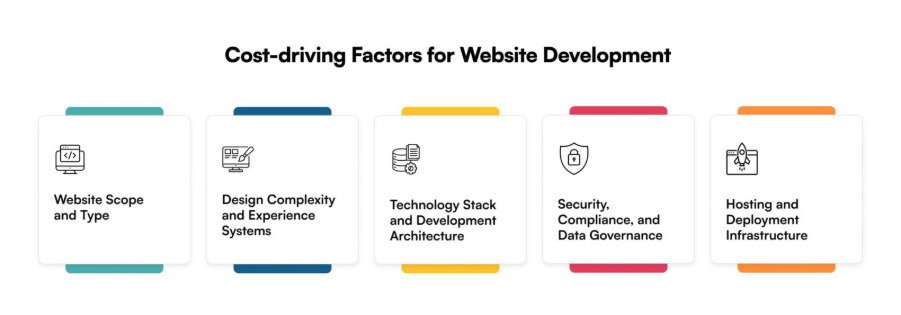
Once you start estimating your website development cost, you will realize that numbers vary not just by company but by what is happening behind the build. Two websites may look similar on the surface, yet one can cost twice as much because enterprise websites are not priced on visuals alone. They are priced on what powers them underneath. 

Below are the key factors that truly decide the average cost to develop a website, and why understanding them early helps you budget smarter. 

Website Scope and Type 

Your website’s scope defines its cost foundation. A basic business website serves as a digital brochure; a corporate site handles content workflows; a SaaS dashboard or eCommerce platform demands user authentication, analytics, and secure integrations. 

Every added layer—from an interactive dashboard to multi-region deployment—increases the website development cost, not arbitrarily but proportionally to the engineering required behind it. 

Think of it this way: you are not paying for “pages” but for architecture, reliability, and the ability to scale. 

That’s why at Galaxy Weblinks, we often help enterprises map this phase first. Once your purpose is clear, your cost becomes predictable. 

Design Complexity and Experience Systems 

Design does not just affect how your website looks but how it performs. An enterprise website must balance aesthetics with logic: how fast users can find what they need, how accessible it is across devices, and how consistently it performs under heavy traffic. 

This is where a strategic UI/UX design process changes the equation. Wireframes, interaction maps, and accessibility checks may add time to early development, but they cut rework and redesign costs drastically later. 

A design-first system is not an expense; it’s a cost-control strategy. 

Our design teams at Galaxy Weblinks treat UI/UX as the blueprint for performance, ensuring every visual decision supports the backend logic that follows. 

Technology Stack and Development Architecture 

The tools you choose define what your website can do and how far it can go. A React or Angular front-end can make your platform lightning-fast. A scalable software architecture built on microservices ensures future updates do not break your system. But these advantages come with initial setup and planning that directly affect your website development costs. 

Choosing the right tech stack early helps balance cost, performance, and maintainability. It’s a decision that defines your website’s lifespan, not just its launch. 

Security, Compliance, and Data Governance 

Enterprises handle data and data needs protection. That means SSL encryption, firewalls, identity management, and compliance with regulations like GDPR or HIPAA. These layers often go unnoticed during budgeting but significantly impact the average cost to develop a website. 

They are not optional but risk management investments that protect your brand, your users, and your revenue. 

Hosting and Deployment Infrastructure 

The last major cost driver is where your website lives and its infrastructure. A shared hosting plan may be fine for a startup, but enterprises demand resilience, uptime, and flexibility. That’s why most shift toward cloud hosting and DevOps systems like AWS or Azure. They allow continuous updates, backups, and performance monitoring across global regions. 

Web Development Cost Breakdown by Website Type 

Once you understand what drives your website development cost, the next question is inevitable—how much does it cost to develop a website like mine? 

The answer depends on what you are building. A marketing site for brand visibility is vastly different from a web platform designed to handle transactions, dashboards, or multi-level integrations. At the enterprise level, the difference lies not just in scale but in purpose. 

Here’s a practical overview of what different types of websites typically cost in 2025, based on their function, depth, and performance expectations: 

Type of Website Key Features Average Cost to Develop a Website (USD) Timeframe 
Basic business website Static pages, CMS integration, contact forms $5,000 – $10,000 3–5 weeks 
Custom corporate portal Multi-user dashboards, content workflows, analytics $15,000 – $30,000 6–8 weeks 
eCommerce platform Product listings, cart, payment gateway, security layers $25,000 – $60,000 8–12 weeks 
Enterprise-grade web app Microservices architecture, compliance, integrations $50,000+ 12–20 weeks 

These figures are not arbitrary. They represent structured estimates drawn from real-world enterprise builds where every functionality, integration, and compliance layer adds measurable time and technical effort. 

A basic business website offers an entry-level digital presence. It’s ideal for small brands needing visibility and credibility. But as soon as you introduce workflows, analytics, or real-time dashboards, the website creation cost grows because engineering complexity grows. 

When you move toward eCommerce or enterprise-grade systems, you are not just building a website—you are building infrastructure. Security audits, microservices, and integration testing add layers of precision and reliability that basic sites do not require. 

Whether you are planning a custom web app development or scaling an existing digital system, the scope defines your final website creation cost—not the size of your homepage. 

What truly determines long-term cost efficiency is the architecture you choose at the start. Cloud-native foundations, modular codebases, and a solid DevOps setup make scaling faster and cheaper later. 

Cost by Development Approach: In-house vs Outsourcing vs Agency 

Even after you have finalized the scope and features, one key decision still determines your overall website development cost—who will build it? This single choice can change your budget by tens of thousands of dollars — and more importantly, decide how stable, scalable, and maintainable your website will be in the long run. 

For enterprises, the three most common approaches are: hiring an in-house team, working with freelancers, or partnering with a professional agency. Each comes with a different mix of cost, control, and accountability. 

In-house Team 

An in-house team gives you full oversight—your developers, designers, and QA specialists are always available. But that control comes with significant fixed costs. You will need to manage salaries, tools, cloud environments, and ongoing maintenance—even when active development slows down. 

For large organizations with multiple ongoing projects, this investment may make sense. But for most enterprises that only need one or two major builds a year, maintaining an internal tech team often pushes the average cost to develop a website much higher than expected. 

Freelancers 

Freelancers appear to be the most affordable route, and for small-scale websites, they might be. But when the project expands beyond a few static pages, things get complicated. 

Managing multiple freelancers across design, backend, and testing can quickly turn into a coordination puzzle. Missed handoffs, inconsistent design systems, or unaligned timelines are common pain points. 

You might save money upfront, but lose time — and eventually, quality. 

Professional Agency 

A professional agency combines flexibility with structure. You do not just hire people — you hire a process. Agencies bring cross-functional teams that work in sync, use proven frameworks, and deliver measurable outcomes. 

Partnering with a digital transformation partner ensures technical precision, clear ownership, and faster time to market without the chaos of managing multiple vendors. 

At Galaxy Weblinks, this is exactly where we step in. We have helped enterprises build and revamp complex web ecosystems, managing end-to-end delivery through structured sprints, clear documentation, and scalable systems that grow with your business. 

Ultimately, the right choice depends on your priorities. If you value full-time availability, in-house may suit you. If you want flexibility, freelancers can work for smaller projects. But if your goal is long-term reliability, performance, and ROI, working with a dedicated agency delivers the strongest balance between cost and continuity. 

Additional Factors That Add to Website Development Cost 

Even after budgeting for design, development, and hosting, most enterprises still find their website development cost shifting once the project begins. Not because of hidden fees — but because of the hidden layers of what makes a website secure, scalable, and future-ready. 

These are the quiet contributors to cost—the things not always discussed during proposal calls, yet the ones that make the difference between a website that merely works and one that performs effortlessly at scale. 

Hosting & Domain Infrastructure 

Your hosting environment is where your website lives, and it directly impacts speed, uptime, and reliability. A shared hosting setup may save money at launch, but it often struggles when user traffic spikes or security standards evolve. 

Enterprises usually move toward multi-cloud or dedicated infrastructure early, as it supports global availability and faster disaster recovery. Yes, it increases initial website development costs, but it also ensures stability that prevents expensive downtime later. 

The short-term expense of reliable hosting often saves tenfold in operational and reputational costs over time. 

Security Certificates & Compliance Layers 

Implementing SSL, firewalls, authentication protocols, and meeting compliance frameworks like GDPR or HIPAA are not optional anymore. They are essential to safeguarding customer data and protecting your brand’s credibility. 

Each layer adds minor increments to your average cost to develop a website, but collectively, they create resilience. And resilience is priceless when your business operates across regions or industries that demand airtight data handling. 

Integrations with AI-Driven Systems 

Modern enterprises do not stop at static websites. They integrate automation, personalization, and analytics to improve user engagement and efficiency. That’s where AI in web development plays a pivotal role. 

As AI in web development becomes mainstream, integrations such as chatbots, predictive personalization, and adaptive analytics directly influence your website development cost but also redefine your ROI. 

From conversational assistants to product recommendation engines, these AI layers transform your website into a self-learning digital ecosystem that grows smarter with time. 

Content Updates & Scalability Upgrades 

A website is never truly “done.” It’s a living system that needs updates, fresh content, new integrations, and ongoing optimization. 

A robust scalable software architecture makes these updates easier, faster, and cheaper in the long run. Without it, even minor upgrades can become expensive and disruptive. Similarly, a thoughtful performance optimization strategy ensures your site loads quickly, retains users, and supports global access—all of which influence both cost and conversion outcomes. 

While a scalable foundation might slightly increase upfront costs, it dramatically lowers the lifetime maintenance spend. 

How Galaxy Weblinks Simplifies Your Website Development Process 

When enterprises invest in a new website, two questions often surface before anything else: How much will it cost, and how soon can it go live? 
Both are fair questions — and both are notoriously difficult to answer when development happens in silos. Delays pile up, communication breaks, and what starts as a fixed website creation cost soon becomes a moving target. 

At Galaxy Weblinks, we have solved that problem by reengineering the process itself. We combine design intelligence, automation, and human expertise to make every stage —from planning to deployment — faster, more predictable, and more cost-efficient. 

Design-First Execution, End-to-End Accountability 

What makes our process different is that design never takes a back seat. We do not start with code but with intent. Every interaction, layout, and system logic is purpose-built to support your business goals. 

A Partnership Built on Clarity 

We do not overpromise; we show exactly what’s achievable within your timeline and budget. Whether you are building from scratch or modernizing legacy infrastructure, our web development services are designed to give you transparency. 

Curious about your exact website development cost? Explore our web development services to get a clear, enterprise-ready estimate. 

At Galaxy Weblinks, we don’t just develop — we help enterprises build digital systems that last. 

Final Takeaway 

In the end, your website development cost is defined by the decisions behind it. Every factor, from your design complexity and development architecture to hosting, compliance, and integrations shapes how much you’ll invest and what value you’ll receive in return. 

On average, here’s what you can expect as the final website cost: 

  • Basic business website: $5,000–$10,000 
  • Corporate or mid-level website: $15,000–$30,000 
  • eCommerce platform: $25,000–$60,000 
  • Enterprise-grade web system: $60,000–$150,000+ 

But here’s the part most decision-makers overlook: spending wisely on design and architecture early can save you exponentially more in maintenance and upgrades later. A smart, scalable foundation reduces friction, improves performance, and makes future innovations seamless. 

Flutter vs React Native: Which One is Better in 2025?  

When it comes to cross-platform app development, Flutter and React Native are the two frameworks dominating the game. Thanks to these frameworks, you can develop robust mobile apps that run on both Android and iOS devices. Besides, they are also used to develop desktop apps for Windows, Linux, and Mac OS as well as web-based applications.  

Cross-platform app development frameworks like React Native and Flutter offer many advantages, such as cost-effective development, faster-to-market, single codebase, easy maintenance, and more. Therefore, these frameworks are quite popular for developing apps for mobiles, desktops, and the web.  

Indeed, Statista’s report states that Flutter and React Native are among the top frameworks for developing mobile apps. While both these frameworks fall in the category of cross-platform frameworks, they differ in terms of their design, architecture, and technology. So, when it comes to developing apps, a dilemma about Flutter vs React Native arises.  

While both these frameworks are great, understanding which one suits your mobile app development project is crucial to developing a top-notch app. This comprehensive blog on which one is better in React Native vs Flutter in 2025 provides essential information that will clear your confusion. So, let’s see which framework is best for cross-platform apps in 2025. 

info

A Quick Overview of Flutter vs React Native Differences 

The primary difference between Flutter and React Native is the programming language they use. While Flutter uses Dart, React Native leverages the JavaScript programming language to create apps. The following table provides a detailed comparison of these two popular cross-platform frameworks.  

Basis  React Native  Flutter 
Primary Language  JavaScript (with TypeScript)  Dart 
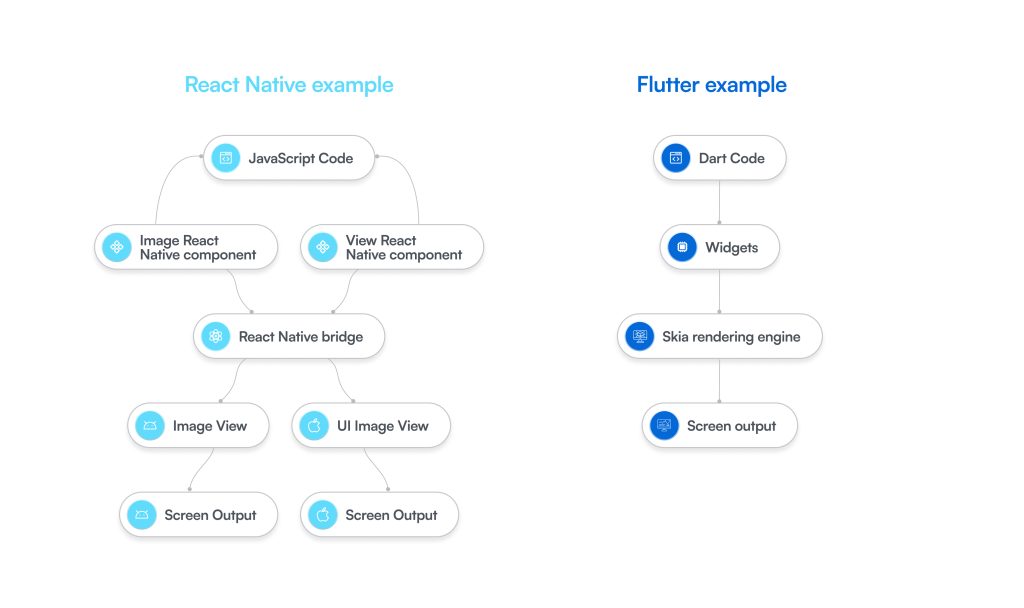
Architecture  It uses Fabric Render for UI rendering and TurboModules to create native modules that were previously handled by the JavaScript bridge. JavaScript code is converted to native components for Android and iOS devices.   Flutter has its own rendering engine, known as Skia, that draws UI from scratch. It offers a widget-based system for creating and rendering components.  
Performance  React Native offers near-native performance for apps. But sometimes minor issues may arise if you use the JavaScript bridge, but with the new rendering methods can address this problem well.   It usually delivers more consistent and superior performance, especially in the case of UIs or animations, due to the Flutter AOT compilation.  
UI/UX  By default, React Native offers a more native look and feel because it converts code to native components of iOS or Android. But it also requires extra effort to ensure a consistent user experience.  Flutter offers high UI consistency across different devices. It offers built-in customizable widgets (Cupertino for iOS and Material for Android) to create appealing and consistent UIs. 
Learning Curve  Moderate learning curve if your team is already proficient in JavaScript and React.   Steeper because your team has to learn Dart, which is a language similar to Java or C#. 
Ecosystem  React Native is a vast and mature cross-platform development framework with a large number of third-party libraries.  The Flutter framework is relatively new, but it’s growing rapidly. There are several official packages available for development and maintenance by Google.  
Tooling  Good tooling like Expo for quick prototyping and Fast Refresh for quick iterations.  Excellent tooling like Hot Reload for rapid iterations and Flutter Doctor command utility for diagnosing Flutter development environment on a PC.  

Understanding Flutter and React Native in Detail 

React Native is an open-source component-based cross-platform framework that was created by Facebook (now Meta). Facebook React Native was released in 2015 and has 124k stars on GitHub. It uses JavaScript to develop applications and creates a single codebase to build apps that run across multiple OS.   

Real-world examples of React Native apps include Facebook, Skype, Uber Eats, Microsoft Teams, Discord, Instagram, and Tableau. The following table shows the advantages and disadvantages of React Native development.  

Advantages  Disadvantages 
It is based on the write once and run anywhere philosophy. It means a single codebase is used to develop apps that run both on Android and iOS.  Native module dependence requires developers to write native code in Java/Kotlin for Android and Swift/Objective-C for iOS for certain features or libraries. So, separate codebases might have to be maintained in such cases. 
The hot reload feature known as “Fast Refresh” speeds up iteration cycles in app development as it instantly reflects code changes.   When using the JavaScript bridge, there are performance overheads due to communication between JavaScript and native layers in the case of complex UIs or heavy computations.  
There are a lot of options for libraries and third-party integrations due to the vast JavaScript ecosystem.  There is an inconsistent and fragmented set of tools and libraries that React Native depends on that could make app development challenging.  
Developers are easily available for React Native development due to its dependence on web-based technologies. It is also easy to find support for troubleshooting.    React Native offers a real native feel, but it’s not truly native.  
Code reuse and component-based coding ensure compact structure and easy maintenance.   It can be difficult to debug apps if issues arise beyond JavaScript, React, and native layers. 

Flutter is also an open-source cross-platform framework for developing mobile apps. It is often referred to as a UI framework. You can use Flutter to build stunning mobile apps, web apps, desktop apps, and embedded experiences. It was developed by Google and is now maintained by it.  

Google Flutter is also among the most popular frameworks for developing apps for a wide range of platforms, and it has over 173k stars on GitHub. With a single codebase, you can deploy your app on multiple platforms and offer an excellent user experience.  

Real-world examples of Flutter apps include Google, Alibaba, BMW, eBay, Google Pay, Google Earth, and Capital One. The following table shows the advantages and disadvantages of Flutter.  

Advantages   Disadvantages 
Flutter excels in terms of performance and efficient UI rendering due to its own rendering engine Skia, and compilation of components to native code. It offers a smoother UI.   Due to a larger bundle size, Flutter apps APK or IPA) are larger in size compared to native or React Native apps.  
It is a flexible framework that works cohesively with its widget-based structure. All components, or the full UI, are created with the use of customizable widgets that simplify development.  This framework is based on the Dart language, which has a limited talent pool compared to other popular languages like JavaScript.  
The hot reload feature helps inject code changes in a running app that reflect instantly, offering faster development and iteration cycles.   It is still in the growing stage and is a new framework with a smaller ecosystem of third-party libraries and packages.  
Flutter is backed by Google, which gets constant support, maintenance, and updates. It has good documentation for troubleshooting issues.   Custom rendering ensures that the UI looks consistent, but it may not perfectly match the native UI subtly.  
Truly support different types of platforms, including mobile, desktop, and the web.   Though Flutter and Dart have strong tooling, but support for them is less ubiquitous across various IDEs and code editors. 

Flutter vs React Native: A Head-to-Head Comparison in Detail 

React Native and Flutter are two robust frameworks for cross-platform app development. Although there are several commonalities between these two frameworks, they also stand out from each other in many aspects. Let’s check out a detailed comparison of these cross-platform frameworks to know how they differ from each other.  

Popularity 

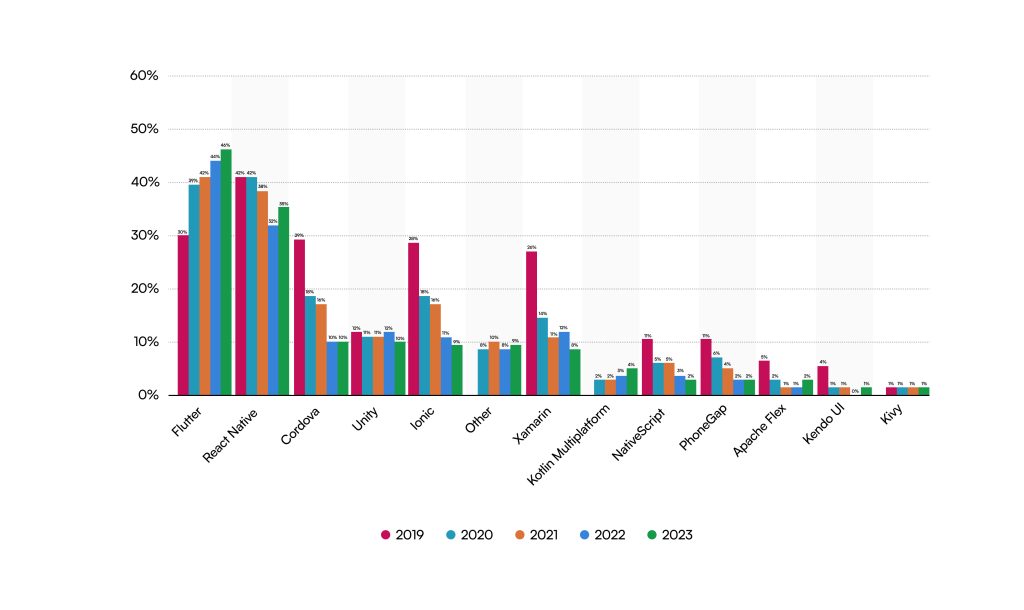
Both frameworks do well in terms of popularity, as they are among the top technologies to build mobile apps, as shown in the image below.  

Flutter

The above image shows the top cross-platform mobile frameworks used by developers from 2019-2023, presented by Statista. Flutter has consistently increased in position, reaching the top of this chart, and React Native follows it.  

Although React Native is a well-established framework compared to Flutter, because it was launched earlier, the latter has gained a significant edge over the years. Since JavaScript is a popular programming language and fundamental to web development projects, many developers desire to work on it due to the shorter learning cycle.  

Performance 

Performance is another crucial factor to consider for the React Native vs Flutter dilemma. When comparing these two frameworks from a performance point of view, Flutter usually holds a distinct advantage because of its architecture. Since Flutter depends on its own render engine Skia, it draws every widget from scratch on a native canvas, thus offering smoother and more consistent UI. 

On the other hand, React Native uses a bridge to convert JavaScript code to native UI components for Android and iOS. In this case, UI can lag in case of heavy animations or updates. So, based on their approach to rendering, the performance of these frameworks varies, and Flutter could be better in some cases.  

Community Support 

When perusing cross-platform development, community support plays a vital role in overcoming challenges and ensuring a successful project. React Native, being a mature framework compared to Flutter, offers a more vibrant community support. Besides, the JavaScript foundation is another reason for extensive support.  

Flutter is constantly growing, and there is also sufficient community support for this framework. Besides, it is actively maintained by Google, and there is a robust community that helps to resolve various issues and difficulties in app development projects.  

External Dependence 

Flutter is usually touted as a “batteries included” cross-platform framework, which means it offers plenty of built-in widgets and libraries that are enough to build consistent UIs for iOS and Android. It can work without even depending much on third-party libraries.  

On the other hand, React Native is highly dependent on third-party libraries for creating mobile apps. Developers have to repeatedly refer to third-party libraries when it comes to developing apps. Therefore, Flutter makes development speedier and smoother compared to React Native. 

What is the Right Choice: React Native or Flutter? 

Now that you have plenty of information about React Native and Flutter, it’s time to ponder the question: which one is better? However, there isn’t a straightforward answer to this question because both frameworks are best for developing mobile apps with excellent features and benefits.  

Moreover, which one is better depends on many factors, such as project requirements and business goals. There are many cases when Flutter app development is the best option, and there are many cases when React Native app development is the right choice.     

Choose React Native when: 

  • Looking to scale your app with cross-platform functionality. 
  • To build apps with low memory consumption, especially on Android. 
  • Looking to build lightweight and feature-rich native apps. 
  • Your app depends on native features such as GPS, Camera, Bluetooth, etc. React Native offers robust integration with native APIs. 

Choose Flutter when: 

  • Looking to build apps with pixel-perfect UIs and customizable designs. 
  • Your app doesn’t require much native functionality. 
  • Need to build and publish your app faster. 
  • Want an app with a single codebase supported on the web and desktops with a uniform user interface.  
  • Your app has heavy graphics and complex UI that must be handled with high performance. Flutter’s own rendering engine can handle this well. 

Galaxy Weblinks Can Help You with React Native vs Flutter Dilemma 

Developing the right mobile app is crucial to building your space in crowded marketplaces. Just like a unique idea is important to build an app that stands out, the underlying tech stack you choose plays an equally important role. Choosing between Flutter and React Native can be confusing.  

Galaxy Weblinks can help you build a robust mobile app for your business by picking the best framework between Flutter and React Native that best aligns with your requirements and goals. Our team cautiously listens to your requirements, identifies your challenges, and recommends the best option based on scalability, performance, and time-to-market. 

We help you build the right mobile app by leveraging Flutter and React Native. Our expertise in these frameworks enables us to develop top-notch apps that align with your expectations. We implement top security features, craft seamless UI/UX, and make sure your app adheres to industry standards and compliance.  

Contact us to discuss your project and let us make your dream come true with a winning mobile application.  

Top Web Development Trends in 2025 

Web development is a constantly evolving field, and changing user behavior is the driving force behind it. How users interact with websites and web applications today differs from how they used to interact a few years ago.  

Indeed, there was a time when websites looked like a directory of information with little or no user interactions, and today’s websites are more dynamic, interactive, and feel much like a desktop or mobile application.  

Thanks to different web development trends, over the years, user experience has significantly improved. As every year there are changes in user behavior, new trends in web development emerge – AI chatbots and voice search for example.  

If you are considering developing a website or web application, understanding the latest web development trends in 2025 is essential to develop a state-of-the-art solution to stay competitive. By implementing the latest trends in web development, you can create the best user experience.  

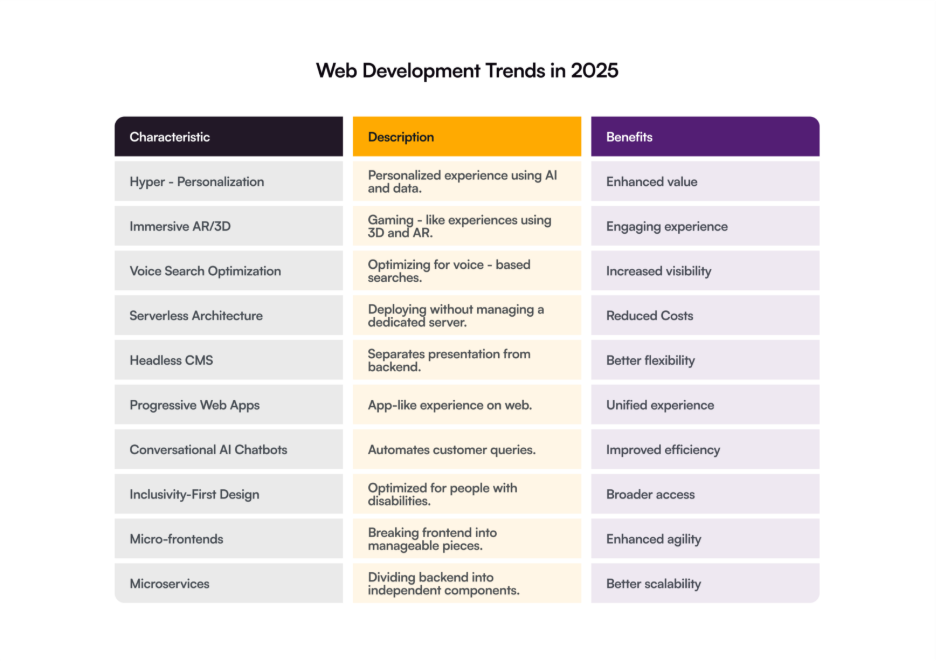
Hyper-Personalization  

A major shift in user behavior today is their expectation for a personalized experience. Imagine when a user logs in to your website, they find recommendations for products, articles, news content, or anything else that it has to offer. This is the practical use of hyper-personalization.  

Such functionality improves user experience and reduces user churn by offering enhanced value. Hyper-personalization uses AI and data to offer personalized services and product recommendations by analyzing users’ search/purchase history, physical location, and other factors. 

Today’s customers expect brands to know them and understand what they need. Brands that value personalization are 71% more likely to earn loyal customers compared to only 48% of the possibility for brands that don’t offer personalization, as per Deloitte research.  

Businesses are widely using the hyper-personalization web development trend, and you can also use it with the following features.  

  • AI-driven dynamic content delivery is a data-driven content delivery strategy for websites and web apps to offer personalized experience.  
  • Personalization offers content that resonates with users, making them more likely to engage with content.  
  • Your business can gather data from CRMs, websites, feedback, and other sources to offer personalization. 

Immersive AR and 3D Experiences 

Gaming-like experiences are quite popular among younger generations. Many businesses have recognized it and adapted UIs for their websites and web apps to attract such users. Therefore, websites and web apps with rich 3D and AR experiences have emerged among the top web development trends in 2025.  

The use of APIs like WebGPU enables web developers to create immersive web experiences with 3D worlds, parallel computing, high-performance graphics, and advanced features. You can develop more interactive and realistic web experiences by leveraging AR/VR technologies.  

Apart from creating gaming-like experiences, AR/VR has many other excellent uses for websites and web apps. For example, IKEA Place is a good example of how VR works in which customers use their smartphones to visualize virtual furniture and place them in different places in their house to see where it fits the best.      

Similarly, virtual try-ons help customers virtually try clothes to see how they fit and look. These features on websites and web apps help users make decisions. 3D elements and graphics in UIs create an engaging experience that not only attracts users but also encourages them to take specific actions.   

Voice Search Optimization 

Although it’s not a new trend, voice search optimization remains one of the top trends in web development in 2025. The increasing popularity of virtual assistants like Google Assistant, Siri, and Alexa have accelerated this trend. Users are leveraging voice assistants and smart speakers not only for listening to music and searching for information; they also leverage them for shopping.  

With voice-based commands, virtual assistants can help users conveniently search for information and order food, book movie tickets, or purchase a product. So, optimizing voice search has become crucial to ensure that your website is visible in these searches. Voice recognition and artificial intelligence are the key technologies behind voice search functionality.  

Serverless Architecture 

Serverless architecture is one of the top web development trends becoming popular to build efficient and high-performance web solutions. It is a revolutionary technology in web development that enables you to deploy your website or web application and its functions without managing a dedicated server. You can use the cloud to deploy, manage, and scale your website or web app. 

There are many advantages to using this model like faster time-to-market, reduced operational costs, and automatic scaling because resources are dynamically allocated. The cloud resources can be scaled up easily on demand to handle increased traffic for your website and web app. 

With serverless architecture, you can focus on developing a robust website or web app without being concerned about the deployment environment. This allows you to create a customizable frontend of your website or web app while using a plug-and-play backend.  

Headless CMS 

Managing content on your website or web app can be challenging without a CMS (Content Management System) that provides a single interface for managing all content. There are many top CMS platforms like WordPress, Drupal, Joomla, etc.  

Moreover, the use of headless CMS is one of the key trends in web development today that offers a more flexible way to manage content. A headless CMS separates the presentation layer from the backend layer. APIs play a vital role in connecting the backend to the frontend. So, the data is managed via APIs by fetching data from backend to presenting it on the frontend.  

There are several headless CMS like Strapi, Contentful, and Umbraco that separates the content repository from the presentation layer and allows managing content through APIs. Headless CMSs offer better flexibility and customization in presentations over traditional CMS. Besides, you can freely decide which framework or technology to choose for frontend. 

Progressive Web Apps 

Among the different web development trends is PWA that has taken web experience to a whole new level. A progressive web app (PWA) is downloadable and can be installed on a mobile or desktop. It offers an app-like experience with offline functionality. Companies like Pinterest, Instagram, Starbucks, and Uber have already launched their PWAs.  

The use of PWAs is a popular web development trend that will continue in 2025 and beyond. You can increase user engagement, attract more audiences, and increase revenue by investing in PWA development.    

Progressive web apps offer many app-like features like push notifications, installation, and offline accessibility. These applications ensure a unified experience across different platforms like desktops and mobile devices.  

Conversation AI Chatbots 

Customer support is often hectic, time consuming, and slow. The introduction of conversational AI bots has revolutionized this field. Conversational AI bots transform overall customer experience by improving operational efficiency, enhancing user engagement, and offering personalized experience. 

With the advancements in natural language processing and machine learning, AI bots are now widespread, and companies use them to streamline their customer support services. With the use of these bots, your business can automate customer queries and minimize time while improving overall user experience.  

These bots offer many advantages for your business, from interactively handling customer queries to providing help to fix their issues instantly. Conversational AI bots transform the way users interact and fix their issues.  

Inclusivity-first Design 

Inclusivity-first design focuses on developing web solutions that are optimized for over 1 billion people living with disabilities worldwide. It focuses on creating an accessibility-first and inclusive web solution that allows a broader spectrum of people to use it without a hitch.  

This is a vital web development trend and requires you to build solutions that comply with WCAG (Web Content Accessibility Guidelines). These guidelines provide necessary recommendations for creating interactive and inclusive web solutions.  

Micro-frontends 

Micro-frontend is another popular web development trend today that helps create flexible and scalable architectures for web apps and websites. It involves breaking a monolithic frontend application into manageable pieces. Each piece in such a front-end application is an independent and self-contained module.  

Each of these micro-frontends are created, tested, and deployed independently that enhances agility, scalability, and maintainability. These modules create a cohesive and unified interface providing a smooth user experience.  

Each of the modules in micro-frontends can be managed by separate teams that reduce complexity. It is a suitable architecture for larger applications that require multiple teams to manage it. Netflix is an ideal example of such applications that leverage micro-frontends. 

Microservices 

Microservices are akin to micro-frontends but define the architecture for the backend of an application. In this case, an application is divided into smaller components called microservices that are independent from each other and can be developed, tested, and deployed individually.  

Microservices have emerged as a prominent web development trend in 2025 and have been adopted by many companies like Amazon, Spotify, Netflix, and PayPal. The key advantages of microservices include flexibility, scalability, security, and easy maintenance.  

Just like micro-frontends, microservices can be managed by different teams, and they are self-contained deployed or managed without affecting other microservices. These microservices work cohesively to make a web application functional.  

To Wrap Up 

Web development has been evolving rapidly over the years, and there are many new innovations that are shaping the future of this domain. If you want to develop a website or web application, knowing and implementing these trends is crucial to developing a top-notch solution. 

As 2025 unfolds, trends like AI-driven personalization, progressive web apps, voice search optimization, and headless development are setting new benchmarks for user experience and performance. Staying ahead means more than just keeping up — it’s about embracing change with a future-focused mindset.  

Whether you’re starting fresh or upgrading an existing platform, adopting these cutting-edge web development trends will help your business stay relevant, competitive, and ready for the next digital leap.   

At Galaxy Weblinks, we leverage these top trends to help businesses create cutting-edge websites and web applications. We are a well-established web development company with 25+ years of experience in the domain.  

Contact us to discuss your project and help you develop a robust website or web application.   

Essential Things You Must Consider During Web Application Development 

Today, web apps are an indispensable part of our daily routines. From using Gmail to send emails, Facebook for social communication, Evernote for organizing ideas, to Trello for team collaboration, there are plenty of web apps that have received a special place in our lives.    

Their accessibility, ease of use, and significance in solving real-world problems make them vital to us. From a business perspective, they help build a loyal user base, generate steady revenues, and help scale globally. Owing to these benefits, many businesses are gravitating to invest in web application development.  

However, not every web app development project reaches the success milestone; many of them become a disaster. The reasons for the failure of most software projects vary, and you need to analyze them before making an investment to ensure success.  

Whether you are a business owner or a developer, this blog guides you in creating a foolproof web app by introducing you to the essential things you must consider during web app development. It will ensure your project goes in the right direction, and you build the perfect web app instead of ending up in vain.   

What Makes Web Application Development Attractive? 

Web apps are software applications that are accessed via web browsers or can be installed on a device, like in the case of a progressive web application. It is a client-side program built on front-end technologies like HTML, CSS, and JavaScript, or using frameworks like ReactJS, Angular, VueJS, etc. 

The key benefits of accessibility, scalability, and usability make web apps attractive to both users and businesses. They can be easily accessed regardless of the target device. Their ability to handle increasing user traffic without major changes makes them highly scalable.  

User adoption is great for web apps due to their intuitive user interface. Besides, they are ready for third-party integrations, enabling you to extend the functionality of your app without refactoring or re-coding it.  

So, web applications have become a hotcake for investments. Businesses in different industries like healthcare, ecommerce, education, finance, etc, are investing in these apps. A major reason is that they are more cost-effective than native applications.  

If we look at the data regarding web application development, you will understand why it is creating hype among businesses. Statista’s report shows that the projected revenue in the web application market is USD 295.77 billion by the end of 2025.  

Important Considerations While Developing a Web Application 

Web apps are useful for businesses and open new opportunities. But developing them the wrong way can result in losses instead of revenues. The following are the key considerations for developing a robust web application. 

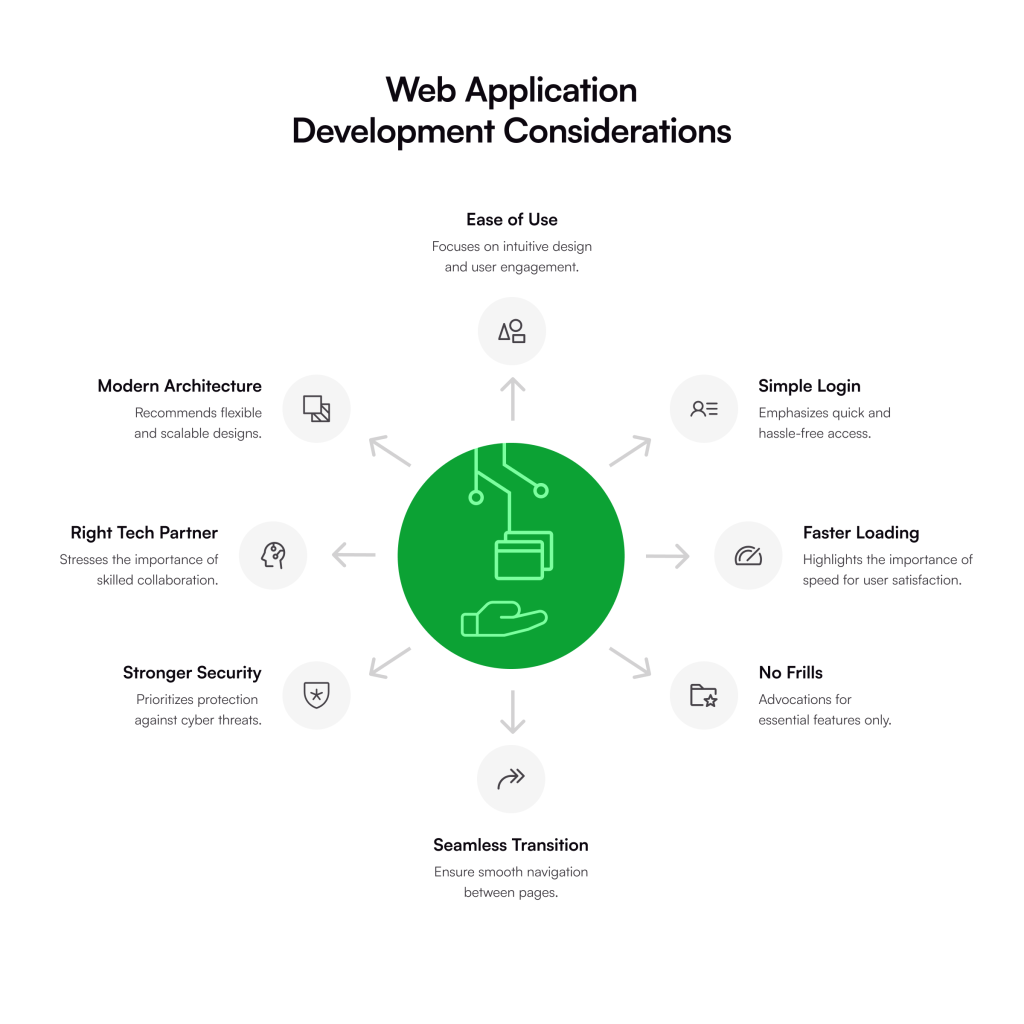
Ease of Use 

Needless to say, a good user interface will not only attract users but also increase engagement. While users today crave next-gen functionalities and innovative designs, the simple UI keeps them engaged with seamless interactions.  

Usability matters most to every user, while they expect up-to-date features. Web apps with complicated navigation, features, and excessive options that confuse users fail to win users’ hearts. Poor user experience will lead users to leave negative feedback about the app, resulting in decreased adoption and engagement. 

Simple and Short Login Screen 

Another mistake often made during custom web application development is creating a login screen with excessive options. Such practices not only annoy users, but your login screen also feels exhaustive with so many options.  

Avoid lengthy login and keep this screen simple and concise for a faster registration or login process. In most cases, when it comes to web application development services, this point becomes the main concern. Lengthy login screens will make users frustrated and prompt them to exit.  

Such a type of UI design of your web application will impact user retention. The best approach you can follow is to offer a login screen for only first-time users and use cookies or any other authentication mechanism for login. Also, you can add a login via social media.  

Faster-loading Speed 

With the improvement in internet speeds around the world and decreasing attention span for users, it’s essential for a web app development services provider to create web apps that load within seconds. Faster speed helps users perform their tasks quickly, increasing retention and engagement.  

On the other hand, users feel frustrated when your application takes longer to load. Higher app loading speed offers an impressive user experience as well as builds trust. You can relate this by recalling a time when you tried using a web app, but that took ages to load, and you felt frustrated.  

Say No to Frills 

You always want to deliver the best web application experience to your users and might decide to add extra features. But did you think these features would add value or just make the user interface more clunky? That will surely hurt your brand value if the extra features are useless or not required. 

The more elements you add to the same web app interface, the more cluttered and complex it feels. This only makes web application development expensive and complicated. So, a professional web application development services provider takes a smarter approach by identifying the users’ needs when it comes to adding more features.  

It starts with MVP development and then rolls out more features in phases after user feedback. With this approach, your web app will have the right features added to it after understanding the requirements of your user base, instead of integrating features based on intuition or ongoing trends.  

Seamless Transitioning 

How does the UI of your web app feel when a user jumps from one page to another? Well, a smooth transition from one interface to another creates a delightful user experience that ensures user engagement and retention. This is one of the key considerations during web application development.  

The smooth transition becomes even more important when your web application is accessed from multiple platforms. You need to optimize the app according to different screens for smoother navigation. 

Stronger Security 

Often, businesses take security for granted, and that’s when they fall prey to cyberattacks. Common security bugs and vulnerabilities creep in during the web development process that should be identified and fixed before deployment to avoid potential cyberattacks. Even the top web applications like Uber, Yahoo!, and Facebook have faced cyberattacks in the past.  

Web apps used across different industries are being targeted by attackers. For today’s businesses, security is imperative and must be considered at every level of the development process, from design to deployment, to build a very secure application. From encryption, access controls, and HTTPS, to firewalls, a responsible web app development company will take every measure to build a secure web application for your business.  

Choose the Right Tech Partner 

Now this might seem a trivial thing to consider for web application development. But this is one of the most important things indeed. Just like a bad chef will cook bad food, similarly, a wrong tech partner will deliver subpar solutions.  

So, carefully choose a web application development services partner to build a robust app for your business. Check their skills, experience, tech stack they use, and portfolios to choose the best company to build your web app. This will ensure that your project is in the right hands. 

Consider a Modern Architecture 

You can build a more flexible and scalable web application by choosing a modern architecture like serverless, microservices, monolithic, single-page application, or progressive web application. Depending on your requirements and user base, you can choose the architecture that fits best. 

Moreover, decoupled architecture is also becoming a popular choice, especially for ecommerce applications known as headless commerce. In this architecture, frontend and backend are separated, unlike a monolithic architecture in which both are intertwined.  

How Does Galaxy Weblinks Help in Web App Development?  

Businesses invest in web applications due to several benefits they provide and the new opportunities they generate. For different industries, web applications have become a vital tool to build loyal customers and earn steady revenues.  

Nevertheless, the real challenge comes when it comes to developing a web application that may become a failure if not created properly. This is when you can rely on Galaxy Weblinks for our real-world experience and years of expertise in creating top-notch web apps for diverse businesses. 

As a trusted web app development company, we don’t just help you build your app; we guide you through the process, from selecting the right tech stack to implementing functionalities that align with your goals. We combine features with a stunning UI/UX design to build an application that will be loved by users and give you an edge on competitors.  

Contact us and discuss your requirements now to help you turn your ideas into a functional reality. 

Frequently asked questions 

What are the best technologies to build web applications? 

There are many top technologies to build web applications, but the right tech stack for your business may be different from others, depending on your requirements, business goals, IT infrastructure, preferences, etc. Key frontend and backend techs for web app development include: 

Frontend 

  • HTML 
  • CSS 
  • JavaScript 
  • AngularJS 
  • ReactJS 
  • VueJS 
  • ASP.NET 

Backend 

  • NodeJS 
  • Laravel 
  • Django 
  • MySQL 
  • PostgreSQL 
  • Cassandra 
  • MongoDB 

What are the main types of web apps? 

There are different types of web applications as given below: 

  •  Dynamic web apps 
  • Static web apps 
  • Single page web apps 
  • PWAs 
  • Multi-page applications 
  • Web apps with CMS 
  • E-commerce web apps 
  • Portal web apps 

Are web apps and mobile apps the same? 

No, web apps and mobile apps are two different things. While a web app runs in a browser and is accessible via the internet from anywhere without installation, a mobile app is a native app that is installed on mobile devices and can be accessed even without the internet.  

How Much Does React Native App Development Cost in 2025?  

Apps are a great way to engage your audience and build a loyal customer base. But creating your dream app can cost you a leg and an arm if you aspire to build a native app. Indeed, it takes a lot of money and time to build native applications for platforms like Android and iOS.   

So, many businesses invest in cross-platform app development that helps them develop a mobile app with a single codebase that can run on both Android and iOS. It not only saves time but also minimizes the overall costs and effort in developing an application.  

While there are several frameworks and technologies to create cross-platform apps, React Native stands out with near-native performance, a strong ecosystem, a reusable codebase, pre-built components, and native modules.  

However, if you are considering developing a React Native app, one thing you would like to know is how much it costs to build one. In this blog, we are going to deep dive into this aspect, providing detailed information on how much it costs to build a React Native app and the factors affecting it.  

Meta Description: Wondering how much React Native app development costs in 2025? Explore pricing by complexity, features, and process steps to plan your mobile app budget. 

An Overview of React Native App Development Cost  

For a rough estimate, the cost of react native app development can range between $10,000 – $350,000. But the actual cost varies with the project requirements, app complexity, features, integrations, and several other factors.  

In fact, the cost can even cross the above range depending on the business requirements and customizations. A highly complex enterprise-grade React Native app is likely to cost more. Apart from this, the developer rates can also affect the cost.  

The following table shows the rough estimates for the React Native app cost based on the complexity level of the app.  

Complexity Level App Cost (Estimates in US$) 
Simple React Native App $10,000 – $30,000 
Medium React Native App $30,000 – $75,000 
Complex React Native App $75,000 – $350,000 

Key Factors Affecting the React Native App Development Cost 

Creating a React Native app requires careful planning, technical expertise, and a professional team. Besides, there are other factors like customization, features, team location, etc, that directly impact the cost of developing a React Native app. Let’s check out all these factors in detail to understand how and how much they impact the cost. 

App Complexity 

Needless to say, the more complex your app is, the more time and effort it will require to be built. App complexity isn’t just about complicated features or design; it includes several factors. Starting with app architecture and the backend. Monolithic application architectures can be complex, but they are not as complex as decoupled or microservices-based architectures that require you to work with diverse technologies and frameworks.  

Further, you may choose to build a custom backend that requires extensive planning and careful execution of the app development process. Therefore, this will increase the overall cost of React Native app development.  

Apart from this, another reason for complexity is advanced apps that involve integration of AR/VR, AI, IoT, and other custom functionalities such as payment and login. In-app purchases also make apps more complex, which increases the React Native app development cost. 

Apps can also leverage native device features such as Bluetooth, Barometers, GPS, etc, that make your app more complex and add more dollars to your mobile app development cost. Integration with legacy systems can add extra complexity in React Native app development.  

Based on this factor, React Native apps can be divided into simple, medium, and complex.  

The following table shows the estimated cost of different features.  

Features Estimated Cost 
API Integrations $5,000 – $6,000 
Push Notifications $1,500 – $3,500 
Social Media Integration $1,000 – $3,000 
GPS Tracking $10,000 – $25,000 
AI Chatbot Integration $15,000 – $35,000+ 
AR/VR $20,000 – $50,000+ 

Team Location and Size 

Another crucial factor that determines the React Native app development cost is the location and size of the team. Software development rates vary across the globe. For advanced economies, the rates are quite high, and they are considerably lower in growing economies.  

For example, a React app development company in the USA charges higher rates than a company in Asia or Europe. So, understanding the developer rates will help you determine the right app development cost for your project. Let’s check the table below for rates.  

Region Rates (Average) 
USA & Canada $100 – $150 
Europe $50 – $80 
Asia $20 – $40 
Australia $65 – $95 
South America $30 – $50 

As you can see in the table, development rates are different for various regions of the world, and they are the lowest in Asia. Therefore, Asia is among the hottest places to outsource app development projects. Developing a React Native app is about 5X cheaper in Asia than in the USA.  

Similarly, it is 2X cheaper to develop your app if your development team is located in Europe. So, your React Native app cost significantly varies depending on where you choose to build an app or where your development team is located.  

Team size also plays a crucial role in the cost of developing a React Native app. The larger the team size is, the higher the cost. A bigger team size depends on the project’s complexity and size.  

Breaking Down the React Native App Development Cost as Per the Development Process 

We can do a breakdown of the cost of React Native development based on different steps in the process. Since the development process involves multiple stages, the cost varies for these stages, such as design, coding, integration, and testing. Let’s check out how it varies. 

Meta Description: Wondering how much React Native app development costs in 2025? Explore pricing by complexity, features, and process steps to plan your mobile app budget. 

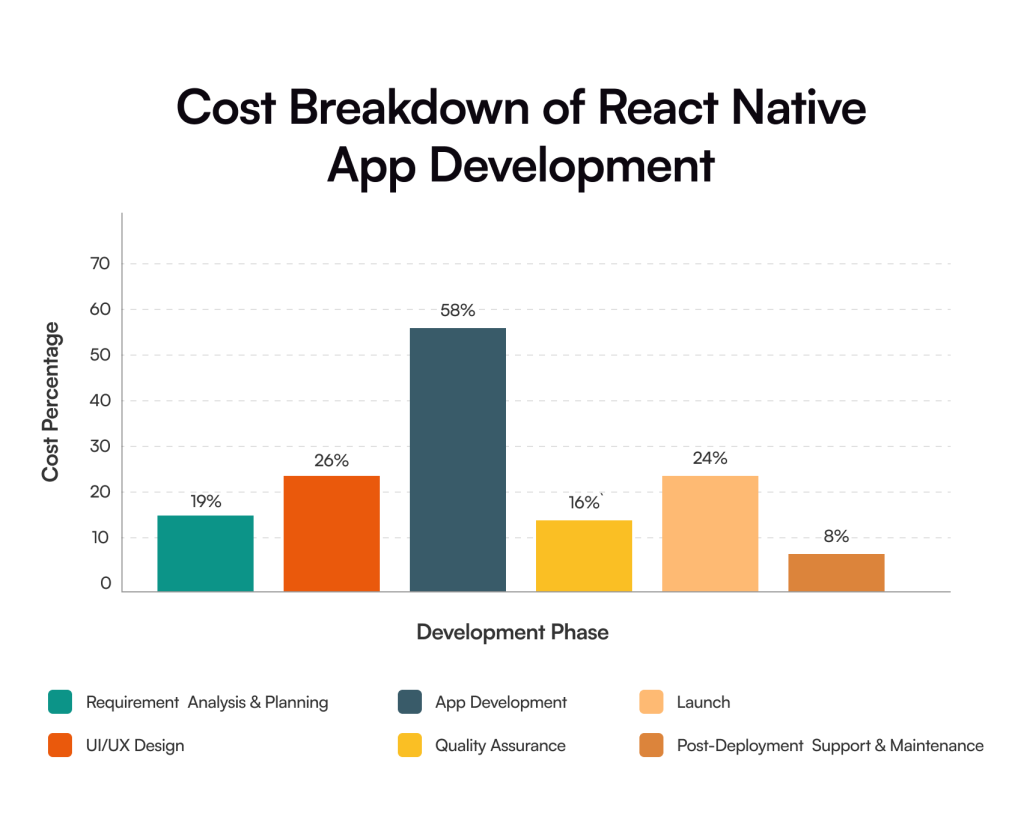
Requirement Analysis & Planning 

This is the initial phase of your React Native project where brainstorming, team discussions, and the research part take place. In this phase, your tech partner will analyze your business, gather requirements, and define the project scope. It sets the foundation for your React native development and can cost around 5-10% of the total project cost.  

UI/UX Design 

UI/UX design is where stunning visuals meet seamless interactions. This phase entails various tasks like wireframing and prototyping that help visualize the idea of how the app’s UI will look and how users will interact with it. This phase helps build a seamless and engaging user experience paired with a stunning layout, visuals, and elements. The cost of UI/UX design varies depending on an app’s complexity, and it typically ranges from $3,000 – $30,000. 

App Development 

This is the phase where wireframes and prototypes are turned into tangible app solutions. It involves coding the front-end and back-end development. So, there will be a cost for front-end and back-end. Apart from this, your React Native app needs third-party integrations like a payment gateway, authentication, APIs, etc. Hence, the React Native app cost depends on these factors. This phase takes most of the cost in the process, ranging from $15,000 – $100,000 or more as the app’s complexity and scale increase.  

Quality Assurance 

Quality assurance is the phase where your React Native app goes through a stringent testing process to check it for bugs, performance issues, security flaws, and more. This process ensures that your app functions seamlessly on different devices while protecting your data. 10-15% of the total React Native app cost goes into this process, which is usually $2,000 – $20,000.  

Launch 

After development, your app is published on Apple App Store and Google Play Store along with necessary configurations and compliance checks. However, costs are relatively lower in this phase compared to other phases. It is around $500 – $2,000 for every project. Publishing an app on different Google and Apple marketplaces also requires a certain fee.  

Post-Deployment Support & Maintenance 

The development and launch of a React Native app is not the end of the story. Support and maintenance take place after launching an app. This is an essential phase that helps you keep your app up-to-date, secure, and high-performance by eliminating hidden bugs, security loopholes, and updating it to the latest versions of frameworks and technologies. Maintenance is an ongoing process, and it costs around 15-20% of the overall development costs annually, usually in the range of $5,000 – $100,000.  

When is React Native App Development a Good Choice? 

Is React Native the best choice for your mobile app development project? Well, the answer depends on your requirements. React Native is indeed an excellent framework to develop high-end native applications for Android and iOS. It is a reliable framework backed by Meta (formerly Facebook) and powers hundreds of thousands of apps, including top brands like Facebook, Instagram, Microsoft Teams, Amazon Shopping, Shopify, Tesla, PlayStation, and more.  

React Native is the right choice for: 

  • Cross-platform app development: If you want to develop a single mobile app for both Android and iOS, React Native is the right choice. It helps build apps with a single codebase.  
  • MVPs & startups: If you want to test and validate your app idea with an MVP, React Native can be the right choice to do it.  
  • Apps with medium-level complexity: React Native is the best framework to build mobile apps with a medium complexity level. 
  • Frequent updates: React Native is suitable for apps that require regular updates or frequent iteration cycles.  
  • Time & budget constraints: You can choose React Native development for faster time-to-market and cost-efficient development.   

While there are diverse benefits of React Native app development, it is not without its limitations. There are some downsides too. Let’s check them out.  

React Native is not the most perfect app development framework when: 

  • High-performance apps: Apps like gaming, AR/VR, or those that require heavy graphics or 3D rendering.  
  • Apps dependent on native features: React Native isn’t the best choice for developing mobile apps that require access to low-level APIs such as NFC, advanced geolocation, Bluetooth, custom camera, etc. 
  • Extreme UI/UX needs: Mobile apps that require extreme UI/UX needs are also challenging to build with React Native. 
  • Apps with highly complex architecture: React Native isn’t the right choice for creating high-grade enterprise apps that have a very complex architecture. 
Meta Description: Wondering how much React Native app development costs in 2025? Explore pricing by complexity, features, and process steps to plan your mobile app budget. 

To Wrap Up 

Mobile apps are vital for modern businesses to ensure growth and brand engagement. However, when it comes to developing a mobile app, businesses find themselves at the crossroads of native vs cross-platform apps. In this dilemma, app development frameworks like React Native are useful, which help develop cross-platform apps, offering a native experience for each Android and iOS device. 

With this framework, you can create native apps for both Android and iOS using a single codebase. It helps develop mobile apps using a single programming language: JavaScript. Galaxy Weblinks helps you build robust React Native apps with its years of experience and an innovative development approach. Our React Native developers are proficient in this framework with proven experience in developing a wide range of apps for various industries.  

You can discuss your project with us, and we can provide an estimate for the cost of developing a React Native app, putting things into perspective. Contact us now to give us details of your project, so we can offer a precise cost estimate and build a top-notch mobile app.  

Frequently asked questions 

What other frameworks than React Native can be used to develop mobile apps? 

React Native is among the top cross-platform mobile app development frameworks. However, there are many other frameworks to build apps like Flutter, Ionic, SwiftUI, .NET MAUI, Xamarin, and more.  

Why should we choose React Native over other frameworks? 

Choosing React Native for app development offers many advantages: 

  • Cross-platform development that offers a low-cost option for developing Android and iOS apps. 
  • Faster development with a single codebase for both Android and iOS, and a single programming language ensures a quick time-to-market.  
  • App development with React Native requires a smaller team size, as a single codebase is created. 
  • Near-native experience with apps created with the React Native framework. 

Is React Native the best choice for mobile app development? 

The answer is both Yes and No, because it is only a matter of project requirements, business goals, type of business, etc. If you want to develop a fully native app for both Android and iOS separately, then this framework isn’t a feasible choice. Similarly, if you want to create a high-end graphics application, then React Native may not meet your expectations. However, it’s the best choice for MVPs, medium-complex apps, budget-constrained apps, and apps with heavy native dependency.  

AI in Healthcare: Transforming the Future of the Medical Field 

Imagine a world where AI in healthcare catches cancer before symptoms appear or crafts drugs tailored to your DNA. Today’s healthcare struggles with misdiagnoses, doctor shortages, and complex data, but AI-powered medical solutions are changing that.  

From sharper diagnostics to personalized treatments, AI streamlines workflows and boosts access. This guide dives into how AI transforms patient care, research, and delivery for healthcare professionals, tech leaders, and policymakers.  

We’ll explore the role of AI in healthcare, its benefits, and show why AI medical innovation matters now. So, let’s read it for detailed information.  

Understanding the Crucial Role of AI in Healthcare      

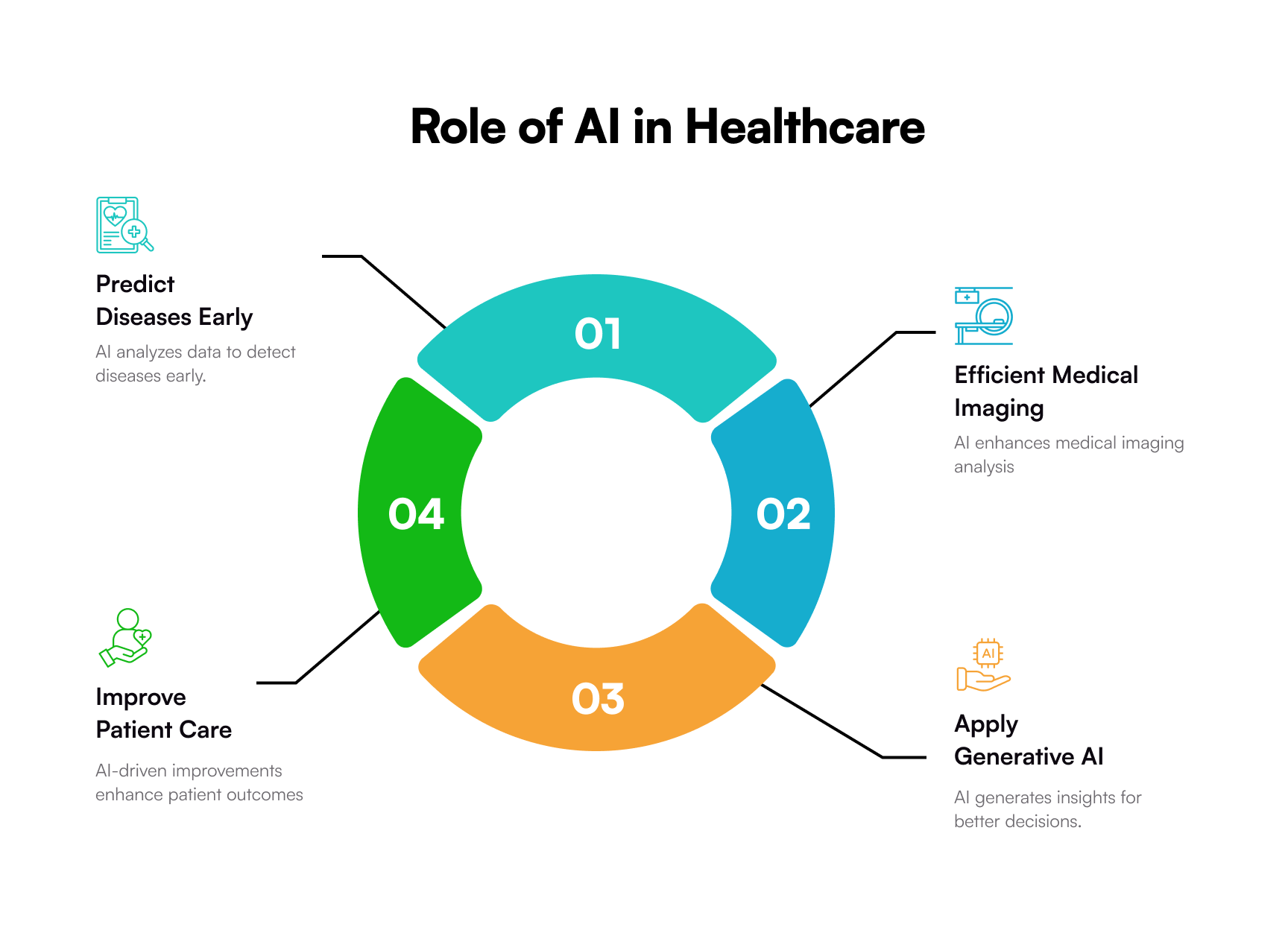
In healthcare, AI is not just an intelligent tool; it is a critical solution that can save lives, improve patient care, and streamline workflow. It has transformed the way healthcare specialists and hospitals tackle health challenges.  

From diagnosis to personalized treatment, AI shines in delivering the utmost value for patients while reducing the burden on hospital staff. It is rising like a shining star in healthcare, and if we look at statistics, the size of the global AI in healthcare market is projected to rise with a CAGR of 38.6% in the upcoming five years, as per the MarketsandMarkets report.   

The following points show how Artificial Intelligence is transforming the landscape for healthcare.  

Predicting Diseases Early 

Identifying and treating diseases early can help save lives by offering instant medical care for critically ill patients. This is known as predictive care that you can do with the use of advanced AI-enabled predictive analytics tools. These tools can analyze reports, imaging, and patient history to diagnose a disease, to help doctors treat patients before it’s too late. Early detection also ensures an effective treatment because for many critical diseases, the sooner it is identified, the better the treatment works.  

Efficient Medical Imaging Analysis 

Today, the use of medical devices is widespread in the healthcare sector. Now the use of AI/ML medical devices is expanding across this industry and helping healthcare providers to improve patient care with better and speedier diagnoses, treatments, and therapies. The integration of AI with medical imaging devices offers enhanced analysis of the data that helps track critical diseases early. 

Applications of Gen AI 

Generative AI in healthcare offers enormous benefits, including enhanced medical imaging, drug discovery and development, clinical documentation, synthetic data generation, and more. This enables healthcare providers to make better decisions.  

Improve Patient Care 

Better diagnosis, personalized treatment plans, and accurate imaging analysis ensure enhanced patient care. Besides, healthcare providers can quickly process documentation and minimize the time spent on it, which improves patients’ experience. This will speed up the process to deliver care in the least possible time.  

5 AI-powered Innovations Transforming Healthcare 

Today, healthcare providers are using diverse AI-powered solutions that help them make their processes more efficient and effective. Let’s learn about these innovations in detail.  

1. Chatbots or Virtual Health Assistants  

Now AI in telemedicine, chatbots, and virtual health assistants is transforming the way hospitals, clinics, and other healthcare centers cater to patients. These AI-powered platforms use Natural Language Processing (NLP) to interact with patients providing answers to their queries, educate them, engage patients, and offer scheduled alerts for medicines or hospital visitors. They can even diagnose symptoms and offer recommendations.  

2. Remote Patient Monitoring 

AI-driven RPM and telemedicine systems are now playing a central role in care delivery as they offer healthcare services in remote regions. Consequently, they now reach patients in areas where traditional healthcare met challenges. This made healthcare services more accessible and inclusive.  

3. Real-Time Data with IoT 

Healthcare providers or hospitals can leverage smart AI platforms and apps with IoT to gather health data like blood glucose, BP, heart rate, oxygen level, and more in real time to monitor patient health. This allows doctors to get data immediately and take prompt actions.  

4. mHealth Applications 

These applications are specifically designed for health services that seamlessly run on mobiles, tablets, and smartwatches. They are vital to remote health monitoring, disease prevention, patient-provider communication, and improving care. They help deliver personalized and efficient healthcare services.  

5. Medical Robotic 

More advanced use of AI in healthcare is medical robotics or hospital robots. They guide surgeons through intricate surgical procedures with great accuracy, resulting in reduced risk of complications and minimizes recovery time. These AI robots can dispense medicines, do cleaning work, and move equipment. 

What are the Benefits of AI in Healthcare?  

Artificial Intelligence isn’t just about integrating technology into your workflow; but it is more like improving the processes in healthcare that result in better patient care. There are many advantages of using AI in the healthcare industry, as discussed below.  

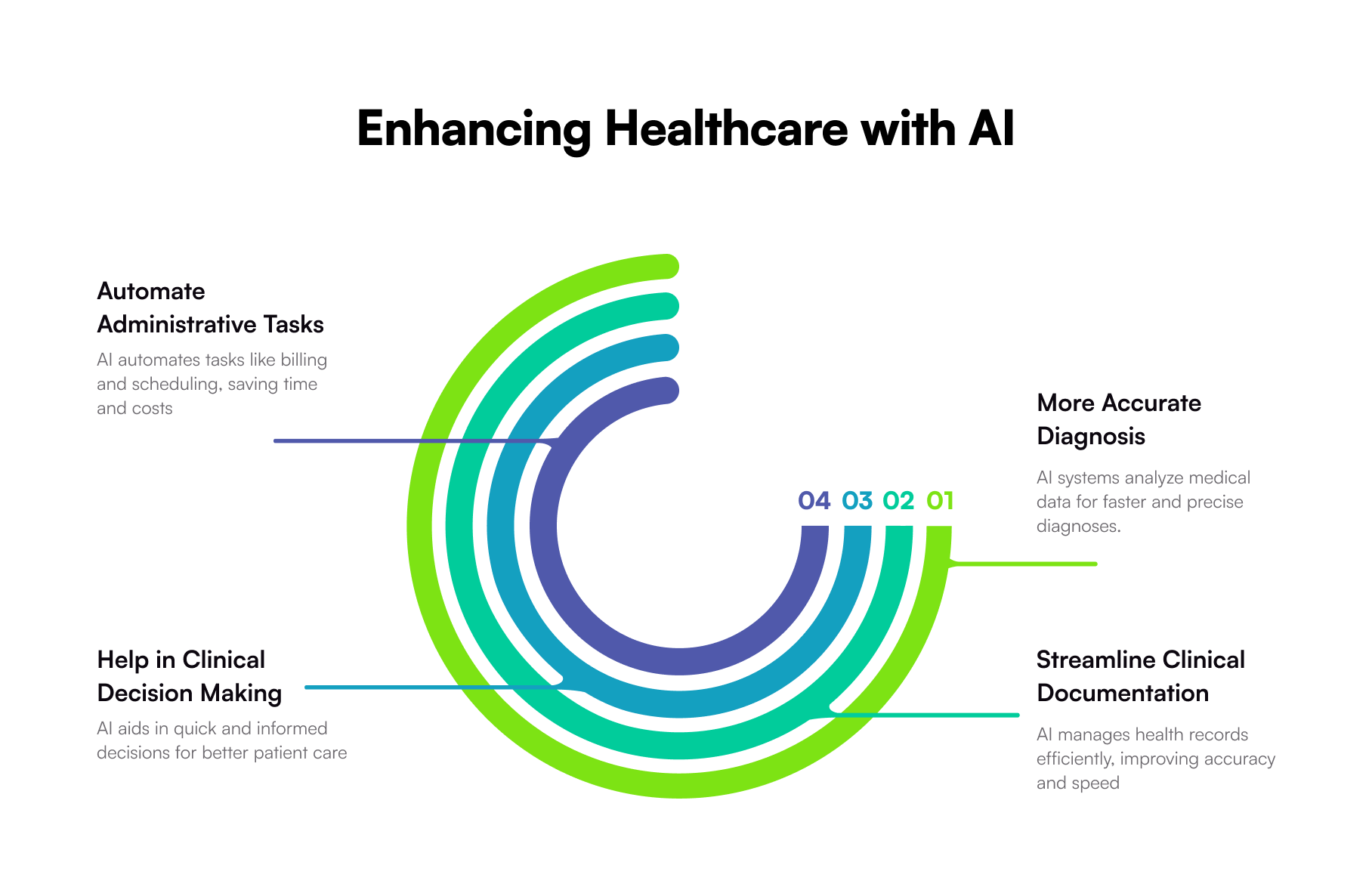
More Accurate Diagnosis Faster 

It looks like a dream if you can diagnose thousands of patients in merely a fraction of the time that a human specialist would take. This is only possible with the use of sophisticated AI systems that can efficiently analyze medical imaging data like X-rays, MRIs, CT scans, ultrasounds, etc.  

For example, an AI system is capable of identifying micro-fractures or early-stage cancers to help save the lives of patients. Such a system can offer more accurate and faster diagnosis by meticulously analyzing patient records, medical imaging, health history, and other information. It results in faster and better delivery of treatments. However, you need the best custom healthcare software development services to develop efficient AI-powered platforms that can speedily analyze imaging data and offer highly accurate diagnosis.  

Streamline Clinical Documentation 

The use of artificial intelligence in healthcare helps manage clinical documentation more efficiently. It improves accuracy, speed, and makes the process less burdensome. Healthcare specialists and hospitals create various health records of patients, including test reports, patient history, diagnoses, and more.  

Managing these documents manually is a herculean task that AI can help complete in a fraction of that time. Powered by NLP (Natural Language Processing) and speech recognition, AI platforms can make the process faster and convenient.  

For example, doctors can leverage voice-to-text transcription to dictate notes after or during a consultation. They can also be integrated with EHR (Electronic Health Record) systems to increase efficiency.  

Help in Clinical Decision Making 

Prompt decision-making is crucial for doctors and healthcare professionals when it comes to critical illnesses. The integration of artificial intelligence in their healthcare processes can enhance the outcome and reduce the turnaround time for reports, resulting in faster diagnosis and decision-making.  

So, AI in healthcare can help medical practitioners make faster decisions that improve overall patient care. AI solutions improve decision-making by helping healthcare providers deliver efficient, accurate, and personalized clinical care.  

Automate Administrative Tasks 

Artificial Intelligence can help reduce the burden on hospital staff and medical professionals by automating tasks. With the use of advanced AI solutions in the healthcare industry, medical practitioners can improve efficiency and save time by automating tasks like billing, scheduling, and updating records.  

By automating the repetitive administrative tasks with AI, healthcare providers can save time and cut down costs. It eliminates roadblocks in healthcare services by offering well-optimized operations.   

Different Types of AI Solutions in Healthcare 

When it comes to AI in the healthcare market, there are diverse benefits and use cases. There are different types of AI for healthcare that help medical practitioners improve efficiency and speed up their processes for better patient care.  

There are diverse solutions, ranging from AI applications in healthcare to conversational AI in healthcare.   

  • AI-powered Image Recognition Systems 
  • Predictive Analytics 
  • Virtual Assistants in Healthcare 
  • Robotic Process Automation (RPA) 
  • Natural Language Processing 
  • Clinical Decision Support Systems 
  • Internet of Things (IoT) 
  • Machine Learning 

To Wrap Up 

The future belongs to AI, and those who fail to adapt will become the past. This statement perfectly applies to almost all kinds of industries, including healthcare. The choice of AI development is going to transform the future of enterprises regardless of the industry type.  

Moreover, creating the right AI solution for healthcare requires technical knowledge and plenty of experience. We have highly proficient and experienced AI developers to help create complex enterprise-grade AI applications, systems, and multi-device platforms for your healthcare institution. 

You can contact us to discuss your project, and we will help you develop a top-notch solution for you that will offer a transformational shift in your processes and workflows.  

Frequently asked questions 

How is AI used in healthcare? 

There are multiple uses of AI in healthcare that range from diagnosing diseases to streamlining operations and in research. It automates processes and helps create faster, efficient, and more reliable patient care services.  

What is the cost of developing a healthcare application? 

It is not easy to define how much it costs to develop a healthcare app because there are many factors that impact the cost. So, it can vary significantly depending on the project requirements, app complexity, features, and other factors. It might cost between $20,000 – $50,000 if your app is basic with limited functionality. However, a more complex and advanced AI healthcare application costs between $100,000 – $300,000.  

Should we pick custom or off-the-shelf AI solutions for healthcare?  

It depends on your requirements. While off-the-shelf solutions are budget-friendly in the short run and can be integrated in the least possible time, they lack tailored features and benefits for healthcare providers. A custom AI solution is specifically created for a healthcare provider that offers unique features and benefits, as well as aligns with a healthcare provider’s needs.  

Integrating AI in Customer Journeys for Enhanced Interactions 

Discover how AI customer touchpoints, customer interaction AI, and AI engagement strategies are reshaping the modern customer journey.  

In a market where customer expectations pivot faster than product launches, the AI customer journey is no longer an experiment—it’s the engine driving modern brand growth. From predictive recommendations that anticipate intent to service channels that resolve issues before they become pain points, AI is orchestrating the entire customer experience in real time. 

Starbucks is already there. Through its AI platform Deep Brew, the company transforms everyday transactions into personalized journeys—predicting when you’ll crave your next order, surfacing tailored offers, and driving digital sales that now account for nearly half of total revenue.  

With the right type of AI-powered platform, applications are no longer just automates the process, but leverage intuition at scale.  

With integrating AI CX, the question isn’t whether AI belongs in the customer journey—it’s how creatively and intelligently you apply it. Every AI customer touchpoint becomes an opportunity for trust; every customer interaction with AI is a chance to extend loyalty.  

The brands pulling ahead aren’t waiting for the future of CX with AI. They’re building it, now. 

Mapping the Modern AI Customer Journey 

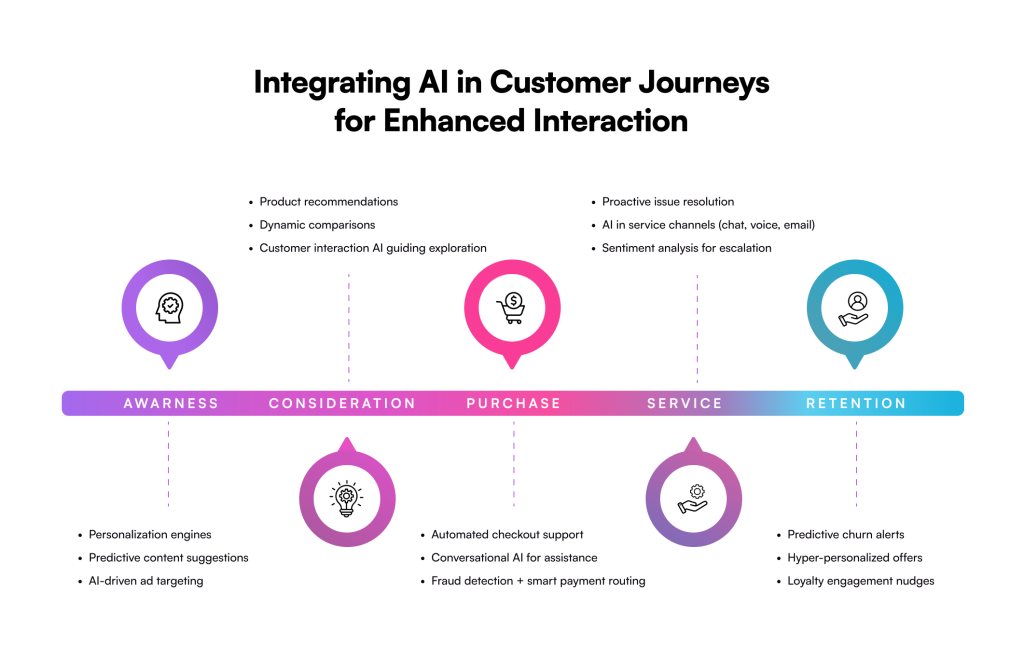
Integrating AI in Customer Journeys for Enhanced Interaction

The customer journey has always followed a familiar arc—awareness, consideration, purchase, service, retention. What’s changed is how intelligence flows through it. Today, AI customer touchpoints are no longer isolated fixes; they’re the hidden infrastructure threading every stage together. 

At awareness, personalization engines surface the right product before a search is even typed. In consideration, predictive nudges reduce friction by narrowing choices to what truly resonates. At purchase, automated support steps in—not as a chatbot answering FAQs, but as customer interaction AI guiding decisions in context. And in service and retention, proactive engagement transforms the after-sale moment from problem-solving into anticipation—resolving issues before they escalate, reminding before a need is felt. 

This is the essence of integrating AI CX: it’s not about layering tools onto touchpoints, it’s about orchestrating a seamless continuum. Each interaction feels less like a transaction and more like an ongoing conversation—AI as the connective tissue that keeps the journey fluid, intuitive, and distinctly human at scale. 

Industry Playbooks: Where AI Transformation CX is Already Delivering 

In boardrooms, the question is no longer if AI creates value in customer experience, but where and how much. Across industries, we’re seeing measurable improvements in retention, revenue-per-user, and cost-to-serve. The playbooks are emerging. 

Retail & eCommerce 

AI isn’t just optimizing clicks—it’s rewriting cart economics. Amazon attributes ≈ 35% of its sales to AI-powered recommendations (McKinsey). Real-time personalization engines reduce bounce rates, while AI in service channels cuts abandonment by stepping in with nudges at checkout.  

Banking & Fintech 

Fraud detection powered by AI models now analyzes millions of transactions in milliseconds—flagging anomalies traditional systems miss. At the same time, conversational AI is reshaping trust as banks facing reduction in response times for routine queries, while customer satisfaction scores climb because agents are freed to focus on high-value advice. The equation is simple: higher retention, lower fraud losses, stronger loyalty. 

Healthcare 

AI is embedding itself into patient journeys—before, during, and after care. Virtual triage reduces unnecessary ER visits; predictive outreach ensures patients don’t miss follow-ups. Hospitals using AI in service channels also report shorter wait times and higher treatment adherence, translating directly into better outcomes and lower costs. 

Travel & Hospitality 

From itinerary planning to post-trip surveys, AI engagement strategies are being used to stitch experiences together. Airlines use predictive AI to reroute passengers before delays cause chaos. The competitive edge comes from orchestrating touchpoints into a continuous, personalized journey. 

B2B SaaS 

Onboarding has always been the leak in the funnel. With seamless AI integration, platforms now proactively detect friction—surfacing help content or routing to support before churn sets in. 

Telecom 

Scaling customer service without exploding cost has always been the telecom paradox. AI-powered predictive issue resolution means providers can now flag and fix network issues before customers call in. For a high-volume, low-margin industry, these metrics compound into significant EBITDA gains. 

Strategic Levers: Where AI Creates Both Advantage & Risk 

In a space where expectations evolve faster than quarterly plans, AI isn’t a side tool—it’s the core lever shaping customer equity. The challenge is to maximize upside without turning automation into a liability. 

Enhancing CX with AI 

  • From hyper-personalization to journey orchestration, AI is enabling brands to anticipate intent, not just react to it. 
  • Done right, it builds loyalty loops that compound lifetime value. Done poorly, it fragments journeys and erodes trust. 

AI User Experience 

  • The real edge isn’t speed—it’s empathy at scale. 
  • A seamless AI user experience means customers feel understood, not processed. Broken flows, irrelevant nudges, or “cold” automation quickly flip advantage into frustration. 

AI Engagement Strategies 

  • Leaders aren’t deploying AI as isolated tools—they’re orchestrating it across touchpoints. 
  • Predictive outreach, proactive engagement, and contextual personalization ensure every moment in the journey adds value. 

Competitive Edge 

  • Speed, scale, and consistency are the raw advantages of AI. 
  • When embedded into service and engagement, these become competitive differentiators measured in margin lift, retention, and reduced cost-to-serve. 

Strategic Risks 

  • Over-automation risks stripping out empathy. 
  • Poorly designed systems create friction and customer churn. 
  • Ethical and regulatory missteps—bias, misuse of data, lack of transparency—aren’t operational issues, they’re brand liabilities that can undermine equity overnight. 

Implementing Seamless AI Integration: What Leaders Must Orchestrate 

In a space where customer expectations move faster than product roadmaps, seamless AI integration isn’t a checklist item — it’s the operating model. Below are the compact levers you need to get right, written as action-first pointers you can use immediately. 

Data alignment (the fuel) 

  • Create a single customer graph so every AI customer touchpoint reads the same truth. 
  • Enforce data contracts, schemas, and real-time streaming so personalization isn’t stale. 
  • Treat privacy and consent as feature requirements — they’re core to trust and to any AI user experience you claim. 

Technology orchestration (the nervous system) 

  • Standardize on API-first models and modular ML services so models are composable, not brittle. 
  • Bake in model versioning, latency SLAs, and CI/CD for ML — scale fails without ops. 
  • Choose platforms that enable seamless AI integration across product, marketing, and support stacks. 

Service channel design (the customer face) 

  • Embed AI in service channels with context persistence: no repeated questions, no lost history. 
  • Design human-in-the-loop handoffs where empathy matters; AI handles scale, humans handle nuance. 
  • Optimize for continuity — the AI that starts a conversation must be able to finish it, across chat, voice, and app. 

Change management (the multiplier) 

  • Run cross-functional squads (data, product, design, ops) accountable for outcomes, not features. 
  • Train teams on interpreting AI signals and on fallbacks — tooling without literacy creates brittle experiences. 
  • Set new KPIs (time-to-insight, automation quality, escalation rates) tied to AI user experience. 

Why implementations fail (and how to avoid it) 

  • Siloed pilots that never integrate into channels — outcome: tools that don’t move metrics. 
  • Chasing point solutions instead of orchestration — outcome: brittle UX and wasted spend. 
  • Ignoring the AI user experience — outcome: automation that feels robotic, not helpful. 
  • No feedback loop from live interactions back into model tuning — outcome: personalization decay. 

Rapid roadmap (4 phases you can run in 90–180 days) 

  • Foundation — unify identity, consent, and event streams. 
  • Pilot & instrument — deploy 1 high-value touchpoint (checkout or onboarding), measure lift. 
  • Orchestrate — connect pilots into channels, enable context handoffs, harden ops. 
  • Scale & govern — rollout across journeys with model governance and ethical guardrails. 

 The Horizon: From Reactive AI to Predictive Journeys 

Customer experience is no longer about responding well — it’s about anticipating what comes next. The horizon for AI transformation CX is staged, and leaders must know where they stand on the curve. 

Near-term: Anticipatory engagement 

  • Shift from reactive bots to AI engagement strategies that predict intent before the click. 
  • Use behavioral signals, historical context, and purchase triggers to reduce friction. 
  • Redefine KPIs around proactivity: fewer tickets, faster resolutions, higher conversions. 

Medium-term: Ambient extensions of CX 

  • Embed AI into AR, VR, wearables, and connected devices — creating continuous touchpoints. 
  • Build for ambient presence: the AI user experience follows customers across contexts without reset. 
  • Treat devices as conduits, not channels — data streams should power one unified journey. 

Long-term: Invisible infrastructure 

  • AI becomes background utility — the “always-on” layer of every customer journey. 
  • Focus on governance, trust, and resilience: invisible doesn’t mean unmanaged. 
  • Leaders who master this phase make AI transformation CX a compounding advantage, not a one-off project. 

Leadership takeaway 

  • The horizon is not about features — it’s about orchestration over time. 
  • Every step compounds: reactive → predictive → ambient → invisible. 
  • Miss a phase, and competitors own the customer journey you failed to design. 

Turning Journeys into Growth Engines With Galaxy Weblinks 

You don’t have to imagine what exceptional CX looks like—we’ve already built it. In a project with NETGEAR for its Orbi mobile app, Galaxy Weblinks worked to: 

  • Modernize architecture (MVVM/MVI, dependency injection) so the app’s foundation could evolve, not stagnate.  
  • Dramatically enhance stability and usability, reducing crashes and frustrations that undermined user trust.  
  • Deliver new features (security tools, parental controls, onboarding) embedded smoothly so users actually use them.  

Those improvements didn’t just refresh the UI—they elevated the AI user experience indirectly, set up seamless AI integration paths for future features, and strengthened brand equity. 

Galaxy Weblinks offer innovation-intensive CX consulting services to bring that same depth to any brand serious about its customer journey. If your challenge is reducing abandonment, scaling support, or architecting AI-enabled experiences that feel intuitive—not intrusive—we already have hands-in work that mirror yours. 

Contact us to build your next leap forward together—where every touchpoint feels considered, every interaction adds value, and AI becomes your brand’s infrastructure. 

Enhancing CX Through Secure, Data-Driven Strategies

A great customer experience with a promise of robust security is the key to a successful business, and in this blog, we’ll learn how you can boost it by leveraging effective data-driven strategies. 

Mobile applications with flashy and interactive interfaces are no longer the focus of businesses hopping. They are resorting to secure, data-driven strategies to protect the confidential information of their customers.

Every company operator is obliged to discover the equilibrium between the two factors: security and personalization, so as to achieve better returns on investment and provide an advantage over the competition. Therefore, the returns on the data security market are forecasted to experience a compound annual growth rate (CAGR) of 8.81% from 2025 to 2030.

In this detailed guide, we’ll walk you through the different ways of enhancing the CX by leveraging different secure data management techniques, and much more. 

Maintaining the Balance Between Personalization and Protection for a Better CX

In recent times, personalization has become a driving force for higher engagement, customer loyalty, etc. And you must know that personalization mostly relies on the customer data that automatically comes with the responsibility of protecting it. 

A brand that promises to maintain trust in digital CX can easily survive in the market, all while maintaining personalization. That is why the advanced-thinkers not only prioritize data security & privacy as a core part of CX design. But also leverage customer experience consulting and competitive analysis to stay ahead of changing customer expectations and industry standards.

When you combine personalization with data security, it is possible to take your enterprise to a whole new level in a number of ways. This will have a positive impact on your business’s success rate. Secure and data-centric methods allow businesses (such as yours) to provide an efficient, smooth, and trustworthy experience.

CTA

Top Effective Data-Driven Strategies for a Better Customer Experience

CX

Now that you know the importance of cybersecurity in customer experience, it’s time to bring all the theories into action. Here are some of the effective and proven data-driven strategies you can implement for an improved CX:

  • Leverage Predictive Analytics for Personalization

What if you could understand what your customer might require even before they know it or are just thinking about it? Predictive analytics is the answer to that. By analyzing past behaviors, purchase history, or browsing patterns, you can come up with recommendations that are very close to the mark. Just be certain that the data you are dealing with is handled in a responsible manner and is kept secure.

  • Adopt Robust Data Encryption Practices

Encryption is a way of putting your customer’s data in a highly secure and protected place that only you and your customer have access to. Every login, every payment, every click must be protected. Customers will feel a lot safer interacting with your brand when they know that their sensitive details are secure, and that’s when trust becomes loyalty.

  • Implement Consent-Based Data Collection 

Not really liking the feeling that they are constantly being watched is the way people will respond. Asking for consent before gathering data is a big deal; it makes a huge difference. When you are open about what is being taken and for what reason, customers are ready to give you more information, and at the same time, they will feel satisfied.

  • Use AI-Driven Customer Insights Responsibly

AI is a strong asset in figuring out what the customers want the most. It can find the customer’s pain points, predict the behavior, and even propose ways to improve the CX. But here is the rule of thumb: you should not behave like a stalker and, at the same time, use AI in the customer experience enhancement. Let AI assist and not overload the customer journey.

  • Ensure Compliance with GDPR

At first, rules such as GDPR compliance or CCPA can give the impression of a hindrance; however, these laws are really intended to safeguard the customers. Operating in accordance with these laws is not just keeping you within the legal limits, but also establishes a level of confidence in your customers that their privacy is respected. This is a new and unique selling point in today’s world. 

Step-by-Step Roadmap to Secure and Data-Driven CX

CX

After planning out the foolproof data-driven CX strategies, here is a blueprint to design customer experiences that are personalized as well as secure. 

  • Audit Your Existing CX and Data Practices

The first step is to begin by auditing (or understanding) where you stand today. Ask yourself the following questions to get clarity on the gaps, and then prioritize the fixes accordingly:

  1. Are you collecting too much data?
  2. Is there any weak point in your security setup?
  3. Is the collected data being put to use for CX improvements?
  • Build a Culture of Data Responsibility

If you think that CX is the job of your customer support or marketing teams, it’s not because it requires the full-fledged effort of an organization. As a business owner, you must train your teams to handle the customer data responsibly. So, if the sales team or the IT team already knows the true value of data security, protecting it comes from within. 

  • Pick the Right Tech Stack

If you are not picking the right set of technology, there are chances that your efforts to boost the CX will be in vain. You must choose a suitable technology that will maintain the balance between personalization and data protection. To make sure you are making the right choice, always look for built-in encryption, compliance features, and transparent data processing.

  • Design with Privacy in Mind

While crafting an interactive UI/UX design, never neglect privacy because a visually-appealing interface will stand alone not retain the users for long. Always keep the “privacy-first” approach in mind before setting up the signup form, a chatbot, or an app feature. This way, you are reassuring your customers and keeping the business compliant. 

  • Test, Monitor, and Improve Continuously

Customer expectations are always changing, and they continue to evolve as the digital world and market trends change. Be certain that you are operating your systems regularly to discover possible weaknesses or threats, and also to see how customers are reacting to your CX. A roadmap is not a once-only mission but an endless trip. 

How Galaxy Weblinks Can Help You Boost Your CX with Secure Data Management

At Galaxy Weblinks, we understand the importance of customer experience, and also the fact that CX and security go hand in hand. 

 We have skilful professionals, backed by years of experience, who can build secure, scalable, and user-friendly digital solutions. 

By leveraging cutting-edge technologies, we help businesses (like yours) strike the perfect balance between personalization and data protection. So, if you have got the idea, we have a team that can bring your vision into reality by maintaining A1 security. 

With us, you don’t just get a technology provider but a trusted ally that helps you deliver a secure, seamless, and futuristic customer experience. So, what are you waiting for? 

Give us a call now!

FAQs

1. Why is data security important for customer experience (CX)?

A main aspect of data security is the trust of the client. Your application or website can have wonderful features, but customers will not continue to choose you if they see that their data is in danger. Safe CX provides both a customer with a personalized approach and, at the same time, security, which leads to the creation of trust in the brand in the future.

2. How do data-driven strategies improve CX?

Through data-driven strategies, companies could get the inside scoop on customer preferences and preemptively provide needs-tailored solutions. If done right, the security makes customer engagement more relevant, quicker, and more satisfying, thereby ensuring privacy is not at risk.

3. What’s the biggest challenge in balancing personalization and data protection?

Immersing deep into customers’ lives to provide them with real personalization without crossing their privacy boundaries at the same time is the biggest difficulty. Transparency on how the data is taken, respect for the choice of the customer, and good cryptography are the three points a business should address in order to make a client feel secure with them.

4. How can small businesses adopt secure, data-driven CX strategies?

Small companies can start by reviewing the extant modus operandi, selecting ways that have security features as a part of their service, and concentrating on data collection based on previous customer consent. More so, the steps, important as encryption, transparency, and privacy law conformity, can positively impact the business significantly.

5. What are some examples of secure, data-driven CX practices?

They may be predictive analytics utilization in providing more rational suggestions, complete encryption of all communication with customers, carrying out data collection only after getting customers’ consent, employing AI in a responsible manner for gathering insights, and conforming to globally acknowledged privacy regulations such as GDPR and CCPA.

Complete Guide To Fintech Mobile App Development

Building a fintech app isn’t just about coding features; it’s about creating secure, compliant, and engaging experiences, and this guide shows you exactly how.

Do you remember the last time you stood in a bank queue? Well, it was indeed a long time back. Ever since financial services have slipped into our pockets, every transaction has become faster and a lot easier. 

The shift from traditional financial transactions to modern ones hasn’t happened over time; it’s been more than a decade. The massive demand for fintech app development has completely transformed the way people now think about money. 

Therefore, businesses consider hiring a reputed mobile app development company that can meet their expectations and build top-tier fintech apps, aligning with their business goals. In this comprehensive guide, we will walk you through the nitty-gritty of fintech application development that includes a lot more than just coding and designing. 

Let’s get ready to explore!

Different Types of Fintech Applications

If you think fintech is just an app, it’s not, because it is a whole ecosystem of digital tools that has changed the way people access financial services. There are different types of fintech mobile app development, and each has a different role to play. 

Here are the top 5 finance apps that you must know about:

  1. Digital Banking Apps

Digital applications are disguised as banks, but they are right in your pocket. Popular digital banking apps like PayPal or Venmo are the backbone of financial convenience at the moment. 

These apps allow users to transfer, receive, and manage money quickly and conveniently while retaining excellent security, speed, and other features. The banking industry is changing as a result of digital apps that incorporate AI-powered features. 

  1. Neobanking Apps

Neobanking apps are a new era of digital finance, making traditional banking services outdated and a bit slow. The modern approach towards finance app development has eliminated the long waiting lines, resulting in a smooth user experience. 

In the year 2023, Neobanking apps made $33.5 billion in revenue, where NuBank was the biggest contributor. The revenue growth highlights how this category is modernizing the financial landscape, offering lower fees, greater transparency, and faster transactions. 

  1. Lending Apps 

Imagine you are in urgent need of cash and there is too much paperwork waiting for you. Seems like a burden, right? But with lending apps, like LendingClub or Cash App, you can easily borrow money by directly getting in touch with money lenders. 

Do you know what’s even better? These apps leverage futuristic technologies, like AI and data analysis, to assess your financial data quickly and accurately. Lending applications take advantage of a personalized approach and guide you to secure funds based on your financial profile. 

  1. Investment & Wealth Management Apps

With robo advisors, like Betterment and apps like Robinhood have made it possible for people to create a diversified portfolio in just a few clicks. From stocks and ETFs to cryptocurrencies, users can now easily invest as per their own convenience. 

If you are a startup owner or looking to manage a substantial portfolio, these apps will help you make your investments simpler, faster, and transparent than ever. You will feel like you have a financial advisor by your side, but a lot more affordable and convenient. 

  1. Insurtech Apps

Lastly, we have “Insurtech Apps”, which are completely transforming the insurance industry by combining technology with traditional insurance services. Thanks to the digitally-advanced world and smartphones, you can easily get real-time quotes, purchase insurance, and compare policies. 

Do you want health insurance or life insurance for yourself or your family? Insurtech apps, like Oscar Health or Gradient AI, have got your back. These apps have features, like instant claims, digital ID cards, and round-the-clock support, delivering a seamless user experience. 

Must-Have Features for Your Fintech Mobile App Development

While you get your brand new fintech application, it is important to know that you are not just adding up the features just for the sake of it. You must make sure that each feature is adding value, serving the purpose, and boosting the user experience at the same time. 

Here is a list of top-notch features that you must consider adding to make your finance app stand out in the market. 

  • Seamless Onboarding

The first and foremost thing you must take care of is a seamless onboarding because the first impression is the last, so make it count. You can introduce auto-fill options with seamless KYC integration and instant verification. A smooth entry point while still meeting the compliance standards will not only boost the user experience but also build trust & credibility. 

  • Personalized Dashboards

Making a dashboard that is easy to use and really intuitive is crucial because managing funds is already a daunting to-do list. Emphasize investment recaps, spending breakdowns, saving objectives, and AI-powered suggestions in a clear and structured format. It will transform unprocessed data into insightful knowledge. 

  • Real-Time Notifications & Alerts

Users like it when they are timely updated with every transaction or other financial activities. That is why sending instant updates about low-balance warnings, unautorized transactions, or upcoming bills is necessary. It keeps the users informed and in control, resulting in building trust through transparency. 

  • Robust Security Protocols

When it comes to finances, security automatically becomes essential because no user can compromise on their personal or financial safety. It is important to integrate features, like two-factor authentication, biometric login, data encryption, and detection alerts. Remember that finance mobile app development without robust security is not just a risk but a dealbreaker. 

  • Multi-Tier Payment Options

Don’t just restrict your fintech application development to certain payment methods. From credit cards and net banking to UPI, digital wallets, and even crypto integrations, give multiple options to your users. The offering of diverse payment options helps you reach the audience at a global level. 

  • Offline Functionality

Imagine you want to check your balance or need to make an urgent payment, and suddenly your internet connection goes off. Probably the bad time, right? That is why make sure your fintech application is functional even without an internet connection and has capabilities, like cached account data. 

Future-proof your fintech app with emerging tech innovations that enhance security, scalability, and customer trust.

Explore Now!

Top Fintech Mobile App Development Trends to Watch in 2025 and Beyond

The finance industry is changing so quickly that what is novel now could be outdated tomorrow. Additionally, companies that adapt to these changes are simultaneously influencing and surpassing user expectations. 

To remain competitive and ahead of the curve, one must, nevertheless, keep up with the most recent developments in fintech app development. The following are the main trends you should look at:

  • Blockchain and Crypto Integration 

The integration of Blockchain has completely transformed the way users trust in their financial transactions. Many fintech apps are now integrating crypto wallets, decentralized finance (DeFi) services, and smart contracts to give users greater transparency at lower prices. 

  • AI and ML for Smarter Finance Handling

Personal recommendations, fraud detection, and predictive analytics are all results of the integration of AI and machine learning, which is becoming a requirement rather than a luxury. The financial landscape has become smarter thanks to AI and ML, which can be used for anything from scanning transactions to optimizing savings plans.

  • Biometric Authentication Security

At a compound annual growth rate (CAGR) of about 8%, the cybersecurity market is expected to reach $271.9 billion by 2029. Therefore, adding biometric features, such as facial recognition or fingerprint scanning, improves security and facilitates logging in order to thwart such an attack.

How to Create a Fintech Mobile Application

A full-fledged fintech app development doesn’t just mean coding; it’s about building a secure and user-friendly app, aligning with business requirements. Here is a step-by-step process followed by the development team:

  • Step 01: Define Your Niche and Goals

The very first step for creating a fintech mobile app is defining the business niche & goals for the development team. This way, it becomes easier for both parties to align on the same level, and the clearer the goals are, the better it is to set the right set of features. 

  • Step 02: Research Regulations and Compliance

Understanding that the fintech ecosystem functions in highly regulated contexts is crucial after establishing your company’s objectives. The development of a safe and secure environment that conforms with GDPR, KYC, and AML should take precedence over merely creating the apps. 

  • Step 03: Design the User Experience (UI/UX)

The UI/UX design of your software will be better if it is simpler. Therefore, confirm that the team you hired is developing an app that is easy to use, aesthetically beautiful, and extremely intuitive. Keep in mind that your financial app’s foundation is the trust of its users, so make sure they have a positive and seamless experience.

  • Step 04: Choose the Right Tech Stack

A safe, scalable, and future-ready technological stack that supports high performance and smooth integrations should be used to design your app. To target both iOS and Android users, you should choose cross-platform frameworks like React Native or Flutter. 

  • Step 05: Conduct Robust Testing

Before the final launch, make sure to conduct robust testing, as it will keep your fintech app operational all the time and error-free. Your app will handle a lot of users’ sensitive information, so the team you are hiring must have impeccable encryption and authentication methods. 

  • Step 06: Launch and Gather Feedback

Even after the app has reached the marketplace, the final stage is to deploy it and work on the feedback. Following the launch, keep a careful eye on analytics, track user behaviour, and get immediate feedback. The secret to keeping your app current and new is constant iteration. 

How Much Does It Cost to Build a Fintech App?

The cost of building a FinTech app can vary significantly depending on several key factors. For instance, the type of app, its complexity and features, the development team’s location and more. 

Here is a breakdown of fintech app development:

FactorEstimated Cost/Impact
Complexity & FeaturesBasic: $30k–$50k
Medium: $50k–$100k
Advanced: $100k–$250k+
UI/UX Design$5,000 – $25,000
Development Team LocationU.S./Canada: $100–$200/hr
Europe: $50–$120/hr
Asia: $25–$60/hr
Compliance & Security$10,000 – $50,000+
Maintenance & Updates15–20% of the initial development cost annually

Build Future-Ready Fintech Apps with Galaxy Weblinks

The fintech app development landscape has evolved, and there is no sign of stopping any time soon; rather, it will grow more in the future. Businesses that have already adapted this are already growing and gaining a competitive edge. If you also want to be at the forefront, get in touch with our experts. 

At Galaxy Weblinks, we don’t just build apps; we craft secure, high-performing, and user-centric apps to deliver exceptional financial experiences. What makes us stand out is our approach towards the fintech mobile application development by leveraging cutting-edge technologies, like Blockchain, AI, and cloud stability. 

Whether you have just started with a disruptive idea or a well-established enterprise, to modernize your existing financial app, Galaxy Weblinks can be your go-to partner. 

FAQs

1. How long does it take to develop a fintech app?

The timeline depends on the app’s complexity, features, and compliance requirements. A basic MVP can take 3–6 months, while a full-scale fintech solution with advanced features may take 9–12 months or more.

2. What security measures are essential for fintech apps?

Key measures include end-to-end encryption, biometric authentication, two-factor authentication (2FA), fraud detection systems, and regular security audits. These ensure user trust and regulatory compliance.

3. How do I make sure my fintech app complies with regulations?

Compliance starts with understanding your target region’s regulations, such as KYC (Know Your Customer), AML (Anti-Money Laundering), GDPR, or PCI DSS. Partnering with experienced fintech developers ensures compliance is baked into the development process from the start.

4. What is the average cost of fintech app development?

On average, building a fintech app can cost anywhere from $50,000 to $150,000+, depending on factors like app complexity, design, development team location, and security requirements.

5. Why should I choose Galaxy Weblinks for fintech app development?

Galaxy Weblinks offers end-to-end fintech expertise—from UX-driven design and advanced tech stacks to compliance support and post-launch maintenance. We focus on building secure, scalable, and future-ready apps that help your business stand out in a competitive market.

How Much Does an eCommerce App Development Cost?

Are you considering developing an eCommerce app but are concerned about the expense? With the help of this guide, you may prepare with confidence by uncovering hidden aspects, actual data, and cost-effective advice. 

Having an eCommerce app is not an option in today’s digitally-first marketplace; it is a must. Global retail eCommerce sales topped $4.3 trillion in 2025. Nevertheless, companies that have yet to make an investment in mobile commerce run the danger of missing out on a significant source of income. 

But one of the first and important questions that comes into every entrepreneur, startup, or enterprise’s mind is: “How much does an eCommerce app development cost?” Now, to give you an answer, there is no definite number. This is due to the fact that it depends on a variety of factors, including platform selection, third-party integrations, app complexity, and more. 

We have produced a comprehensive guide to assist you in determining the precise cost of developing an eCommerce mobile app. We’ll outline the main factors that influence eCommerce app development expenses, provide reasonable price estimates, and point out ways to cut costs without sacrificing quality.   

Factors Affecting the Cost of eCommerce App Development 

If you are expecting a straightforward answer to “how much does it cost to create an eCommerce app?”, you might not get one. Do you know why? There are multiple factors influencing the cost of eCommerce app development.  

Here are the top 5 factors that might break your bank a little, but they will be worth every penny once you start receiving higher ROI: 

  • App Complexity & Features 

Naturally, a basic eCommerce software with features like product listings, a shopping cart, and secure payments will be less expensive than one with advanced analytics, AR try-on, or AI-driven suggestions. The cost increases as more features are added. 

  • Design & User Experience 

An eCommerce app’s UI/UX has a direct impact on conversions in eCommerce; it’s not simply about appearances. Although it requires more time (and money), a well-designed, user-friendly layout with seamless navigation and customized experiences results in increased client retention. 

  • Platform Choice 

It is less expensive to build for one platform, but development expenses will go up if you want your program to run on both iOS and Android. To strike a compromise between reach and budget, many companies choose cross-platform frameworks like Flutter or React Native. 

  • Tech Stack & Integrations 

Cost is significantly influenced by the backend technology, payment gateways, CRM/ERP integrations, and APIs you use. For instance, using sophisticated third-party solutions (such as bespoke analytics or AI chatbots) raises the total outlay. 

  • Development Team’s Location 

Your choice of backend technology, payment gateways, CRM/ERP integrations, and APIs greatly influences the price. The total investment is increased, for instance, by incorporating sophisticated third-party solutions (such as AI chatbots or custom analytics). 

Here is an estimated cost for each platform:  

App Platform Basic App Mid-Level App Complex App 
Android App Development $5,000 to $15,000 $15,000 to $30,000 $72,000 and increasing 
iOS App  Development $5,000 to $25,000 $25,000 to $75,000 $75,000 to $150,000+ 
Cross-Platform Development $5,000 to $20,000 $20,000 to $70,000 $70,000 to $250,000+ 

Hidden Factors Affecting the Cost of eCommerce Mobile App Development 

The total cost of developing an eCommerce software can be significantly increased by hidden costs like maintenance or support, which go beyond the obvious elements like features or design. You can save a lot of money if you can identify them early.  

The following are a few hidden fees that you should avoid. 

  1. Maintenance and Optimization 

You cannot overlook post-launch optimization and maintenance services because you will not only make your eCommerce app error-free, but it will also stay up-to-date. So, this might cost you money, yet they are crucial to make your app functional and competitive.  

  1. App Store and Compliance 

If you think publishing your app on the Google Play Store or App Store is free, you are wrong because it does require annual fees. Apart from this, adhering to the respective marketplace’s policies is a different addition to the cost, and rejecting them will automatically increase the price.  

  1. Testing and QA Across Devices 

Real-world testing isn’t going to work; you must make sure your eCommerce app is being tested across multiple devices, screen sizes, and OS versions. Additionally, user research testing is also being conducted to make sure the user experience remains intuitive and up-to-the-mark. So, this kind of testing demands dedicated resources that ultimately lead to an increased price.  

  1. Custom Support Integration 

Integrating live chat support in an eCommerce app is a must to resolve customer queries instantly without hampering their experience. So, the third-party integrations come with a cost, which you must pay only to avoid the increasing bounce rate in the future.  

  1. Scaling and Performance Testing 

When your eCommerce app starts scaling and starts experiencing high transaction volumes, you must optimize your app. Performance tuning or caching strategies are some of the hidden charges that come up while your app scales.  

How You Can Make Money Through an eCommerce Mobile Application? 

Now that you are spending money on developing an eCommerce app of your dreams, it is crucial to know how you can earn a profit out of it. Below is a list of some of the effective ways:  

  • Subscription Plans: With this, users pay a recurring monthly or yearly fee for premium features or an ad-free experience in your eCommerce application.  
  • In-App Advertising: You can make money through interactive ads, videos, or native ads by displaying them in your eCommerce app.  
  • Freemium Model: You can attract users and provide them with the basic features for free, and in case of utilizing the advanced features, you can charge them.  
  • Loyalty & Rewards Partnership: Partner with other companies or service providers to provide consumers with special offers, rebates, or incentives for making regular purchases or using the app. 
  • Data Monetization: By offering market insights to outside researchers, companies, or advertisers who want to learn more about consumer behaviour, the anonymized and aggregated data can be made profitable in a number of ways. 

Partner with Galaxy Weblinks to Build a Cost-Effective eCommerce Mobile App Development 

Although the price of developing an eCommerce software may seem prohibitive, the true query isn’t “How much will it cost?” “How much value will it create?” is the real question.  

At Galaxy Weblinks, we make sure every dollar you invest works harder for you, whether you’re developing a full-featured eCommerce platform with sophisticated integrations or launching a lean MVP to test your idea.  

We concentrate on striking the ideal mix between price, quality, and scalability so that you receive more than simply an app; you receive an engine that generates income. Working with Galaxy Weblinks entails more than just development; it entails having professionals on your side to create an eCommerce app that is ready for the future and will pay for itself many times over. 

You can get in touch with our expert team, which can guide you and turn your app idea into reality! 

FAQs 

1. How much does it cost to develop a basic eCommerce app? 

A simple eCommerce app with core features like product listings, cart, and secure checkout typically costs between $15,000 – $30,000. However, the price can go higher depending on design complexity and integrations. 

2. What factors influence the cost of eCommerce app development the most? 

The biggest cost drivers are features, app complexity, design (UI/UX), chosen platform (iOS/Android), integrations, and developer location. Advanced features like AI recommendations, AR try-on, or multi-vendor support significantly increase development costs. 

3. Is it cheaper to build an app for iOS or Android? 

Developing for a single platform is usually cheaper than building for both. The cost difference between iOS and Android isn’t huge, but if you want to target both, opting for cross-platform frameworks like Flutter or React Native can be more budget-friendly. 

4. Do I need to budget for app maintenance after launch? 

Yes. Post-launch costs include bug fixes, server costs, updates, and new feature rollouts. On average, businesses spend 15–20% of the initial development cost annually on maintenance. 

5. How can I reduce the cost of developing an eCommerce app? 

You can optimize costs by starting with an MVP (Minimum Viable Product), choosing the right tech stack, using cross-platform development, and partnering with an experienced development team that balances cost with quality.